
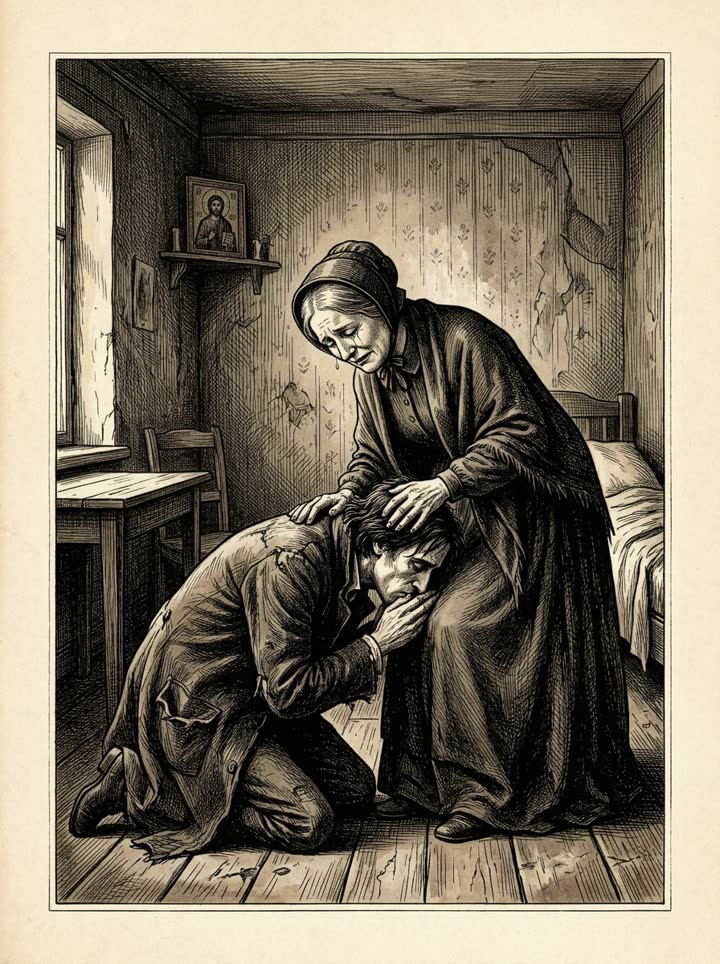
That same day, but now in the evening, at about seven o'clock, Raskolnikov was approaching the lodging of his mother and sister, the very one in Bakaleyev's house where Razumikhin had settled them. The entrance to the staircase was from the street. Raskolnikov approached, still holding back his step and as if hesitating: should he go in or not? But he would not have turned back for anything; his decision was made. "Besides, it makes no difference, they don't know anything yet," he thought, "and they are already used to taking me for a crank..." His clothes were dreadful: everything dirty, having spent the whole night in the rain, torn and tattered. His face was almost disfigured by weariness, bad weather, physical exhaustion and nearly a whole day's struggle with himself. He had spent the whole of that night alone, God knows where. But at least he had made up his mind.
He knocked at the door; his mother opened it. Dunechka was not at home. Even the servant happened not to be there at the time. Pulcheria Alexandrovna was struck dumb at first with joyful astonishment; then she seized him by the hand and drew him into the room.
"Well, here you are!" she began, stammering with joy. "Don't be angry with me, Rodya, for welcoming you so foolishly, with tears. I'm laughing, not crying. Do you think I'm crying? No, I'm glad, but I have such a foolish habit: the tears just run. It's been so with me since your father died, I cry at everything. Sit down, my dear, you must be tired, I can see. Ah, how dirty you've got."
"I was out in the rain yesterday, Mother..." Raskolnikov began.
"No, no, no!" Pulcheria Alexandrovna started up, interrupting him. "You thought I would start questioning you at once, in my old womanish way. Don't worry. I understand, I understand everything. I've learned how things are done here now, and truly I can see for myself that it's wiser. I decided once and for all: how could I understand your reasons and demand accounts from you? You may have God knows what business and plans in your head, or some thoughts may be forming there; and am I to nudge your elbow and ask what you're thinking about? Here I... Ah, Lord! What am I fussing about, here and there, like one possessed... Rodya, I'm reading your article in the journal for the third time already, Dmitri Prokofich brought it to me. I simply gasped when I saw it. What a fool I am, I said to myself, so this is what he's busy with, this is the answer to it all! Perhaps he has new thoughts in his head at the moment, and he's turning them over, and I torment and confuse him. I read it, my friend, and of course there's a great deal I don't understand; but then, that's how it should be: how could I?"
"Show me, Mother."
Raskolnikov took the little newspaper and glanced briefly at his article. However much it contradicted his position and his state, he felt that strange, bitingly sweet feeling which an author feels when he sees himself in print for the first time; besides, he was only twenty-three, and it told. This lasted one moment. After reading a few lines he frowned, and a terrible anguish gripped his heart. All his spiritual struggle of the last months came back to him at once. With disgust and vexation he threw the article down on the table.
"But, Rodya, however stupid I am, I can still judge that you will very soon be one of the foremost men, if not the very first, in our learned world. And they dared to think of you that you had gone out of your mind. Ha, ha, ha! You don't know, they did think it! Ah, the base worms, how could they understand what a mind is! And even Dunechka nearly believed it, think of that! Your late father twice sent things to the journals, first verses (I still keep the notebook, I'll show it to you some day), and then a whole story (I begged him myself to let me copy it out), and how we both prayed that they would take it, and they didn't! Rodya, six or seven days ago I was brokenhearted looking at your clothes, at how you live, what you eat and what you go about in. And now I see that again I was foolish, because if you want to, you can get everything for yourself at once, with your mind and talent. So for the present you don't want to, and you are busy with far more important matters..."
"Isn't Dunya at home, Mother?"
"No, Rodya. I very often don't see her at home, she leaves me alone. Dmitri Prokofich, thank him, comes in to sit with me and talks all the time about you. He loves you and respects you, my friend. As for your sister, I won't say she's very disrespectful to me. I'm not complaining. She has her character, I have mine; she has some secrets of her own now; but I have no secrets from you. Of course I'm firmly convinced that Dunya is far too clever and, besides, loves both me and you... but I don't know what it will all lead to. You've made me happy now, Rodya, by coming, and she has gone and missed it; when she comes I'll say: your brother was here without you, and where were you pleased to spend your time? Don't spoil me too much, Rodya: if you can, come in; if you can't, there's nothing to be done, I'll wait. I shall still know that you love me, and that's enough for me. I'll read your writings, I'll hear about you from everybody, and now and then you'll come to see me yourself, what could be better? Why, you've come now to comfort your mother, I can see it..."
Here Pulcheria Alexandrovna suddenly began to cry.
"There I go again! Don't look at me, foolish woman that I am! Ah, Lord, why am I sitting here," she cried, jumping up from her place, "there's coffee, and I'm not offering you any! That's what an old woman's selfishness means. In a moment, in a moment!"
"Mother, leave that, I'm going in a moment. I didn't come for that. Please, listen to me."
Pulcheria Alexandrovna came up to him timidly.
"Mother, whatever happens, whatever you may hear about me, whatever they may tell you about me, will you love me as you do now?" he asked suddenly, from the fullness of his heart, as if not thinking about his words and not weighing them.
"Rodya, Rodya, what is the matter with you? How can you even ask such a thing! Who is going to tell me anything about you? I wouldn't believe anyone, whoever came to me, I would simply drive him away."
"I came to assure you that I have always loved you, and now I am glad that we are alone, glad even that Dunechka is not here," he went on with the same impulse. "I came to tell you plainly that although you will be unhappy, you must still know that your son loves you now more than himself, and that everything you thought about me, that I was cruel and didn't love you, was all untrue. I shall never stop loving you... Well, that's enough; it seemed to me that I had to do this, and begin with this..."
Pulcheria Alexandrovna embraced him in silence, pressed him to her breast and wept quietly.
"I don't know what is the matter with you, Rodya," she said at last. "All this time I thought we were simply wearying you, and now I see by everything that some great grief is being prepared for you, and that is why you are so low. I've foreseen it for a long time, Rodya. Forgive me for speaking of it; I think of it all the time and don't sleep at night. Last night your sister too lay raving the whole night through, and kept speaking of you. I caught something, but understood nothing. All morning I went about as if before an execution, waiting for something, foreboding, and now it has come! Rodya, Rodya, where are you going? Are you going somewhere?"
"I am."
"I thought so! But I can go with you too, if you need it. And Dunya; she loves you, she loves you very much, and Sofya Semyonovna, let her come with us too if need be; you see, I would gladly take her in place of a daughter even. Dmitri Prokofich will help us get ready together... but... where are you... going?"
"Goodbye, Mother."
"What! Today!" she cried out, as if losing him for ever.
"I can't, it's time, I really must..."
"And I can't go with you?"
"No, but kneel down and pray to God for me. Your prayer may reach him."
"Let me make the sign of the cross over you, and bless you! Like that, like that. O God, what are we doing!"
Yes, he was glad, he was very glad that there was no one else, that he was alone with his mother. It was as if his heart had softened all at once for the whole of this terrible time. He fell down before her, he kissed her feet, and the two of them, embracing, wept. And this time she was not surprised and did not question him. She had understood for a long time that something terrible was happening to her son, and now some dreadful moment had come for him.
"Rodya, my darling, my firstborn," she said, sobbing, "now you are just as you were when you were little, you came to me in the same way, embraced and kissed me in the same way; even when your father and I were living in poverty, you comforted us simply by being with us, and when I buried your father, how many times did we weep on his grave, embracing like this, as we are now. And that I have been crying for so long, that was my mother's heart foreknowing trouble. The first time I saw you then, in the evening, do you remember, when we had just arrived here, I guessed everything from your look alone, and my heart trembled then; and today when I opened the door to you and looked, well, I thought, the fatal hour has come. Rodya, Rodya, you are not going away this minute?"
"No."
"You will come again?"
"Yes... I will come."
"Rodya, don't be angry, I don't even dare to ask. I know I don't dare, but just two little words tell me, is it far, where you are going?"
"Very far."
"What is it there, some post, some career for you?"
"Whatever God sends... only pray for me..."
Raskolnikov went to the door, but she clutched at him and looked into his eyes with a desperate gaze. Her face was distorted with horror.
"Enough, Mother," said Raskolnikov, deeply regretting that he had thought of coming.
"Not for ever? It isn't for ever yet? You will come, you will come tomorrow?"
"I will come, I will come, goodbye."
He tore himself away at last.
The evening was fresh, warm and clear; the weather had cleared up since morning. Raskolnikov was going to his lodging; he was hurrying. He wanted to finish everything before sunset. Until then he would not have liked to meet anyone. As he went up to his lodging he noticed that Nastasya, tearing herself away from the samovar, was watching him intently and following him with her eyes. "Is there someone in my room?" he thought. With disgust he imagined Porfiry. But when he reached his room and opened it, he saw Dunechka. She was sitting all alone, deep in thought, and, it seemed, had been waiting for him a long time. He stopped on the threshold. She half rose from the sofa in fright and drew herself up before him. Her look, fixed motionlessly on him, expressed horror and inconsolable sorrow. And from that look alone he understood at once that she knew everything.
"Well, am I to come in to you or go away?" he asked mistrustfully.
"I sat the whole day at Sofya Semyonovna's; we both waited for you. We thought you would be sure to go in there."
Raskolnikov went into the room and sat down on a chair in exhaustion.
"I am somehow weak, Dunya; I am very tired; and I would like at least at this moment to be fully master of myself."
He glanced up at her mistrustfully.
"Where were you all night?"
"I don't remember well; you see, sister, I wanted to decide once and for all, and I walked many times near the Neva; that I remember. I wanted to make an end there, but... I didn't dare..." he whispered, again glancing mistrustfully at Dunya.
"Thank God! And how we feared exactly that, I and Sofya Semyonovna! So you still believe in life: thank God, thank God!"
Raskolnikov smiled bitterly.
"I didn't believe; but just now, with Mother, we embraced and wept; I don't believe, and yet I asked her to pray for me. God knows how it happens, Dunechka, and I understand nothing of it."
"You were at Mother's? And you told her?" cried Dunya in horror. "Can you really have decided to tell her?"
"No, I didn't tell... in words; but she understood a great deal. She heard you raving in the night. I am certain she already understands half of it. Perhaps I did wrong to go in. I don't even know why I went in at all. I am a base man, Dunya."
"A base man, and yet ready to go to suffering! You are going, aren't you?"
"I am going. Now. Yes, to avoid this shame I wanted to drown myself, Dunya, but I thought, standing over the water, that if I have considered myself strong until now, then let me not be afraid of shame either," he said, forestalling her. "Is that pride, Dunya?"
"It is pride, Rodya."
It was as though a fire flashed in his dulled eyes; he seemed pleased to find that he was still proud.
"And don't you think, sister, that I was simply afraid of the water?" he asked with an ugly smile, peering into her face.
"Oh, Rodya, stop!" Dunya cried bitterly.
Two minutes of silence went by. He sat with lowered eyes, looking at the floor; Dunechka stood at the other end of the table and looked at him in torment. Suddenly he got up.
"It is late, it's time. I am going now to give myself up. But I don't know why I am going to give myself up."
Large tears were running down her cheeks.
"You are crying, sister, but can you hold out your hand to me?"
"And did you doubt it?"
She embraced him tightly.
"Are you not, by going to suffering, already washing away half your crime?" she cried, clasping him in her arms and kissing him.
"Crime? What crime?" he cried suddenly, in a sort of sudden fury. "That I killed a vile, noxious louse, a little old woman, a moneylender, of no use to anyone, for killing whom forty sins would be forgiven, who sucked the lifeblood of the poor, and that is a crime? I don't think about it and I don't think of washing it away. And why does everyone jab at me from every side: 'crime, crime!' Only now do I see clearly all the absurdity of my faintheartedness, now that I have decided to go to this needless shame! It is simply from my baseness and lack of talent that I decide, or perhaps for the advantage too, as that... Porfiry suggested!..."
"Brother, brother, what are you saying! But you shed blood!" cried Dunya in despair.
"Which everyone sheds," he caught up, almost in frenzy, "which flows and has always flowed in the world like a waterfall, which people pour out like champagne, and for which they are crowned in the Capitol and afterwards called benefactors of mankind. Only look more closely and see! I myself wished good to people and would have done hundreds, thousands of good deeds instead of this one stupidity, not even stupidity, but simply clumsiness, since the whole idea was not nearly so stupid as it seems now, after the failure... (After a failure everything seems stupid!) By this stupidity I only wanted to put myself in an independent position, to take the first step, to obtain means, and then everything would have been made good by a benefit immeasurable, in comparison... But I, I could not even hold out through the first step, because I am a scoundrel! That is what the whole matter is! And all the same I will not look with your eyes: if I had succeeded, I would have been crowned, and now I am in the trap!"
"But that isn't it, not at all! Brother, what are you saying!"
"Ah! The wrong form, not an aesthetically fine form! Well, I positively don't understand: why is pelting people with bombs in a regular siege a more respectable form? Fear of aesthetics is the first sign of impotence!.. Never, never have I been more clearly conscious of this than now, and more than ever I don't understand my crime! Never, never have I been stronger and more convinced than now!.."
The colour even rushed into his pale, worn face. But as he uttered the last exclamation he happened to meet Dunya's eyes, and he met in that look so much, so much anguish for his sake that he involuntarily came to himself. He felt that, after all, he had made these two poor women unhappy. After all, he was the cause...
"Dunya, dear! If I am guilty, forgive me (though I cannot be forgiven, if I am guilty). Goodbye! Let us not argue! It is time, high time. Don't follow me, I beg you, I still have somewhere to call... But go now and sit down at once by Mother. I implore you! It is the last and greatest request I make of you. Don't leave her side all this time; I left her in an anxiety she will hardly bear: she will either die or lose her mind. So be with her! Razumikhin will be with you; I have spoken to him... Don't cry for me: I will try to be both manly and honest all my life, though I am a murderer. Perhaps you will hear my name some day. I will not disgrace you, you will see; I will yet prove... for now, goodbye," he hastened to conclude, noticing again some strange expression in Dunya's eyes at his last words and promises. "Why are you crying so? Don't cry, don't cry; we are not parting altogether!.. Ah, yes! Wait, I forgot!.."
He went to the table, took a thick, dusty book, opened it and took out a small portrait, in watercolour on ivory, which was tucked between the leaves. It was a portrait of his landlady's daughter, his former fiancée, who had died of fever, that same strange girl who had wanted to go into a convent. For a minute he gazed at that expressive, sickly little face, kissed the portrait and handed it to Dunechka.
"I talked a great deal with her about this, with her alone," he said thoughtfully, "to her heart I confided much of what afterwards came true so hideously. Don't worry," he turned to Dunya, "she did not agree, any more than you, and I am glad that she is gone. The main thing, the main thing is that everything will now go in a new way, will break in two," he cried suddenly, returning again to his anguish, "everything, everything, and am I prepared for it? Do I myself want it? They say it is necessary, as my ordeal! Why, why all these senseless ordeals? What for? Shall I be more conscious of it then, crushed by torments, by idiocy, in senile weakness after twenty years of penal servitude, than I am now, and what shall I live for then? Why do I agree now to live like this? Oh, I knew I was a scoundrel when I stood over the Neva today at dawn!"
They both went out at last. It was hard for Dunya, but she loved him! She walked on, but after going some fifty paces she turned once more to look at him. He could still be seen. But when he reached the corner he turned too; for the last time their eyes met; but, noticing that she was looking at him, he waved his hand impatiently and even with vexation for her to go, and himself turned sharply round the corner.
"I am wicked, I see it," he thought to himself, ashamed a minute later of his vexed gesture to Dunya. "But why do they love me so, if I am not worth it! Oh, if only I were alone and nobody loved me, and I myself had never loved anyone! None of this would have happened! But it's curious, will my soul really become so humble in these coming fifteen or twenty years that I shall whimper before people with reverence, calling myself a robber at every word? Yes, precisely, precisely! That is why they are exiling me now, that is just what they want... Here they all scurry along the street, to and fro, and every one of them is a scoundrel and a robber already by his nature; worse than that, an idiot! But try to let me off with exile, and they will all go wild with noble indignation! Oh, how I hate them all!"
He fell deeply to thinking about this: "by what process can it come about that at last he will submit before all of them, without arguments, submit by conviction! Well, and why not? Of course it must be so. Will twenty years of unceasing oppression not finish him off? Water wears away stone. And why, why live after that, why am I going now, when I myself know that it will all be exactly as in a book, and not otherwise!"
He had asked himself, perhaps, this question for the hundredth time since yesterday evening, but still he went on.