
All that evening, until ten o'clock, he spent going from one tavern and cesspit to another. Somewhere or other Katya turned up too, and sang yet another footman's song, about how somebody, "a scoundrel and a tyrant,"
Began to kiss Katya.
Svidrigailov stood drinks for Katya, and for the organ-grinder, and the singers, and the waiters, and two clerklings of some sort. He had got mixed up with these two clerklings chiefly because both of them had crooked noses: one nose went crooked to the right and the other to the left. This struck Svidrigailov. They dragged him off at last to some pleasure garden, where he paid for them and for the entrance. In this garden there was one thin little fir tree, three years old, and three bushes. Besides that, a "vauxhall" had been put up, in fact a tavern, but you could get tea there too, and there were also a few green tables and chairs. A chorus of dreadful singers and some drunken Munich German, a sort of clown with a red nose, yet for some reason extraordinarily mournful, entertained the public. The clerklings quarrelled with some other clerklings and were on the point of starting a fight. Svidrigailov was chosen by them as judge. He had been judging them for a good quarter of an hour, but they shouted so that there was not the slightest possibility of making anything out. Most likely it was this: one of them had stolen something and had even managed to sell it on the spot to some Jew who happened to come by; but having sold it, he did not want to share with his comrade. It turned out in the end that the article sold was a teaspoon belonging to the vauxhall. The spoon was missed, and the affair began to take on troublesome proportions. Svidrigailov paid for the spoon, got up and left the garden. It was about ten o'clock. He himself had not drunk a single drop of wine all this time, and had only asked for tea in the vauxhall, and that more for form's sake. Meanwhile the evening was close and gloomy. By ten o'clock terrible clouds had closed in from all sides; thunder crashed and the rain poured down like a waterfall. The water fell not in drops but beat on the earth in whole streams. Lightning flashed every minute, and in each glare you could count as many as five flashes. Wet through to the skin, he reached home, locked himself in, opened his bureau, took out all his money and tore up two or three papers. Then, thrusting the money into his pocket, he meant to change his clothes, but, looking out of the window and listening to the thunder and the rain, he gave it up with a wave of his hand, took his hat and went out, without locking the flat. He went straight to Sonya. She was at home.
She was not alone; around her were the four little Kapernaumov children. Sofya Semyonovna was giving them tea. She received Svidrigailov in silence and respectfully, looked in surprise at his soaked clothes, but did not say a word. As for the children, they all ran away at once in indescribable terror.
Svidrigailov sat down at the table and asked Sonya to sit beside him. She timidly prepared to listen.
"I may be going to America, Sofya Semyonovna," said Svidrigailov, "and since we shall probably see each other for the last time, I have come to make some arrangements. Well, you saw that lady today? I know what she said to you, there is no need to repeat it. (Sonya made a movement and blushed.) That sort of people have their own bent. As for your little sisters and your brother, they really are provided for, and the money due to each of them I have paid out, against receipts, to the proper place, into reliable hands. You may as well take these receipts for yourself, just in case. Here, take them! Well, now, that is settled. Now, here are three five per cent bonds, three thousand in all. These you are to take for yourself, for yourself alone, and let it be just between us, so that nobody knows, whatever you may hear. You will need them, because, Sofya Semyonovna, to go on living as you did before is vile, and besides you have no need of it any more."
"You have done so much for me, sir, for the orphans, sir, and for the dead woman," Sonya hurried to say, "that if till now I have thanked you so little, then... please do not think..."
"Oh, enough, enough."
"But this money, Arkady Ivanovich, I am very grateful to you, but I do not need it now. I can always feed myself, just me on my own, do not think me ungrateful: if you are so kind, then this money, sir..."
"It is for you, for you, Sofya Semyonovna, and please, no special speeches, because I have not even the time. And you will need it. Rodion Romanovich has two roads: either a bullet in the forehead, or the Vladimirka. (Sonya looked at him wildly and trembled.) Don't be alarmed, I know everything, from himself, and I am no gossip; I shall tell no one. You advised him well then, that he should go himself and give himself up. It will be far better for him. Well, when it comes to the Vladimirka, he will go along it, and you will follow him? Won't you? Won't you? Well, and if so, then this money will be needed. Needed for him, you understand? In giving it to you I am as good as giving it to him. Besides, you promised to pay Amalia Ivanovna the debt too; I heard. Why is it, Sofya Semyonovna, that you take on yourself, so thoughtlessly, all these contracts and obligations? It was Katerina Ivanovna who stayed in debt to this German woman, not you, so you might just as well spit on the German woman. One cannot get on in the world like that. Well, then, if anyone should ask you, well, tomorrow or the day after, about me or concerning me (and they will ask you), then do not mention that I have been to see you now, and do not show the money on any account, and do not tell anyone that I gave it to you. Well, now, good-bye. (He rose from his chair.) My regards to Rodion Romanych. By the way: keep the money for the time being with Mr. Razumikhin, say. Do you know Mr. Razumikhin? Of course you do. He is a middling sort of fellow. Take it to him tomorrow or... when the time comes. And until then hide it away well."
Sonya also jumped up from her chair and looked at him in fright. She very much wanted to say something, to ask something, but in the first moments she did not dare, and did not even know how to begin.
"But how... how can you, sir, now, in such rain, go out?"
"Well, to set off for America and be afraid of rain, he-he! Good-bye, my dear, Sofya Semyonovna! Live, and live long, you will be of use to others. By the way... tell Mr. Razumikhin that I send my regards. Just so, pass it on: Arkady Ivanovich Svidrigailov sends his regards. Be sure you do."
He went out, leaving Sonya in amazement, in fear and in some vague and heavy suspicion.
It came out afterwards that on this same evening, some time after eleven, he paid yet another most eccentric and unexpected visit. The rain had still not stopped. Wet through, at twenty minutes past eleven he entered the cramped little flat of his betrothed's parents, on Vasilyevsky Island, in the Third Line, on the Little Prospect. He had to knock a long time before they let him in, and at first caused great commotion; but Arkady Ivanovich, when he wished, was a man of most charming manners, so that the first guess of the sensible parents of the bride (a most ingenious one, though), that Arkady Ivanovich had probably been somewhere and soaked himself so drunk that he no longer knew himself, fell away at once of its own accord. The feeble father was wheeled out in his chair to Arkady Ivanovich by the tender-hearted and sensible mother of the bride, who, as was her habit, at once proceeded to some roundabout questions. (This woman never asked direct questions, but always began with smiles and rubbing of hands, and then, if she had to find out something certainly and exactly, for example when it would please Arkady Ivanovich to fix the wedding, she began with the most curious and almost greedy questions about Paris and about court life there, and only afterwards, in due order, came round to the Third Line of Vasilyevsky Island.) At another time all this would of course have inspired great respect, but this time Arkady Ivanovich proved somehow particularly impatient and flatly demanded to see the bride, although he had been told right at the start that the bride had already gone to bed. Of course the bride appeared. Arkady Ivanovich told her straight out that for a time he had to leave Petersburg on a most important matter, and therefore had brought her fifteen thousand silver roubles, in various notes, asking her to accept them from him as a present, since he had long meant to give her this trifle before the wedding. No particularly logical connection between the present and the immediate departure, and the absolute necessity of coming for it in the rain and at midnight, was of course shown by these explanations, but the matter went off quite smoothly all the same. Even the necessary oh-ing and ah-ing, the questions and exclamations of surprise, suddenly became somehow extraordinarily moderate and restrained; but gratitude was expressed in the most ardent terms and was even reinforced by the tears of the most sensible of mothers. Arkady Ivanovich got up, laughed, kissed the bride, patted her cheek, confirmed that he would soon be back, and, noticing in her little eyes a childish curiosity, to be sure, but at the same time some very serious, mute question, thought for a moment, kissed her a second time, and at once sincerely regretted in his heart that the present would go immediately under lock and key in the keeping of the most sensible of mothers. He went out, leaving them all in an unusually excited state. But the tender-hearted mamma at once, in a half-whisper and rapid patter, resolved certain of the most important perplexities, namely that Arkady Ivanovich was a great man, a man of affairs and connections, a rich man; God knows what he had in his head, he took a notion and went, he took a notion and gave the money away, and so there was nothing to wonder at. Of course it was strange that he was all wet, but the English, for example, are even more eccentric, and all these people of the highest tone do not look at what is said about them and do not stand on ceremony. Perhaps he even goes about like that on purpose, to show that he is afraid of nobody. And the main thing, not a word of this to anyone, because God knows what might come of it, and the money quickly under lock, and of course the best thing in all this was that Fedosya had sat in the kitchen, and the main thing, on no account, no account, no account must anything be told to that sly creature Resslich, and so on, and so on. They sat and whispered until about two o'clock. The bride, however, had gone to bed much earlier, astonished and a little sad.
And Svidrigailov meanwhile, at exactly midnight, was crossing the bridge in the direction of the Petersburg Side. The rain had stopped, but the wind was noisy. He began to shiver, and for one minute he looked at the black water of the Little Neva with a peculiar curiosity, and even with a question. But soon it seemed to him very cold to stand over the water; he turned and walked towards the Prospect. He had been striding along the endless Prospect for a very long time, almost half an hour, more than once stumbling in the dark on the wooden pavement, but he did not stop searching with curiosity for something on the right-hand side of the prospect. Somewhere here, already at the end of the prospect, he had noticed, driving past a while ago, a hotel, wooden but large, and its name, as far as he remembered, was something like Adrianople. He was not mistaken in his reckoning: in such a wilderness this hotel was so conspicuous a point that it was impossible not to find it, even in the dark. It was a long, blackened wooden building in which, in spite of the late hour, lights were still burning and some bustle could be noticed. He went in and asked a ragged fellow he met in the corridor for a room. The ragged fellow, glancing over Svidrigailov, pulled himself together and at once led him to a remote room, stuffy and cramped, somewhere at the very end of the corridor, in a corner under the stairs. But there was no other; all were taken. The ragged fellow looked at him inquiringly.
"Is there tea?" asked Svidrigailov.
"That can be done, sir."
"What else is there?"
"Veal, sir, vodka, sir, a snack, sir."
"Bring veal and tea."
"And nothing more will be needed?" asked the ragged fellow, even in some bewilderment.
"Nothing, nothing!"
The ragged fellow went away, completely disappointed.
"A fine place it must be," thought Svidrigailov, "how is it I did not know of it. I too probably have the look of one coming back from some café chantant, but one who has already had an adventure on the way. And yet it is curious, who stops and spends the night here?"
He lit a candle and examined the room more closely. It was a cell so small that it was almost too short for Svidrigailov's height, with one window; a very dirty bed, a plain painted table and a chair took up almost all the space. The walls looked as if knocked together out of boards, with scuffed wallpaper, so dusty and torn that its colour (yellow) could still be guessed, but no pattern could be made out at all. One part of the wall and ceiling was cut off aslant, as usual in attics, but here a staircase ran over that slope. Svidrigailov put down the candle, sat on the bed and fell to thinking. But a strange and unceasing whisper, sometimes rising almost to a shout, in the next cell finally drew his attention. This whisper had not stopped since he came in. He listened: someone was scolding and, almost in tears, reproaching another, but only one voice could be heard. Svidrigailov got up, shielded the candle with his hand, and at once a little chink gleamed in the wall; he went up and began to look. In the room, somewhat larger than his own, there were two visitors. One of them, without a coat, with an extraordinarily curly head and a red, inflamed face, stood in an orator's pose, his legs apart to keep his balance, and, beating himself on the chest with his hand, was pathetically reproaching the other for being a beggar and not even having a rank to his name, for having been pulled out of the mud by him, and for being someone he could turn out whenever he liked, and that all this was seen by the finger of the Almighty alone. The reproached friend sat on a chair and had the look of a man who very much wants to sneeze but cannot manage it at all. He now and then looked at the orator with a dull, clouded, sheep-like gaze, but obviously had no idea what it was about, and hardly even heard anything. On the table a candle was burning down, and there stood an almost empty decanter of vodka, little glasses, bread, tumblers, cucumbers, and a dish of tea long since drunk. Having examined this picture attentively, Svidrigailov moved away from the chink indifferently and sat down on the bed.
The ragged fellow, who came back with the tea and the veal, could not help asking once more, "Will you not need anything else?" and, having heard a negative answer again, went away for good. Svidrigailov fell on the tea to warm himself and drank a glass, but could not eat a morsel, having completely lost his appetite. A fever was evidently beginning in him. He took off his overcoat and jacket, wrapped himself in the blanket and lay down on the bed. He was vexed: "it would be better to be well just this once," he thought, and smiled. The room was stuffy, the candle burned dimly, the wind was roaring outside, somewhere in a corner a mouse was scratching, and the whole room seemed to smell of mice and of something leathery. He lay as though dreaming: thought followed thought, and it seemed he would very much like to fasten his imagination on something in particular. "That must be some garden under the window," he thought, "the trees are rustling; how I dislike the noise of trees at night, in a storm and in the dark, a nasty feeling!" And he remembered how, passing by Petrovsky Park a while ago, he had even thought of it with disgust. Then he remembered, in passing, the bridge and the Little Neva too, and again he felt cold, as before when he had stood over the water. "Never in my life have I liked water, even in landscapes," he thought again, and suddenly smiled again at one strange thought: "you would think that now it should be all the same about all this aesthetics and comfort, and yet it is just now that I have turned fussy, like an animal that is sure to choose a place for itself... in a similar case. I ought to have turned off to Petrovsky just now! I suppose it looked dark, cold, he-he! Wanted pleasant sensations, almost!... By the way, why don't I put out the candle? (He blew it out.) They have gone to bed next door," he thought, seeing no light in the chink where it had been before. "Well now, Marfa Petrovna, now would be the time for you to favour me with a visit, with the darkness, and a suitable place, and an original moment. But it is just now that you will not come..."
He suddenly remembered, for some reason, how a while ago, an hour before carrying out his design on Dunechka, he had recommended Raskolnikov to entrust her to the protection of Razumikhin. "In fact I probably said it more for my own mischief then, as Raskolnikov guessed. But he is a rogue, that Raskolnikov! He has carried a great deal on his back. He may be a great rogue in time, when the nonsense has jumped out of him, but now he wants to live far too much! On that point these people are scoundrels. Well, the devil take him, let him do as he likes, what is it to me."
He still could not sleep. Little by little the image of Dunechka from before began to rise before him, and suddenly a shudder ran through his body. "No, this must be dropped now," he thought, coming to himself, "I must think of something else. Strange and ridiculous: I have never felt great hatred for anyone, I never particularly wished for revenge, even, and that is a bad sign, a bad sign! I did not like to argue, either, and never grew heated, also a bad sign! And how much I promised her just now, ugh, the devil! And yet she might perhaps have ground me down somehow..." He fell silent again and clenched his teeth: again the image of Dunechka appeared before him exactly as she had been when, having fired the first time, she was terribly frightened, lowered the revolver and, dead pale, looked at him, so that he could have seized her twice, and she would not have raised a hand in defence if he had not reminded her himself. He remembered how at that moment he had felt as if sorry for her, how his heart had been squeezed... "Ah! To the devil! These thoughts again, all this must be dropped, dropped!..."
He was already drifting off; the feverish shivering was subsiding, when suddenly something seemed to run under the blanket over his arm and leg. He started: "Ugh, the devil, why, I do believe it's a mouse!" he thought, "I left the veal on the table..." He terribly did not want to uncover himself, get up, and freeze, but suddenly something again scraped unpleasantly across his leg; he tore the blanket off and lit the candle. Trembling with feverish cold, he bent down to examine the bed: there was nothing; he shook the blanket, and suddenly a mouse jumped out on the sheet. He rushed to catch it; but the mouse did not run off the bed, it darted in zigzags in all directions, slipped from under his fingers, ran over his hand and suddenly whisked under the pillow; he threw off the pillow, but in an instant he felt something jump inside his shirt, scrape across his body, and now it was behind his back, under his shirt. He trembled nervously and woke up. It was dark in the room, he lay on the bed, wrapped in the blanket as before, and under the window the wind howled. "How vile!" he thought with vexation.
He got up and sat down on the edge of the bed, with his back to the window. "It would be better not to sleep at all," he decided. From the window, however, it was cold and damp; without getting up he dragged the blanket over himself and wrapped himself in it. He did not light the candle. He thought of nothing, and did not want to think; but dreams rose one after another, scraps of thoughts flashed by, without beginning or end and without connection. It was as if he were falling into a half-doze. Whether the cold, or the darkness, or the dampness, or the wind that howled under the window and swayed the trees, aroused in him some persistent fantastic inclination and desire, but flowers began to appear to him all the time. A lovely landscape was pictured to him; a bright, almost hot day, a holiday, Trinity Day. A rich, luxurious country cottage in the English taste, all overgrown with fragrant flower beds, planted with borders running round the whole house; a porch twined with climbing plants, set with beds of roses; a bright, cool staircase, spread with a luxurious carpet, set about with rare flowers in Chinese jars. He noticed especially, in jars of water on the windows, bouquets of white and tender narcissi, bending on their bright green, fleshy, long stems, with a strong fragrant smell. He did not even want to move away from them, but he went up the stairs and entered a large, high hall, and again here too everywhere, by the windows, near the open doors to the terrace, on the terrace itself, everywhere there were flowers. The floors were strewn with fresh-mown fragrant grass, the windows were open, fresh, light, cool air penetrated the room, little birds twittered under the windows, and in the middle of the hall, on tables covered with white satin cloths, stood a coffin. This coffin was upholstered in white gros de Naples and trimmed with a thick white ruche. Garlands of flowers wreathed it on all sides. Covered with flowers lay in it a girl, in a white tulle dress, with her arms folded and pressed on her breast, as though carved from marble. But her loose hair, the hair of a light blonde, was wet; a wreath of roses wound round her head. The stern and already stiffened profile of her face was also as though carved from marble, but the smile on her pale lips was full of some unchildlike, boundless sorrow and great complaint. Svidrigailov knew this girl; there was no holy image or lighted candles by this coffin, and no prayers were heard. This girl was a suicide, a drowned girl. She was only fourteen years old, but it was already a broken heart, and it had destroyed itself, offended by an insult that had horrified and astonished that young, childish mind, had flooded her angelically pure soul with undeserved shame, and torn from her a last cry of despair, unheard, but insolently mocked, on a dark night, in the gloom, in the cold, in the wet thaw, when the wind howled...
Svidrigailov came to himself, got up from the bed and stepped to the window. He groped for the catch and opened the window. The wind rushed furiously into his cramped little room and, like frost, plastered itself over his face and over his chest, covered by only a shirt. Under the window there really must have been something like a garden, and apparently a pleasure garden too; probably by day singers sang here as well and tea was carried out to the tables. Now, however, spray flew in at the window from the trees and bushes, it was dark as in a cellar, so that one could barely, barely make out only some dark patches that marked objects. Svidrigailov, bending forward and leaning on his elbows on the windowsill, had been looking for five minutes, without turning away, into this murk. In the midst of the darkness and the night a cannon shot sounded, then another.
"Ah, the signal! The water is rising," he thought, "by morning it will pour, where the ground is lower, into the streets, flood basements and cellars, the cellar rats will float up, and amid the rain and wind people will begin, cursing, wet, to drag their rubbish up to the upper floors... And what time is it now?" And hardly had he thought it when somewhere close by a wall clock, ticking and as if hurrying with all its might, struck three. "Aha, in an hour it will be getting light! What am I waiting for? I'll go out now, go straight to Petrovsky: somewhere there I'll choose a big bush, all drenched with rain, so that the barest touch of a shoulder showers millions of drops over my whole head..." He moved away from the window, shut it, lit the candle, pulled on his waistcoat, his overcoat, put on his hat and went out with the candle into the corridor to look for the ragged fellow, who was asleep somewhere in a cubbyhole among all sorts of junk and candle-ends, to pay him for the room and leave the hotel. "The very best moment, I could not choose better!"
He walked a long time up and down the whole long, narrow corridor without finding anyone, and was about to call out loudly when suddenly in a dark corner, between an old cupboard and the door, he made out some strange object, something that seemed alive. He bent down with the candle and saw a child, a little girl of five years old, no more, in a dress soaked like a scrubbing rag, trembling and crying. She seemed not even to be afraid of Svidrigailov, but looked at him with dull surprise with her big black eyes and now and then sobbed, as children do who have cried for a long time but have already stopped and even been comforted, and yet every now and then suddenly sob again. The little girl's face was pale and worn; she was stiff with cold, but "how did she get here? So she hid here and did not sleep all night." He began to question her. The little girl suddenly brightened and began to babble something to him very quickly in her childish language. There was something about her "mamma," and that "mamma will smack," and about some cup that she had "breaked." The little girl talked without stopping; from all these stories one could somehow guess that she was an unloved child, whom her mother, some eternally drunken cook, probably from this very hotel, had beaten and terrorised; that the girl had broken her mother's cup and was so frightened that she had run away since the evening; had probably hidden somewhere in the yard for a long time, in the rain, and finally crept in here, hidden behind the cupboard and sat here in the corner all night, crying, trembling from the damp, from the darkness and from fear that she would now be badly beaten for all this. He took her in his arms, went to his room, sat her on the bed and began to undress her. Her holey little shoes, on bare feet, were so wet it was as if they had lain in a puddle all night. Having undressed her, he laid her on the bed, covered her and wrapped her completely, head and all, in the blanket. She fell asleep at once. Having finished it all, he again fell gloomily to thinking.
"Now I've taken it into my head to get mixed up in this too!" he decided suddenly, with a heavy and spiteful feeling. "What nonsense!" In vexation he took the candle to go and find the ragged fellow at all costs and get away from here as soon as possible. "Ah, the girl!" he thought with a curse, already opening the door, but he turned back once more to look at the child, whether she was asleep and how she slept. He carefully lifted the blanket. The girl was sleeping a sound and blissful sleep. She had grown warm under the blanket, and colour had already spread over her pale little cheeks. But strange: this colour appeared somehow brighter and stronger than ordinary childish rosiness could be. "It is a feverish flush," thought Svidrigailov, it is like the flush of wine, just as if she had been given a whole glass to drink. The scarlet little lips seem to burn and blaze; but what is this? It suddenly seemed to him that her long black eyelashes were quivering and blinking, as though lifting, and from under them peeped a sly, sharp, somehow unchildishly winking little eye, as though the girl were not asleep and were pretending. Yes, so it is: her little lips part in a smile; the corners of the lips quiver, as if still holding back. But now she has quite ceased to hold back; it is already laughter, open laughter; something brazen, challenging shines in this not at all childish face; it is vice, it is the face of a camellia, the brazen face of a venal camellia, of the French sort. Now, no longer hiding at all, both eyes open: they sweep over him with a fiery and shameless look, they call him, they laugh... Something infinitely ugly and insulting was in that laughter, in those eyes, in all that vileness in the face of a child. "What! A five-year-old!" whispered Svidrigailov in genuine horror, "this... what is this?" But now she turns quite round to him with her whole burning little face, stretches out her arms... "Ah, you accursed thing!" cried Svidrigailov in horror, raising his hand over her... But at that same minute he woke up.
He was on the same bed, wrapped in the blanket in the same way; the candle was not lit, and in the windows full day was already whitening.
"Nightmare the whole night!" He raised himself spitefully, feeling thoroughly broken; his bones ached. Outside there was a completely thick fog and nothing could be made out. It was nearly five o'clock; he had overslept! He got up and put on his jacket and overcoat, still damp. Feeling the revolver in his pocket, he took it out and adjusted the cap; then he sat down, took a notebook from his pocket and on the front page, the most conspicuous one, wrote a few lines in large letters. Having reread them, he fell to thinking, leaning his elbows on the table. The revolver and the notebook lay there, by his elbow. Flies that had woken up were crawling over the untouched portion of veal that stood there on the table. He looked at them for a long time and at last with his free right hand began to try to catch one fly. For a long time he wore himself out in efforts, but could not catch it at all. At last, catching himself at this interesting occupation, he came to, shuddered, got up and went decisively out of the room. A minute later he was in the street.
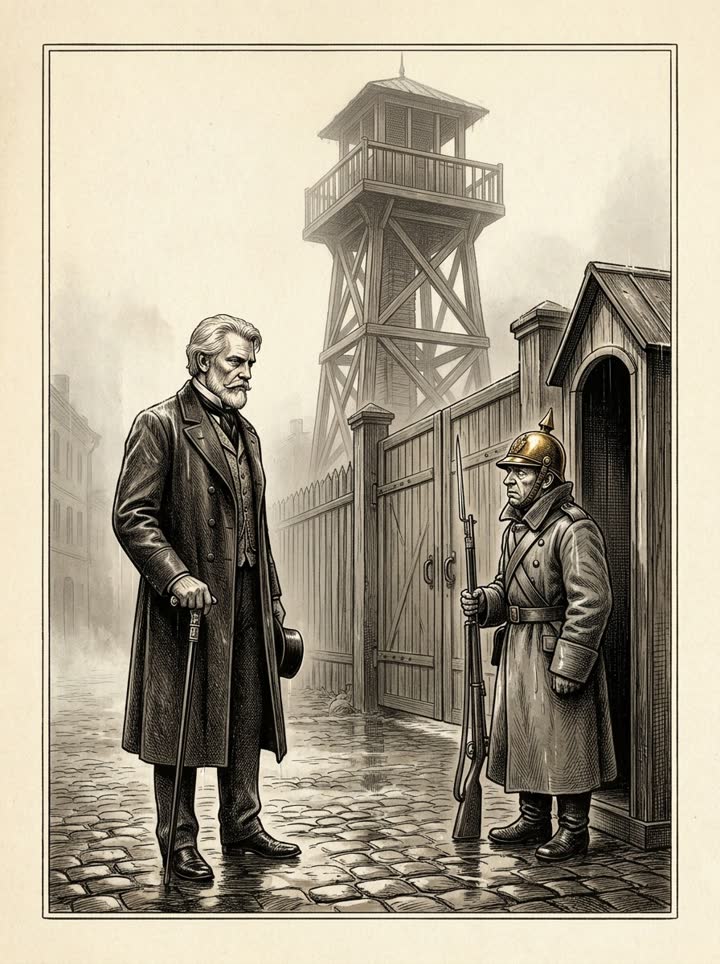
A milky, thick fog lay over the city. Svidrigailov walked along the slippery, muddy wooden pavement in the direction of the Little Neva. He imagined the water of the Little Neva risen high during the night, Petrovsky Island, the wet paths, wet grass, wet trees and bushes and, at last, that very bush... In vexation he began to examine the houses, in order to think of something else. Neither a passer-by nor a cabman met him along the prospect. Dismally and dirtily the bright yellow wooden little houses with closed shutters looked on. Cold and damp penetrated his whole body, and he began to shiver. Now and then he came upon shop and greengrocer signboards and read each one carefully. Now the wooden pavement had ended. He was already level with a large stone house. A dirty, shivering little dog, with its tail between its legs, ran across his path. Some dead-drunk man, in a greatcoat, lay face down across the pavement. He looked at him and went on. A tall fire tower flashed on his left. "Ba!" he thought, "here is the place, why Petrovsky? At least in the presence of an official witness..." He almost smiled at this new thought and turned off into a side street. There stood a large house with a tower. At the locked big gates of the house stood, leaning against them with his shoulder, a little man wrapped in a grey soldier's coat and wearing a brass Achilles helmet. With a drowsy look he glanced coldly sideways at the approaching Svidrigailov. On his face was that age-old peevish sorrow which has stamped itself so sourly on every face, without exception, of the Jewish race. Both of them, Svidrigailov and Achilles, for some time, in silence, examined one another. At last it seemed to Achilles out of order that a man who was not drunk should stand before him three paces away, stare straight at him and say nothing.
"And so what is it, then, you are wanting here?" he said, still not moving and not changing his position.
"Nothing, brother, good morning!" answered Svidrigailov.
"Here is not the place."
"I, brother, am going to foreign parts."
"To foreign parts?"
"To America."
"To America?"
Svidrigailov took out the revolver and cocked it. Achilles raised his eyebrows.
"And so what, then, such jokes, here is not the place for them!"
"And why should it not be the place?"
"Because, then, it is not the place."
"Well, brother, that makes no difference. It is a good place; if they ask you, then answer that he went off to America, so he said."
He put the revolver to his right temple.
"So here you can't, here is not the place!" Achilles started up, his pupils widening more and more.
Svidrigailov pulled the trigger.