
When he came in to Sonya's, twilight was already beginning. Sonya had waited for him all day in terrible agitation. She and Dunya had waited together. Dunya had come to her early in the morning, remembering Svidrigailov's words of the day before, that Sonya "knew about it." We shall not relate the details of the conversation and the tears of the two women, nor how close they grew to one another. From that meeting Dunya carried away at least one comfort: that her brother would not be alone. It was to Sonya, to her first, that he had come with his confession; in her he had looked for a human being when he needed a human being; and she would go after him wherever fate sent him. Dunya did not ask, but she knew it would be so. She looked at Sonya even with a kind of reverence, and at first almost embarrassed her by the reverent feeling with which she treated her. Sonya was ready to cry, almost: she, on the contrary, thought herself unworthy even to look at Dunya. The lovely image of Dunya, as she had bowed to her with such attention and respect at their first meeting in Raskolnikov's room, had remained in her soul ever since, for ever, as one of the most beautiful and unattainable visions of her life.
Dunechka at last could bear it no longer and left Sonya, to wait for her brother at his lodgings; it kept seeming to her that he would come there first. Left alone, Sonya at once began to torment herself with fear at the thought that perhaps he really would make an end of himself. Dunya feared the same. But all day long the two of them had competed in talking each other out of it, with every argument, that this could not be, and they were calmer while they were together. Now, as soon as they had parted, both of them began to think of this one thing only. Sonya recalled how Svidrigailov had told her yesterday that Raskolnikov had two roads, the Vladimirka or... She knew besides his vanity, his arrogance, his pride and his unbelief. "Can mere weakness of spirit and the fear of death be all that will make him live?" she thought at last, in despair. The sun meanwhile was already setting. She stood sadly before the window and gazed fixedly out of it, but from that window one could see only the blank, unwhitewashed wall of the neighbouring house. At last, when she had come to a complete conviction of the unhappy man's death, he walked into her room.
A cry of joy burst from her breast. But, looking closely into his face, she suddenly turned pale.
"Well, yes!" said Raskolnikov, smiling crookedly. "I've come for your crosses, Sonya. You yourself sent me to the crossroads; so now that it has come to the point, have you lost your nerve?"
Sonya looked at him in amazement. His tone seemed strange to her; a cold shiver ran over her body, but a minute later she guessed that both the tone and the words were all put on. And he spoke to her looking somehow into a corner, as though avoiding looking straight into her face.
"You see, Sonya, I've reasoned that this way, perhaps, will actually be more advantageous. There's a circumstance... Well, it would take long to tell, and there's nothing to tell. Do you know what angers me? It annoys me that all these stupid, brutish mugs will crowd round me in a moment, stare at me with their goggle eyes, put their stupid questions to me, which I'll have to answer, point their fingers at me... Pah! You know, I'm not going to Porfiry; I'm sick of him. I'd rather go to my friend Gunpowder: won't I surprise him, won't I make an effect, of a kind! But I ought to be cooler; I've become too bilious lately. Would you believe it, I just shook my fist, very nearly, at my sister, only because she turned round to look at me one last time. It's swinish, a state like that! Eh, what I've come to! Well, then, where are the crosses?"
He was as if beside himself. He could not stand still in one place even for a minute, could not fix his attention on a single thing; his thoughts leapt one over another, he rambled; his hands trembled slightly.
Sonya silently took two crosses out of a drawer, a cypress one and a copper one, crossed herself, crossed him, and put the cypress cross on his chest.
"So that's the symbol that I'm taking the cross upon myself, he-he! And it's true, I've suffered little so far! The cypress one, that is, the common people's; the copper one is Lizaveta's, you're taking that for yourself, let me see it? So she had it on her... at that moment? I know of two crosses like that too, a silver one and a little icon. I threw them on the old woman's breast then. Those would be just the thing now, really, those are the ones I ought to put on... But I'm talking nonsense, I'll forget what I came for; I'm so absent-minded somehow!.. You see, Sonya, I really came to warn you, so that you should know... Well, that's all... That's all I came for. (Hm, though I thought I'd say more.) But you yourself wanted me to go, well, so I'll sit in prison, and your wish will be fulfilled; so why are you crying? And you too? Stop, enough; oh, how hard all this is for me!"
A feeling, however, was born in him; his heart tightened as he looked at her. "This one, this one, what is the matter with her?" he thought to himself. "What am I to her? Why is she crying, why is she getting me ready for the road, like my mother or Dunya? She'll be my nursemaid!"
"Cross yourself, pray, if only once," Sonya asked in a trembling, timid voice.
"Oh, certainly, as much as you like! And from a pure heart, Sonya, from a pure heart..."
He wanted, however, to say something else.
He crossed himself several times. Sonya seized her shawl and threw it over her head. It was a green drap-de-dames shawl, probably the very one Marmeladov had mentioned then, the "family" one. The thought of it flashed through Raskolnikov's mind, but he did not ask. And indeed he himself was beginning to feel that he was terribly absent-minded and somehow shamefully agitated. This frightened him. He was struck suddenly too by the fact that Sonya wanted to go out with him.
"What are you doing! Where are you going? Stay, stay! I'll go alone," he cried in craven vexation and, almost enraged, walked to the door. "And what's the use of a whole retinue!" he muttered as he went out.
Sonya remained in the middle of the room. He had not even said goodbye to her, he had already forgotten her; one bitter, rebellious doubt was boiling up in his soul.
"But is it so, is it really so, all this?" he thought again as he went down the stairs. "Is it really impossible to stop even now, and put everything right again... and not go?"
But he went on all the same. He suddenly felt, once and for all, that there was no use asking himself questions. Out in the street he remembered that he had not said goodbye to Sonya, that she had stayed in the middle of the room in her green shawl, not daring to stir at his shout, and he stopped for a moment. At that instant a thought suddenly lit him up brightly, as if it had been waiting to strike him once and for all.
"Why, why did I come to her just now? I told her: on business; but what business? There was no business at all! To announce that I'm going; well, and what of it? What a necessity! Do I love her, then? I don't, do I, I don't? Why, I drove her off just now like a dog. Did I really need crosses from her? Oh, how low I've fallen! No, I needed her tears, I needed to see her fright, to watch how her heart ached and was tormented! I had to catch hold of something, to delay, to look at a human being! And I dared to hope so much for myself, to dream so about myself, I, a beggar, I, a nothing, a scoundrel, a scoundrel!"
He walked along the canal embankment, and he had not far to go. But when he reached the bridge he stopped, and suddenly turned onto the bridge, aside, and went to the Haymarket.
He looked eagerly to right and left, peered with strain at every object and could fix his attention on nothing; everything slipped away. "In a week, in a month, they'll drive me somewhere in one of those prison vans over this bridge; how will I look at this canal then? Should I remember it?" flashed through his head. "This signboard, how will I read these very letters then? Here it says: 'Partnership,' written wrong; well, so let me remember that, the letter a, and look at it in a month, at that very a: how will I look at it then? What will I feel and think then?.. Good God, how low it all must be, all these present... cares of mine! Of course all this must be curious... in its own way... (ha-ha-ha! what am I thinking about!) I'm turning into a child, I'm showing off to myself; and why am I shaming myself? Ugh, how they shove! This fat one, a German, I suppose, who shoved me: does he know whom he shoved? A peasant woman with a baby begging alms; it's curious that she thinks me happier than herself. Why not give her something, for the curiosity of it. Ha, a five-kopeck piece has survived in my pocket, where from? Here, here... take it, my dear!"
"God keep you!" came the beggar-woman's plaintive voice.
He came into the Haymarket. It was unpleasant, very unpleasant to him to bump against people, but he went precisely where there seemed to be more people. He would have given anything in the world to be alone; but he himself felt that he would not be alone for a single minute. In the crowd a drunk was making a spectacle of himself: he kept wanting to dance, but kept falling over to one side. They crowded round him. Raskolnikov squeezed through the crowd, looked at the drunk for several minutes, and suddenly burst into a short, abrupt laugh. A minute later he had already forgotten him, did not even see him, though he was looking at him. He moved away at last, not even remembering where he was; but when he reached the middle of the square, a sudden movement came over him, one sensation seized him all at once and took hold of him wholly, body and thought.
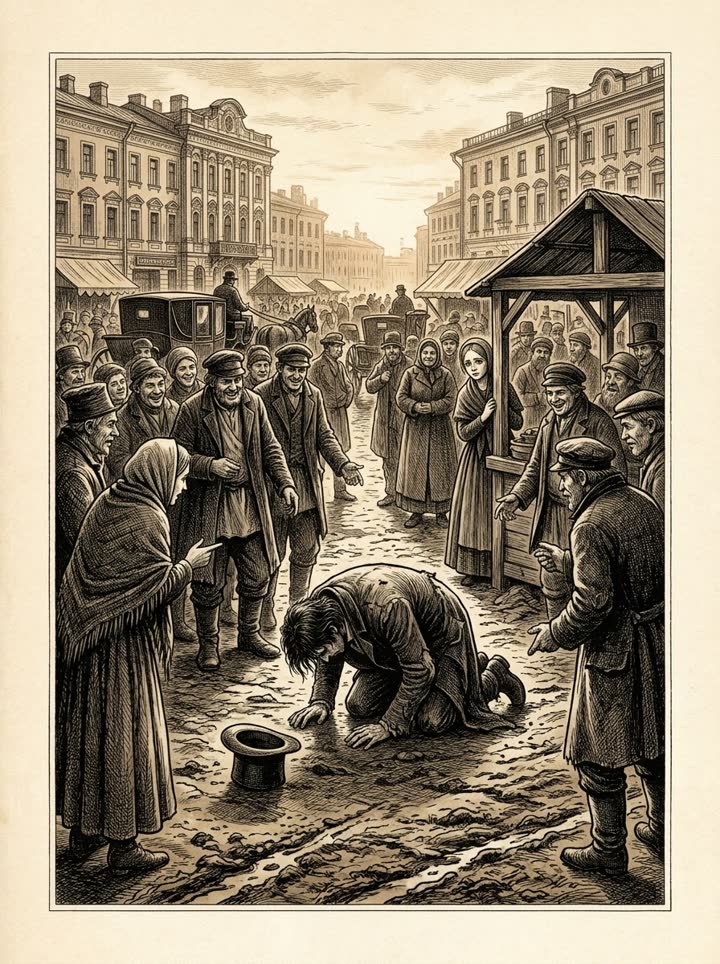
He suddenly remembered Sonya's words: "Go to the crossroads, bow down to the people, kiss the earth, for you have sinned against it too, and say aloud to the whole world: 'I am a murderer!'" He trembled all over as he remembered it. And the hopeless anguish and anxiety of all this time, but especially of the last hours, had so crushed him already that he simply flung himself into the possibility of this whole, new, full sensation. It came upon him suddenly like a seizure: it kindled in his soul as one spark and then, like fire, caught the whole of him. Everything in him softened at once, and tears gushed out. Just as he stood, he fell to the ground...
He knelt in the middle of the square, bowed down to the earth and kissed that filthy earth, with delight and happiness. He got up and bowed down a second time.
"Look at him, he's drunk himself silly!" remarked a lad beside him.
Laughter rang out.
"He's going to Jerusalem, brothers, he's saying goodbye to his children and his homeland, bowing to the whole world, kissing the capital city of St. Petersburg and its ground," added some tipsy tradesman.
"Still a young lad!" put in a third.
"From the gentry!" someone remarked in a solid voice.
"These days you can't tell who's gentry and who's not."
All these remarks and talk checked Raskolnikov, and the words "I killed," which perhaps had been getting ready to fly from his tongue, died within him. He bore all these shouts calmly, however, and without looking round went straight through a side street in the direction of the police office. One vision flashed before him on the way, but he was not surprised at it; he had already foreseen that it must be so. At the moment when he bowed down to the earth in the Haymarket a second time, turning to the left, some fifty paces from himself, he saw Sonya. She was hiding from him behind one of the wooden booths that stood in the square; so she had accompanied him all through his sorrowful procession! Raskolnikov felt and understood in that moment, once and for all, that Sonya was now with him for ever and would follow him to the ends of the earth, wherever fate might send him. His whole heart turned over... but, there he was already at the fateful place...
He entered the yard fairly briskly. He had to go up to the third floor. "There's still the climb up first," he thought. In general it seemed to him that the fateful moment was still far off, that much time still remained, that there was still much to think over.
Again the same rubbish, the same shells on the spiral staircase, again the doors of the flats standing wide open, again the same kitchens from which came fumes and stench. Raskolnikov had not been here since. His legs were going numb and giving way, but they went. He stopped for a moment to catch his breath, to compose himself, to enter like a man. "But what for? why?" he thought suddenly, aware of what he was doing. "If this cup has to be drunk, isn't it all the same? The fouler the better." In his imagination at that moment the figure of Ilya Petrovich Gunpowder flashed. "Can I really go to him? Couldn't it be someone else? Couldn't it be Nikodim Fomich? Turn back now and go to the superintendent's own flat? At least it would be settled privately... No, no! To Gunpowder, to Gunpowder! If I'm to drink, then drink it all at once..."
Chilled through, and barely aware of himself, he opened the door of the office. This time there were very few people in it; a yardkeeper stood there and some other common fellow. The doorman did not even look out of his partition. Raskolnikov went on into the next room. "Perhaps it will still be possible not to speak," flickered in him. Here a certain person among the clerks, in a civilian frock coat, was settling down to write something at a bureau. In a corner another clerk was seating himself. Zametov was not there. Nikodim Fomich, of course, was not there either.
"Is nobody here?" Raskolnikov asked, addressing the person at the bureau.
"Who is it you want?"
"A-ah! There's no sound, no sight, but the Russian smell... how does it go in the fairy tale... I've forgotten! M-my r-respects!" a familiar voice suddenly cried.
Raskolnikov shuddered. Gunpowder stood before him; he had suddenly come out of the third room. "It's fate itself," thought Raskolnikov, "why is he here?"
"To see us? On what business?" cried Ilya Petrovich. (He was evidently in the most excellent and even a trifle excited frame of mind.) "If it's business, you've come too early. I'm here myself by chance... But still, whatever I can do. I confess to you... what? what? Forgive me..."
"Raskolnikov."
"Well, yes: Raskolnikov! And could you really suppose that I had forgotten! Please don't take me for such a... Rodion Ro... Ro... Rodionych, is that right?"
"Rodion Romanych."
"Yes, yes, yes! Rodion Romanych, Rodion Romanych! That's just what I was after. I even made inquiries several times. I confess to you that ever since I've been sincerely grieved that we should have... I was told afterwards, I learned that you were a young man of letters and even a scholar, and, so to speak, taking your first steps... Oh Lord! And what man of letters or scholar did not make original steps at first! My wife and I, we both respect literature, and my wife to the point of passion!.. Literature and art! If a man is noble, all the rest can be acquired by talent, knowledge, reason, genius! A hat, well, what, for example, does a hat mean? A hat is a pancake, I can buy it at Zimmermann's; but what is kept under the hat and covered by the hat, that I can't buy, sir!.. I confess I even wanted to come to you to explain myself, but I thought perhaps you... But I haven't even asked: is there really something you need? Your relations have come to you, they say?"
"Yes, my mother and sister."
"I even had the honour and happiness of meeting your sister, a cultivated and charming person. I confess I was sorry that we got so heated then. A freak occurrence! And as for the look I gave you then, over your fainting fit, it was explained afterwards in the most brilliant manner! Bigotry and fanaticism! I understand your indignation. Perhaps you are changing your lodgings on account of the family's arrival?"
"N-no, I only... I came in to ask... I thought I'd find Zametov here."
"Ah, yes! You made friends, I heard, sir. Well, we haven't Zametov, you've missed him. Yes, sir, we've lost Alexander Grigorievich! As of yesterday he is not on the premises; he's transferred... and in transferring he even quarrelled with everyone... quite impolitely, even... A flighty boy, nothing more; he might even have given hope; but there, what can you do with them, with our brilliant young people! He wants to take some examination, I suppose, but with us it's only a matter of talking and showing off, and that's where the examination ends. It's not like you, for example, or Mr. Razumikhin, your friend! Your career is the learned side, and failures will not throw you off! All these beauties of life, one may say, are nihil est to you, an ascetic, a monk, a hermit!.. For you a book, a pen behind the ear, learned researches, that's where your spirit soars! I myself, to some extent... have you read Livingstone's travels?"
"No."
"But I have. Nowadays, however, a great many nihilists have spread about; well, it's understandable, what times are these, I ask you? But then, with you I... you, of course, are not a nihilist! Answer frankly, frankly!"
"N-no..."
"No, you know, be frank with me, don't be constrained, as though you were alone with yourself! Service is one thing, another thing is... you thought I was going to say: friendship, no, sir, you didn't guess! Not friendship, but the feeling of a citizen and a human being, the feeling of humanity and love for the Almighty. I may be an official person, in office, but I am bound always to feel the citizen and the human being in myself and to give an account... You were pleased to speak of Zametov. Zametov, he'll make some scandal in the French manner in a disreputable establishment, over a glass of champagne or Don wine, that's what your Zametov is! While I, perhaps, so to speak, am consumed with devotion and lofty feelings, and moreover I have importance, rank, I occupy a post! I'm married and have children. I fulfil my duty as a citizen and a human being, and he, who is he, allow me to ask? I address you as a man ennobled by education. Now these midwives too are spreading excessively."
Raskolnikov raised his eyebrows questioningly. The words of Ilya Petrovich, who had evidently just risen from dinner, rattled and showered before him for the most part as empty sounds. But a part of them he still somehow understood; he looked questioningly and did not know how all this would end.
"I'm speaking of these girls with cropped hair," went on the talkative Ilya Petrovich. "I've nicknamed them myself 'midwives,' and I find the name completely satisfactory. He-he! They push into the academy, they study anatomy; well, tell me, if I fall ill, would I send for a young lady to treat me? He-he!"
Ilya Petrovich laughed, thoroughly pleased with his witticisms.
"It's granted, the thirst for enlightenment is immoderate; but you've been enlightened, and that's enough. Why abuse it? Why insult respectable persons, as that scoundrel Zametov does? Why did he insult me, I ask you? And then, how many of these suicides have spread, you can't imagine. They all spend their last money and kill themselves. Girls, boys, old men... Why, only this morning a report came in about some gentleman who had just arrived. Nil Pavlych, oh, Nil Pavlych! what was his name, the gentleman who was reported a while ago, who shot himself on the Petersburg Side?"
"Svidrigailov," someone answered hoarsely and indifferently from the other room.
Raskolnikov started.
"Svidrigailov! Svidrigailov has shot himself!" he cried.
"What! Do you know Svidrigailov?"
"Yes... I know him... He arrived recently..."
"Yes, recently arrived, lost his wife, a man of reckless conduct, and suddenly he shot himself, and so scandalously that you can't imagine... he left a few words in his notebook, that he is dying in his right mind and asks that no one be blamed for his death. This man had money, they say. How is it you know him?"
"I... am acquainted... my sister lived in their house as a governess..."
"Well, well, well... Then you can tell us about him. And you never suspected?"
"I saw him yesterday... he... was drinking wine... I knew nothing."
Raskolnikov felt as though something had fallen on him and was crushing him.
"You seem to have turned pale again. It's so stuffy in here with us..."
"Yes, it's time for me to go, sir," muttered Raskolnikov. "Forgive me for troubling you..."
"Oh, not at all, not at all, come whenever you like! You've given us pleasure, and I am glad to declare..."
Ilya Petrovich even held out his hand.
"I only wanted... I came to see Zametov..."
"I understand, I understand, and you've given us pleasure."
"I'm... very glad... goodbye, sir..." Raskolnikov smiled.
He went out; he was reeling. His head was spinning. He could not feel whether he was standing on his feet. He began to go down the stairs, leaning his right hand against the wall. It seemed to him that some yardkeeper with a book in his hand, climbing up to the office, jostled him as they met; that some little dog was barking itself hoarse somewhere on the ground floor, and that some woman threw a rolling pin at it and shouted. He went down and came out into the yard. There in the yard, not far from the exit, stood Sonya, pale, quite deathly, and she looked at him wildly, wildly. He stopped before her. Something sick and tormented was expressed in her face, something desperate. She clasped her hands. An ugly, lost smile was forced out on his lips. He stood, smiled, and turned back upstairs, again to the office.
Ilya Petrovich had sat down and was rummaging among some papers. Before him stood the very peasant who had just jostled Raskolnikov as he climbed the stairs.
"A-ah? You again! Did you leave something behind?.. But what is the matter with you?"
Raskolnikov, with whitened lips and a fixed stare, quietly approached him, came right up to the table, leaned on it with his hand, wanted to say something, but could not; only some incoherent sounds were heard.
"You're unwell, a chair! Here, sit down on the chair, sit! Water!"
Raskolnikov sank onto the chair, but did not take his eyes off the face of the very unpleasantly surprised Ilya Petrovich. For a minute they both looked at each other and waited. Water was brought.
"It was I..." Raskolnikov began.
"Drink some water."
Raskolnikov pushed the water away with his hand and said quietly, with pauses, but distinctly:
"It was I who killed the old woman, the official's widow, and her sister Lizaveta, with an axe, and robbed them."
Ilya Petrovich opened his mouth. People ran in from all sides.
Raskolnikov repeated his statement.