
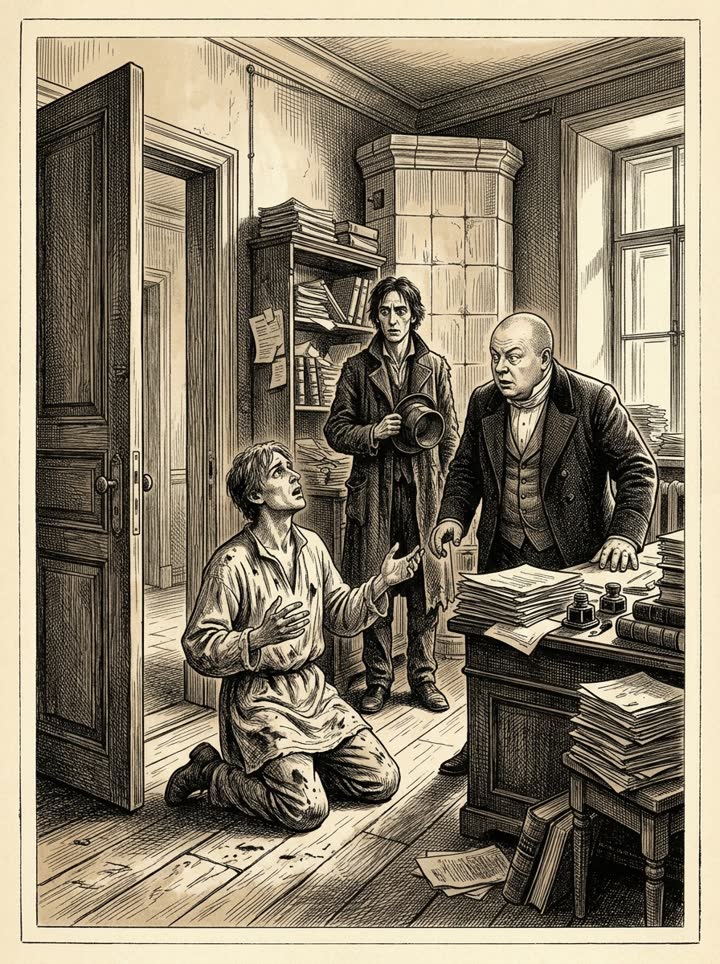
Afterwards, when Raskolnikov recalled that moment, it all appeared to him in this way.
The noise that had been heard behind the door suddenly grew rapidly louder, and the door opened a little.
"What is it?" Porfiry Petrovich cried with annoyance. "I gave orders..."
For a moment there was no answer, but it was plain that several people were standing behind the door and that someone was being pushed back.
"But what is going on there?" Porfiry Petrovich repeated, alarmed.
"The prisoner has been brought, Nikolai," said somebody's voice.
"Not now! Away! Let him wait!.. Why did he push in here! What disorder is this!" Porfiry shouted, rushing to the door.
"But he..." the same voice began again, and suddenly broke off.
For two seconds, no more, a real struggle went on; then all at once someone seemed to thrust someone else violently aside, and immediately after that a very pale man stepped straight into Porfiry Petrovich's room.
The look of this man was very strange at first sight. He stared straight in front of him, but as if seeing no one. Resolution flashed in his eyes, yet at the same time a deathly pallor covered his face, as if he were being led to execution. His lips, gone quite white, trembled slightly.
He was still very young, dressed like a common man, of middle height, thin, with his hair cut round like a bowl, and with fine, as it were dried-up features. The man he had so unexpectedly pushed away was the first to rush into the room after him and had managed to seize him by the shoulder: this was the escort; but Nikolai jerked his arm and tore himself free of him once more.
Several curious people crowded in the doorway. Some of them tried to come in. Everything described took place almost in a single instant.
"Away, it's too early! Wait till you're called!.. Why was he brought in before his time?" muttered Porfiry Petrovich in the greatest annoyance, as if thrown off his balance. But Nikolai suddenly knelt down.
"What's the matter with you?" Porfiry cried in amazement.
"I'm guilty! It's my sin! I'm the murderer!" Nikolai suddenly pronounced, somewhat breathlessly, but in a fairly loud voice.
For some ten seconds there was silence, as if a stupor had come over everyone; even the escort recoiled and no longer went up to Nikolai, but retreated mechanically to the door and stood motionless.
"What is this?" cried Porfiry Petrovich, coming out of his momentary numbness.
"I... am the murderer..." Nikolai repeated, after being silent a little while.
"How... you... How... Whom did you kill?"
Porfiry Petrovich was evidently at a loss.
Nikolai was silent a little while again.
"Alyona Ivanovna and her sister, Lizaveta Ivanovna, I... killed... with an axe. A darkness came over me..." he added suddenly and fell silent again. He was still on his knees.
Porfiry Petrovich stood for several moments as if thinking it over, but suddenly started up again and waved his arms at the uninvited witnesses. They vanished in an instant, and the door was closed. Then he looked at Raskolnikov, who was standing in the corner staring wildly at Nikolai, and was about to go over to him, but suddenly stopped, looked at him, immediately turned his gaze to Nikolai, then again to Raskolnikov, then again to Nikolai, and suddenly, as if carried away, flew at Nikolai again.
"Why do you run ahead of me with your darkness?" he shouted at him almost with spite. "I haven't yet asked you whether a darkness came over you or not... Speak: did you kill?"
"I'm the murderer... I give my statement..." said Nikolai.
"Ah! What did you kill with?"
"An axe. I had it ready."
"Ah, he's in a hurry! Alone?"
Nikolai did not understand the question.
"Did you kill alone?"
"Alone. And Mitka is innocent and had no part in any of it."
"Don't be in a hurry with Mitka! Ah!"
"How was it, well, how was it that you ran down the stairs then? The yardkeepers met the two of you, didn't they?"
"That was to put them off... then... I ran with Mitka," Nikolai answered, as if hurrying and having prepared it beforehand.
"There, just as I thought!" Porfiry cried spitefully. "He's not speaking his own words!" he muttered as if to himself, and suddenly saw Raskolnikov again.
He had evidently been so carried away with Nikolai that for a moment he had even forgotten Raskolnikov. Now he suddenly came to himself, was even embarrassed...
"Rodion Romanovich, my dear sir! Forgive me, sir," he rushed up to him, "this won't do, sir; if you please, sir... there's nothing for you here... I myself... you see what surprises!.. if you please, sir!.."
And taking him by the hand, he pointed him to the door.
"You didn't expect this, it seems?" said Raskolnikov, who of course did not yet understand anything clearly, but had already managed to take heart greatly.
"And you didn't expect it either, my dear sir. Look how your little hand trembles! He-he!"
"And you tremble too, Porfiry Petrovich."
"I tremble too, sir; I didn't expect it, sir!.."
They were already standing in the doorway. Porfiry was waiting impatiently for Raskolnikov to go through.
"And so you won't show me the little surprise after all?" Raskolnikov said suddenly.
"He talks, and his own little teeth are still knocking against each other in his mouth, he-he! What an ironical man you are! Well, sir, good-bye, sir."
"To my mind, farewell!"
"As God wills, sir, as God wills!" muttered Porfiry with a somehow twisted smile.
Passing through the office, Raskolnikov noticed that many people looked at him fixedly. In the entrance hall, in the crowd, he managed to make out both yardkeepers from that house, whom he had called over that night to the police officer. They were standing and waiting for something. But he had no sooner gone out onto the stairs than he suddenly heard Porfiry Petrovich's voice behind him again. Turning round, he saw that the man was catching up with him, quite out of breath.
"One little word, sir, Rodion Romanovich; as for all the rest of it, as God wills, but all the same there are some things I shall have to ask you, as the form requires, sir... so we shall see each other again, sir, yes."
And Porfiry stopped in front of him with a smile.
"Yes, sir," he added once more.
One could have supposed that he wanted to say something more, but somehow it would not come out.
"And you, Porfiry Petrovich, will forgive me for earlier... I lost my temper," Raskolnikov began. He had taken heart so completely by now that he felt an irresistible desire to show off.
"Nothing, sir, nothing..." Porfiry caught it up almost joyfully. "I myself, sir... I have a venomous character, I confess, I confess! But we shall meet, sir. If God wills, we shall meet a great deal, a great deal, sir!.."
"And we shall finally come to know each other?" Raskolnikov caught up.
"And we shall finally come to know each other," Porfiry Petrovich echoed, and, screwing up his eyes, looked at him very seriously. "Are you off to a name-day party now, sir?"
"To a funeral, sir."
"Ah yes, the funeral! Take care of your health, your health, sir..."
"And I really don't know what to wish you on my side!" Raskolnikov caught up, already beginning to go down the stairs, but suddenly turning again to Porfiry. "I would wish you great successes, but you see how comic your position is!"
"Why comic, sir?" Porfiry Petrovich at once pricked up his ears, he too having been about to turn away.
"Why, how you must have tormented and tortured this poor Mikolka, psychologically, in your own fashion, until he confessed; day and night you must have been proving to him: 'You are the murderer, you are the murderer...' and now that he has confessed, you will begin again to take him apart bone by bone: 'You're lying,' you'll say, 'you're not the murderer! You can't have been! You're not speaking your own words!' Well then, how is your position not comic after that?"
"He-he-he! So you noticed what I said to Nikolai just now, that he was 'not speaking his own words'?"
"How could I not notice?"
"He-he! You are witty, witty, sir. You notice everything! A truly playful mind, sir! And you touch the very comic string... he-he! They say that among writers it was Gogol who had this trait in the highest degree?"
"Yes, Gogol."
"Yes, sir, Gogol, sir... till our most pleasant next meeting, sir."
"Till our most pleasant next meeting..."
Raskolnikov went straight home. He was so confused and bewildered that, having come home and thrown himself on the sofa, he sat there for a quarter of an hour, only resting and trying to collect his thoughts at least somewhat. About Nikolai he did not even undertake to reason: he felt that he was stunned; that in Nikolai's confession there was something inexplicable, astonishing, which he could not now understand at all. But Nikolai's confession was an actual fact. The consequences of this fact at once became clear to him: the lie could not fail to be discovered, and then they would set to work on him again. But at least until then he was free and must certainly do something for himself, because the danger was unavoidable.
But to what degree, however? The position began to clear. Recalling in rough outline, in its general connection, the whole of his scene with Porfiry a little while ago, he could not help shuddering with horror once more. Of course he did not yet know all of Porfiry's aims, could not fathom all his calculations of a little while ago. But part of the game had been revealed, and certainly no one could understand better than he how terrible for him had been this "move" in Porfiry's game. A little more, and he might have given himself away completely, in actual fact. Knowing the morbidness of his character and having grasped and seen through him correctly at first glance, Porfiry had acted far too boldly, it was true, but almost without fail. There was no denying that Raskolnikov had already compromised himself too much a little while ago, but it had still not come to facts; everything was still only relative. But was he, though, was he understanding it all rightly now? Was he not mistaken? To precisely what result had Porfiry been leading today? Had he really had something prepared for today? And what exactly? Was he really waiting for something or not? How exactly would they have parted today if the unexpected catastrophe through Nikolai had not come?
Porfiry had shown almost his whole game; of course he had taken a risk, but he had shown it, and (it still seemed so to Raskolnikov) if Porfiry had really had anything more, he would have shown that too. What was this "surprise"? A mockery, perhaps? Did it mean anything or not? Could there be hidden under it anything resembling a fact, a positive accusation? The man of yesterday? Where on earth had he vanished to? Where had he been today? For if Porfiry had anything positive at all, then of course it was connected with the man of yesterday...
He sat on the sofa, his head hanging down, his elbows on his knees and his face covered with his hands. A nervous trembling still went on through his whole body. At last he stood up, took his cap, thought, and went towards the door.
He had a sort of foreboding that, at least for today, he could almost certainly consider himself safe. Suddenly in his heart he felt almost joy: he wanted to be with Katerina Ivanovna as soon as possible. He was of course too late for the funeral, but he would be in time for the memorial dinner, and there, at once, he would see Sonya.
He stopped, thought, and a sickly smile was forced out on his lips.
"Today! Today!" he repeated to himself. "Yes, this very day! It must be so..."
He was just about to open the door when suddenly it began to open by itself. He trembled and leaped back. The door opened slowly and quietly, and suddenly a figure appeared, the man of yesterday, out of the ground.
The man stopped on the threshold, looked silently at Raskolnikov and took a step into the room. He was exactly as he had been yesterday, the same figure, the same clothes, but in his face and in his look a strong change had taken place: he looked now somehow sorrowful and, after standing a little, sighed deeply. All that was lacking was for him to put his palm to his cheek and tilt his head to one side, to look completely like a peasant woman.
"What do you want?" asked Raskolnikov, deathly pale.
The man was silent and suddenly bowed to him deeply, almost to the ground. At least he touched the ground with a finger of his right hand.
"What are you doing?" cried Raskolnikov.
"I'm guilty," the man said quietly.
"Of what?"
"Of wicked thoughts."
They both looked at each other.
"I was hurt. When you came that time, perhaps in drink, and called the yardkeepers to the police station and asked about blood, I was hurt that they let it drop and took you for a drunkard. And so hurt that I lost my sleep. And having remembered the address, we came here yesterday and asked..."
"Who came?" Raskolnikov interrupted, instantly beginning to remember.
"I did, that is. I wronged you."
"So you are from that house?"
"Well, I stood there too, at that time, in the gateway with them, or have you forgotten? We've had our trade there too, for years and years. We're furriers, tradesmen, we take work home... and above all I was hurt..."
And suddenly the whole scene of the day before yesterday under the gateway came back clearly to Raskolnikov; he realised that besides the yardkeepers there had been several other people standing there, and women too. He remembered one voice proposing to take him straight to the police station. The face of the speaker he could not recall and even now did not recognise, but he remembered that he had even answered him something then, had turned to him...
So this, then, was how all that horror of yesterday had been resolved. The most terrible thing was to think that he had really almost perished, had almost destroyed himself because of such a trifling circumstance. So, besides the hiring of the flat and the talk about blood, this man could tell nothing. So Porfiry too had nothing, nothing but this delirium, no facts but psychology, which cuts both ways, nothing positive. So if no more facts appeared (and they must not appear any more, must not, must not!), then... then what could they do to him? How could they convict him finally, even if they arrested him? And so Porfiry had only now, only this moment, learned about the flat, and until now had not known.
"Was it you who told Porfiry today... that I had come?" he cried, struck by a sudden idea.
"Which Porfiry?"
"The examining magistrate."
"I told him. The yardkeepers wouldn't go then, so I went."
"Today?"
"A minute before you. And I heard everything, everything, how he tortured you."
"Where? What? When?"
"Why, there in his place behind the partition, I sat there the whole time."
"What? So it was you who were the surprise? But how could that have happened? For pity's sake!"
"Seeing," the tradesman began, "that the yardkeepers wouldn't go on my word, because, they say, it's late now, and perhaps he'll be angry that we didn't come at the time, I was hurt, and lost my sleep, and began to find out. And having found out yesterday, I went today. The first time I came, he wasn't there. An hour later I came, they wouldn't receive me, the third time I came, they let me in. I began to report to him everything as it was, and he began to leap about the room and beat himself on the chest with his fist: 'What are you doing to me, you robbers?' he says. 'If I had known such a thing, I'd have sent for him with an escort!' Then he ran out, called somebody and began to talk with him in a corner, and then again to me, and began to question and to scold me. And he reproached me a great deal; and I reported everything to him and said that after my words yesterday you had not dared to answer me anything and that you had not recognised me. And he began to run about again, and kept beating himself on the chest, and was angry, and ran about, and when you were announced, well, he says, climb behind the partition, sit there for now, don't stir, whatever you hear, and he brought a chair there for me himself and locked me in; perhaps, he says, I'll question you. And when Nikolai was brought, then he led me out, after you: I'll send for you again, he says, and I'll question you more..."
"And did he question Nikolai in your presence?"
"As soon as he led you out, he led me out too, and began to examine Nikolai."
The tradesman stopped and suddenly bowed again, touching the floor with a finger.
"Forgive me for the slander and for my malice."
"God will forgive," answered Raskolnikov, and as soon as he had said it, the tradesman bowed to him, but now not to the ground, only from the waist, slowly turned and went out of the room. "Everything cuts both ways, now everything cuts both ways," Raskolnikov kept repeating, and, more cheerful than ever, went out of the room.
"Now we shall still fight it out," he said with a spiteful smile as he went down the stairs. But the spite was directed at himself: he recalled with contempt and shame his "faint-heartedness."