
The morning that followed the explanation with Dunechka and Pulcheria Alexandrovna, so fatal for Pyotr Petrovich, had its sobering effect on Pyotr Petrovich too. To his great displeasure he was obliged, little by little, to accept as a fact, done and irrevocable, what only yesterday had seemed to him an almost fantastic occurrence, which had happened, yes, but still somehow seemed impossible. The black snake of wounded vanity had been sucking at his heart all night. As soon as he got out of bed, Pyotr Petrovich looked at himself in the mirror. He was afraid that the bile might have spread in him overnight. In that respect, however, all was well for the time being, and looking at his noble, white face, which had grown a little plump of late, Pyotr Petrovich was even comforted for a moment, in the fullest conviction that he would find himself a bride somewhere else, and perhaps a still better one. But he instantly came to his senses and spat vigorously to one side, which called forth a silent but sarcastic smile from his young friend and fellow lodger, Andrei Semyonovich Lebezyatnikov. Pyotr Petrovich noticed the smile and at once, to himself, put it down to his young friend's account. He had put down a good many things to his account lately. His spite doubled when he suddenly realised that he ought not to have told Andrei Semyonovich yesterday about yesterday's results. That was his second mistake of yesterday, made in the heat of the moment, from too much effusiveness, in irritation... And then, all through that morning, as if on purpose, one unpleasantness followed another. Even at the Senate some failure awaited him in the business he was pressing there. But what irritated him most of all was the landlord of the flat he had taken in view of his coming marriage and was fitting up at his own expense. This landlord, some German craftsman who had grown rich, would on no account agree to break the contract just signed and demanded the full penalty written in the contract, although Pyotr Petrovich was handing the flat back to him almost newly done up. In just the same way the furniture shop would not return a single rouble of the deposit for the furniture he had bought but not yet had carried to the flat. "I'm not going to marry for the sake of the furniture!" Pyotr Petrovich ground his teeth to himself, and at the same moment a desperate hope flashed in him once more: "Can it really be that all this is so irrevocably lost and finished? Can't I try once more?" The thought of Dunechka once more pricked his heart temptingly. He endured that moment with torment, and certainly, if it had been possible to kill Raskolnikov this minute by a mere wish, Pyotr Petrovich would have uttered that wish immediately.
"The mistake was also that I never gave them any money at all," he thought, returning sadly to Lebezyatnikov's little room, "and why the devil was I so much of a Jew? There wasn't even any calculation in it! I thought I'd keep them on short rations and bring them to look on me as Providence, and look at them now!... Pah!... No, if I had given them during all this time, say, fifteen hundred for the trousseau, and for presents, for little boxes and dressing-cases and cornelians and stuffs and all that trash from Knop's and the English shop, then the business would have been cleaner and... firmer! They could not have refused me so easily now! They are the sort of people who would certainly have felt bound to return both presents and money in case of a refusal; and to return them would have been hard and a pity! And their conscience would have pricked them: how, they'd think, can we suddenly drive away a man who has been so generous so far and fairly delicate?... Hm! I've blundered!" And, grinding his teeth once more, Pyotr Petrovich called himself a fool on the spot, to himself, of course.
Having come to this conclusion, he returned home twice as angry and irritable as he had gone out. The preparations for the funeral dinner in Katerina Ivanovna's room partly aroused his curiosity. He had heard something about this dinner yesterday already; he even seemed to remember that he too had been invited; but being taken up with his own troubles he had let all the rest pass without attention. Hastening to enquire of Madame Lippewechsel, who was bustling about the table being laid in Katerina Ivanovna's absence (she was at the cemetery), he learned that the dinner would be a solemn one, that nearly all the lodgers had been invited, even some who had not known the deceased, that even Andrei Semyonovich Lebezyatnikov was invited, in spite of his former quarrel with Katerina Ivanovna, and finally that he himself, Pyotr Petrovich, was not only invited but even awaited with great impatience, since he was almost the most important guest among all the lodgers. Amalia Ivanovna herself had been invited too, with great honour, in spite of all the past unpleasantness, and therefore was now playing hostess and bustling about almost with enjoyment, and besides she was all dressed up, in mourning, it is true, but in everything new, in silk, in her finest feathers, and was proud of it. All these facts and bits of information gave Pyotr Petrovich a certain idea, and he went to his room, that is, to the room of Andrei Semyonovich Lebezyatnikov, in some thoughtfulness. The fact was that he had learned also that Raskolnikov was among the guests.
Andrei Semyonovich had for some reason been sitting at home all that morning. Between Pyotr Petrovich and this gentleman there had established itself a strange sort of relation, though in part a natural one: Pyotr Petrovich despised and hated him beyond measure, almost from the very day he came to lodge with him, but at the same time seemed to be somewhat afraid of him. On arriving in Petersburg he had stayed with him not only from stingy economy, though that was almost the chief reason, but there was another reason too. Even in the provinces he had heard of Andrei Semyonovich, his former pupil, as one of the most advanced young progressives, and even as playing a considerable part in certain curious and legendary circles. This had struck Pyotr Petrovich. These mighty, all-knowing circles, which despised everybody and denounced everybody, had long frightened Pyotr Petrovich with a special sort of fear, quite vague, however. Naturally he himself, and in the provinces too, could not form any exact notion, even an approximate one, of anything of the kind. He had heard, like everyone, that there existed, especially in Petersburg, some progressives, nihilists, exposers and so on, and so on, but, like many people, he exaggerated and distorted the sense and meaning of those names to an absurd degree. What he feared most of all, for some years now, was exposure, and that was the chief ground of his constant, exaggerated uneasiness, especially in his dreams of transferring his activity to Petersburg. In this respect he was, as they say, frightened, as little children are sometimes frightened. A few years earlier in the provinces, when he was only beginning to arrange his career, he had witnessed two cases in which fairly important provincial persons, to whom he had till then clung and who had protected him, were cruelly exposed. One case had ended in a particularly scandalous way for the exposed person, and the other had very nearly ended in a most troublesome one. That was why Pyotr Petrovich resolved, on arriving in Petersburg, to find out at once what the matter was, and if need be to run ahead just in case and curry favour with "our younger generations." In this he counted on Andrei Semyonovich, and when visiting Raskolnikov, for example, he had already learned somehow to round off certain phrases picked up at second hand...
Of course he quickly managed to see that Andrei Semyonovich was an extremely vulgar and simple little man. But this did not at all disabuse or encourage Pyotr Petrovich. Even if he had become convinced that all progressives were just such little fools, his uneasiness would not have subsided. All those doctrines, ideas, systems (with which Andrei Semyonovich had so pounced on him) were really no concern of his. He had his own purpose. He only needed to find out quickly and at once: what and how had it all happened here? Were these people strong or not strong? Had he anything to fear himself, or not? Would they expose him if he undertook this or that, or would they not? And if they would, what for exactly, and what exactly were they exposing now? More than that: could he not somehow fawn on them and cheat them on the spot, if they really were strong? Was that necessary or not? Could he not, for example, arrange something in his career precisely through them? In a word, there were hundreds of questions before him.
This Andrei Semyonovich was a thin, scrofulous little man, of small stature, who served somewhere, and was strangely fair-haired, with side-whiskers shaped like cutlets, of which he was very proud. Besides this, his eyes were almost constantly sore. His heart was rather soft, but his speech very self-assured, and at times even extremely arrogant, which, compared with his little figure, almost always came out funny. Amalia Ivanovna, however, counted him among the rather respected lodgers, that is, he did not get drunk and paid his rent regularly. In spite of all these qualities, Andrei Semyonovich was really rather stupid. And he had attached himself to progress and to "our younger generations" out of passion. He was one of that countless and many-faced legion of vulgar creatures, feeble abortions and half-taught petty tyrants, who instantly cling to the most fashionable current idea, so as at once to make it vulgar, so as to caricature in a moment everything they themselves sometimes serve in the most sincere way.
Yet Lebezyatnikov, although he was very good-natured, was also beginning somewhat to dislike his fellow lodger and former guardian, Pyotr Petrovich. It had come about on both sides somehow by chance and mutually. Simple as Andrei Semyonovich was, he nevertheless began little by little to see that Pyotr Petrovich was cheating him and secretly despised him, and that "he was not at all that sort of man." He had tried to expound to him the system of Fourier and the theory of Darwin, but Pyotr Petrovich, especially of late, had begun to listen somehow too sarcastically, and quite lately had even begun to abuse him. The fact was that Pyotr Petrovich was beginning, by instinct, to see through Lebezyatnikov, to see that he was not only a vulgar and rather stupid little man but perhaps even a little liar, and that he had no connections of any importance even in his own circle, but had only heard things at third hand; more than that, he perhaps did not know his own business, the propaganda, properly, because he got too much confused, and what sort of an exposer could he be! Let us remark in passing that Pyotr Petrovich, in this week and a half, had willingly accepted (especially at first) even very strange praise from Andrei Semyonovich, that is, he did not object, for example, and kept silent if Andrei Semyonovich ascribed to him a readiness to promote the future and early founding of a new "commune" somewhere in Meshchanskaya Street; or, for example, not to interfere with Dunechka if she should take it into her head, in the very first month of marriage, to take a lover; or not to baptise his future children, and so on, and so on, everything of that kind. Pyotr Petrovich, as was his habit, did not object to such qualities ascribed to him and allowed himself to be praised even in that way, so pleasant to him was any praise.
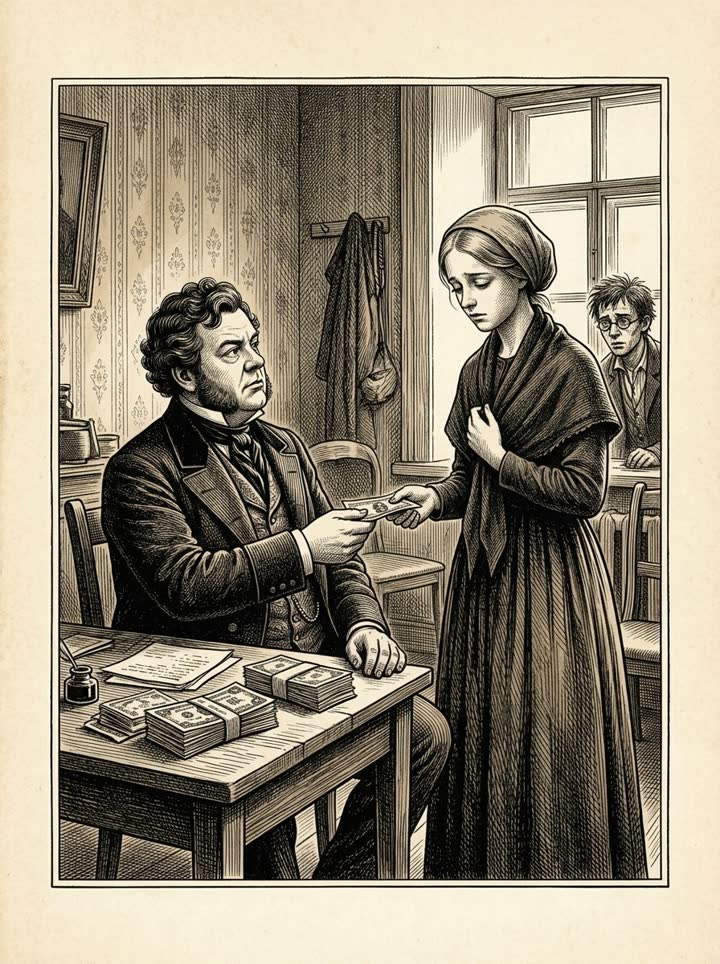
Pyotr Petrovich, who for some reason had changed several five per cent bonds that morning, was sitting at the table counting over bundles of notes and certificates. Andrei Semyonovich, who almost never had any money, was walking about the room and pretending to himself that he looked at all these bundles with indifference and even with contempt. Pyotr Petrovich, for example, would never in the world have believed that Andrei Semyonovich really could look at such money with indifference; and Andrei Semyonovich in his turn thought bitterly that Pyotr Petrovich might indeed be capable of thinking that of him, and perhaps was even glad of the chance to tickle and tease his young friend with the bundles of notes laid out, reminding him of his insignificance and of all the supposed difference between the two of them.
He found him this time unusually irritable and inattentive, although he, Andrei Semyonovich, had set off to develop before him his favourite theme of founding a new, special "commune." The brief objections and remarks that escaped Pyotr Petrovich in the intervals between the clicking of the beads on the abacus breathed the most obvious and intentionally impolite mockery. But the "humane" Andrei Semyonovich ascribed Pyotr Petrovich's mood to the impression of yesterday's break with Dunechka and burned with desire to speak on that subject as soon as possible: he had something progressive and propagandist to say about it which might console his respected friend and "undoubtedly" be of use to his further development.
"What sort of funeral dinner is it they're arranging there at that... at the widow's?" Pyotr Petrovich asked suddenly, interrupting Andrei Semyonovich at the most interesting place.
"As if you didn't know; why, I spoke to you on this very subject yesterday and developed my thoughts about all these ceremonies... And she invited you too, I heard. You spoke with her yourself yesterday..."
"I never expected that beggarly fool would spend on a funeral dinner all the money she got from that other fool... Raskolnikov. I was even astonished just now, passing: such preparations, wines!... Several people are invited, the devil knows what it is!" Pyotr Petrovich went on, questioning and leading the talk in this direction as if with some aim. "What? You say I was invited too?" he added suddenly, raising his head. "When was that? I don't remember, sir. However, I shan't go. What should I do there? I only spoke to her yesterday, in passing, about the possibility of her receiving, as the poor widow of an official, a year's salary as a lump-sum grant. Is it not for that, then, that she invites me? Hee-hee!"
"I don't intend to go either," said Lebezyatnikov.
"I should think not! You thrashed her with your own hands. Naturally you're ashamed, hee-hee-hee!"
"Who thrashed? Whom?" Lebezyatnikov was suddenly alarmed and even blushed.
"Why, you did, Katerina Ivanovna, about a month ago, or so! I heard it, sir, yesterday, sir... So that's what convictions come to!... And the woman question has stumbled too. Hee-hee-hee!"
And Pyotr Petrovich, as if comforted, began clicking the abacus again.
"That is all nonsense and slander!" Lebezyatnikov flared up, he who was always afraid of any reminder of that affair. "And it was not like that at all! It was different... You heard it wrong; it's gossip! I was simply defending myself then. She flew at me first with her claws... She pulled out a whole side-whisker of mine... Every man is allowed, I hope, to defend his person. Besides, I will not allow anyone to use force on me... On principle. Because that is almost despotism. What was I to do, stand there in front of her? I only pushed her away."
"Hee-hee-hee!" Luzhin went on laughing spitefully.
"You tease me like this because you are angry yourself and in a temper... But that is nonsense and has nothing, nothing at all to do with the woman question! You don't understand; I even thought that if it is accepted that woman is equal to man in everything, even in strength (as some already maintain), then there must be equality here too. Of course I reasoned afterwards that such a question, in essence, ought not to exist, because there ought not to be fighting, and that cases of fighting in the future society are unthinkable... and that it is strange, of course, to seek equality in a fight. I am not so stupid... though fighting, to be sure, does exist... that is, afterwards it won't, but now it still does... pah! devil! You make me lose my thread! I am not going to the funeral dinner because of that unpleasantness. I am simply not going on principle, so as not to take part in the vile prejudice of funeral dinners, that's why! However, I might have gone, only to laugh... But it's a pity there will be no priests. Otherwise I should certainly have gone."
"That is, to sit down to another's bread and salt and spit on it on the spot, and likewise on those who invited you. Is that it?"
"Not spit at all, but protest. I have a useful aim. I can indirectly further development and propaganda. Every man is obliged to develop and propagate, and perhaps the sharper the better. I can throw out an idea, a seed... From that seed a fact will grow. How do I offend them? At first they'll be offended, and then they'll see for themselves that I did them good. Look, they blamed Terebyeva (the one who is now in the commune) because when she left her family and... gave herself, she wrote to her mother and father that she did not want to live among prejudices and was entering a civil marriage, and they said it was too crude, with her parents, that they might have been spared, that she might have written more softly. In my opinion all that is nonsense, and there is no need at all to be softer; on the contrary, on the contrary, that is just where to protest. Look at Varents: she lived seven years with her husband, abandoned two children, and cut it off at once in a letter to her husband: 'I have realised that I cannot be happy with you. I shall never forgive you for deceiving me by hiding from me that there exists another arrangement of society, by means of communes. I learned all this lately from a generous man, to whom I have given myself, and together with him I am setting up a commune. I speak plainly because I consider it dishonourable to deceive you. Remain as you please. Do not hope to get me back, you are too late. I wish you to be happy.' That is how letters of that sort are written!"
"And this Terebyeva, is she the very one you told me about, that she's in her third civil marriage?"
"Only in her second, if you judge properly! And even if it were the fourth, even the fifteenth, it's all nonsense! And if I ever regretted that my father and mother were dead, it is certainly now. I have even dreamed several times that if they were still alive, how I would have hit them with a protest! I would have led up to it on purpose... What would that be, some 'slice cut off the loaf'? Pah! I would have shown them! I would have surprised them! Really, it's a pity there is no one!"
"To surprise them? Hee-hee! Well, let that be as you like," Pyotr Petrovich interrupted, "but tell me this: you know the dead man's daughter, the skinny little one? Is it quite true, what they say about her, eh?"
"What of it? In my opinion, that is, by my personal conviction, that is the most normal condition of a woman. Why not? That is, distinguons. In present society it is of course not quite normal, because it is forced, but in the future it will be perfectly normal, because free. And even now she had the right: she was suffering, and that was her fund, her capital, so to speak, of which she had full right to dispose. Of course in the future society there will be no need of funds; but her role will be marked out in another sense, determined harmoniously and rationally. As for Sofya Semyonovna personally, at the present time I look on her actions as an energetic and embodied protest against the structure of society, and I deeply respect her for it; I even rejoice looking at her!"
"But I was told that it was you who drove her out of these rooms!"
Lebezyatnikov even grew furious.
"That is another piece of gossip!" he shrieked. "It was not like that at all, not at all! This is where it is not so! It was all Katerina Ivanovna who made it up then, because she understood nothing! And I never made up to Sofya Semyonovna at all! I was simply, plainly developing her, quite disinterestedly, trying to rouse a protest in her... A protest was all I needed, and Sofya Semyonovna herself could not stay on here in the rooms anyway!"
"Invited her to the commune, did you?"
"You keep laughing, and very unsuccessfully, allow me to tell you. You understand nothing! In a commune there are no such roles. The commune is organised precisely so that there should be no such roles. In a commune this role will change its whole present essence, and what is stupid here will be clever there, what is unnatural here, in present circumstances, will be perfectly natural there. Everything depends on what surroundings and what environment a man is in. Everything comes from environment, and man himself is nothing. And with Sofya Semyonovna I am on good terms even now, which may serve you as proof that she never considered me her enemy or her offender. Yes! I am tempting her into the commune now, but on entirely, entirely different grounds! What are you laughing at? We want to found our own commune, a special one, only on broader foundations than the earlier ones. We have gone further in our convictions. We deny more! If Dobrolyubov rose from the grave, I would argue with him. And as for Belinsky, I'd give him a proper drubbing! Meanwhile I continue to develop Sofya Semyonovna. She is a beautiful, beautiful nature!"
"Well, and you make use of the beautiful nature, eh? Hee-hee!"
"No, no! Oh no! On the contrary!"
"Oh, on the contrary! Hee-hee-hee! What a thing to say!"
"But believe me! For what reasons should I hide it from you, tell me please? On the contrary, I find it strange myself: with me she is somehow intensely, somehow fearfully chaste and shy!"
"And you, of course, develop her... hee-hee! prove to her that all this shyness is nonsense?..."
"Not at all! Not at all! Oh, how crudely, how even stupidly, forgive me, you understand the word development! Y-you understand nothing! O God, how... unprepared you still are! We seek the freedom of woman, and you have only one thing on your mind... Leaving aside altogether the question of chastity and of feminine shyness, as things in themselves useless and even prejudiced, I fully, fully allow her chastity with me, because in that lies all her will, all her right. Of course, if she herself said to me, 'I want to have you,' I should consider myself very lucky, because I like the girl very much; but now, now at least, certainly no one has ever treated her more politely and courteously than I, with more respect for her dignity... I wait and hope, and that is all!"
"You'd do better to make her a present of something. I'll bet you never thought of that."
"Y-you understand nothing, I tell you! It is true, of course, that such is her position, but that is another question! A quite different one! You simply despise her. Seeing a fact which you mistakenly consider deserving of contempt, you already refuse a human being a humane view of her. You don't yet know what a nature she is! I am only very vexed that lately she has somehow quite stopped reading and no longer takes books from me. She used to. It is a pity too that with all her energy and resolution to protest, which she has already proved once, she still seems to have too little independence, so to speak, too little negation, to break away entirely from certain prejudices and... follies. In spite of that she understands some questions excellently. She understood splendidly, for example, the question of kissing hands, that is, that a man insults a woman by inequality if he kisses her hand. That question was debated among us and I at once passed it on to her. She also listened attentively about the workers' associations in France. Now I am explaining to her the question of free entrance into rooms in the future society."
"What's that now?"
"There has been debated lately the question: has a member of the commune the right to enter another member's room, a man's or a woman's, at any time... well, and it was decided that he has..."
"Well, and what if he or she is busy at that moment with some necessary needs, hee-hee!"
Andrei Semyonovich even grew angry.
"You keep on about that, about those accursed 'needs'!" he cried with hatred. "Pah, how I am angry and vexed that when I was expounding the system I mentioned those accursed needs to you prematurely! The devil! That is the stumbling-block for all your sort, and worse still, you seize on it and make a jest of it before you know what it is about! And as if you were right! As if you were proud of something! Pah! I have asserted several times that this whole question can be expounded to novices only at the very end, when he is already convinced of the system, when the man is already developed and directed. And what, tell me please, what do you find so shameful and contemptible even in cesspools? I'm the first, I am ready to clean out any cesspools you like! There is not even any self-sacrifice in it! It is simply work, a noble activity, useful to society, which is worth any other, and much higher, for example, than the activity of some Raphael or Pushkin, because it is more useful!"
"And nobler, nobler, hee-hee-hee!"
"What is 'nobler'? I do not understand such expressions in the sense of defining human activity. 'Nobler,' 'more magnanimous,' all that is nonsense, absurdities, old prejudiced words which I deny! Whatever is useful to mankind is noble! I understand only one word: useful! Giggle as you like, but that is so!"
Pyotr Petrovich laughed a great deal. He had already finished counting and had put the money away. Part of it, however, for some reason still remained on the table. This "question of cesspools" had already several times, in spite of all its vulgarity, served as the occasion of a rupture and disagreement between Pyotr Petrovich and his young friend. The whole stupidity of it was that Andrei Semyonovich really did get angry. Luzhin, however, relieved his feelings on it, and at this moment he particularly wanted to vex Lebezyatnikov.
"It is from your failure yesterday that you are so spiteful and pick on me," Lebezyatnikov burst out at last. In general, in spite of all his "independence" and all his "protests," he somehow did not dare to oppose Pyotr Petrovich, and still maintained before him a certain respect, a habit from former years.
"You had better tell me this," Pyotr Petrovich interrupted haughtily and with annoyance, "can you, sir... or rather: are you really on such close terms with the young person just mentioned as to ask her to come here, to this room, for a minute, right now? It seems they have all come back from the cemetery now... I can hear people moving about... I need to see her, sir, that person, sir."
"But what do you want her for?" Lebezyatnikov asked in surprise.
"Just so, sir, I need to, sir. Today or tomorrow I am moving out of here, and therefore I should like to tell her... However, be present here, if you like, during the explanation. That is even better. Otherwise you will perhaps think God knows what."
"I shall think precisely nothing... I only asked, and if you have business, nothing is easier than to call her. I'll go at once. And rest assured I shall not hinder you myself."
And in fact, five minutes later Lebezyatnikov came back with Sonechka. She came in extremely surprised and, as usual, timid. She was always timid in such cases and was very afraid of new faces and new acquaintances, had been afraid even before, since childhood, and now all the more... Pyotr Petrovich met her "affably and politely," with, however, a certain shade of a sort of cheerful familiarity, which was proper, however, in the opinion of Pyotr Petrovich, for such a respectable and solid man as he, in relation to such a young and in a certain sense interesting creature. He hastened to "encourage" her and sat her down at the table opposite himself. Sonya sat down, looked round, at Lebezyatnikov, at the money lying on the table, and then suddenly again at Pyotr Petrovich, and no longer took her eyes from him, as if she were riveted to him. Lebezyatnikov moved towards the door. Pyotr Petrovich stood up, signed to Sonya to remain seated, and stopped Lebezyatnikov in the doorway.
"Is that Raskolnikov there? Has he come?" he asked him in a whisper.
"Raskolnikov? He's there. What of it? Yes, he's there... He has only just come in, I saw him... What of it?"
"Well, then I shall particularly ask you to stay here with us and not leave me alone with this... young woman. The matter is trifling, but God knows what they'll make of it. I don't want Raskolnikov to tell them there... Do you understand what I am speaking of?"
"Ah, I understand, I understand!" Lebezyatnikov suddenly guessed. "Yes, you have the right... Of course, by my personal conviction, you carry your apprehensions too far, but... you have the right all the same. Very well, I stay. I shall stand here by the window and not hinder you... In my opinion you have the right..."
Pyotr Petrovich returned to the sofa, sat down opposite Sonya, looked at her attentively, and suddenly assumed an extremely solid, even somewhat stern look, as if to say, "And don't you go thinking anything yourself, madam." Sonya was utterly confused.
"First of all, Sofya Semyonovna, please excuse me to your much-respected mamma... Is that right? Katerina Ivanovna stands to you in place of a mother?" Pyotr Petrovich began very solidly, though rather affably. It was clear that he had the most friendly intentions.
"Exactly so, sir, so, sir; in place of a mother, sir," Sonya answered hurriedly and fearfully.
"Well, madam, then do excuse me to her, that owing to circumstances beyond my control I am obliged to fail you and shall not be at your pancakes... that is, at the funeral dinner, in spite of your mamma's kind invitation."
"Yes, sir; I'll tell her, sir; at once, sir," and Sonechka hurriedly jumped up from her chair.
"That is not all yet, madam," Pyotr Petrovich stopped her, smiling at her simplicity and ignorance of the proprieties, "and you know me little, my dearest Sofya Semyonovna, if you thought that for this unimportant reason, which concerns me alone, I would trouble you personally and summon to me a person such as yourself. I have another purpose, madam."
Sonya sat down hurriedly. The grey and rainbow-coloured notes, not put away from the table, flickered again before her eyes, but she quickly turned her face away from them and raised it to Pyotr Petrovich: it suddenly seemed to her terribly improper, especially for her, to look at other people's money. She tried fixing her gaze on Pyotr Petrovich's gold lorgnette, which he held in his left hand, and at the same time on the large, massive, extremely handsome ring with a yellow stone on the middle finger of that hand, but suddenly she turned her eyes away from that too and, not knowing where to put them, ended by staring again straight into Pyotr Petrovich's eyes. After a pause still more solid than before, he went on:
"I happened yesterday, in passing, to exchange a couple of words with the unhappy Katerina Ivanovna. Two words were enough to learn that she is in a state which is unnatural, if one may put it so..."
"Yes, sir... unnatural, sir," Sonya hastened to agree.
"Or, to put it more simply and intelligibly, a sick one."
"Yes, sir, more simply and intell... yes, sir, she is sick, sir."
"Just so. Well then, from a feeling of humanity and, and, so to speak, compassion, I should like to be of some use on my side, foreseeing her inevitably unhappy fate. It seems that this whole most wretched family now depends on you alone."
"Allow me to ask," Sonya suddenly stood up, "what did you say to her yesterday about the possibility of a pension? Because she told me yesterday that you had undertaken to obtain a pension for her. Is that true, sir?"
"Not at all, sir, and even in a certain sense an absurdity. I only hinted at temporary assistance for the widow of an official who died in the service, if only there is influence, but it seems that your late father not only had not served out his term but had not even been serving at all of late. In a word, there might be hope, but a very ephemeral one, because in essence no rights to assistance exist in this case, but even quite the contrary... And she has already dreamed up a pension, hee-hee-hee! A spirited lady!"
"Yes, sir, a pension... Because she is credulous and kind, and from kindness believes everything, and... and... and... she has that sort of mind... Yes, sir... excuse me, sir," said Sonya and again stood up to go.
"Allow me, you have not heard me out yet, madam."
"Yes, sir, I haven't heard you out, sir," Sonya muttered.
"Then do sit down, madam."
Sonya was terribly embarrassed and sat down again, for the third time.
"Seeing her position, with the unhappy little children, I should like, as I have already said, to be of some use, so far as I can, that is what is called so far as I can, no more. It would be possible, for example, to arrange a subscription for her benefit, or, so to speak, a lottery... or something of the kind, as is always arranged in such cases by relatives or even by outsiders who generally wish to help. It was this that I intended to tell you. It could be done, madam."
"Yes, sir, very well, sir... God will reward you for it, sir..." Sonya faltered, looking fixedly at Pyotr Petrovich.
"It could, madam, but... we shall do that later... that is, we could begin even today. We shall meet in the evening, come to an agreement, and lay, so to speak, the foundation. Come to me here at about seven o'clock. Andrei Semyonovich, I hope, will also take part with us... But... there is one circumstance which must be mentioned beforehand and carefully. It was for this that I troubled you, Sofya Semyonovna, with my summons here. It is precisely my opinion that the money cannot be put into the hands of Katerina Ivanovna herself, and indeed that it is dangerous to do so; the proof of it is this very funeral dinner today. Having not, so to speak, one crust of daily bread for tomorrow and... well, and no shoes, and nothing, today she buys Jamaica rum, and even, it seems, Madeira, and, and coffee. I saw it passing. And tomorrow it will all fall on you again, down to the last piece of bread; that is absurd, madam. And therefore the subscription, in my personal view, ought to take place so that the unhappy widow, so to speak, should not know of the money, and only you, for example, should know. Am I right?"
"I don't know, sir. It is only today that she is like this, sir... it is once in a lifetime... she wanted so much to honour his memory, to do him honour, to remember him... and she is very clever, sir. But as you please, sir, and I shall be very, very, very... they will all be... and God will... and the orphans, sir..."
Sonya did not finish and began to cry.
"Just so. Well then, keep it in mind, madam; and now be so good as to accept, for the needs of your relative, to begin with, a modest sum from me personally. I very, very much desire that my name should not be mentioned in this. Here, madam... having, so to speak, cares of my own, I am not able to do more..."
And Pyotr Petrovich held out to Sonya a ten-rouble note, carefully unfolded. Sonya took it, flushed, jumped up, muttered something and hastened to take her leave. Pyotr Petrovich solemnly saw her to the door. She sprang out of the room at last, all agitated and exhausted, and returned to Katerina Ivanovna in extreme confusion.
All through this scene Andrei Semyonovich had either stood at the window or walked about the room, not wishing to interrupt the conversation; and when Sonya had gone, he suddenly went up to Pyotr Petrovich and solemnly held out his hand:
"I heard everything and saw everything," he said, laying particular stress on the last word. "That is noble, that is, I meant to say, humane! You wished to avoid thanks, I saw! And although, I confess to you, I cannot sympathise on principle with private charity, because it not only does not root out evil radically but even feeds it more, nevertheless I cannot but admit that I watched your action with pleasure, yes, yes, I like it."
"Oh, all this is nonsense!" muttered Pyotr Petrovich, somewhat agitated and eyeing Lebezyatnikov somehow attentively.
"No, it is not nonsense! A man offended and vexed, as you are, by yesterday's occurrence and at the same time capable of thinking of the misfortune of others, such a man, sir... although by his actions he makes a social error, nevertheless... is worthy of respect! I did not even expect it of you, Pyotr Petrovich, the more so as by your notions, oh! how your notions still hinder you! How, for example, this failure of yesterday upsets you," exclaimed the good-natured Andrei Semyonovich, again feeling an intense liking for Pyotr Petrovich, "and why, why do you absolutely need this marriage, this legal marriage, most noble, most amiable Pyotr Petrovich? Why do you absolutely need this legality in marriage? Well, if you like, beat me, but I am glad, glad that it did not come off, that you are free, that you are not yet quite lost to mankind, glad... You see: I have spoken out!"
"Because, sir, in your civil marriage I do not want to wear horns and breed other men's children, that is why I need a legal marriage, sir," said Luzhin, to give some answer. He was particularly occupied with something and thoughtful.
"Children? You touched on children?" Andrei Semyonovich started like a war-horse hearing the military trumpet. "Children are a social question and a question of the first importance, I agree; but the question of children will be settled differently. Some even deny children altogether, as every hint of the family. We shall talk of children afterwards, and now let us take up horns! I confess to you, this is my weak point. That nasty, hussarlike, Pushkinian expression is even unthinkable in the future lexicon. And what are horns, anyway? Oh, what a delusion! What horns? Why horns? What nonsense! On the contrary, in a civil marriage there will be none! Horns are only the natural consequence of every legal marriage, its correction, so to speak, its protest, so that in that sense they are not at all humiliating... And if I ever, supposing an absurdity, were in a legal marriage, I should even be glad of your confounded horns; I should then say to my wife: 'My friend, till now I only loved you, but now I respect you, because you knew how to protest!' You laugh? That is because you cannot tear yourself away from prejudices! The devil, I do understand exactly what the unpleasantness is when one is cheated in a legal marriage; but that is only the base consequence of a base fact, where both are humiliated. But when the horns are set openly, as in a civil marriage, then they no longer exist, they are unthinkable and lose even the name of horns. On the contrary, your wife will only prove to you how she respects you, considering you incapable of opposing her happiness and so developed as not to revenge yourself on her for a new husband. The devil, I sometimes dream that if I were given in marriage, pah! if I married (civilly or legally, it makes no difference), I think I would bring a lover to my wife myself, if she did not take one for a long time. 'My friend,' I would say to her, 'I love you, but besides that I wish you to respect me, there!' Am I right, am I right?..."
Pyotr Petrovich tittered as he listened, but without much enthusiasm. He hardly even listened. He really was pondering something else, and even Lebezyatnikov finally noticed it. Pyotr Petrovich was even agitated, rubbed his hands, fell into thought. All this Andrei Semyonovich afterwards worked out and recalled...