
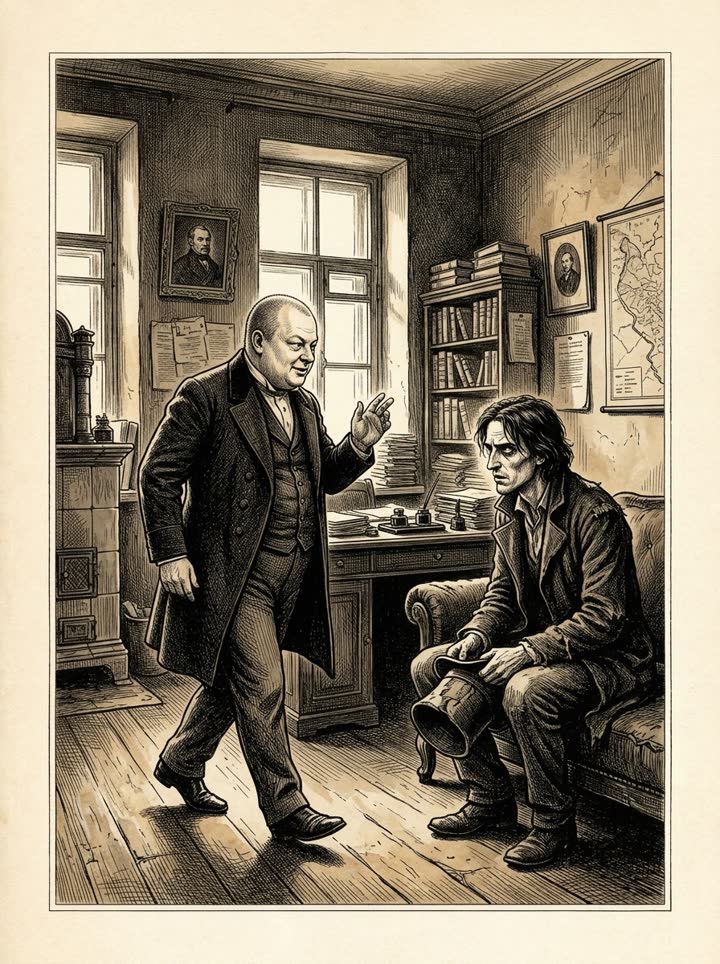
When on the next morning, at exactly eleven o'clock, Raskolnikov went into the building of the ... district police station, to the department of the examining magistrate, and asked for Porfiry Petrovich to be told of him, he was even surprised at how long they kept him waiting: at least ten minutes passed before he was called. By his reckoning they ought, it seemed, to have fallen upon him at once. Meanwhile he stood in the reception room, and people walked up and down past him who evidently had no business with him at all. In the next room, which looked like an office, several clerks sat writing, and it was obvious that not one of them had the least idea who or what Raskolnikov was. With an uneasy and suspicious look he followed everything around him, searching: was there not some guard near him, some mysterious glance appointed to watch him so that he should not slip away anywhere? But there was nothing of the kind. He saw only office faces, petty and preoccupied, and then some other people, and nobody had any need of him whatever: he might have gone off to all four corners of the earth that very minute. More and more firmly the thought took hold of him that if that mysterious man of yesterday, that apparition risen out of the ground, really knew everything and had seen everything, would they have let him, Raskolnikov, stand like this and wait calmly? And would they have waited for him here until eleven o'clock, until it pleased him to appear? It came to this: either that man had not yet informed on him, or... or else he simply knew nothing either and had seen nothing with his own eyes (and how could he have seen?), and so all of that yesterday, all that had happened to him, Raskolnikov, was again only an apparition, exaggerated by his irritated and sick imagination. This guess had begun to take hold of him even yesterday, in the midst of his worst alarms and despair. Thinking all this over now and preparing for a new battle, he suddenly felt that he was trembling, and indignation even boiled up in him at the thought that he was trembling with fear before the hateful Porfiry Petrovich. The most terrible thing for him was to meet this man again: he hated him beyond measure, endlessly, and was even afraid that his hatred might somehow betray him. And his indignation was so strong that it stopped the trembling at once. He got ready to go in with a cold and insolent air, and gave himself his word to keep as silent as possible, to look and listen, and, for this time at least, to conquer at all costs his sickly irritable nature. At that very moment he was called in to Porfiry Petrovich.
It turned out that at that moment Porfiry Petrovich was alone in his study. His study was a room neither large nor small. It held a big writing table standing before a sofa covered in oilcloth, a bureau, a cupboard in the corner and several chairs, all government furniture of polished yellow wood. In the corner of the back wall, or rather the partition, was a locked door: further on, beyond the partition, there must therefore be some other rooms. When Raskolnikov came in, Porfiry Petrovich at once closed the door by which he had entered, and they were left alone. He received his guest, apparently, with a most cheerful and friendly look, and only a few minutes later did Raskolnikov notice from certain signs a kind of embarrassment in him, as if he had suddenly been thrown off his balance or caught at something very private and secret.
"Ah, most esteemed sir! So here you are... in our parts..." Porfiry began, holding out both his hands to him. "Well, sit down, my dear fellow! Or perhaps you don't like to be called most esteemed sir and... my dear fellow, just like that, tout court? Please don't think it familiarity... Here, sir, on the little sofa."
Raskolnikov sat down, not taking his eyes off him.
"In our parts", the apology for familiarity, the little French word "tout court" and so on and so on, all these were characteristic signs. "He held out both his hands to me, but he didn't give me either one, he drew them back in time," flashed through him suspiciously. They were watching each other, but the moment their eyes met, both, quick as lightning, looked away.
"I've brought you this little paper... about the watch... here, sir. Is it written properly, or must I copy it out again?"
"What? A paper? Yes, yes... don't trouble yourself, it's exactly right, sir," said Porfiry Petrovich, as if in a hurry to be somewhere, and having said it he took the paper and looked it over. "Yes, exactly right, sir. Nothing more is needed," he confirmed in the same rapid patter, and laid the paper on the table. Then, a minute later, already talking of something else, he took it from the table again and moved it to his bureau.
"You said yesterday, I think, that you wished to ask me... formally... about my acquaintance with this... murdered woman?" Raskolnikov began again. "Why did I put in 'I think'?" flashed through him like lightning. "Why am I so troubled about having put in that 'I think'?" came another thought at once, like lightning.
And he suddenly felt that his suspiciousness, from the mere contact with Porfiry, from two words only, from two glances only, had in one instant grown to monstrous size... and that this was terribly dangerous: his nerves were getting irritated, his agitation was increasing. "Trouble! Trouble!.. I'll blurt something out again."
"Yes, yes, yes! Don't worry! There's time, there's time, sir," muttered Porfiry Petrovich, walking to and fro around the table, but somehow without any purpose, as if darting now to the window, now to the bureau, now back to the table, now avoiding Raskolnikov's suspicious glance, now suddenly stopping on the spot and looking straight at him. His small, plump, round little figure looked extraordinarily strange at this, like a ball rolling in different directions and at once bouncing off all the walls and corners.
"We'll manage, sir, we'll manage!.. Do you smoke? Have you got any? Here, sir, a little cigarette..." he went on, offering his guest a cigarette. "You know, I receive you here, but my flat is just here, behind the partition... government-owned, sir, but I'm out of it just now. Some little repairs had to be made here. It's nearly done now... a government flat, you know, is a splendid thing, eh? What do you think?"
"Yes, a splendid thing," answered Raskolnikov, looking at him almost mockingly.
"A splendid thing, a splendid thing..." repeated Porfiry Petrovich, as if suddenly lost in thought about something quite different, "yes! a splendid thing!" he almost cried out at the end, suddenly raising his eyes to Raskolnikov and stopping two paces from him. This repeated silly remark, that a government flat is a splendid thing, was in its very vulgarity too much at odds with the serious, thoughtful and enigmatic look that he now fixed on his guest.
But this only made Raskolnikov's spite boil the more, and he could not possibly hold back from a mocking and rather imprudent challenge.
"And do you know what," he asked suddenly, looking at him almost insolently and as if feeling a delight in his own insolence, "there exists, I believe, a certain legal rule, a certain legal method, for all possible examining magistrates: to begin at first from a distance, with trifles, or even with something serious but quite beside the point, so as, so to speak, to encourage or rather to distract the person being questioned, to lull his caution, and then suddenly, in the most unexpected way, to stun him on the very crown of his head with some most fatal and dangerous question. Is that so? In all the rules and instructions, I believe, this is still faithfully mentioned?"
"So, so... what, do you think I was, with the government flat, you know, hinting... eh?" And as he said this Porfiry Petrovich screwed up his eyes and winked. Something merry and sly ran over his face, the wrinkles on his forehead smoothed out, his little eyes narrowed, his features spread, and he suddenly burst into a nervous, prolonged laughter, shaking and rocking with his whole body and looking straight into Raskolnikov's eyes. Raskolnikov began to laugh himself, forcing himself a little; but when Porfiry, seeing that he was laughing too, fell into such a fit of laughter that he almost turned crimson, Raskolnikov's revulsion suddenly overcame all his caution. He stopped laughing, frowned, and for a long time stared at Porfiry with hatred, not taking his eyes off him during the whole of his long laughter, which seemed to go on on purpose. The imprudence, however, was evident on both sides: it looked as though Porfiry Petrovich was laughing in his guest's face, while the guest took this laughter with hatred, and that Porfiry was very little embarrassed by the circumstance. That last point was very significant for Raskolnikov: he understood that Porfiry Petrovich had probably not been embarrassed a moment ago either, and that, on the contrary, he, Raskolnikov, had perhaps walked into a trap; that there was plainly something here that he did not know, some purpose; that perhaps everything was already prepared and would at any moment, this very minute, be revealed and crash down on him...
He went straight to the point at once, stood up and took his cap.
"Porfiry Petrovich," he began resolutely, but with quite strong irritability, "yesterday you expressed a wish that I should come for some interrogations (he put a special stress on the word: interrogations). I have come, and if you need anything, then ask, or else allow me to withdraw. I have no time, I have business... I must be at the funeral of that same clerk who was crushed by the horses, about whom you... also know..." he added, at once growing angry at this addition, and therefore at once becoming still more irritated. "I am sick of all this, sir, do you hear, and have been for a long time... I was ill partly because of it... in a word," he almost shouted, feeling that the phrase about illness was still more out of place, "in a word: be so good as either to question me or to let me go, at once... and if you question me, then only in the proper form, sir! Otherwise I won't allow it; and so, for the time being, good-bye, since we two have nothing to do here now."
"Good Lord! What is this! What is there to question you about," Porfiry Petrovich suddenly clucked, at once changing both his tone and his look and in an instant ceasing to laugh. "Don't trouble yourself, please," he fussed, now dashing off in all directions again, now suddenly setting about seating Raskolnikov, "there's time, there's time, sir, and it's all nothing, sir! I am, on the contrary, so glad that you have finally come to us... I receive you as a guest. And for that accursed laughter, my dear Rodion Romanovich, you must forgive me. Rodion Romanovich? That is right, isn't it, your name and patronymic?.. A nervous man, sir, you made me laugh so much with the wit of your remark; sometimes, really, I shake like a rubber ball, and so for half an hour... I'm given to laughter, sir. With my build I even fear a paralytic stroke. But do sit down, what is this?.. Please, my dear fellow, or I shall think you are angry..."
Raskolnikov was silent, listening and observing, still frowning angrily. He did sit down, however, but without letting go of his cap.
"I will tell you one thing about myself, my dear Rodion Romanovich, by way of explaining my character, so to speak," Porfiry Petrovich went on, bustling about the room and, as before, seeming to avoid meeting his guest's eyes. "I am, you know, a bachelor, a man who is not of the world and not known, and what is more a finished man, a stiffened man, sir, gone to seed and... and... and have you noticed, Rodion Romanovich, that with us, that is with us in Russia, sir, and most of all in our Petersburg circles, when two clever men, not yet very well acquainted with each other but, so to speak, mutually respecting each other, as you and I do now, sir, come together, they cannot find a subject for conversation for a full half hour. They go numb before each other, they sit and are embarrassed with each other. Everyone has a subject for conversation, ladies, for example... people of the world, of the highest tone, for example, always have a topic of conversation, c'est de rigueur, it is required; but middling people like us are all shy and unconversational... thinking people, I mean. Why is this, my dear fellow, sir? Is it that we have no public interests, or are we so honest that we don't wish to deceive each other, I don't know, sir. Eh? What do you think? But do put your cap aside, sir, as if you were just about to leave, really, it's awkward to look at... I am, on the contrary, so glad, sir..."
Raskolnikov put down his cap, continuing to be silent and listening gravely, with a frown, to Porfiry's empty and muddled chatter. "What, does he really want to distract my attention with this silly chatter of his?"
"I don't offer you coffee, sir, it's not the place; but why shouldn't one sit five minutes with a friend, for diversion," Porfiry poured on without a pause, "and you know, sir, all these official duties... but you, my dear fellow, mustn't be offended that I keep walking, to and fro, sir; forgive me, my dear fellow, I'm very afraid of offending you, but exercise is simply necessary to me, sir. I sit and sit, and I'm so glad to walk about five minutes... haemorrhoids, sir... I keep meaning to cure myself with gymnastics; they say that there state councillors, actual state councillors and even privy councillors willingly skip over a rope, sir; that's how it is, science in our century, sir... yes, sir... And as for these duties here, interrogations and all this formality... you yourself, my dear fellow, just now deigned to mention interrogations, sir... so, you know, it's true, my dear Rodion Romanovich, that these interrogations sometimes muddle the questioner more than the questioned. On this you, my dear fellow, just now remarked with perfect justice and wit. (Raskolnikov had remarked nothing of the kind.) You get tangled, sir! Truly, you get tangled! And always the same thing, always the same thing, like a drum! Now there's a reform coming, and we shall at least be renamed, he-he-he! And as for our legal methods, as you wittily expressed it, I entirely agree with you, sir. Why, tell me, who among all the accused, even the very homespun peasantry, does not know that they will begin by lulling him with outside questions (to use your happy expression), and then suddenly stun him on the crown of the head, with the butt of the axe, sir, he-he-he! on the very crown, by your happy comparison, he-he! so you really thought that I meant to hint at you with the flat... he-he! What an ironical man you are. Well, I won't! Ah yes, by the way, one word calls another, one thought brings up another. You also mentioned just now the proper form, you know, in regard to a little interrogation, sir... But what's the form! Form, you know, in many cases is nonsense, sir. Sometimes you just have a friendly talk, and it pays better. Form will never go away, allow me to set you at ease on that, sir; and what is form in essence, I ask you? One cannot constrain an examining magistrate by form at every step. The examiner's business is, so to speak, a free art, in its way, sir, or something of the sort... he-he-he!.."
Porfiry Petrovich drew breath for a moment. He simply poured it out without tiring, now senselessly empty phrases, now suddenly dropping some enigmatic little word and at once sliding back again into nonsense. He was now almost running about the room, moving his fat little legs faster and faster, looking at the ground all the while, with his right hand thrust behind his back and his left continually waving and making various gestures, each time wonderfully unsuited to his words. Raskolnikov suddenly noticed that, running about the room, he seemed twice to stop for a moment near the door, as if listening... "Is he waiting for something?"
"And you are really quite right in this, sir," Porfiry took up again, looking at Raskolnikov gaily, with extraordinary simplicity (which made him start and instantly get ready), "really right, sir, to have laughed with such wit at the legal forms, he-he! These profoundly psychological methods of ours (some of them, of course) are extremely ridiculous, sir, and perhaps useless, sir, if one is too much constrained by form. Yes, sir... again about form: well, suppose I recognise or, better say, suspect somebody, one, another, a third, as a criminal, sir, in some little case entrusted to me... You are preparing for the law, are you not, Rodion Romanovich?"
"Yes, I was preparing..."
"Well then, here is, so to speak, a little example for the future, that is, don't think that I would dare to teach you: why, look what articles on crime you print! No, sir, but as a mere fact, I venture to offer an example. So if I regard, say, one, another, a third as a criminal, why, I ask, should I disturb him before the time, even if I have evidence against him, sir? One man I am bound, for example, to arrest as soon as possible, but another is not of that character, really, sir; so why not let him walk about the town a while, he-he, sir! No, I see you don't quite understand, so I'll put it more plainly, sir: if I lock him up, for example, too early, why, I may thereby give him, so to speak, a moral support, he-he! You laugh? (Raskolnikov was not thinking of laughing: he sat with his lips pressed together, not taking his inflamed gaze from Porfiry Petrovich's eyes.) And yet it is so, sir, with some subject especially, because people are many and various, sir, and over everything there is only practice, sir. You are pleased to say now: evidence; well, suppose it is evidence, sir, but evidence, my dear fellow, is for the most part two-edged, and I am an examining magistrate, and so a weak man, I confess: I should like to present an investigation, so to speak, mathematically clear, I should like to get such a bit of evidence as would look like twice two is four! As would look like direct and indisputable proof! And if I lock him up at the wrong time, even though I were sure that it was he, why, I might deprive myself of the means of exposing him further, and why? Because I should give him, so to speak, a definite position, define him psychologically, so to speak, and set him at rest, and he would slip away from me into his shell: he would understand at last that he is a prisoner. They say that in Sevastopol, right after the Alma, the clever people were terribly afraid that the enemy would attack at once with open force and take Sevastopol straight off; but when they saw that the enemy preferred a regular siege and was opening the first parallel, then, they say, the clever people were overjoyed and calmed down: it would drag on for two months at least, since when would they take it by regular siege! Again you laugh, again you don't believe? Of course you are right too. Right, sir, right, sir! These are all special cases, I agree with you; the case I put is indeed special, sir! But here is what must be observed, most excellent Rodion Romanovich: the general case, sir, the very case to which all legal forms and rules are fitted and from which they are calculated and written down in books, does not exist at all, for the very reason that every case, every one, even a crime, for example, as soon as it happens in reality, at once turns into a completely special case, sir; and sometimes into what a case: one resembling nothing that went before, sir. Quite comic cases sometimes happen of this kind, sir. Now suppose I leave some gentleman quite alone: I don't take him and don't disturb him, but let him know every hour and every minute, or at least suspect, that I know everything, the whole inside story, and watch him day and night, guard him unsleepingly, and he lives knowingly under my perpetual suspicion and fear, why, by God, his head will spin, truly, sir, he will come himself and perhaps even do something that will look like twice two, will have, so to speak, a mathematical look, which is pleasant, sir. This can happen even with a clumsy peasant, but with our brother, a clever man of the present day, and developed moreover in a certain direction, all the more! Because, my dear fellow, it is a very important thing to understand in which direction a man is developed. And nerves, sir, nerves, sir, you have quite forgotten them, sir! Why, all of them nowadays are sickly, and in a bad way, and irritated!.. And the bile, the bile in them all, how much! Why, I tell you, on occasion that is a kind of mine, sir! And what trouble is it to me that he walks about the town unbound! Let him, let him walk about for the present, let him; I know without that that he is my little victim and will not run away from me! And where could he run, he-he! Abroad, perhaps? A Pole will run abroad, but not he, the more so as I am watching, and have taken measures. Into the depths of the fatherland, perhaps? But there live peasants, real ones, homespun, Russian; and a man developed in the modern way will sooner prefer prison than live with such foreigners as our little peasants, he-he! But all this is nonsense and surface. What does it mean: run away! That is the formal part; and the main thing is not that; it is not only because he has nowhere to run that he won't run away from me: he won't run away from me psychologically, he-he! What an expression! By a law of nature he won't run away from me, even if there were somewhere to run. Have you seen a moth before a candle? Well, so he will go on and on circling around me as around a candle; freedom will lose its charm, he will begin to brood, to get tangled, will tangle himself all around as in nets, will worry himself to death!.. And more than that: he will himself prepare me some mathematical little thing, like twice two, if only I give him a longer interval... And he will go on and on making circles about me, narrowing and narrowing the radius, and, flop! He'll fly straight into my mouth, and I'll swallow him, sir, and that is very pleasant, sir, he-he-he! You don't believe it?"
Raskolnikov did not answer; he sat pale and motionless, still gazing with the same strain into Porfiry's face.
"A good lesson!" he thought, turning cold. "This is not even a cat and mouse, as it was yesterday. And he is not showing me his power for nothing and... hinting: he is far too clever for that! There is another purpose here, but what? Oh, nonsense, brother, you are frightening me and being cunning! You have no proofs, and the man of yesterday does not exist! You simply want to muddle me, to irritate me prematurely, and crush me in that state, only you're lying, you'll slip, you'll slip! But why, why hint to me to such a degree?.. Are you counting on my sick nerves?.. No, brother, you're lying, you'll slip, though you have prepared something... Well, we shall see what it is that you've prepared there."
And he braced himself with all his strength, getting ready for some terrible, unknown catastrophe. At moments he wanted to throw himself on Porfiry and strangle him on the spot. He had feared this malice even as he came in. He felt that his lips were dry, his heart was pounding, foam had caked on his lips. But he still resolved to be silent and not to utter a word before the time. He understood that this was the best tactic in his position, because not only would he not blurt anything out, but, on the contrary, he would irritate the enemy himself by his silence, and the enemy might perhaps blurt something out to him. At least he hoped so.
"No, I see you don't believe it, sir, you think I'm just playing innocent little jokes on you," Porfiry took up, growing gayer and gayer and giggling continually with pleasure, and again beginning to circle about the room. "Of course, you are right, sir; my figure is so made by God that it rouses only comic thoughts in others; a buffoon, sir; but I'll tell you this, and say again, that you, my dear Rodion Romanovich, forgive an old man, are still a young man, sir, in your first youth, so to speak, and therefore you value human intellect above all, following the example of all the young. The playful sharpness of wit and the abstract arguments of reason tempt you, sir. And it's exactly like the old Austrian Court War Council, for example, as far as I can judge military events: on paper they beat Napoleon and took him prisoner, and calculated and summed up everything in their cabinet in the wittiest manner, and then you look, and General Mack surrenders with his whole army, he-he-he! I see, I see, my dear fellow Rodion Romanovich, you are laughing at me, that I, such a civilian, keep picking my little examples from military history. But what's to be done, it's a weakness, I love military matters, and I so love reading all those military reports... decidedly I missed my career. I ought to have served in the army, sir, really, sir. I might not have become a Napoleon, but I would have been a major, sir, he-he-he! Well, sir, so now I'll tell you the whole detailed truth, my dear, about that special case, I mean: reality and nature, my dear sir, are an important thing, and how they sometimes cut across the most far-sighted calculation! Hey, listen to an old man, I speak seriously, Rodion Romanovich (as he said this Porfiry Petrovich, who was hardly thirty-five, really seemed suddenly to grow old all over: even his voice changed, and he somehow stooped all over), and besides, I am a frank man, sir... Am I a frank man or not? What do you think? It seems quite so: such things I tell you for nothing, and don't even ask a reward for it, he-he! Well, so, sir, I continue, sir: wit, in my opinion, is a magnificent thing, sir; it is, so to speak, nature's adornment and the comfort of life, and what tricks it can play, it seems, so that how can some poor little examining magistrate guess it sometimes, who is, besides, himself carried away by his fancy, as always happens, because he is a man too, sir! But the nature of the poor little magistrate comes to his rescue, sir, that's the trouble! And of this the youth carried away by wit, "stepping over all obstacles" (as you most wittily and cunningly deigned to express it), doesn't think. He may lie, that is, the man, the special case, sir, the incognito, sir, and lie excellently, in the most cunning manner; here, it seems, is the triumph, enjoy the fruits of your wit, and he, flop! at the most interesting, the most scandalous point, faints. Granted, illness, or stuffiness in rooms sometimes, but still, sir! Still, he has put an idea into someone's head! He lied incomparably, but he could not reckon on nature. There is the treachery, sir! Another time, carried away by the playfulness of his wit, he'll begin to make a fool of the man who suspects him, will turn pale as if on purpose, as if in play, but will turn pale too naturally, too like the truth, and again he has put the idea into someone's head! Though he cheats him the first time, the other will think it over during the night, if he is no fool himself. And at every step like that, sir! And what's more: he will begin to run ahead of himself, to poke himself in where he isn't asked, to talk incessantly of what, on the contrary, he should be silent about, to drop various allegories, he-he! He'll come himself and begin to ask: why are they so long in taking me? he-he-he! And this can happen to the wittiest man, to a psychologist and man of letters, sir! Nature is a mirror, sir, the most transparent one, sir! Look into it and admire, that's what, sir! But why have you turned so pale, Rodion Romanovich, isn't it stuffy for you, shall I open the little window?"
"Oh, don't trouble, please," cried Raskolnikov, and suddenly burst out laughing, "please don't trouble!"
Porfiry stopped in front of him, waited, and suddenly himself burst out laughing after him. Raskolnikov got up from the sofa, abruptly cutting short his own quite hysterical laughter.
"Porfiry Petrovich!" he said loudly and distinctly, though he could hardly stand on his trembling legs, "I see clearly at last that you positively suspect me of the murder of that old woman and her sister Lizaveta. For my part, I declare to you that I have long been sick of all this. If you find that you have the right to prosecute me lawfully, then prosecute; to arrest me, then arrest. But I will not allow you to laugh in my face and torment me."
Suddenly his lips trembled, his eyes blazed with fury, and his voice, held in till now, rang out.
"I will not allow it, sir!" he cried suddenly, striking the table with his fist with all his might. "Do you hear that, Porfiry Petrovich? I will not allow it!"
"Ah, Lord, what is this again!" cried Porfiry Petrovich, in apparently complete fright. "My dear fellow! Rodion Romanovich! My dear one! Father! What is the matter with you?"
"I will not allow it!" Raskolnikov cried a second time.
"My dear fellow, softer! They will hear, they'll come! Well, what shall we tell them then, think!" whispered Porfiry Petrovich in horror, bringing his face close up to Raskolnikov's face.
"I will not allow it, I will not allow it!" Raskolnikov repeated mechanically, but also suddenly in a perfect whisper.
Porfiry turned quickly away and ran to open the window.
"Let in some air, fresh air! And you ought to drink some water, my dear fellow, why, this is a fit, sir!" And he was about to rush to the door to order water, but just then a decanter of water was found in the corner, conveniently.
"My dear fellow, drink," he whispered, rushing up to him with the decanter, "perhaps it will help..." Porfiry Petrovich's fright and his very sympathy were so natural that Raskolnikov fell silent and began to examine him with wild curiosity. He did not take the water, however.
"Rodion Romanovich! dear one! why, you will drive yourself out of your mind like this, I assure you, ah-ah! Oh! Drink it! Drink at least a little!"
He did manage to make him take the glass of water in his hand. Raskolnikov mechanically raised it to his lips, but, coming to himself, set it down on the table with disgust.
"Yes, sir, we have had a little fit, sir! Like this, my dear fellow, you will bring back your old illness again," Porfiry Petrovich clucked with friendly sympathy, though still with a somewhat bewildered air. "Lord! But how can one not take care of oneself like this? Dmitri Prokofich came to me yesterday, too, I agree, I agree, sir, that I have a caustic, nasty character, but look what they drew from it!.. Lord! He came yesterday, after you, we dined, he talked and talked, I could only spread my hands; well, I think... ah, Lord! Did he come from you? But do sit down, my dear fellow, sit down for Christ's sake!"
"No, not from me! But I knew that he had gone to you and why he went," Raskolnikov answered sharply.
"You knew?"
"I knew. Well, what of it?"
"Why this, my dear fellow Rodion Romanovich, that I know even more of your exploits than that; I am informed of everything, sir! Why, I know how you went to take the flat, towards nightfall, when it had grown dark, and began to ring the bell, and asked about the blood, and confused the workmen and yardkeepers. Why, I understand your state of mind, that one then... but still, like this you will simply drive yourself mad, by God, sir! You'll spin yourself dizzy! The indignation in you boils up too strongly, sir, a noble one, sir, at the offences received, first from fate and then from the district officers, and so you rush this way and that, so as, so to speak, to make everyone speak out as soon as possible and so finish everything at once, because you are tired of these stupidities and all these suspicions. Isn't it so? Have I guessed the mood, sir?.. Only like this you will set not only yourself but Razumikhin too spinning; why, he is too good a man for that, you know yourself. You have illness, and he has virtue, and your illness turns out to be catching for him... I'll tell you, my dear fellow, when you calm down... but do sit down, my dear fellow, for Christ's sake! Please, rest, you look like death; do sit down."
Raskolnikov sat down; his shaking was passing, and heat came out over his whole body. In deep amazement he listened intently to the frightened Porfiry Petrovich, who was fussing over him in a friendly way. But he did not believe a single word of his, though he felt some strange inclination to believe. Porfiry's unexpected words about the flat completely struck him. "How is this, then, he knows about the flat?" it suddenly occurred to him, "and tells me himself!"
"Yes, sir, there was almost exactly such a case, a psychological one, in our judicial practice, sir, a sickly case, sir," Porfiry went on in a patter. "Another man also accused himself falsely of a murder, sir, and how he did it: he devised a whole hallucination, presented facts, told circumstances, muddled and confused everyone, and why? He himself, quite unintentionally, was partly the cause of the murder, but only partly, and when he learned that he had given the murderers occasion, he fell into melancholy, grew confused, began to imagine things, was quite unhinged, and convinced himself that he was the murderer! But the Governing Senate at last examined the case, and the unfortunate man was acquitted and placed under care. Thanks to the Governing Senate! Oh dear, oh dear, oh dear! But what is this, my dear fellow? Like this you can get a brain fever, when such inclinations to irritate your nerves appear, going at night to ring bells and ask about blood! This psychology I have studied entirely in practice, sir. Sometimes a man is drawn to leap from a window or a bell tower, and the sensation is so tempting. And bells too, sir... Illness, Rodion Romanovich, illness! You have begun to neglect your illness too much, sir. You should consult an experienced doctor, and what is that fat one of yours!.. You are in delirium! All this you simply do in delirium!.."
For a moment everything whirled round Raskolnikov.
"Can it be, can it be," flashed in him, "that he is lying even now? Impossible, impossible!" He pushed this thought away from him, feeling beforehand to what degree of rage and fury it might bring him, feeling that he might go mad with fury.
"It was not in delirium, it was in reality!" he cried, straining all the forces of his reason to penetrate Porfiry's game. "In reality, in reality! Do you hear?"
"Yes, I understand and hear, sir! You said yesterday too that it was not in delirium, you even insisted specially that it was not in delirium! All that you can say, I understand, sir! Oh!.. But listen, Rodion Romanovich, my benefactor, take this very circumstance. Why, if you were really, in fact, guilty or somehow mixed up in this accursed affair, would you, for pity's sake, insist yourself that you did all this not in delirium but, on the contrary, fully conscious? And insist specially, with such stubbornness, so specially, insist, well, could it be, could it be, for pity's sake? Why, quite the contrary, in my opinion. For if you felt anything on your conscience, you precisely ought to insist: that it was certainly in delirium! Is that so? Isn't it so?"
Something sly was heard in this question. Raskolnikov shrank back against the very back of the sofa from Porfiry, who was leaning towards him, and in silence, point-blank, in bewilderment, examined him.
"Or take Mr. Razumikhin, that is, whether he came yesterday to speak on his own account or at your instigation? Why, you precisely ought to say that he came of himself, and conceal that it was at your instigation! And yet you don't conceal it! You precisely insist that it was at your instigation!"
Raskolnikov had never insisted on this. A chill went down his spine.
"You are lying all the time," he said slowly and weakly, his lips twisted into a sickly smile, "you want to show me again that you know my whole game, know all my answers beforehand," he said, almost feeling himself that he was no longer weighing his words as he should, "you want to frighten me... or simply laugh at me..."
He went on staring at him point-blank as he said this, and suddenly again boundless malice flashed in his eyes.
"You are lying all the time!" he cried. "You know perfectly well yourself that the best dodge for a criminal is to conceal as little as possible of what can be left unconcealed. I don't believe you!"
"What a slippery fellow you are!" Porfiry giggled. "There's no managing you, my dear fellow; some monomania has settled in you. So you don't believe me? But I tell you that you already believe, you already believe by a quarter of an arshin, and I'll make you believe by the whole arshin, because I truly love you and sincerely wish you well."
Raskolnikov's lips trembled.
"Yes, sir, I wish you well, I tell you finally, sir," he went on, lightly, in a friendly way, taking Raskolnikov by the arm a little above the elbow, "I tell you finally, sir: look after your illness. Besides, your family has come to you now; remember them. You must soothe and cherish them, and you only frighten them..."
"What is it to you? How do you know it? Why do you take such an interest? So you are watching me and want to show me this?"
"My dear fellow! Why, I learned everything from you, from yourself! You don't notice that in your agitation you tell everything beforehand yourself, both to me and to others. From Mr. Razumikhin, Dmitri Prokofich, too, I learned yesterday many interesting details. No, sir, you interrupted me, but I will say that through your suspiciousness, with all your wit, you have even lost a sound view of things. Well, take, for example, the same subject again, about the bells: such a treasure, such a fact (a whole fact, sir!), I simply handed it over to you whole, I, the examining magistrate! And you see nothing in that? If I suspected you even a little, was that how I should have acted? On the contrary, I ought first to have lulled your suspicions, and given no sign that I already knew this fact; to have drawn you off in the opposite direction, and then suddenly, like a blow on the crown (by your own expression), to stun you: 'And what, my dear sir, were you doing in the murdered woman's flat at ten o'clock in the evening, and perhaps nearly eleven? And why did you ring the bell? And why did you ask about the blood? And why did you confuse the yardkeepers and call them to the station, to the district lieutenant?' That is how I ought to have acted if I had had even a drop of suspicion of you. I ought to have taken your deposition in full form, made a search, and perhaps even arrested you... So I do not harbour suspicions of you, since I acted otherwise! But you have lost your sound view and see nothing, I repeat, sir!"
Raskolnikov shuddered all over, so that Porfiry Petrovich noticed it all too clearly.
"You are lying all the time!" he cried. "I don't know your aims, but you are lying all the time... A while ago you did not speak in this sense, and I cannot be mistaken... You are lying!"
"I am lying?" Porfiry took up, apparently getting hot, but keeping a most merry and mocking look, and seemingly not in the least troubled by what opinion Mr. Raskolnikov had of him. "I am lying?.. But how did I act with you a while ago (I, the examining magistrate), prompting you myself and handing you every means of defence, myself supplying you with all this psychology: 'Illness, you see, delirium, he was offended, melancholy and the district officers,' and all the rest? Eh? he-he-he! Though, by the way, I may say, all these psychological means of defence, excuses and dodges, are extremely unsound, and two-edged: 'Illness, you see, delirium, dreams, it seemed to me, I don't remember,' all that is so, sir, but why, my dear fellow, in illness and delirium do just such dreams appear, and not others? Others might have appeared, sir? Isn't that so? He-he-he-he!"
Raskolnikov looked at him proudly and with contempt.
"In a word," he said insistently and loudly, getting up and somewhat pushing Porfiry aside as he did so, "in a word, I want to know: do you acknowledge me finally free from suspicion or not? Speak, Porfiry Petrovich, speak positively and finally, and quickly, now!"
"What a trial! Well, you really are a trial!" cried Porfiry with a perfectly merry, sly and not at all troubled look. "And why must you know, why must you know so much, when they haven't begun to trouble you at all yet! Why, you are like a child: give it me, put the fire in my hands! And why do you worry so? Why do you yourself force yourself on us so, for what reasons? Eh? he-he-he!"
"I repeat to you," cried Raskolnikov in fury, "that I cannot bear any longer..."
"What, sir? The uncertainty?" Porfiry interrupted.
"Don't sting me! I don't want it!.. I tell you that I don't want it!.. I can't and I won't!.. Do you hear! Do you hear!" he cried, striking the table again with his fist.
"But quieter, quieter! They will hear! I warn you seriously: take care of yourself. I am not joking, sir!" whispered Porfiry, but this time there was no longer in his face the womanish good-natured and frightened expression of a while ago; on the contrary, he was now giving a plain order, sternly, with knitted brows, and as if at once breaking through all the secrets and ambiguities. But this was only for a moment. Raskolnikov, who had been taken aback, suddenly fell into real frenzy; but, strangely, he again obeyed the order to speak more quietly, though he was in the most violent paroxysm of fury.
"I will not let myself be tormented!" he suddenly whispered, as before, instantly realising with pain and hatred that he could not help obeying the order, and growing still more furious at this thought. "Arrest me, search me, but be so good as to act in proper form, and not play with me, sir! Don't dare..."
"But don't worry about form," Porfiry interrupted with the same sly smile and as if even admiring Raskolnikov with enjoyment, "I invited you now, my dear fellow, in a homely way, quite in a friendly way!"
"I don't want your friendship and I spit on it! Do you hear? And here: I take my cap and go. Well, what will you say now, if you intend to arrest me?"
He seized his cap and went to the door.
"And wouldn't you like to see the little surprise?" Porfiry giggled, again catching him by the arm a little above the elbow and stopping him at the door. He was visibly growing merrier and more playful, which finally drove Raskolnikov beside himself.
"What little surprise? What is it?" he asked, suddenly stopping and looking at Porfiry with fear.
"A little surprise, sir, here, sitting behind my door, he-he-he! (He pointed his finger at the locked door in the partition, which led to his government flat.) I even locked it so that he shouldn't run away."
"What is it? where? what?.." Raskolnikov went up to the door and wanted to open it, but it was locked.
"Locked, sir, and here is the key!"
And in fact he showed him a key, taking it out of his pocket.
"You are lying all the time!" howled Raskolnikov, no longer restraining himself. "You lie, you accursed Punchinello!" and he threw himself on Porfiry, who retreated to the door but was not at all frightened.
"I understand everything, everything!" he sprang up to him. "You lie and tease me so that I'll give myself away..."
"But one can't give oneself away any more than that, my dear fellow Rodion Romanych. Why, you have fallen into a frenzy. Don't shout, or I'll call my people in, sir!"
"You lie, nothing will come of it! Call them in! You knew that I was ill and wanted to irritate me, to fury, so that I'd give myself away, that is your aim! No, give me facts! I've understood everything! You have no facts, you have only wretched, worthless guesses, Zametov's kind!.. You knew my character, you wanted to bring me to frenzy and then suddenly stun me with priests and deputies... Are you waiting for them? eh? What are you waiting for? Where are they? Produce them!"
"But what deputies, my dear fellow! The things a man can imagine! Why, one can't act in form like that, as you say, you don't know the business, my dear... And form won't go away, sir, you will see!.." muttered Porfiry, listening at the door.
Indeed, at that moment there seemed to be a noise in the other room, right by the door.
"Ah, they are coming!" cried Raskolnikov. "You sent for them!.. You were waiting for them! You calculated... Well, bring them all in here: deputies, witnesses, whatever you like... bring them! I am ready! ready!.."
But here a strange event occurred, something so unexpected, in the ordinary course of things, that of course neither Raskolnikov nor Porfiry Petrovich could have reckoned on such a conclusion.