
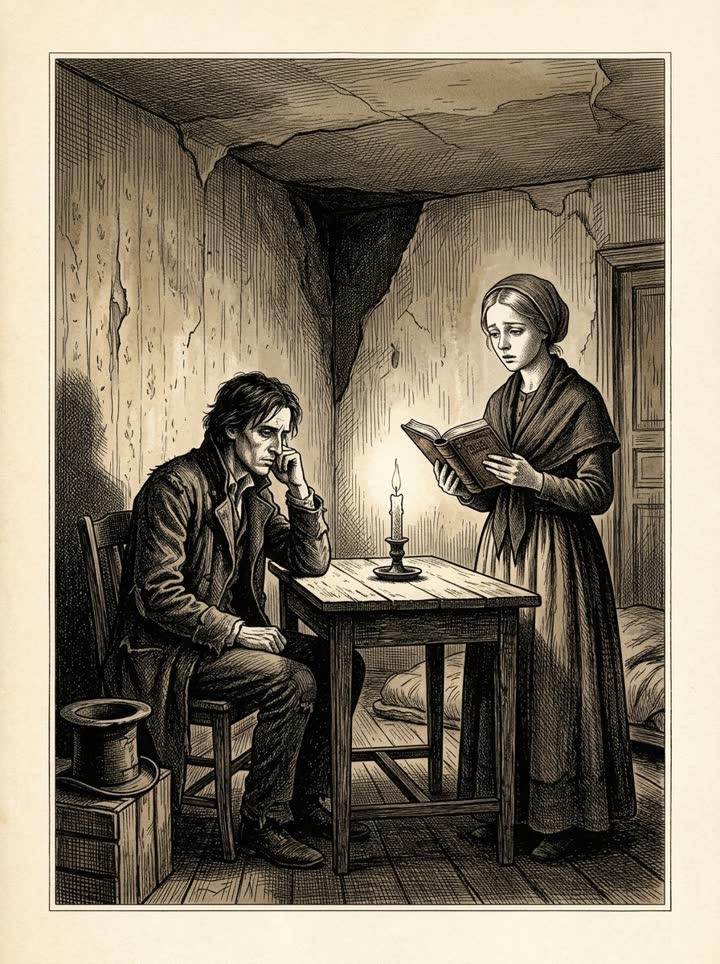
And Raskolnikov went straight to the house on the canal where Sonya lived. It was a three-storeyed house, old and painted green. He tracked down the yardkeeper and got from him some vague directions as to where Kapernaumov the tailor lived. Having found, in a corner of the yard, the entrance to a narrow, dark staircase, he climbed at last to the second floor and came out on a gallery that ran round it on the side facing the yard. While he wandered in the dark, puzzled where the entrance to Kapernaumov's could be, suddenly, three paces from him, a door opened; he caught hold of it mechanically.
"Who's there?" a woman's voice asked anxiously.
"It's I... to see you," answered Raskolnikov, and he went into a tiny entry. There, on a broken-down chair, in a bent copper candlestick, stood a candle.
"It's you! Good God!" Sonya cried weakly, and stood rooted to the spot.
"Which way to your room? This way?"
And Raskolnikov, trying not to look at her, passed quickly into the room.
A minute later Sonya came in too, with the candle, set the candle down and stood herself before him, quite lost, in inexpressible agitation and evidently frightened by his unexpected visit. Suddenly the colour rushed into her pale face, and even tears came to her eyes... She felt sick, and ashamed, and sweet... Raskolnikov turned away quickly and sat down on a chair by the table. In passing he managed to take in the room at a glance.
It was a large room, but extremely low, the only one sublet by the Kapernaumovs, whose locked door was in the wall on the left. On the opposite side, in the right-hand wall, there was another door, always fastened tight. Beyond it was another, neighbouring apartment, under a different number. Sonya's room looked rather like a barn; it was a very irregular quadrilateral, and that gave it something ugly. The wall with three windows, which looked out on the canal, cut across the room somehow aslant, so that one corner, terribly acute, ran off somewhere into the depths, so that in the weak light one could not even make it out properly; the other corner was too hideously obtuse. In all this large room there was almost no furniture at all. In the corner on the right was a bed; beside it, nearer the door, a chair. Along the same wall as the bed, close to the door into the strangers' apartment, stood a plain deal table covered with a blue cloth; beside the table two wicker chairs. Then, by the opposite wall, near the acute corner, stood a small chest of drawers of plain wood, as if lost in the emptiness. That was all there was in the room. The yellowish, scuffed and worn wallpaper had turned black in all the corners; it must have been damp here, and full of fumes, in winter. The poverty was plain to see; even the bed had no curtains.
Sonya silently looked at her guest, who was examining her room so attentively and unceremoniously, and at last even began to tremble with fear, as though she stood before a judge, the arbiter of her fate.
"I'm late... Is it eleven o'clock?" he asked, still not raising his eyes to her.
"Yes," Sonya muttered. "Oh yes, it is!" she hurried suddenly, as though everything for her depended on it. "The landlord's clock has just struck... and I heard it myself... It is."
"I've come to you for the last time," Raskolnikov went on gloomily, although it was in fact only the first, "perhaps I shall not see you any more..."
"You are... going away?"
"I don't know... everything tomorrow..."
"Then you won't be at Katerina Ivanovna's tomorrow?" Sonya's voice trembled.
"I don't know. Everything tomorrow morning... That's not the point: I came to say one word..."
He raised his thoughtful gaze to her and suddenly noticed that he was sitting while she was still standing before him.
"Why are you standing? Sit down," he said, suddenly, in a changed voice, quiet and gentle.
She sat down. He looked at her kindly and almost with compassion for a minute.
"How thin you are! Look at your hand! Quite transparent. Fingers like a dead woman's."
He took her hand. Sonya smiled faintly.
"I've always been like that," she said.
"Even when you lived at home?"
"Yes."
"Well, of course!" he said abruptly, and the expression of his face and the sound of his voice changed again suddenly. He looked round the room once more.
"You rent this from Kapernaumov?"
"Yes, sir..."
"They are there, behind the door?"
"Yes... They have a room just like this."
"All in one room?"
"In one, sir."
"I should be afraid in your room at night," he remarked gloomily.
"The landlords are very good, very kind," answered Sonya, still as though she had not come to herself and could not collect her thoughts, "and all the furniture, and everything... everything is the landlords'. And they are very kind, and the children come to me often too..."
"The ones who stammer?"
"Yes, sir... He stammers, and he's lame too. And his wife too... Not that she stammers, but she can't seem to get all her words out. She's kind, very. And he was a house serf once. And there are seven children... and only the eldest one stammers, and the others are just sickly... but they don't stammer... But how do you know about them?" she added with some surprise.
"Your father told me everything then. He told me everything about you... And how you went out at six o'clock and came back after eight, and how Katerina Ivanovna knelt by your bed."
Sonya was confused.
"I seemed to see him today," she whispered hesitantly.
"Whom?"
"Father. I was walking along the street, near here, at the corner, past nine o'clock, and he seemed to be walking ahead of me. It was exactly as if it were he. I was just going to go in to Katerina Ivanovna..."
"You were out walking?"
"Yes," Sonya whispered abruptly, confused again and looking down.
"Katerina Ivanovna almost beat you, at your father's, didn't she?"
"Oh no, what are you saying, what are you saying, no!" Sonya looked at him with something like fright.
"So you love her?"
"Her? Why, ho-o-ow could I not!" Sonya drew out the words piteously, and suddenly clasped her hands in suffering. "Ah! You... about her... If only you knew. She is just like a child... Her mind is quite unhinged... from grief. And how clever she was... how generous... how kind! You know nothing, nothing... ah!"
Sonya said this as though in despair, agitated and suffering, wringing her hands. Her pale cheeks flushed again, and torment showed in her eyes. One could see that something in her had been touched terribly deeply, that she longed terribly to express something, to say it, to stand up for her. A kind of insatiable compassion, if one may put it so, suddenly showed in all the features of her face.
"Beat me! What are you saying! Good God, beat me! And even if she did beat me, what of it! Well, what of it? You know nothing, nothing... She is so unhappy, ah, so unhappy! And ill... She seeks justice... She is pure. She believes so, that there must be justice in everything, and she demands it... And you may torture her, but she will not do an unjust thing. She doesn't notice herself how it's impossible for everything among people to be just, and she gets irritated... Like a child, like a child! She is just, she is just!"
"And what will happen to you?"
Sonya looked at him questioningly.
"They've been left on your hands. It's true, everything was on you before too, and the late man used to come to you to ask for money for his hangover. Well, and now what will happen?"
"I don't know," Sonya said sadly.
"Will they stay there?"
"I don't know, they owe money on that apartment; only the landlady, I hear, said today that she wants to turn them out, and Katerina Ivanovna says that she herself won't stay a minute."
"Why does she put on such a brave face? Does she rely on you?"
"Ah no, don't say that!.. We live as one, together," Sonya suddenly became agitated again and even irritated, exactly as an angry canary or some other little bird might. "And what is she to do? Well, what, what is she to do?" she asked, growing hot and agitated. "And how much, how much she cried today! Her mind is going, haven't you noticed? It is going; one moment she's anxious, like a little child, that everything should be proper tomorrow, that there should be the snacks and everything... the next she wrings her hands, coughs blood, weeps, suddenly begins to knock her head against the wall, as if in despair. And then she is comforted again, she pins all her hopes on you: she says that you are now her helper and that she will borrow a little money somewhere and go to her own town, with me, and open a boarding school for gentlewomen's daughters, and take me as a supervisor, and a completely new, beautiful life will begin for us, and she kisses me, embraces me, comforts me, and she really believes it! really believes these fancies! Well, how can one contradict her? And all day today she herself has been washing, cleaning, mending, she dragged the tub into the room herself, with her poor weak strength, and was out of breath, and simply fell on the bed; and then this morning we went with her to the shops to buy shoes for Polechka and Lena, because theirs have all fallen to pieces, only we didn't have enough money by our reckoning, a great deal too little, and she chose such pretty little boots, because she has taste, you don't know... Right there in the shop she burst into tears, in front of the merchants, because there wasn't enough... Ah, it was so pitiful to see."
"Well, after that it's understandable that you... live as you do," said Raskolnikov with a bitter smile.
"And aren't you sorry for them? Aren't you sorry?" Sonya flared up again. "Why, you, I know, you gave your last money yourself, before you had seen anything. And if you had seen everything, oh God! And how many, how many times I have brought her to tears! Why, only last week! Oh, I! Only a week before his death. I behaved cruelly! And how many, how many times I have done it. Ah, how painful it has been to remember it all day today!"
Sonya even wrung her hands as she spoke, from the pain of the memory.
"You, cruel?"
"Yes, I, I! I came then," she went on, weeping, "and the late man said: 'Read to me, Sonya,' he says, 'my head aches somehow, read to me... here's a little book,' some book he had, he'd got it from Andrei Semyonovich, from Lebezyatnikov, who lives here, he was always getting hold of such funny books. And I said: 'It's time for me to go,' and so I didn't want to read, and I had looked in on them chiefly to show Katerina Ivanovna some collars; Lizaveta, the pedlar woman, had brought me collars and cuffs cheap, pretty ones, new, with a pattern. And Katerina Ivanovna liked them very much, she put them on and looked at herself in the mirror, and she liked them very, very much: 'Give them to me, Sonya,' she says, 'please.' She said please, and she wanted them so much. And where could she wear them! It was just that she remembered the old, happy times! She looks at herself in the mirror, admires herself, and she has no dresses at all, no things at all, for so many years now! And she never asks anything of anyone; she is proud, she would sooner give away her last, and here she asked, she liked them so much! And I grudged giving them, 'What do you want them for, Katerina Ivanovna?' I said. Just so, 'what for.' I ought never to have said that to her! She looked at me so, and it hurt her so, so much that I refused, and it was so pitiful to see... And it hurt her not for the collars, but because I refused, I saw that. Ah, how I would like now to bring it all back, to undo it all, all those words of before... Oh, I... but what!.. it's all the same to you!"
"You knew this Lizaveta, the pedlar woman?"
"Yes... Did you know her?" Sonya asked back with some surprise.
"Katerina Ivanovna has consumption, a bad kind; she will die soon," said Raskolnikov, after a silence, not answering the question.
"Oh no, no, no!" And Sonya, with an unconscious gesture, seized both his hands, as if begging that it should not be so.
"But it would be better if she died."
"No, not better, not better, not better at all!" she repeated in fright, without knowing why.
"And the children? Where will you take them then, if not to yourself?"
"Oh, I don't know!" cried Sonya, almost in despair, and clutched her head. One could see that this thought had flashed through her many, many times, and he had only startled it again.
"Well, and if you, while Katerina Ivanovna is still alive, now fall ill and are taken to the hospital, what will happen then?" he insisted pitilessly.
"Ah, what are you saying, what are you saying! That cannot be!" and Sonya's face was twisted with terrible fear.
"How can it not be?" Raskolnikov went on with a harsh smile. "You're not insured, are you? Then what will become of them? They'll all go out on the street in a crowd, she will cough and beg, and knock her head against some wall, as she did today, and the children will cry... And then she will fall down, they'll take her to the police station, to the hospital, she will die, and the children..."
"Oh no!.. God will not allow it!" burst at last from Sonya's constricted breast. She listened, looking at him imploringly and clasping her hands in dumb entreaty, as though everything depended on him.
Raskolnikov got up and began to walk about the room. A minute passed. Sonya stood with her arms and head lowered, in terrible anguish.
"And can't you save? Put something aside for a rainy day?" he asked, suddenly stopping before her.
"No," whispered Sonya.
"Of course not! But have you tried?" he added almost mockingly.
"I have."
"And it fell through! Well, of course! What is there to ask!"
And again he walked about the room. Another minute passed.
"You don't get paid every day, do you?"
Sonya was more confused than before, and the colour struck her face again.
"No," she whispered with a painful effort.
"It will certainly be the same with Polechka," he said suddenly.
"No! no! It cannot be, no!" Sonya cried out loudly, like one in despair, as though she had been suddenly stabbed with a knife. "God, God will not allow such a horror!.."
"He allows it to others."
"No, no! God will protect her, God!.." she repeated, beside herself.
"Yes, but perhaps there is no God at all," Raskolnikov answered with a sort of malicious pleasure, laughed and looked at her.
Sonya's face suddenly changed terribly: convulsions ran across it. With inexpressible reproach she looked at him, tried to say something, but could not utter a word, and only suddenly sobbed bitterly, bitterly, covering her face with her hands.
"You say Katerina Ivanovna's mind is going; your own mind is going," he said after a silence.
Five minutes passed. He kept walking up and down, silent and not looking at her. At last he went up to her; his eyes glittered. He took her by the shoulders with both hands and looked straight into her weeping face. His look was dry, feverish, sharp, his lips quivered violently... Suddenly he bent quickly down all the way and, dropping to the floor, kissed her foot. Sonya drew back from him in horror, as from a madman. And indeed he looked quite mad.
"What are you doing, what is this? Before me!" she muttered, turning pale, and her heart was suddenly squeezed painfully, painfully.
He stood up at once.
"I did not bow down to you, I bowed down to all human suffering," he said somehow wildly and walked away to the window. "Listen," he added, coming back to her after a minute, "I said to an insulter a little while ago that he was not worth one of your little fingers... and that I did my sister an honour today by seating her beside you."
"Ah, why did you say that to them! And in her presence?" Sonya cried out in fright. "Sit with me! An honour! Why, I am... dishonourable... I am a great, great sinner! Ah, why did you say that!"
"It was not for your dishonour and sin that I said it about you, but for your great suffering. And that you are a great sinner, that is so," he added almost ecstatically, "and most of all you are a sinner because you killed and betrayed yourself for nothing. How can that not be a horror! How can it not be a horror that you live in this filth that you so hate, and at the same time know yourself (you have only to open your eyes) that you help no one by it and save no one from anything! But tell me, tell me at last," he said, almost in frenzy, "how such shame and such baseness can exist in you side by side with other, opposite and holy feelings? It would be more just, a thousand times more just and more sensible, to go headlong into the water and make an end of it at once!"
"But what would become of them?" Sonya asked weakly, looking at him with suffering, but at the same time as if not at all surprised by his suggestion. Raskolnikov looked at her strangely.
He read everything in a single glance of hers. So she herself really had already had this thought. Perhaps, in despair, she had many times and seriously considered how to make an end of it at once, and so seriously that now she was almost not surprised at his suggestion. She did not even notice the cruelty of his words (the sense of his reproaches and his peculiar view of her shame she of course did not notice either, and this was plain to him). But he understood fully to what monstrous pain she had been tormented, and for a long time, by the thought of her dishonourable and shameful position. What, what could it be, he thought, that had held back her resolution up to now to make an end of it at once? And only here did he fully understand what these poor little orphan children and this pitiful, half-mad Katerina Ivanovna, with her consumption and her knocking of her head against the wall, meant to her.
But all the same it was again clear to him that Sonya, with her character and with the sort of education she had nevertheless received, could in no case stay as she was. It was still a question to him: how could she remain so very long in such a position and not go out of her mind, if she had not the strength to throw herself into the water? Of course he understood that Sonya's position was an accidental phenomenon in society, though unfortunately far from being solitary and exceptional. But this very accident, this education of hers, such as it was, and her whole previous life might, it seemed, have killed her at once at the first step on this loathsome road. What held her up? Not debauchery? This shame had evidently touched her only mechanically; real debauchery had not yet penetrated with a single drop into her heart: he saw it; she stood before him in the flesh...
"She has three roads," he thought: "to throw herself into the canal, to end in the madhouse, or... or, finally, to throw herself into debauchery, which stupefies the mind and turns the heart to stone." The last thought was the most loathsome to him; but he was already a sceptic, he was young, abstract and therefore cruel, and so he could not help believing that the last way out, that is, debauchery, was the most probable.
"But can it be true," he exclaimed to himself, "can it be true that this creature, who still keeps her purity of spirit, will at last consciously be drawn into this foul, stinking pit? Can it be that this drawing in has already begun, and that she has been able to endure until now only because vice no longer seems so loathsome to her? No, no, it cannot be!" he exclaimed, as Sonya had a little while ago, "no, what has held her back from the canal until now is the thought of sin, and they, those... And if she has not yet gone out of her mind... But who says that she has not gone out of her mind already? Is she in her right mind? Can one talk as she does? Can one in one's right mind reason as she does? Can one sit over one's ruin, right over the stinking pit that is already drawing her in, and wave one's hands, and stop one's ears when she is told of the danger? What is she doing, is she waiting for a miracle? Surely so. Aren't all these signs of madness?"
He fixed stubbornly on this thought. This way out even pleased him more than any other. He began to look at her more intently.
"So you pray to God a great deal, Sonya?" he asked her.
Sonya was silent, he stood beside her and waited for the answer.
"What would I be without God?" she whispered quickly, energetically, flashing a glance at him with suddenly gleaming eyes, and she squeezed his hand hard.
"Well, so it is!" he thought.
"And what does God do for you for it?" he asked, probing further.
Sonya was silent for a long time, as though she could not answer. Her weak little breast heaved with emotion.
"Be quiet! Don't ask! You are not worthy!.." she cried out suddenly, looking at him sternly and angrily.
"So it is! so it is!" he repeated insistently to himself.
"He does everything!" she whispered quickly, looking down again.
"There is the way out! There is the explanation of the way out!" he decided to himself, examining her with greedy curiosity.
With a new, strange, almost painful feeling he gazed at this pale, thin, irregular, angular little face, at these meek blue eyes that could flash with such fire, such stern, energetic feeling, at this little body still trembling with indignation and anger, and all this seemed to him more and more strange, almost impossible. "A holy fool! a holy fool!" he kept repeating to himself.
On the chest of drawers lay a book. Each time he passed back and forth he noticed it; now he picked it up and looked at it. It was the New Testament in the Russian translation. The book was old, well used, bound in leather.
"Where is this from?" he called to her across the room. She was still standing in the same place, three paces from the table.
"It was brought to me," she answered, as if unwillingly and not looking at him.
"Who brought it?"
"Lizaveta brought it, I asked her to."
"Lizaveta! Strange!" he thought. Everything about Sonya became somehow stranger and more wonderful to him with every minute. He carried the book over to the candle and began to turn the pages.
"Where is the part about Lazarus?" he asked suddenly.
Sonya stubbornly looked at the ground and did not answer. She stood a little sideways to the table.
"The raising of Lazarus, where is it? Find it for me, Sonya."
She glanced at him sidelong.
"You're not looking in the right place... it's in the fourth gospel..." she whispered sternly, without moving towards him.
"Find it and read it to me," he said, sat down, leaned his elbows on the table, propped his head on his hand and stared gloomily aside, preparing to listen.
"In three weeks, to the seventh verst, you're welcome! I think I'll be there myself, if it doesn't get even worse," he muttered to himself.
Sonya stepped hesitantly to the table, having listened distrustfully to Raskolnikov's strange wish. However, she took the book.
"Have you not read it?" she asked, glancing at him across the table, from under her brows. Her voice was growing sterner and sterner.
"A long time ago... When I was studying. Read!"
"And haven't you heard it in church?"
"I... don't go. Do you go often?"
"N-no," whispered Sonya.
Raskolnikov smiled.
"I understand... And so you won't go to your father's funeral tomorrow?"
"I will. I went last week too... I had a requiem sung."
"For whom?"
"For Lizaveta. She was killed with an axe."
His nerves were growing more and more irritated. His head began to spin.
"Were you friends with Lizaveta?"
"Yes... She was righteous... she came... seldom... she couldn't. We used to read together and... talk. She will see God."
These bookish words sounded strange to him, and again there was something new: some mysterious meetings with Lizaveta, and both of them holy fools.
"You'll turn into a holy fool yourself here! It's catching!" he thought. "Read!" he exclaimed suddenly, insistently and irritably.
Sonya still hesitated. Her heart was pounding. Somehow she did not dare to read to him. He looked almost with torment at the "unhappy madwoman."
"Why do you want it? You don't believe, do you?.." she whispered softly and somehow gasping.
"Read! I want it so!" he insisted. "You read to Lizaveta!"
Sonya opened the book and found the place. Her hands trembled, her voice failed her. Twice she began, and the first syllable would not come out.
"Now a certain man was sick, Lazarus, of Bethany..." she pronounced at last, with effort, but suddenly, at the third word, her voice rang and broke like a string stretched too tight. Her breath was cut off, and her chest tightened.
Raskolnikov understood in part why Sonya did not dare to read to him, and the more he understood it, the more roughly and irritably, as it were, he insisted on the reading. He understood only too well how hard it was for her now to give away and expose all that was hers. He understood that these feelings really did make up her true and perhaps long-standing secret, perhaps from her very girlhood, still in her family, beside her unhappy father and her stepmother, mad with grief, among hungry children, hideous shouts and reproaches. But at the same time he knew now, and knew for certain, that although she was sad and terribly afraid of something as she began to read now, yet she herself longed painfully to read, in spite of all the sadness and all the apprehension, and precisely to him, so that he should hear, and certainly now, "whatever might come of it afterwards!"... He read this in her eyes, he understood it from her rapturous agitation... She overcame herself, suppressed the spasm in her throat that had cut off her voice at the beginning of the verse, and went on reading the eleventh chapter of the Gospel of John. So she read to the nineteenth verse:
"And many of the Jews came to Martha and Mary to comfort them in their grief for their brother. Martha, hearing that Jesus was coming, went to meet him; but Mary sat at home. Then Martha said to Jesus: Lord! if you had been here, my brother would not have died. But even now I know that whatever you ask of God, God will give you."
Here she stopped again, with shame foreseeing that her voice would tremble and break again...
"Jesus said to her: Your brother will rise again. Martha said to him: I know that he will rise again in the resurrection, on the last day. Jesus said to her: I am the resurrection and the life; he who believes in me, though he die, will live. And everyone who lives and believes in me will never die. Do you believe this? She said to him
(and, drawing breath as if with pain, Sonya read distinctly and with force, as though she herself were making a public confession):
Yes, Lord! I believe that you are the Christ, the Son of God, who is coming into the world."
She was about to stop, she quickly began to raise her eyes to him, but hastened to master herself and went on reading. Raskolnikov sat and listened without moving, not turning round, leaning on the table and looking aside. They read on to the thirty-second verse.
"And Mary, when she came to where Jesus was, and saw him, fell at his feet; and said to him: Lord! if you had been here, my brother would not have died. When Jesus saw her weeping, and the Jews who had come with her weeping, he himself was grieved in spirit and troubled. And said: Where have you laid him? They say to him: Lord! come and see. Jesus wept. Then the Jews said: See how he loved him. But some of them said: Could not this man, who opened the eyes of the blind, have caused that this man also should not die?"
Raskolnikov turned to her and looked at her with agitation: yes, so it was! She was already trembling all over in a real, true fever. He had expected this. She was approaching the words of the greatest and unheard-of miracle, and a feeling of great triumph seized her. Her voice became ringing, like metal; triumph and joy sounded in it and strengthened it. The lines blurred before her, because her eyes were darkening, but she knew by heart what she was reading. At the last verse, "Could not this man, who opened the eyes of the blind..." she lowered her voice and conveyed hotly and passionately the doubt, reproach and blasphemy of the unbelieving, blind Jews, who in a moment, as if struck by thunder, would fall down, sob and believe... "And he, he too, blinded and unbelieving, he too will hear in a moment, he too will believe, yes, yes! at once, now, now," she dreamed, and she trembled with joyful expectation.
"And Jesus, again grieving inwardly, comes to the tomb. It was a cave, and a stone lay upon it. Jesus says: Take away the stone. Martha, the sister of the dead man, says to him: Lord! he already stinks; for he has been four days in the tomb."
She struck the word four with energy.
"Jesus says to her: Did I not tell you that if you believe, you will see the glory of God? So they took away the stone from the cave where the dead man lay. And Jesus lifted up his eyes to heaven and said: Father, I thank you that you have heard me. I knew that you always hear me; but I said this for the people standing here, that they may believe that you sent me. Having said this, he cried with a loud voice: Lazarus! come out. And the dead man came out,
(she read loudly and rapturously, trembling and growing cold, as though she saw it with her own eyes):
bound hand and foot with grave clothes; and his face was wrapped in a cloth. Jesus says to them: Unbind him; let him go.
Then many of the Jews who had come to Mary and had seen what Jesus did believed in him."
She did not read further and could not; she closed the book and quickly got up from her chair.
"That is all about the raising of Lazarus," she whispered abruptly and sternly, and stood motionless, turned aside, not daring and as if ashamed to raise her eyes to him. Her feverish trembling still continued. The candle-end had long been guttering in the crooked candlestick, dimly lighting in this beggarly room the murderer and the harlot, strangely brought together over the reading of the eternal book. Five minutes or more passed.
"I came to talk about business," Raskolnikov said suddenly, loudly and frowning, and he got up and went to Sonya. She silently raised her eyes to him. His look was particularly stern, and a sort of wild resolution was expressed in it.
"Today I abandoned my family," he said, "my mother and sister. I shall not go to them now. I have broken everything off there."
"Why?" Sonya asked as if stunned. The recent meeting with his mother and sister had left an extraordinary impression on her, though unclear even to herself. She heard the news of the break almost with horror.
"Now I have only you," he added. "Let us go together... I have come to you. We are both accursed, and together we shall go!"
His eyes glittered. "Like a half-wit!" thought Sonya in her turn.
"Go where?" she asked in fear and involuntarily stepped back.
"How do I know? I only know that it is by one road, I know that for certain, and that's all. One goal!"
She looked at him and understood nothing. She understood only that he was terribly, infinitely unhappy.
"None of them will understand anything, if you speak to them," he went on, "but I understood. I need you, that is why I have come to you."
"I don't understand..." whispered Sonya.
"Later you will understand. Haven't you done the same? You too have stepped over... have been able to step over. You laid hands on yourself, you ruined a life... your own (it's all the same!). You could have lived in spirit and reason, and you will end on the Haymarket... But you cannot endure it, and if you are left alone, you will go out of your mind, like me. You are like a madwoman even now; so we must go together, by one road! Let us go!"
"Why? Why are you saying this!" said Sonya, strangely and rebelliously stirred by his words.
"Why? Because one cannot remain like this, that is why! It is time at last to reason seriously and directly, and not to cry like a child and shout that God will not allow it! Well, what will happen if tomorrow they really take you to the hospital? That one is out of her mind and consumptive, she will die soon, and the children? Will Polechka not perish? Haven't you seen children here, in the corners, whom their mothers send out to beg? I have found out where these mothers live and in what surroundings. There children cannot remain children. There a seven-year-old is depraved and a thief. And yet children are the image of Christ: 'For of such is the kingdom of God.' He commanded us to honour and love them, they are the future of mankind..."
"What then, what is to be done?" Sonya repeated, weeping hysterically and wringing her hands.
"What is to be done? Break what must be broken, once and for all, and that's all: and take the suffering upon oneself! What? You don't understand? Later you will understand... Freedom and power, and above all power! Over every trembling creature and over the whole anthill!.. That is the goal! Remember that! That is my farewell word to you! Perhaps I am speaking with you for the last time. If I don't come tomorrow, you will hear of everything yourself, and then remember these present words. And some day, afterwards, in years, with life, perhaps you will understand what they meant. But if I do come tomorrow, I shall tell you who killed Lizaveta. Goodbye!"
Sonya shuddered all over with fear.
"But do you really know who killed her?" she asked, freezing with horror and looking at him wildly.
"I know and I shall tell... You, you alone! I have chosen you. I shall not come to you to ask forgiveness, I shall simply tell. I chose you long ago to say this to you, even then, when your father spoke of you and when Lizaveta was alive, I thought of this. Goodbye. Don't give me your hand. Tomorrow!"
He went out. Sonya looked at him as at a madman; but she herself too was like one insane and felt it. Her head was spinning. "Lord! how does he know who killed Lizaveta? What did those words mean? It is frightening!" But at the same time the thought did not enter her head. Not at all! Not at all!.. "Oh, he must be terribly unhappy!.. He has abandoned his mother and sister. Why? What happened? And what does he intend? What was that he said to her? He kissed her foot and said... said (yes, he said it clearly) that he could not live without her any more... Oh Lord!"
Sonya spent the whole night in fever and delirium. She jumped up at times, wept, wrung her hands, then fell again into feverish sleep, and she dreamed of Polechka, Katerina Ivanovna, Lizaveta, the reading of the Gospel and him... him, with his pale face, with his burning eyes... He kisses her feet, weeps... Oh Lord!
Behind the door on the right, the very door that divided Sonya's apartment from the apartment of Gertruda Karlovna Resslich, was an intermediate room, long empty, belonging to Madame Resslich's apartment and offered by her for rent, as notices on the gates and little papers pasted on the windowpanes that looked out on the canal announced. Sonya had long been accustomed to consider this room uninhabited. And yet, all this time, Mr. Svidrigailov had been standing at the door in the empty room, concealed, eavesdropping. When Raskolnikov went out, he stood a while, thought, went on tiptoe to his own room, adjoining the empty one, fetched a chair and noiselessly carried it right up to the door leading into Sonya's room. The conversation seemed to him entertaining and significant, and he liked it very, very much, so much that he even carried over the chair, so that in future, tomorrow for instance, he would not again be subjected to the unpleasantness of standing a whole hour on his feet, but could settle himself more comfortably, so as to get full enjoyment in every respect.