
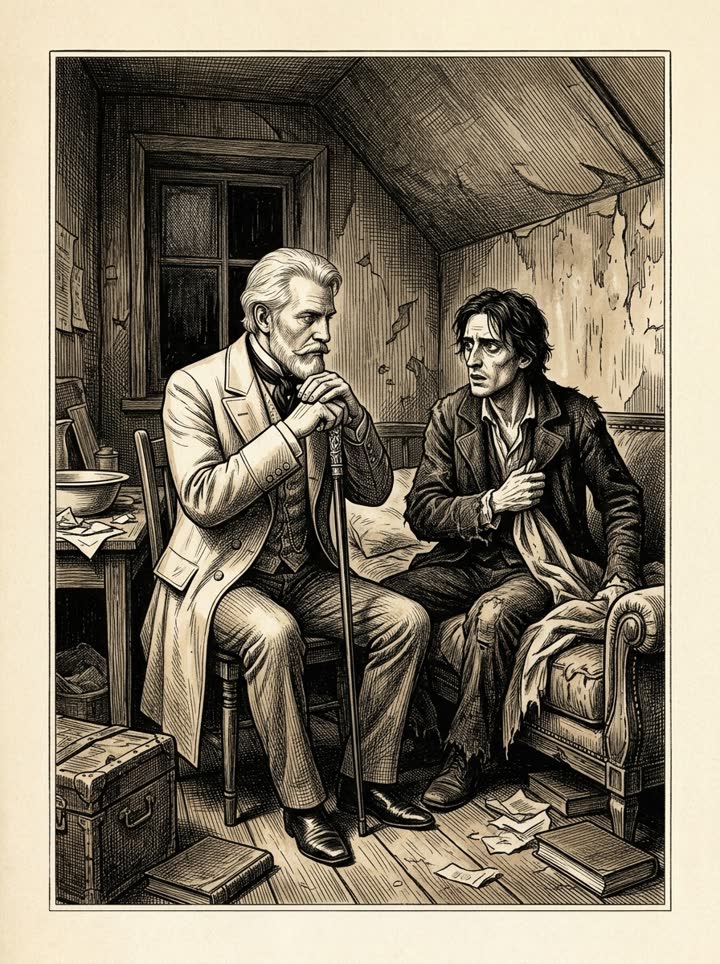
"Can this really be the continuation of the dream?" Raskolnikov thought once more. Warily and distrustfully he studied the unexpected guest.
"Svidrigailov? What nonsense! It can't be!" he said at last, aloud, in bewilderment.
The visitor did not seem in the least surprised at this exclamation.
"I have come to you for two reasons. In the first place, I wanted to make your personal acquaintance, as I have long heard of you from a most curious point of view, and one favourable to you. And in the second, I dream that perhaps you will not refuse to help me in an undertaking that touches directly the interests of your sister, Avdotya Romanovna. On my own, without a recommendation, I may not even be let into her yard now, owing to her prejudice against me. But with your help, on the contrary, I reckon..."
"You reckon badly," Raskolnikov interrupted.
"They only arrived yesterday, may I ask?"
Raskolnikov did not answer.
"Yesterday, I know. I only arrived myself the day before yesterday. Well now, here is what I will say to you on this score, Rodion Romanovich. I consider it superfluous to justify myself, but allow me to declare one thing too: what is there, in all this, really, that is so especially criminal on my side? I mean without prejudice, judging sensibly?"
Raskolnikov went on looking at him in silence.
"That in my own house I persecuted a defenceless girl and 'insulted her with my vile proposals', is that it, sir? (I am running ahead of you myself!) But only suppose that I too am a man, and nothing human... in a word, that I too am capable of being charmed and of falling in love (which, of course, is not done at our bidding), and then everything is explained in the most natural way. The whole question is this: am I a monster, or am I myself a victim? Well, and what if a victim? For when I proposed to the object of my feelings that she run away with me to America or Switzerland, I may have been cherishing the most respectful feelings, and thinking besides to arrange our mutual happiness!.. Reason serves passion, after all. I was perhaps ruining myself even more, for mercy's sake!.."
"But that's not the point at all," Raskolnikov interrupted with disgust. "Quite simply, you are repulsive, whether you are right or wrong, and so people don't want to know you, and drive you out, so go!.."
Svidrigailov suddenly burst out laughing.
"Well, but you... but there's no throwing you off!" he said, laughing in the frankest way. "I meant to be cunning, but no, you went straight to the real point!"
"And you go on being cunning even at this minute."
"What of it? What of it?" Svidrigailov repeated, laughing openly. "It's fair play, as they say, and the most permissible cunning!.. But all the same you interrupted me. One way or another, I confirm again: there would have been no unpleasantness at all if it had not been for the incident in the garden. Marfa Petrovna..."
"And Marfa Petrovna too, they say, you did away with?" Raskolnikov interrupted rudely.
"So you have heard about that too? Well, how could you not hear... As for this question of yours, really, I don't know how to put it to you, though my own conscience is in the highest degree quiet on that score. I mean, don't think that I am afraid of anything of that sort. All of it was carried out in perfect order and with complete exactness: the medical inquiry found apoplexy, brought on by bathing straight after a heavy dinner, with almost a whole bottle of wine drunk, and it could not have found anything else... No, sir, here is what I thought to myself for some time, especially on the road, sitting in the railway carriage: did I not contribute to all this... this misfortune, somehow, by upsetting her morally, or in some such way? But I concluded that this too positively could not be."
Raskolnikov laughed.
"What a thing to trouble yourself about!"
"But what are you laughing at? Consider: I struck her only twice with a little whip, there were not even any marks... Please don't take me for a cynic. I know exactly how vile that was on my part, and so on, and so on. But I also know for certain that Marfa Petrovna was perhaps even glad of this, so to speak, outburst of mine. The story about your sister had been worn out completely. Marfa Petrovna had been forced to sit at home for the third day. She had nothing left to take into town, and besides she had bored everyone there to death with that letter of hers (you heard about the reading of the letter?). And suddenly these two lashes fell as if from heaven! The first thing she did was order the carriage to be got ready!.. I won't even speak of the fact that there are cases with women when it is very, very pleasant to be insulted, in spite of all their visible indignation. Everyone has such cases; a man in general very, very much likes to be insulted, have you noticed that? With women it is especially so. One might even say that they live on nothing else."
For a while Raskolnikov thought of getting up and leaving, and so ending the meeting. But a certain curiosity, and even something like calculation, held him back for the moment.
"Are you fond of fighting?" he asked absently.
"No, not very," Svidrigailov answered calmly. "And with Marfa Petrovna there was almost never any fighting. We lived together very agreeably, and she was always pleased with me. I used the whip, in all our seven years, only twice (if you do not count a third occasion, a very ambiguous one, however). The first time, two months after our marriage, immediately on our arrival in the country, and now this last occasion. And you had already thought me such a monster, a reactionary, a serf-owner? Hee-hee... And by the way, don't you remember, Rodion Romanovich, how some years ago, in the days of beneficent publicity, a certain nobleman was disgraced before the whole nation and the whole of literature? I forget his name. He thrashed a German woman in a railway carriage, remember? That was the same year, I think, when 'The Disgraceful Act of the Age' happened too (well, the 'Egyptian Nights', the public reading, remember? Those black eyes! Oh, where are you, golden time of our youth!). Well then, here is my opinion: for the gentleman who thrashed the German woman I have no sympathy whatever, because really it is... why feel sympathy! But I cannot help declaring along with this that sometimes there turn up such provoking 'German women' that, it seems to me, there is not a single progressive who could entirely answer for himself. Nobody looked at the matter from that point of view then, and yet that point of view is the truly humane one, truly it is, sir!"
Having said this, Svidrigailov suddenly burst out laughing again. It was clear to Raskolnikov that this was a man who had firmly made up his mind about something, and kept his own counsel.
"You must have spoken to no one for several days running?" he asked.
"Almost so. Why? No doubt you are surprised that I am such an easy-mannered man?"
"No, I am surprised that you are too easy-mannered a man."
"Because I wasn't offended by the rudeness of your questions? Is that it? Yes... what is there to be offended at? As you asked, so I answered," he added with an astonishing expression of simplicity. "You see, I am hardly interested in anything in particular, upon my word," he went on rather thoughtfully. "Especially now, I am occupied with nothing... Though you are entitled to think that I am currying favour for some purpose, all the more as I have business with your sister, I declared it myself. But I will tell you frankly: it is very dull! These three days especially, so that I was even glad of you... Don't be angry, Rodion Romanovich, but you yourself seem to me for some reason terribly strange. Say what you like, there is something in you. And precisely now, that is, not exactly at this minute, but generally now... Well, well, I won't, I won't, don't frown! I am not such a bear as you think."
Raskolnikov looked at him gloomily.
"Perhaps you are not a bear at all," he said. "It even seems to me that you are of very good society, or at least know how, when occasion demands, to be a decent man."
"I am not particularly interested in anybody's opinion," Svidrigailov answered drily, and even with a shade of haughtiness, "and so why not be a vulgar fellow, when that dress is so convenient to wear in our climate and... and especially if one has a natural inclination for it," he added, laughing again.
"I have heard, however, that you have many acquaintances here. You are what is called 'not without connections'. Then what do you want me for, if not for some purpose?"
"You are right that I have acquaintances," Svidrigailov picked up, without answering the main point. "I have already met some. It is the third day that I have been wandering about, and I recognise them myself, and they seem to recognise me. Of course, I am decently dressed and am counted a man of means. The peasant reform passed us by, too: woods and flooded meadows, and the income is not lost. But... I won't go there. I was sick of it even before, and now I go about the third day and make myself known to nobody... And then there is this town! I mean, how did it come to be composed like this, tell me, if you please! A town of clerks and every possible sort of seminarist! Really, I did not notice much of it here before, eight years ago, when I was loafing about here... I put my only hope now in anatomy, upon my word!"
"What anatomy?"
"As for these clubs of yours, Dussauts, these Points of yours, or perhaps progress as well, well, let that be without us," he continued, again not noticing the question. "And who wants to be a card-sharper?"
"So you were a sharper too?"
"How could it be otherwise? There was a whole company of us, most respectable, eight years ago. We passed the time, and all of them, you know, men with manners. There were poets, there were capitalists. And in general among us, in Russian society, the best manners belong to those who have been beaten, have you noticed that? It is only now in the country that I have let myself go. All the same, I was put in prison then for debts, by a little Greek from Nezhin. And it was then that Marfa Petrovna turned up, bargained, and bought me out for thirty thousand pieces of silver. (In all I owed seventy thousand.) We were joined in lawful marriage, and she carried me off at once to her country place, like some treasure. She was five years older than I. She loved me very much. For seven years I did not leave the country. And note that all her life she kept a bond against me, in somebody else's name, for those thirty thousand, so that if I took it into my head to rebel in any way, I would be in the trap at once! And she would have done it! With women all that lives together."
"And if it had not been for the bond, would you have taken to your heels?"
"I don't know how to put it to you. The bond hardly hampered me. I didn't want to go anywhere, and Marfa Petrovna herself invited me abroad twice, seeing that I was bored. But what of it! I used to go abroad before, and it always made me sick. It isn't that, exactly, but the dawn is breaking, the Bay of Naples, the sea, you look, and somehow it makes you sad. The most disgusting thing is that you really are sad about something! No, it is better in one's own country: here at least you blame everyone else for everything and justify yourself. I might perhaps go on an expedition to the North Pole now, because drink makes me vicious, and drinking is repugnant to me, and nothing is left but wine. I have tried. By the way, they say Berg is going to fly in a huge balloon next Sunday from the Yusupov Garden and invites fellow passengers at a certain fee, is it true?"
"Well, would you fly?"
"I? No... just..." Svidrigailov muttered, as if really deep in thought.
"What is the matter with him, really?" thought Raskolnikov.
"No, the bond did not hamper me," Svidrigailov went on musingly. "It was I myself who did not leave the country. And it will be a year now since Marfa Petrovna, on my name day, gave me back this bond, and on top of that presented me with a remarkable sum of money. She had capital, you see. 'You see how I trust you, Arkady Ivanovich,' upon my word, that is how she put it. You don't believe she put it that way? And do you know, I became a decent landowner in the country. They know me in the district. I used to order books too. Marfa Petrovna approved at first, and then was always afraid that I would study myself to death."
"You seem to miss Marfa Petrovna very much?"
"I? Perhaps. Really, perhaps. And by the way, do you believe in ghosts?"
"What ghosts?"
"Ordinary ghosts, what ghosts!"
"And do you believe in them?"
"Well, perhaps not, to please you... That is, not that I don't..."
"Do they appear, then?"
Svidrigailov looked at him somehow strangely.
"Marfa Petrovna deigns to visit me," he said, twisting his mouth into a strange smile.
"What do you mean, deigns to visit you?"
"She has come three times already. I first saw her on the very day of the funeral, an hour after the cemetery. That was the eve of my departure for here. The second time was the day before yesterday, on the road, at dawn, at the station of Malaya Vishera. And the third time, two hours ago, in the room where I am lodging. I was alone."
"Awake?"
"Quite. Awake all three times. She comes, talks a minute, and goes out by the door, always by the door. One can even seem to hear her."
"Why is it that I was sure something of the sort must be happening to you!" Raskolnikov said suddenly, and in the same minute was astonished that he had said it. He was in great agitation.
"Re-ally? You thought that?" Svidrigailov asked in surprise. "Can it be? Well, didn't I say there was some point in common between us, eh?"
"You never said so!" Raskolnikov answered sharply and with heat.
"I didn't?"
"No!"
"I thought I did. Just now, when I came in and saw you lying with your eyes shut, and pretending, I said to myself at once: 'This is the very one!'"
"What do you mean, the very one? What are you talking about?" cried Raskolnikov.
"What about? Really, I don't know what about..." Svidrigailov muttered sincerely, and as if he had himself become confused.
For a minute they were silent. They stared at each other with wide-open eyes.
"It's all nonsense!" Raskolnikov cried out with vexation. "What does she say to you when she comes?"
"She? Imagine, about the most trifling nonsense, and you may well marvel at human beings. That is just what makes me angry. The first time she came in (I was tired, you know: the funeral service, the 'Rest with the saints', then the litany, the lunch. At last I was left alone in my study, lit a cigar, and began to think), she came in at the door. 'And you, Arkady Ivanovich,' she says, 'with all today's fuss, forgot to wind the clock in the dining room.' And that clock I really did wind myself every week, all seven years, and if I forgot she would always remind me. The next day I was already on my way here. I went into the station at dawn. I had dozed during the night, I was broken, my eyes full of sleep. I took some coffee. I looked, and suddenly Marfa Petrovna sat down beside me, with a pack of cards in her hands: 'Shall I tell your fortune for the journey, Arkady Ivanovich?' And she was a master at telling fortunes. And I will never forgive myself for not letting her! I ran away in fright, and just then, true enough, the bell rang for the train. I sat today after a wretched dinner from a cook-shop, with a heavy stomach, sitting, smoking, and suddenly Marfa Petrovna again, coming in all dressed up, in a new green silk dress with a very long train: 'Good day, Arkady Ivanovich! How do you like my dress? Aniska could not sew like that.' (Aniska is a seamstress we have in the country, one of the former serfs, who was trained in Moscow, a pretty girl.) She stands there, turns round in front of me. I examined the dress, then looked carefully into her face: 'Why trouble yourself, Marfa Petrovna,' I say, 'coming to me about such trifles?' 'Oh, my God, my dear, so one can't even disturb you!' To tease her I say: 'Marfa Petrovna, I want to marry.' 'That is just like you, Arkady Ivanovich. It does you little credit that before you have even buried your wife you go off to get married. And if only you had chosen well! But I know it will do no good to her or to you, you will only make good people laugh.' And off she went, and her train seemed to rustle. What nonsense, eh?"
"But perhaps you are lying about all of it?" Raskolnikov responded.
"I rarely lie," Svidrigailov answered thoughtfully, and as if he had not noticed the rudeness of the question at all.
"And before this, you never saw ghosts?"
"N... no, I did, only once in my life, six years ago. I had a house serf, Filka. They had only just buried him when I called out, forgetting myself: 'Filka, my pipe!' He came in and went straight to the cabinet where I keep my pipes. I sat there thinking: 'He has come to take revenge on me', because just before his death we had quarrelled badly. 'How dare you,' I say, 'come in to me with a torn elbow? Out, you scoundrel!' He turned, went out, and never came again. I did not tell Marfa Petrovna then. I wanted to have a requiem sung for him, but was ashamed."
"Go to a doctor."
"I understand without your telling me that I am unwell, though really I don't know with what. In my opinion I am certainly five times healthier than you. That is not what I asked you, whether you believe or not that ghosts appear. I asked you: do you believe that there are ghosts?"
"No, I will never believe it!" Raskolnikov cried, even with a sort of malice.
"How do people usually talk?" Svidrigailov muttered, as if to himself, looking aside and bowing his head a little. "They say: 'You are ill, and so what you see is only a non-existent delirium.' But there is no strict logic in that. I agree that ghosts appear only to the sick, but that proves only that ghosts cannot appear except to the sick, not that they do not exist, in themselves."
"Of course they don't!" Raskolnikov insisted irritably.
"They don't? You think so?" Svidrigailov went on, slowly looking at him. "Well, and what if one reasons like this (do help me here): 'Ghosts are, so to speak, scraps and fragments of other worlds, their beginning. A healthy man, of course, has no need to see them, because a healthy man is the most earthly man, and so must live only this life here, for the sake of fullness and order. But as soon as he falls ill, as soon as the normal earthly order in the organism is disturbed, at once the possibility of another world begins to show itself, and the more ill he is, the more contacts he has with the other world, so that when a man dies altogether he passes straight into the other world.' I reasoned about this long ago. If you believe in a future life, you can believe this reasoning too."
"I don't believe in a future life," said Raskolnikov.
Svidrigailov sat lost in thought.
"And what if there are only spiders there, or something of that sort," he said suddenly.
"He is mad," thought Raskolnikov.
"We always picture eternity as an idea that cannot be understood, something enormous, enormous! But why must it be enormous? And suddenly, instead of all that, imagine there will be just one little room there, something like a village bath-house, sooty, and spiders in every corner, and that is all eternity. I sometimes, you know, see something like that in my mind."
"And can it be, can it be that you picture nothing more comforting and more just than that!" Raskolnikov cried with a painful feeling.
"More just? And who knows, perhaps that is just, and do you know, I would certainly have made it so on purpose!" answered Svidrigailov, smiling vaguely.
A sort of chill suddenly seized Raskolnikov at this hideous answer. Svidrigailov raised his head, looked at him fixedly, and suddenly burst out laughing.
"No, just consider this," he cried. "Half an hour ago we had never seen each other, we count ourselves enemies, there is an unsettled matter between us, and we have dropped the matter and strayed off into literature of this kind! Well, wasn't I right to say that we are birds of a feather?"
"Be so good," Raskolnikov went on irritably, "as to allow me to ask you to explain yourself quickly and tell me why you have honoured me with your visit... and... and... I am in a hurry, I have no time, I want to go out..."
"By all means, by all means. Your sister, Avdotya Romanovna, is marrying Mr. Luzhin, Pyotr Petrovich?"
"Could you possibly avoid every question about my sister and not mention her name? I don't even understand how you dare to pronounce her name in my presence, if you really are Svidrigailov?"
"But I came precisely to speak about her, how can I not mention her?"
"Good. Speak, but quickly!"
"I am sure that you have already formed your opinion of this Mr. Luzhin, my relation by marriage, if you have seen him even for half an hour or heard anything about him that was true and exact. He is no match for Avdotya Romanovna. In my opinion Avdotya Romanovna is sacrificing herself in this affair very generously and without calculation for... for her family. It seemed to me, from everything I had heard of you, that you for your part would be very glad if this marriage could be broken off without damage to anyone's interests. Now, having met you in person, I am even sure of it."
"All this on your part is very naive. Excuse me, I meant to say: impudent," said Raskolnikov.
"That is, you mean that I am out to line my own pocket. Don't worry, Rodion Romanovich, if I were working for my own profit I would not have spoken out so directly. I am not quite a fool, after all. On this score I will reveal to you a psychological peculiarity. Just now, justifying my love for Avdotya Romanovna, I said that I myself was a victim. Well, then know that I feel no love now, n-none at all, so that it seems strange even to me, because I really did feel something..."
"From idleness and depravity," Raskolnikov interrupted.
"True, I am a depraved and idle man. And yet your sister has so many advantages that I could not help yielding to a certain impression. But all that is nonsense, as I now see myself."
"Have you seen it for long?"
"I began to notice it earlier, and became finally convinced the day before yesterday, almost at the very moment of my arrival in Petersburg. Though even in Moscow I imagined I was going to seek Avdotya Romanovna's hand and to rival Mr. Luzhin."
"Excuse me for interrupting you, but be so good: could you not cut it short and pass straight to the object of your visit? I am in a hurry, I must go out..."
"With the greatest pleasure. Having arrived here and having resolved now to undertake a certain... voyage, I wished to make the necessary preliminary arrangements. My children have stayed with their aunt. They are rich, and they have no personal need of me. And what sort of father am I! For myself I took only what Marfa Petrovna gave me a year ago. That is enough for me. Excuse me, I am coming to the point at once. Before the voyage, which may perhaps come off, I want to be done with Mr. Luzhin too. Not that I cannot bear him so very much, but it was through him, after all, that this quarrel of mine with Marfa Petrovna arose, when I learned that she had cooked up this wedding. I want now to see Avdotya Romanovna, through your mediation, and perhaps in your presence, to explain to her, first, that from Mr. Luzhin she will not only gain not the slightest advantage, but will most certainly suffer open loss. Then, having begged her pardon for all these recent unpleasantnesses, I would ask permission to offer her ten thousand roubles, and in this way to make the break easier with Mr. Luzhin, a break which, I am sure, she herself would not be averse to, if only the possibility appeared."
"But you really, really are mad!" cried Raskolnikov, not so much angry as astonished. "How dare you speak like that!"
"I knew you would cry out. But in the first place, though I am not rich, I have these ten thousand roubles to spare, that is, I have no need of them at all, none at all. If Avdotya Romanovna does not accept them, I will perhaps use them still more stupidly. That is one. Second: my conscience is perfectly calm. I offer without any calculation. Believe it or not, but later you will find out, and Avdotya Romanovna too. It is all in this: that I really did cause much trouble and unpleasantness to your much respected sister. And so, feeling sincere repentance, I heartily wish, not to buy myself off, not to pay for the unpleasantness, but quite simply to do something to her advantage, on the ground that I have not, after all, taken out a patent to do nothing but evil. If there were a millionth part of calculation in my offer, I would not make it so directly. Nor would I offer only ten thousand, when only five weeks ago I offered her more. Besides, I may very, very soon marry a certain young lady, and consequently all suspicion of any attempts against Avdotya Romanovna must thereby be destroyed. In conclusion I will say that in marrying Mr. Luzhin, Avdotya Romanovna takes the same money, only from another side... Don't be angry, Rodion Romanovich, but judge calmly and coolly."
As he said this, Svidrigailov himself was extremely cool and calm.
"I beg you to stop," said Raskolnikov. "In any case this is unpardonably insolent."
"Not in the least. By that reasoning one man can do another only evil in this world, and on the contrary has no right to do a crumb of good, because of some empty accepted formalities. That is absurd. If, for example, I died and left this sum to your sister in a will, would she refuse to accept it even then?"
"Very possibly."
"Oh no, sir, surely not. Still, if not, then not, so be it. But ten thousand is a splendid thing, on occasion. In any case I ask you to pass on what I have said to Avdotya Romanovna."
"No, I will not pass it on."
"In that case, Rodion Romanovich, I will be forced to seek a personal meeting myself, and consequently to disturb her."
"And if I do pass it on, you will not seek a personal meeting?"
"Really, I don't know how to put it to you. I should very much like to see her once."
"Don't hope for it."
"A pity. However, you don't know me. Perhaps we shall get to know each other better."
"You think we shall get to know each other better?"
"And why not?" said Svidrigailov, smiling, and he stood up and took his hat. "It is not that I so very much wished to disturb you, and coming here I did not even much count on it, though your face did strike me this very morning..."
"Where did you see me this morning?" Raskolnikov asked anxiously.
"By chance, sir... It keeps seeming to me that there is something in you akin to me... But don't worry, I am not tiresome. I got on with card-sharpers, and did not bore Prince Svirbei, my distant relative and a great nobleman, and I managed to write about Raphael's Madonna in Madame Prilukova's album, and I lived seven years with Marfa Petrovna without leaving the country, and in the old days I used to spend nights in Vyazemsky's house in the Haymarket, and I may fly in the balloon with Berg."
"Well, very good, sir. Allow me to ask, are you leaving soon on your journey?"
"What journey?"
"Well, this 'voyage'... You said so yourself."
"A voyage? Ah, yes!.. really, I did tell you about a voyage... Well, that is a wide question... But if you only knew what you are asking about!" he added, and suddenly laughed, loudly and briefly. "Perhaps instead of a voyage I shall marry. They are arranging a match for me."
"Here?"
"Yes."
"When did you have time for that?"
"But I very much want to see Avdotya Romanovna once. I ask it seriously. Well, goodbye... ah, yes! Here is what I forgot! Tell your sister, Rodion Romanovich, that in Marfa Petrovna's will she has been left three thousand. That is positively true. Marfa Petrovna made the arrangement a week before her death, and it was done in my presence. In two or three weeks Avdotya Romanovna can receive the money."
"Are you telling the truth?"
"The truth. Pass it on. Well, sir, your servant. I am staying not far from you at all."
As he went out, Svidrigailov met Razumikhin in the doorway.