
It was almost eight o'clock; both were hurrying to Bakaleyev's, to arrive before Luzhin.
"Well, who was that?" asked Razumikhin, as soon as they had come out into the street.
"That was Svidrigailov, the same landowner in whose house my sister was insulted when she was a governess there. Because of his amorous pursuit of her she left them, driven out by his wife, Marfa Petrovna. This Marfa Petrovna afterwards begged Dunya's forgiveness, and now she has suddenly died. It was she they were talking about earlier. I don't know why, but I am very much afraid of this man. He came immediately after his wife's funeral. He is very strange, and he has made up his mind to something... He seems to know something... Dunya must be protected from him... that is what I wanted to tell you, do you hear?"
"Protected! What can he do against Avdotya Romanovna? Well, thank you, Rodya, for telling me so... We'll protect her, we'll protect her!.. Where does he live?"
"I don't know."
"Why didn't you ask? Ah, what a pity! Never mind, I'll find out!"
"Did you see him?" asked Raskolnikov after some silence.
"Well, yes, I noticed him; I took a good, firm look at him."
"You really saw him? You saw him clearly?" Raskolnikov insisted.
"Well, yes, I remember him clearly; I'd know him among a thousand, I have a good memory for faces."
They were silent again.
"Hm... so that's it..." muttered Raskolnikov. "Because, you know... I thought... it keeps seeming to me... that it may be a fantasy."
"But what do you mean? I don't quite understand you."
"You all keep saying," Raskolnikov went on, twisting his mouth into a smile, "that I'm mad; and just now it seemed to me that perhaps I really am mad, and have only seen a phantom!"
"What's this you're saying?"
"But who knows! Perhaps I really am mad, and everything that has happened in all these days, perhaps it was all only in my imagination..."
"Ah, Rodya! They've upset you again!.. But what did he say, what did he come for?"
Raskolnikov did not answer; Razumikhin thought for a minute.
"Well, listen to my answer," he began. "I called on you, and you were asleep. Then we had dinner, and then I went to Porfiry. Zametov was still with him. I wanted to begin, and nothing came of it. I simply couldn't speak properly. They seem not to understand, and not to be able to understand, but they aren't in the least embarrassed. I took Porfiry to the window and began to talk, but again somehow it didn't come out right: he looks away, and I look away. In the end I held my fist up to his mug and said I'd smash him, in a friendly way, as a relative. He only looked at me. I spat and left, and that's all. Very stupid. I said not a word to Zametov. Only, you see, I thought I had made a mess of it, but as I was going down the stairs one thought came to me, it simply dawned on me: why are we fussing, you and I? If you were in danger, or something of the kind, well, of course. But what is it to you! You have nothing to do with it, so to the devil with them; we'll laugh at them afterwards, and in your place I would even mystify them some more. How ashamed they'll be afterwards! Spit on it; later we can give them a thrashing too, but for now let's laugh!"
"Of course, you're right!" answered Raskolnikov. "And what will you say tomorrow?" he thought to himself. Strange to say, it had never once occurred to him until now: "What will Razumikhin think when he finds out?" As he thought this, Raskolnikov looked at him fixedly. Razumikhin's present account of his visit to Porfiry interested him very little: so much had gone and so much had been added since then!..
In the corridor they ran into Luzhin: he had arrived at exactly eight o'clock and was looking for their rooms, so that all three went in together, but without looking at one another and without bowing. The young men went ahead, while Pyotr Petrovich, for the sake of propriety, lingered a little in the entrance, taking off his coat. Pulcheria Alexandrovna came out at once to meet him on the threshold. Dunya was greeting her brother.
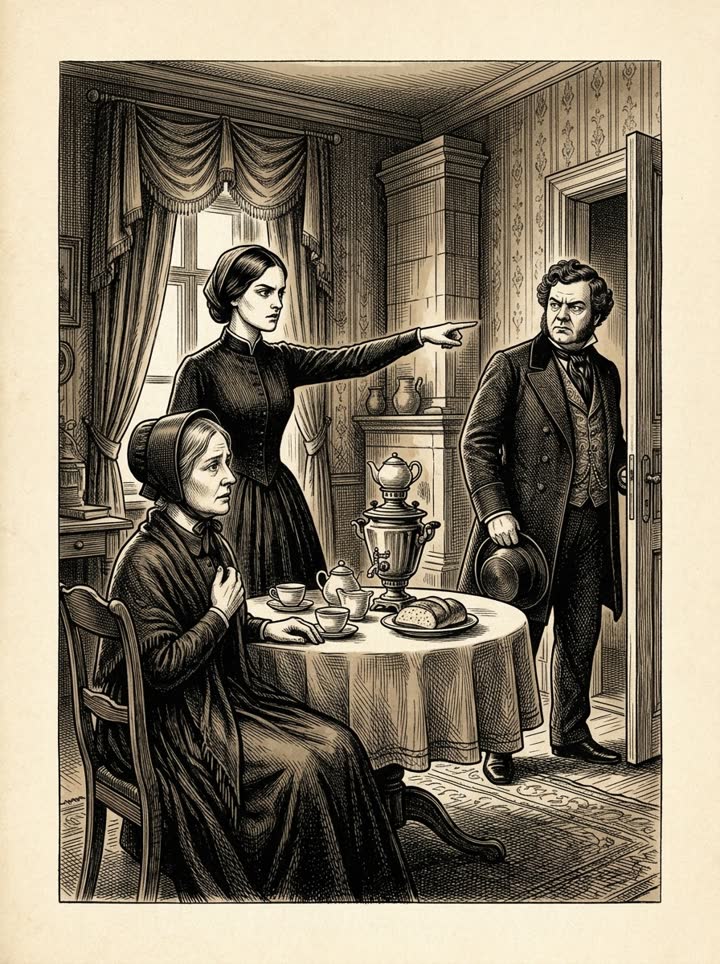
Pyotr Petrovich came in and bowed to the ladies rather amiably, though with doubled solemnity. However, he looked as if he were a little flustered and had not yet recovered himself. Pulcheria Alexandrovna, who also seemed embarrassed, hurried at once to seat everyone at the round table where the samovar was boiling. Dunya and Luzhin placed themselves opposite one another at the two ends of the table. Razumikhin and Raskolnikov were opposite Pulcheria Alexandrovna, Razumikhin nearer to Luzhin, and Raskolnikov next to his sister.
There was a moment's silence. Pyotr Petrovich unhurriedly took out a cambric handkerchief that gave off a waft of scent, and blew his nose with the air of a man who is virtuous, to be sure, but somewhat offended in his dignity, and firmly resolved to demand an explanation. Already in the entrance the thought had occurred to him: not to take off his coat and to go away, and so to punish both ladies severely and impressively, making them feel everything at once. But he had not dared. Besides, this man disliked uncertainty, and here it had to be cleared up: if his order had been so openly disobeyed, then there was something behind it, and so it was better to find out beforehand; as for punishing, there would always be time, and it was in his hands.
"I hope the journey went well?" he addressed Pulcheria Alexandrovna formally.
"Thank God, Pyotr Petrovich."
"Very pleasant to hear it, madam. And Avdotya Romanovna is not tired either?"
"I am young and strong, I don't tire, but for mamma it was very hard," answered Dunechka.
"What is to be done, madam; our national roads are very long. Great is so-called 'Mother Russia'... For my part, with the best will in the world, I could in no way hurry to meet you yesterday. I hope, however, that everything passed without particular trouble?"
"Oh, no, Pyotr Petrovich, we were very much dismayed," Pulcheria Alexandrovna hastened to declare with a peculiar intonation, "and if God himself, it seems, had not sent us Dmitri Prokofich yesterday, we should simply have been lost. Here he is, Dmitri Prokofich Razumikhin," she added, introducing him to Luzhin.
"Why yes, I had the pleasure... yesterday," muttered Luzhin, glancing at Razumikhin sideways with dislike, and then he frowned and fell silent. Pyotr Petrovich in general belonged to the class of people who seem extremely amiable in society and make a particular claim to amiability, but who, the moment anything is not to their liking, lose all their resources at once and become more like sacks of flour than like free-and-easy gentlemen who enliven a company. Everyone fell silent again: Raskolnikov stubbornly kept silent, Avdotya Romanovna did not wish to break the silence before its time, Razumikhin had nothing to say, so that Pulcheria Alexandrovna grew anxious again.
"Marfa Petrovna has died, have you heard?" she began, resorting to her chief resource.
"Yes indeed, I heard, madam. I was informed at the very first rumour, and have even come now to tell you that Arkady Ivanovich Svidrigailov, immediately after the funeral of his wife, set off in haste for Petersburg. So, at least, according to the most exact information I have received."
"To Petersburg? Here?" asked Dunechka anxiously, and exchanged a glance with her mother.
"Precisely so, madam, and of course not without purpose, taking into account the haste of his departure and, in general, the circumstances that preceded it."
"Good Lord! Surely he won't leave Dunechka in peace even here?" cried Pulcheria Alexandrovna.
"It seems to me there is no need for particular alarm, either for you or for Avdotya Romanovna, provided, of course, that you yourselves do not wish to enter into any relations with him whatever. As for me, I am keeping watch, and am now finding out where he is staying..."
"Ah, Pyotr Petrovich, you wouldn't believe how much you have frightened me just now!" Pulcheria Alexandrovna went on. "I saw him only twice, and he seemed to me terrible, terrible! I am sure that he was the cause of the death of the late Marfa Petrovna."
"One cannot conclude that. I have exact information. I do not deny that he may have hastened the course of things, so to speak, by the moral influence of an insult; but as for the man's conduct and moral character in general, I agree with you. I do not know whether he is rich now, or what exactly Marfa Petrovna left him; that will be known to me in a very short time; but certainly here in Petersburg, if he has even some money, he will at once take up his old ways. He is the most depraved man, sunk in vice, of all men of that kind! I have considerable ground for supposing that Marfa Petrovna, who had the misfortune to love him so much and who paid off his debts eight years ago, served him in yet another respect: it was solely through her efforts and sacrifices that a criminal case was hushed up at the very beginning, one involving a brutal and, so to speak, fantastic murder, for which he might very, very well have taken a walk to Siberia. That is what this man is like, if you want to know."
"Ah, Lord!" cried Pulcheria Alexandrovna. Raskolnikov listened attentively.
"Do you speak the truth, that you have exact information about this?" asked Dunya, sternly and impressively.
"I say only what I myself heard, in secret, from the late Marfa Petrovna. It must be noted that from the legal point of view the affair is very obscure. There lived here, and I think still lives, a certain Resslich, a foreigner and, besides, a petty moneylender, who also engaged in other business. With this Resslich Mr. Svidrigailov had for a long time been in certain very close and mysterious relations. A distant relation lived with her, a niece I think, a deaf and dumb girl of fifteen or even fourteen, whom this Resslich hated beyond measure and reproached for every morsel; she even beat her inhumanly. Once the girl was found hanged in the attic. It was decided that it was suicide. After the usual procedures that was the end of the matter, but later, however, an information was laid that the child had been... cruelly abused by Svidrigailov. True, it was all obscure, the information came from another German woman, a notorious one who was not to be trusted; in the end, in fact, there was no information, thanks to the efforts and the money of Marfa Petrovna; it was all confined to rumour. But this rumour was, nevertheless, very significant. You, of course, Avdotya Romanovna, also heard in their house the story of the manservant Philip, who died of ill-treatment some six years ago, still in the time of serfdom."
"I heard, on the contrary, that this Philip hanged himself."
"Precisely so, madam, but he was forced, or rather, driven to a violent death by the unceasing system of persecution and punishment practised by Mr. Svidrigailov."
"I don't know that," Dunya answered drily, "I only heard a very strange story, that this Philip was some sort of hypochondriac, a sort of household philosopher, the servants said he had 'read himself silly,' and that he hanged himself more from mockery than from Mr. Svidrigailov's blows. And in my time he treated the servants well, and they even liked him, though it is true they also blamed him for Philip's death."
"I see, Avdotya Romanovna, that you have suddenly become somehow inclined to justify him," remarked Luzhin, twisting his mouth into an ambiguous smile. "He is indeed a cunning man, and seductive where ladies are concerned, of which Marfa Petrovna, who died so strangely, serves as a lamentable example. I only wished to serve you and your mamma with my advice, in view of his new and undoubtedly impending attempts. As for me, I am firmly convinced that this man will undoubtedly disappear again into a debtors' prison. Marfa Petrovna never had the slightest intention of settling anything on him, having the children in view, and if she left him something, it can only be something quite indispensable, of small value, ephemeral, which would not last a year for a man with his habits."
"Pyotr Petrovich, I beg you," said Dunya, "let us stop talking about Mr. Svidrigailov. It makes me melancholy."
"He came to see me just now," said Raskolnikov suddenly, breaking the silence for the first time.
Exclamations rose from all sides, and everyone turned to him. Even Pyotr Petrovich was agitated.
"An hour and a half ago, while I was asleep, he came in, woke me and introduced himself," Raskolnikov went on. "He was rather free and easy and cheerful, and he quite hopes that I shall come to terms with him. Among other things, he very much asks and seeks a meeting with you, Dunya, and asked me to be the intermediary for that meeting. He has a proposal to make to you; what it is, he told me. Besides that, he informed me positively that Marfa Petrovna, a week before her death, managed to leave you, Dunya, three thousand roubles in her will, and you can receive this money in a very short time."
"Thank God!" cried Pulcheria Alexandrovna and crossed herself. "Pray for her, Dunya, pray!"
"That is perfectly true," Luzhin let slip.
"Well, well, what next?" Dunechka urged.
"Then he said that he himself is not rich and the whole estate goes to his children, who are now with an aunt. Then, that he is staying somewhere not far from me, but where, I don't know, I didn't ask..."
"But what, what does he want to propose to Dunechka?" asked Pulcheria Alexandrovna, terrified. "Did he tell you?"
"Yes, he told me."
"What is it?"
"I'll tell you later." Raskolnikov fell silent and turned to his tea.
Pyotr Petrovich took out his watch and looked at it.
"I must go on business, and so I shall not be in the way," he added with a somewhat piqued air, and began to rise from his chair.
"Stay, Pyotr Petrovich," said Dunya, "you intended to spend the evening with us. Besides, you yourself wrote that you wished to have some explanation with mamma."
"Precisely so, Avdotya Romanovna," Pyotr Petrovich said impressively, sitting down again on his chair but still keeping his hat in his hands, "I did indeed wish to have an explanation both with you and with your highly esteemed mamma, and even on very important points. But just as your brother cannot explain in my presence about certain proposals of Mr. Svidrigailov, so I too do not wish and cannot explain... before others... about certain very, very important points. Besides, my chief and most urgent request has not been fulfilled..."
Luzhin put on a bitter look and fell silent with dignity.
"Your request, that my brother should not be present at our meeting, was not fulfilled solely at my insistence," said Dunya. "You wrote that you had been insulted by my brother; I think that this must be cleared up at once, and you must be reconciled. And if Rodya really has insulted you, then he must and will ask your pardon."
Pyotr Petrovich at once grew haughty.
"There are certain insults, Avdotya Romanovna, which, with the best will in the world, cannot be forgotten, madam. In everything there is a line which it is dangerous to cross; for once it is crossed, there is no going back."
"That is not really what I was talking about, Pyotr Petrovich," Dunya interrupted with some impatience. "Understand clearly that our whole future depends now on whether all this is cleared up and settled as soon as possible or not. I tell you straight out, from the first word, that I cannot look at it otherwise, and if you value me at all, then, hard as it is, this whole business must end today. I repeat to you, if my brother is in the wrong, he will ask forgiveness."
"I am surprised that you put the question so, Avdotya Romanovna," Luzhin said, growing more and more irritated. "Prizing you and, so to speak, adoring you, I may at the same time very, very well dislike some member of your family. Claiming the happiness of your hand, I cannot at the same time take upon myself obligations that are irreconcilable..."
"Ah, drop all this touchiness, Pyotr Petrovich," Dunya interrupted with feeling, "and be that intelligent and noble man whom I have always considered you and wish to consider you. I have given you a great promise, I am your betrothed; trust me in this matter, and believe that I shall be able to judge impartially. That I take upon myself the role of judge is as much a surprise to my brother as to you. When I invited him today, after your letter, to be sure to come to our meeting, I told him nothing of my intentions. Understand that if you are not reconciled, I must choose between you: either you or he. That is how the question has been put, on his side and on yours. I do not want to make a mistake in my choice, and I must not. For your sake I must break with my brother; for my brother's sake I must break with you. I want to know, and I can know now for certain: is he a brother to me? And as for you: am I dear to you, do you prize me: are you a husband to me?"
"Avdotya Romanovna," said Luzhin, bristling, "your words are too significant for me, I will say more, even offensive, in view of the position which I have the honour to occupy in relation to you. Not to speak at all of the offensive and strange putting side by side, on one level, of me and... an arrogant youth, by your words you admit the possibility of a breach of the promise given to me. You say: 'either you or he,' and thereby show me how little I mean to you... I cannot allow this, given the relations and... the obligations existing between us."
"What!" Dunya flared up. "I set your interest beside everything that has been precious to me in life until now, that has until now made up my whole life, and suddenly you take offence that I give you too little value!"
Raskolnikov smiled silently and bitingly, and a shudder went through Razumikhin; but Pyotr Petrovich did not accept the objection; on the contrary, with every word he became more captious and irritable, as if he were getting a taste for it.
"Love for one's future companion in life, for one's husband, ought to exceed love for a brother," he pronounced sententiously, "and in any case, I cannot stand on one level... Although I insisted a little while ago that in the presence of your brother I do not wish and cannot explain all that I came for, nevertheless I intend now to address your highly esteemed mamma for a necessary explanation on one very important point, which is offensive to me. Your son," he turned to Pulcheria Alexandrovna, "yesterday, in the presence of Mr. Rassudkin (or... is that right? Forgive me, I have forgotten your surname," he bowed amiably to Razumikhin), "insulted me by distorting a thought of mine, which I communicated to you in private conversation, over coffee, namely, that marriage with a poor girl who has already experienced the sorrows of life is, in my opinion, more advantageous in the matrimonial respect than with one who has known comfort, since it is more useful for morals. Your son deliberately exaggerated the meaning of my words to the point of absurdity, accusing me of malicious intentions, and, in my view, basing himself on your own correspondence. I shall consider myself happy if you, Pulcheria Alexandrovna, can undeceive me in the contrary respect, and so reassure me considerably. Tell me, then, in precisely what terms you passed on my words in your letter to Rodion Romanovich?"
"I don't remember," Pulcheria Alexandrovna faltered, "I passed them on as I myself understood them. I don't know how Rodya passed them on to you... Perhaps he exaggerated something."
"Without your prompting he could not have exaggerated."
"Pyotr Petrovich," said Pulcheria Alexandrovna with dignity, "the proof that Dunya and I did not take your words in a very bad sense is that we are here."
"Well said, mamma!" said Dunya approvingly.
"So I am to blame here too!" said Luzhin, offended.
"Well, Pyotr Petrovich, you keep blaming Rodion, but you yourself wrote something untrue about him in your letter," added Pulcheria Alexandrovna, emboldened.
"I do not remember writing anything untrue, madam."
"You wrote," said Raskolnikov sharply, not turning to Luzhin, "that yesterday I gave the money not to the widow of the man who was crushed, as was in fact the case, but to his daughter (whom I had never seen before yesterday). You wrote that to set me at odds with my family, and for that purpose added, in vile expressions, about the conduct of a girl whom you do not know. All this is gossip and baseness."
"Excuse me, sir," Luzhin answered, trembling with rage, "in my letter I enlarged on your qualities and actions solely in fulfilment of the request of your sister and mamma, to describe to them how I found you and what impression you made on me. As for what is stated in my letter, find me a single line that is unjust, that is, that you did not spend the money, and that there were no unworthy persons in that family, however unfortunate it may be?"
"And in my opinion, you, with all your merits, are not worth the little finger of that unfortunate girl at whom you throw stones."
"So you would resolve even to introduce her into the society of your mother and sister?"
"I have already done so, if you want to know. I sat her down today beside mamma and Dunya."
"Rodya!" cried Pulcheria Alexandrovna.
Dunechka blushed; Razumikhin knitted his brows. Luzhin smiled with a biting and haughty smile.
"You see for yourself, Avdotya Romanovna," he said, "whether agreement is possible here. I hope now that this matter is ended and cleared up, once and for all. I shall withdraw, so as not to hinder the further pleasantness of this family meeting and the communication of secrets (he rose from his chair and took his hat). But in leaving, I venture to remark that in future I hope to be spared such meetings and, so to speak, compromises. And of you especially, highly esteemed Pulcheria Alexandrovna, I shall ask the same on this subject, the more so as my letter was addressed to you and not to anyone else."
Pulcheria Alexandrovna was a little offended.
"You really take us quite into your power, Pyotr Petrovich. Dunya has told you the reason why your wish was not fulfilled: she had good intentions. And you write to me as if you were giving orders. Are we to take your every wish as a command? I will tell you, on the contrary, that you ought now to be particularly delicate and indulgent towards us, because we have thrown everything up and come here trusting in you, and so we are almost in your power as it is."
"That is not quite just, Pulcheria Alexandrovna, especially at the present moment, when the three thousand left by Marfa Petrovna has been announced, which seems very timely, judging by the new tone in which you have begun to speak to me," he added sarcastically.
"Judging by that remark, one may indeed suppose that you were counting on our helplessness," Dunya observed irritably.
"But now, at least, I cannot count on it, and I especially do not wish to hinder the communication of the secret proposals of Arkady Ivanovich Svidrigailov, with which he has entrusted your brother and which, as I see, have for you a capital, and perhaps a very pleasant significance."
"Ah, my God!" cried Pulcheria Alexandrovna.
Razumikhin could not sit still on his chair.
"And aren't you ashamed now, sister?" asked Raskolnikov.
"I am ashamed, Rodya," said Dunya. "Pyotr Petrovich, get out!" she turned to him, pale with anger.
Pyotr Petrovich, it seems, had not expected such an ending at all. He had relied too much on himself, on his power, and on the helplessness of his victims. He did not believe it even now. He turned pale, and his lips began to tremble.
"Avdotya Romanovna, if I go out through this door now, with such a send-off, then, mark this, I shall never come back. Think it over carefully! My word is firm."
"What insolence!" cried Dunya, rising quickly from her place. "Why, I don't want you to come back!"
"What? So tha-a-at's how it is, madam!" cried Luzhin, who had utterly failed to believe in such an outcome until the last moment, and had therefore now quite lost the thread. "So that's how it is! But do you know, Avdotya Romanovna, that I could protest, madam."
"What right have you to speak to her like that!" Pulcheria Alexandrovna intervened hotly. "What can you protest with? And what rights are these of yours? Well, am I to give you my Dunya, a man like you? Go, leave us altogether! We ourselves are to blame for entering on an unjust affair, and I most of all..."
"However, Pulcheria Alexandrovna," Luzhin fumed in a rage, "you bound me by your given word, which you now renounce... and finally... finally, I was drawn, so to speak, thereby into expenses..."
This last claim was so characteristic of Pyotr Petrovich that Raskolnikov, who was growing pale with anger and with the effort of restraining it, suddenly could not hold out and burst out laughing. But Pulcheria Alexandrovna lost her temper:
"Expenses? What expenses are these? Surely you are not speaking of our trunk? Why, the conductor carried it for you for nothing. Lord, it is we who bound you! Come to your senses, Pyotr Petrovich, it is you who have bound us hand and foot, not we you!"
"Enough, mamma, please, enough!" Avdotya Romanovna begged. "Pyotr Petrovich, be so kind, go away!"
"I'll go, madam, but only one last word!" he said, almost entirely losing control of himself. "Your mamma, it seems, has quite forgotten that I resolved to take you, so to speak, after the town gossip that had spread all over the neighbourhood about your reputation. In disregarding public opinion for your sake and restoring your reputation, I might certainly, very, very well, have hoped for a return and even demanded your gratitude... And only now are my eyes opened! I see myself that perhaps I acted very, very rashly in disregarding the public voice..."
"Has he got a spare head, or what!" shouted Razumikhin, jumping up from his chair and already preparing to deal with him.
"You are a base and wicked man!" said Dunya.
"Not a word! Not a gesture!" cried Raskolnikov, holding Razumikhin back; then, going up almost face to face with Luzhin:
"Kindly get out," he said quietly and distinctly, "and not a word more, or else..."
Pyotr Petrovich looked at him for several seconds with a pale face distorted with spite, then turned and went out, and certainly rarely has anyone carried away in his heart so much malicious hatred against another as this man did against Raskolnikov. Him, and him alone, he blamed for everything. It is remarkable that even as he went down the stairs he still imagined that the affair was perhaps not wholly lost, and that, as far as the ladies alone were concerned, it was even "very, very" much amendable.