
"... I don't believe it! I can't believe it!" Razumikhin kept repeating, bewildered, trying with all his might to refute Raskolnikov's arguments. They were already approaching Bakaleyev's rooms, where Pulcheria Alexandrovna and Dunya had long been waiting for them. In the heat of the talk Razumikhin kept stopping on the way, confused and agitated by the very fact that for the first time they had spoken of this plainly.
"Don't believe it!" Raskolnikov answered with a cold, careless smile. "You, as usual, noticed nothing, but I weighed every word."
"You're suspicious by nature, that's why you weighed them... Hm... Really, I agree, Porfiry's tone was rather strange, and that scoundrel Zametov especially!.. You're right, there was something in him, but why? Why?"
"He thought better of it overnight."
"But on the contrary, on the contrary! If they had this brainless idea, they would try with all their might to keep it hidden and hide their cards, so as to catch you later... But as it is, it's brazen and careless!"
"If they had facts, that is, real facts, or even any halfway sound suspicions, then they really would try to hide their game, in the hope of winning still more (and besides, they would have searched the place long ago!). But they have no fact, not one. It's all a mirage, everything cuts both ways, nothing but a fleeting idea. So they try to throw me off with brazenness. Or perhaps he himself was angry that there were no facts, and in his vexation he burst out. Or perhaps he has some intention... He seems to be a clever man... Perhaps he wanted to frighten me with what he knows... There's a psychology of his own in it, brother... But it's vile to explain all this. Leave it!"
"And insulting, insulting! I understand you! But... since we have now begun to speak plainly (and it's excellent that we've finally spoken plainly, I'm glad!), I'll admit to you straight out that I noticed this in them a long time ago, this idea, all this time, of course only in a tiny, creeping form, but why even creeping! How dare they? Where, where do these roots of theirs lie hidden? If you knew how furious I was! What, because a poor student, crippled by poverty and hypochondria, on the eve of a violent illness with delirium, which perhaps was already beginning in him (mark that!), suspicious, proud, who knows his own worth, who for six months had seen nobody in his corner, in rags and boots without soles, stands before some wretched district policemen and endures their insults; and then an unexpected debt under his nose, an overdue promissory note to the court councillor Chebarov, rotten paint, thirty degrees Reaumur, stuffy air, a crowd of people, a story about the murder of a person he had visited the day before, and all this on an empty belly! How could he help fainting! And on that, on that to base everything! The devil take it! I understand that it's annoying, but in your place, Rodka, I would burst out laughing in all their faces, or better still: spit in all their faces, and a good thick spit, and hand out a couple of dozen cuffs to every side, cleverly, as they always ought to be given, and finish it there. Spit on it! Cheer up! Shame on you!"
"He put it well, though," thought Raskolnikov.
"Spit on it? And tomorrow another interrogation!" he said bitterly. "Am I really to go into explanations with them? I'm vexed enough that yesterday in the tavern I lowered myself to Zametov..."
"The devil take it! I'll go to Porfiry myself! And I'll press him, as one of the family; let him lay out everything to the roots! And as for Zametov..."
"At last he's guessed!" thought Raskolnikov.
"Stop!" cried Razumikhin, suddenly seizing him by the shoulder. "Stop! You've lied! I've thought it out: you've lied! What sort of a trick is that? You say the question about the workmen was a trick? Think it through: if you had done it, could you have let slip that you saw them painting the flat... and the workmen? On the contrary: you saw nothing, even if you had seen it! Who confesses against himself?"
"If I had done that deed, I should certainly have said that I saw both the workmen and the flat," Raskolnikov went on answering, reluctantly and with visible disgust.
"But why speak against yourself?"
"Because only peasants, or the most inexperienced beginners, deny everything outright and straight through at interrogations. A man who is at all developed and experienced will certainly try, as far as possible, to admit all the external and unavoidable facts; only he finds other reasons for them, slips in some trait of his own, special and unexpected, which gives them quite another meaning and puts them in another light. Porfiry might well have counted on my answering exactly like that, and saying that I saw it, to be plausible, and adding something to explain it..."
"But he would have told you at once that there couldn't have been workmen there two days before, and that therefore you were there on the very day of the murder, some time after seven. He'd have tripped you up on a trifle!"
"But that is just what he counted on, that I wouldn't have time to think, and would hurry to answer in the most plausible way, and forget that there couldn't have been workmen two days before."
"But how could you forget that?"
"Easiest thing in the world! It is precisely on the emptiest things that cunning people are most easily caught. The more cunning a man is, the less he suspects he'll be caught on something simple. The most cunning man must be caught on the simplest thing. Porfiry is not nearly so stupid as you think..."
"He's a scoundrel, then, after that!"
Raskolnikov could not help laughing. But in that same minute his own animation and eagerness seemed strange to him, the eagerness with which he had delivered that last explanation, whereas all the previous conversation he had kept up with sullen disgust, obviously for a purpose, out of necessity.
"I'm getting a taste for it in some points!" he thought to himself.
But almost at the same moment he somehow suddenly grew uneasy, as if some unexpected and alarming thought had struck him. His uneasiness increased. They had already reached the entrance to Bakaleyev's rooms.
"Go up alone," Raskolnikov said suddenly. "I'll be back in a moment."
"Where are you going? But we're already here!"
"I must, I must; it's business... I'll come in half an hour... Tell them there."
"Have it your own way, I'll go after you!"
"What, you too want to torment me!" he cried, with such bitter irritation, with such despair in his look, that Razumikhin's hands dropped. For some time he stood on the steps and gloomily watched him walking quickly in the direction of his lane. At last, clenching his teeth and his fists, and swearing on the spot that he would squeeze Porfiry like a lemon that very day, he went upstairs to calm Pulcheria Alexandrovna, who was already alarmed by their long absence.
When Raskolnikov reached his house, his temples were wet with sweat and he was breathing heavily. He hurried up the stairs, went into his unlocked room and at once fastened himself in with the hook. Then, frightened and frantic, he rushed to the corner, to that very hole in the wallpaper where the things had lain then, thrust his hand into it and for several minutes carefully felt about in the hole, going over all its nooks and all the folds of the paper. Finding nothing, he got up and drew a deep breath. As he was coming up to Bakaleyev's steps just now, it had suddenly come into his head that some object, some chain, a stud, or even the scrap of paper they were wrapped in, with a mark in the old woman's hand, might somehow have slipped out then and got lost in some crack, and then suddenly come out before him as an unexpected and irrefutable piece of evidence.
He stood as if lost in thought, and a strange, humbled, half-senseless smile wandered on his lips. At last he took his cap and quietly went out of the room. His thoughts were tangled. Thoughtfully he went down under the gateway.
"Why, here he is himself!" a loud voice cried; he raised his head.
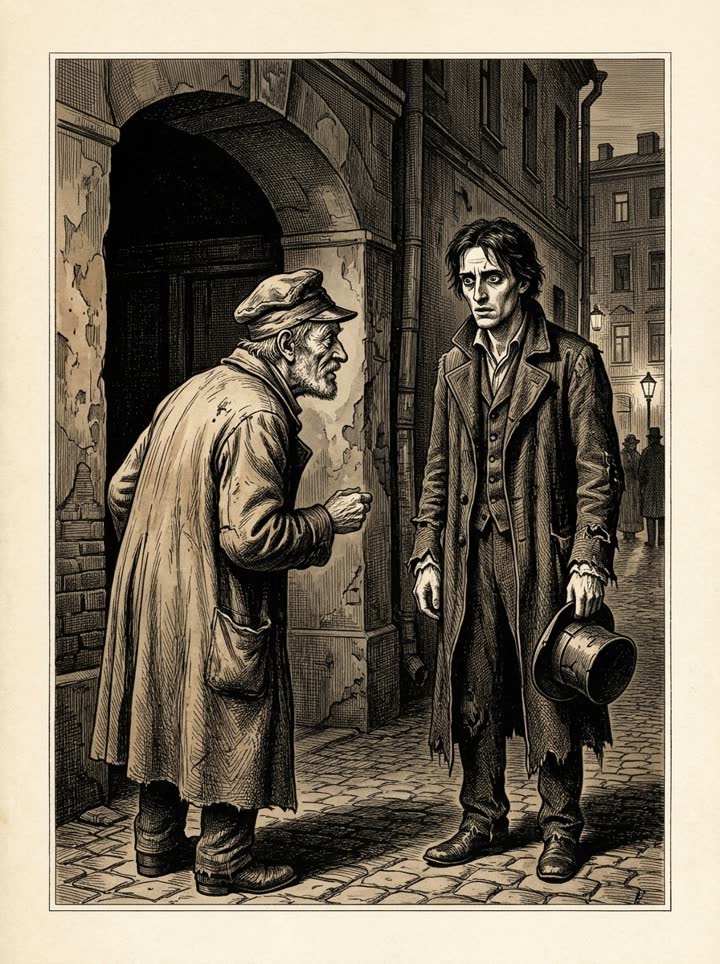
The yardkeeper stood at the door of his lodge and was pointing straight at him to a short man, who looked like a tradesman, dressed in something like a dressing-gown, with a waistcoat, and from a distance very much like a peasant woman. His head, in a greasy cap, hung down, and his whole figure seemed bent. His flabby, wrinkled face showed him to be over fifty; his small, swollen eyes looked sullen, stern and displeased.
"What is it?" asked Raskolnikov, going up to the yardkeeper.
The tradesman squinted at him from under his brows and looked him over fixedly and attentively, without hurrying; then he slowly turned and, without saying a word, went out of the gate of the house into the street.
"But what is it!" cried Raskolnikov.
"Why, someone was asking whether a student lives here, he named you, asked with whom you lodge. You came down just then, I pointed you out, and he went off. There, you see."
The yardkeeper was also in some perplexity, though not very much, and after thinking a little longer he turned and clambered back into his lodge.
Raskolnikov rushed after the tradesman and at once saw him walking on the other side of the street, at the same even, unhurried pace, with his eyes fixed on the ground, as if pondering something. He soon caught him up, but for some time walked behind him; at last he drew level and looked into his face from the side. The man noticed him at once, glanced him over quickly, but dropped his eyes again, and so they walked for a minute, one beside the other, without saying a word.
"You were asking for me... of the yardkeeper?" Raskolnikov said at last, but somehow very quietly.
The tradesman gave no answer and did not even look at him. Again they were silent.
"But what do you mean... coming to ask... and keeping silent... what is this?" Raskolnikov's voice broke, and the words somehow refused to come out clearly.
This time the tradesman raised his eyes and looked at Raskolnikov with an ominous, gloomy look.
"Murderer!" he said suddenly, in a quiet but clear and distinct voice...
Raskolnikov walked beside him. His legs suddenly grew terribly weak, his back went cold, and his heart seemed to stop for a moment; then it suddenly began to knock, as if it had torn loose from a hook. So they went about a hundred paces, side by side and again quite silent.
The tradesman did not look at him.
"But what do you... what... who is a murderer?" Raskolnikov muttered, barely audible.
"You are a murderer," the other pronounced, still more distinctly and impressively, and as if with a smile of some hateful triumph, and again looked straight into Raskolnikov's pale face and his deadened eyes. They both came then to a crossing. The tradesman turned into the street to the left and went on without looking back. Raskolnikov stayed where he was and for a long time gazed after him. He saw that, after going some fifty paces, the man turned round and looked at him, still standing motionless in the same place. It was impossible to make it out, but to Raskolnikov it seemed that this time too the man smiled his cold, hateful, triumphant smile.
With slow, weakened steps, with trembling knees and as if terribly chilled, Raskolnikov came back and went up to his little room. He took off his cap and put it on the table and stood beside it for ten minutes, motionless. Then in helplessness he lay down on the sofa and stretched himself out on it painfully, with a faint groan; his eyes were closed. So he lay for about half an hour.
He thought of nothing. There were just some thoughts, or scraps of thoughts, some images, without order or connection, faces of people he had seen in childhood or met somewhere only once and would never have remembered; the belfry of V. church; a billiard table in some tavern and some officer at the billiard table, the smell of cigars in some basement tobacconist's, a tavern, a back staircase, quite dark, all flooded with slops and strewn with eggshells, and from somewhere the Sunday ringing of bells... Objects changed and whirled like a whirlwind. Some of them he even liked, and he clung to them, but they faded out, and in general something was pressing on him inside, but not very much. Sometimes it was even good... The slight chill did not pass, and this too was almost good to feel.
He heard Razumikhin's hurried steps and voice, closed his eyes and pretended to be asleep. Razumikhin opened the door and for some time stood on the threshold, as if deliberating. Then he stepped quietly into the room and approached the sofa carefully. Nastasya's whisper was heard:
"Leave him be; let him sleep it off; he can eat afterwards."
"Quite right," answered Razumikhin.
Both went out carefully and closed the door. Another half hour passed. Raskolnikov opened his eyes and threw himself on his back again, clasping his hands behind his head...
"Who is he? Who is this man who came out of the ground? Where was he and what did he see? He saw everything, that is beyond doubt. Where was he standing then and from where was he watching? Why does he come up out of the floor only now? And how could he have seen, is that even possible?.. Hm..." Raskolnikov went on, turning cold and shuddering, "and the case that Nikolai found behind the door: is that possible too? Evidence? Overlook one hundred-thousandth little line, and there's your evidence, big as an Egyptian pyramid! A fly was flying by, and it saw! Is it possible like that?"
And he suddenly felt with loathing how weak he had become, physically weak.
"I should have known that," he thought with a bitter smile, "and how did I dare, knowing myself, foreseeing myself, to take an axe and shed blood! I was bound to know beforehand... Ah! but I did know beforehand!.." he whispered in despair.
At times he stopped motionless before some thought:
"No, those people are not made like that; the true master, to whom everything is permitted, storms Toulon, makes a massacre in Paris, forgets an army in Egypt, wastes half a million men in the Moscow campaign and gets off with a pun at Vilna; and after his death they set up idols to him, and so everything is permitted to him. No, in such people it seems the body is not flesh but bronze!"
One sudden irrelevant thought almost made him laugh:
"Napoleon, the pyramids, Waterloo, and a skinny, nasty registrar's widow, an old crone, a pawnbroker, with a red trunk under her bed. Well, how is Porfiry Petrovich, for one, to digest that!.. How could they digest it!.. Aesthetics will stand in the way: would Napoleon crawl under the bed of an 'old crone', they'll say! Ah, rubbish!.."
At moments he felt that he was raving: he fell into a feverish, rapturous mood.
"The old crone is nonsense!" he thought hotly and impetuously. "The old woman, perhaps, was a mistake, she's not the point! The old woman was only an illness... I wanted to step over as quickly as I could... I didn't kill a human being, I killed a principle! The principle I did kill, but as for stepping over, I didn't step over, I stayed on this side... All I managed was to kill. And I didn't even manage that, it turns out... A principle? Why was that fool Razumikhin abusing the socialists just now? They are a hard-working, commercial people, they busy themselves with 'the common happiness'... No, life is given to me once, and it will never be again, I don't want to wait for 'universal happiness'. I want to live myself, or else it's better not to live at all. Well? I simply did not want to pass by my hungry mother, clutching my rouble in my pocket, waiting for 'universal happiness'. 'I carry my little brick towards universal happiness, and so I feel peace of heart.' Ha-ha! Why did you let me through, then? I live only once, I too want... Ah, I'm an aesthetic louse and nothing more," he added suddenly, laughing like a madman. "Yes, I really am a louse," he went on, clutching at the thought with spiteful glee, rummaging in it, playing with it and amusing himself with it, "and for that reason alone, first, that I am now reasoning about the fact that I'm a louse; second, because for a whole month I troubled all-good providence, calling it to witness that I was undertaking this not for my own flesh and lust, but had in view a magnificent and agreeable aim, ha-ha! Third, because I resolved to observe the utmost possible justice in the execution, weight and measure and arithmetic, and of all the lice I chose the most utterly useless one, and, having killed her, resolved to take from her exactly as much as I needed for the first step, neither more nor less (and the rest, therefore, would have gone to a monastery, by her will, ha-ha!)... Because, because I am a louse through and through," he added, grinding his teeth, "because I myself, perhaps, am still nastier and fouler than the louse I killed, and I had a presentiment beforehand that I should say this to myself after I had killed! Can anything compare with such horror! Oh, the vulgarity! Oh, the baseness!.. Oh, how I understand the 'prophet', with his sabre, on his horse. Allah commands, and 'trembling' creature, obey! The 'prophet' is right, right, when he sets a gr-r-rand battery across the street somewhere and blazes away at the innocent and the guilty, not deigning even to explain himself! Obey, trembling creature, and do not desire, because it is not your affair!.. Oh, never, never will I forgive the old crone!"
His hair was wet with sweat, his quivering lips were parched, his fixed gaze was turned to the ceiling.
"Mother, sister, how I loved them! Why do I hate them now? Yes, I hate them, I hate them physically, I can't bear them near me... Just now I went up and kissed my mother, I remember... To embrace her and think that if she knew, then... should I tell her then? It's like me to do it... Hm! she must be just the same as I am," he added, thinking with effort, as if struggling with the delirium that was seizing him. "Oh, how I hate the old crone now! It seems I would kill her a second time if she came to life! Poor Lizaveta! Why did she turn up there!.. It's strange, though, why I hardly think of her, as if I hadn't killed her?.. Lizaveta! Sonya! Poor, gentle ones, with gentle eyes... Dear ones!.. Why don't they weep? Why don't they groan?.. They give everything... they look gently and quietly... Sonya, Sonya! Quiet Sonya!.."
He sank into oblivion; it seemed strange to him that he could not remember how he came to be in the street. It was already late evening. Dusk was thickening, the full moon shone brighter and brighter; but the air was somehow especially stifling. People walked in crowds along the streets; craftsmen and busy people were going home, others were out walking; there was a smell of lime, dust, stagnant water. Raskolnikov walked on, sad and preoccupied: he remembered very well that he had left home with some purpose, that he had to do something and hurry, but what exactly, he had forgotten. Suddenly he stopped and saw that on the other side of the street, on the pavement, a man was standing and beckoning to him with his hand. He crossed the street towards him, but suddenly the man turned and went off as if nothing had happened, with his head lowered, not looking round and giving no sign that he had called him. "But did he call me?" thought Raskolnikov, yet he began to follow. Ten paces away he suddenly recognised him and was frightened; it was the tradesman of earlier, in the same dressing-gown and just as bent. Raskolnikov walked at a distance; his heart was knocking; they turned into a lane, and the man still did not look round. "Does he know I am following him?" thought Raskolnikov. The tradesman went in at the gate of a large house. Raskolnikov hurried up to the gate and began to watch: would he look back and call him? In fact, having passed through the whole gateway and already coming out into the yard, the man suddenly turned round and again seemed to beckon to him. Raskolnikov at once passed through the gateway, but in the yard the tradesman was no longer there. So he had gone up the first staircase just now. Raskolnikov rushed after him. Indeed, two flights above, someone's measured, unhurried steps could still be heard. Strange, the staircase seemed familiar! There was the window on the first floor; the moonlight passed sadly and mysteriously through the panes; here was the second floor. Ah! This was that very flat where the workmen had been painting... How was it he had not recognised it at once? The steps of the man ahead died away: "so he has stopped, or hidden somewhere." Here was the third floor; should he go on? And what a silence up there, it was even frightening... But he went on. The noise of his own steps frightened and troubled him. God, how dark it was! The tradesman must be lurking somewhere here in a corner. Ah! the flat was open wide to the staircase; he thought it over and went in. In the entry it was very dark and empty, not a soul, as if everything had been carried out; softly, on tiptoe, he went into the sitting-room: the whole room was brightly flooded with moonlight; everything here was as before: the chairs, the mirror, the yellow sofa and the framed pictures. A huge, round, copper-red moon looked straight in at the windows. "It's the moon that makes this stillness," thought Raskolnikov, "it is surely setting a riddle now." He stood and waited, waited a long time, and the stiller the moon was, the harder his heart knocked, until it even hurt. And all was silence. Suddenly there was an instant dry crack, as if a splinter had been broken, and everything froze again. A fly that had woken flew against the glass and began to buzz plaintively. At that very moment, in the corner, between the little cupboard and the window, he made out what seemed to be a cloak hanging on the wall. "Why is there a cloak here?" he thought, "it wasn't here before..." He went up quietly and guessed that someone seemed to be hiding behind the cloak. Carefully he drew the cloak aside with his hand and saw that there was a chair there, and on the chair, in the corner, sat the old crone, all huddled up and with her head bent, so that he could not make out her face, but it was she. He stood over her: "she's afraid!" he thought, quietly freed the axe from its loop and struck the old woman on the crown of the head, once and again. But strange: she did not even stir at the blows, as if she were made of wood. He was frightened, bent closer and began to examine her; but she too bent her head still lower. Then he stooped right down to the floor and looked up into her face from below, looked and turned cold with horror: the old crone sat and laughed, she was simply dissolving in quiet, soundless laughter, straining with all her might so that he should not hear her. Suddenly it seemed to him that the bedroom door had opened a little and that there too someone seemed to be laughing and whispering. Fury overcame him: with all his strength he began to beat the old woman on the head, but with every blow of the axe the laughter and whispering from the bedroom sounded stronger and more audible, and the old crone shook all over with laughter. He turned to run, but the whole hallway was already full of people, the doors on the staircase were open wide, and on the landing, on the stairs and down below, people, head to head, all looking, but all hushed and waiting, silent... His heart tightened, his legs would not move, they were rooted... He wanted to cry out and woke up.
He drew breath heavily, but strangely, the dream seemed to be still going on: his door was open wide, and on the threshold stood a man quite unknown to him, looking at him intently.
Raskolnikov had not yet quite opened his eyes and instantly closed them again. He lay on his back and did not stir. "Is the dream going on or not," he thought, and barely, imperceptibly raised his lashes again to look: the stranger stood in the same place and went on staring at him. Suddenly he stepped carefully over the threshold, closed the door carefully behind him, went up to the table, waited a minute, all this time never taking his eyes off him, and quietly, without noise, sat down on a chair beside the sofa; he set his hat on the floor at his side, and rested both hands on his stick, lowering his chin on to his hands. It was clear that he had prepared to wait a long time. As far as could be made out through the blinking lashes, the man was no longer young, stout, with a thick, fair, almost white beard...
About ten minutes passed. It was still light, but evening was already coming on. In the room there was perfect stillness. Not a single sound reached it even from the staircase. Only some big fly buzzed and beat itself, flying against the glass. At last this became unbearable: Raskolnikov suddenly raised himself and sat up on the sofa.
"Well, speak, what do you want?"
"I knew very well that you were not asleep, only pretending," the stranger answered oddly, with a calm laugh. "Arkady Ivanovich Svidrigailov, allow me to introduce myself..."