
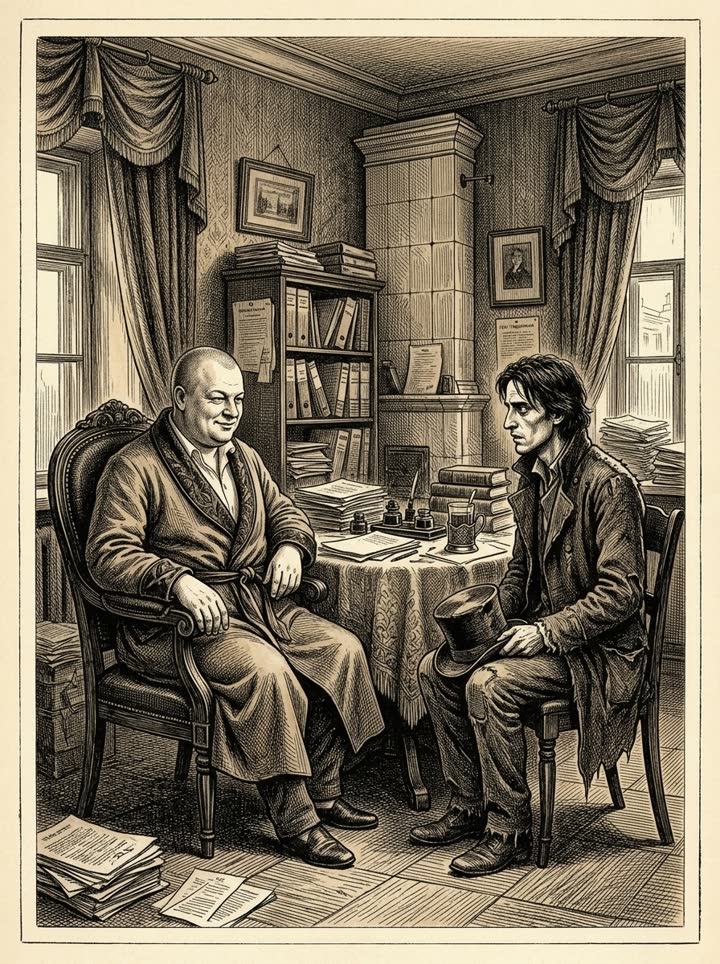
Raskolnikov was already going into the rooms. He went in looking as if he were holding himself back with all his strength to keep from bursting out laughing. Behind him, with a thoroughly discomfited and furious face, red as a peony, lanky and awkward, came the ashamed Razumikhin. His face and his whole figure were truly comic at that moment and justified Raskolnikov's laughter. Raskolnikov, not yet introduced, bowed to the master of the house, who was standing in the middle of the room looking at them questioningly, held out his hand and shook his, still with a visible and extraordinary effort to suppress his merriment and to get out at least two or three words to present himself. But he had barely managed to put on a serious face and mutter something when suddenly, as if involuntarily, he glanced at Razumikhin again, and then he could not hold out any longer: the suppressed laughter broke out all the more irresistibly for having been held back so hard. The extraordinary ferocity with which Razumikhin received this "heartfelt" laughter gave the whole scene the look of the most sincere gaiety and, above all, of naturalness. Razumikhin, as if on purpose, helped the matter along still further.
"Damn it!" he roared, waving his arm, and he struck it right against a little round table on which stood an empty glass of tea. Everything flew and crashed.
"But why break the chairs, gentlemen, it's a loss to the treasury!" Porfiry Petrovich cried gaily.
The scene stood like this: Raskolnikov was finishing his laugh, forgetting his hand in the hand of the master of the house, but, knowing where to stop, he was waiting for the moment to end it as quickly and as naturally as possible. Razumikhin, utterly confused by the fall of the table and the broken glass, looked gloomily at the pieces, spat, and turned sharply to the window, where he stood with his back to the company, his face dreadfully frowning, looking out of the window and seeing nothing. Porfiry Petrovich was laughing and wanted to laugh, but it was obvious that he needed an explanation. In the corner, on a chair, sat Zametov, who had half risen when the visitors came in and was standing waiting, his mouth stretched in a smile, but looking at the whole scene with bewilderment and even, as it were, with distrust, and at Raskolnikov even with a sort of embarrassment. Zametov's unexpected presence struck Raskolnikov unpleasantly.
"This will have to be thought over!" he thought.
"Forgive me, please," he began, putting on a great show of confusion. "Raskolnikov..."
"Not at all, I'm very pleased, sir, and you came in so pleasantly, too... Well, and won't he even say good day?" Porfiry Petrovich nodded towards Razumikhin.
"Upon my word, I don't know why he's flown into a rage with me. I only told him on the way that he looked like Romeo, and... and I proved it, and nothing else happened, I think."
"Pig!" Razumikhin responded without turning round.
"So he must have had very serious reasons, to be so angry over a single word," Porfiry laughed.
"Well, you! Examining magistrate!... Oh, the devil take the lot of you!" Razumikhin snapped, and suddenly, laughing himself, with a cheerful face, as if nothing had happened, he went up to Porfiry Petrovich.
"Enough! We're all fools. To business: here is my friend, Rodion Romanovich Raskolnikov, who first of all has heard a great deal about you and wished to make your acquaintance, and secondly has a little business with you. Ha! Zametov! How did you get here? Do you two know each other? Since when?"
"What's this now!" Raskolnikov thought anxiously.
Zametov seemed embarrassed, but not very.
"We met yesterday at your place," he said easily.
"So God has spared me the trouble: last week he begged me terribly to introduce him to you somehow, Porfiry, and you've sniffed each other out without me... Where is your tobacco?"
Porfiry Petrovich was dressed for home, in a dressing-gown, very clean linen and trodden-down slippers. He was a man of about thirty-five, below the middle height, stout and even with a little paunch, clean-shaven, without moustache or whiskers, with close-cropped hair on a large round head, which was somehow especially prominent and rounded at the back. His plump, round and slightly snub-nosed face was of a sickly, dark yellow colour, but rather lively and even mocking. It would even have been good-natured, if the expression of the eyes had not spoiled it, with a kind of liquid, watery shine, covered by almost white lashes that blinked as if winking at someone. The look of those eyes somehow strangely did not harmonise with the whole figure, which had even something womanish about it, and gave it something much more serious than one could expect of it at first glance.
As soon as Porfiry Petrovich heard that his guest had "a little business" with him, he at once asked him to sit down on the sofa, sat down himself at the other end, and fixed his gaze on the guest, in immediate expectation of the statement of the matter, with that intense and far too serious attention which weighs on you and embarrasses you at first, especially if you are not acquainted, and especially if what you are explaining is, in your own opinion, far out of proportion to such extraordinarily important attention shown to you. But Raskolnikov, in short and coherent words, clearly and exactly explained his business, and was so pleased with himself that he even managed to examine Porfiry quite well. Porfiry Petrovich, too, never once took his eyes off him the whole time. Razumikhin, who had placed himself opposite, at the same table, followed the explanation hotly and impatiently, every minute turning his eyes from one to the other and back again, which was already overdoing it a little.
"Fool!" Raskolnikov swore to himself.
"You ought to file a declaration with the police," Porfiry answered in the most businesslike manner, "to say, sir, that having been informed of such-and-such an occurrence, that is, of this murder, you request in your turn that the examining magistrate to whom the case is entrusted be notified that such-and-such things belong to you and that you wish to redeem them... or something of the kind... but they will write it out for you, in any case."
"The trouble is that at the present moment," Raskolnikov tried as hard as he could to look embarrassed, "I'm not quite in funds... and I can't manage even such a trifle... I would like, you see, for now only to declare that these things are mine, but that when I have the money..."
"That makes no difference, sir," answered Porfiry Petrovich, receiving the explanation about finances coldly, "and besides, you can, if you like, write directly to me, to the same effect, that having been informed of such-and-such and declaring such-and-such things of mine, I ask..."
"On plain paper?" Raskolnikov hastened to interrupt, again taking an interest in the financial side of the matter.
"Oh, the very plainest, sir!" and suddenly Porfiry Petrovich looked at him in an openly mocking way, narrowing his eyes and as if winking at him. However, perhaps it only seemed so to Raskolnikov, because it lasted one moment. At least there was something of the kind. Raskolnikov would have sworn that he had winked at him, the devil knew why.
"He knows!" flashed through him like lightning.
"Forgive me for troubling you with such trifles," he went on, somewhat confused. "My things are worth only five roubles, but they are especially dear to me, as a memory of those from whom they came, and, I confess, when I found out I was very frightened..."
"So that's why you flared up yesterday when I let slip to Zosimov that Porfiry was questioning the pawners!" Razumikhin put in, with obvious intention.
This was already unbearable. Raskolnikov could not stand it and flashed at him maliciously with his black eyes, which blazed with anger. But he came to himself at once.
"You seem to be laughing at me, brother?" he turned to him, with cleverly produced irritation. "I agree that perhaps I do worry too much about such rubbish, in your eyes; but you can't take me for an egoist or a miser for that, and, in my eyes, these two worthless trifles may not be rubbish at all. I told you just now that this silver watch, which isn't worth a kopeck, is the only thing my father left. Laugh at me, but my mother has come to me," he suddenly turned to Porfiry, "and if she found out," he turned away again quickly to Razumikhin, trying especially to make his voice shake, "that the watch was lost, I swear she would be in despair! Women!"
"But not at all! I didn't mean it that way at all! Quite the opposite!" cried the distressed Razumikhin.
"Is it good? Is it natural? Did I overdo it?" Raskolnikov trembled to himself. "Why did I say 'women'?"
"And your mother has come to you?" Porfiry Petrovich inquired, for some reason.
"Yes."
"And when was that, sir?"
"Yesterday evening."
Porfiry was silent, as if considering.
"Your things could not possibly have been lost in any case," he went on calmly and coldly. "You see, I've been expecting you here for a long time."
And as if nothing were the matter, he began carefully pushing an ashtray towards Razumikhin, who was mercilessly dropping ash from his cigarette on the carpet. Raskolnikov shuddered, but Porfiry did not seem even to look, still preoccupied with Razumikhin's cigarette.
"What-at? Expecting him! Did you know, then, that he had pawned things there too?" cried Razumikhin.
Porfiry Petrovich addressed Raskolnikov directly:
"Both your things, the ring and the watch, were wrapped up together in one paper at her place, and on the paper your name is clearly marked in pencil, as well as the date on which she received them from you..."
"How observant you are!..." Raskolnikov smiled awkwardly, especially trying to look straight into his eyes; but he could not hold back and suddenly added: "I say so because there must have been very many pawners... so that it would be hard for you to remember them all... But you, on the contrary, remember them all so exactly, and... and..."
"Stupid! Weak! Why did I add that!"
"But almost all the pawners are known by now, so that you alone have not deigned to appear," answered Porfiry with a barely noticeable shade of mockery.
"I wasn't quite well."
"I heard that too, sir. I even heard that you were very much upset about something. You look rather pale even now?"
"I'm not pale at all... on the contrary, quite well!" Raskolnikov snapped rudely and angrily, suddenly changing his tone. The anger was boiling up in him, and he could not suppress it. "And in my anger I'll blurt it out!" flashed through him again. "And why do they torment me!..."
"Not quite well!" Razumikhin took it up. "What a thing to say! Till yesterday he was delirious, almost unconscious... Believe me, Porfiry, he can hardly stand on his feet, and the moment we, Zosimov and I, turned our backs yesterday, he dressed and slipped away and carried on somewhere almost till midnight, and that, I tell you, in complete delirium, can you imagine it! A most remarkable case!"
"In complete delirium? You don't say!" Porfiry shook his head with a sort of womanish gesture.
"Oh, nonsense! Don't believe it! But then you don't believe it anyway!" it burst out of Raskolnikov, far too spitefully. But Porfiry Petrovich seemed not to have heard these strange words.
"But how could you have gone out if not in delirium?" Razumikhin suddenly flared up. "Why did you go out? What for?... And why in secret, in particular? Well, did you have any common sense then? Now that all the danger is over, I tell you straight!"
"I got terribly sick of them yesterday," Raskolnikov suddenly turned to Porfiry with an insolent, challenging smile. "So I ran away from them to take a flat, so that they wouldn't find me, and I took a heap of money with me. Mr. Zametov there saw the money. Well, Mr. Zametov, was I clever yesterday or delirious? Settle the argument, please!"
He would, it seemed, have strangled Zametov at that moment. Zametov's look and his silence displeased him too much.
"In my opinion you talked very sensibly, sir, and even cunningly, sir, only you were too irritable," Zametov declared drily.
"And today Nikodim Fomich told me," Porfiry Petrovich put in, "that he met you yesterday, very late, in the lodging of a clerk who was run over by horses..."
"Well, take that clerk, for instance!" Razumikhin took it up. "Weren't you mad at the clerk's? You gave the widow your last money for the funeral! Well, if you wanted to help, give fifteen, give twenty, well, at least keep three roubles for yourself, but no, he handed over all twenty-five!"
"Perhaps I found a treasure somewhere and you don't know it? That's why I was so generous yesterday... Mr. Zametov knows that I found a treasure!... Forgive me, please," he turned to Porfiry with trembling lips, "for troubling you for half an hour with such trifling talk. We have bored you, haven't we?"
"Not at all, sir, on the contrary, on the con-trary! If you knew how you interest me! It's curious both to look at you and to listen... and I confess I'm so glad that you have deigned to come at last..."
"But give us some tea at least! My throat is dry!" cried Razumikhin.
"A splendid idea! Perhaps everyone will join us. But wouldn't you like... something more substantial, before the tea?"
"Get out!"
Porfiry Petrovich went out to order tea.
Thoughts were whirling like a hurricane in Raskolnikov's head. He was terribly irritated.
"The main thing is, they don't even hide it, and don't want to stand on ceremony! And why, if you don't know me at all, did you talk about me with Nikodim Fomich? So they don't even want to hide that they're tracking me like a pack of dogs! They spit right in my face!" he shook with fury. "Well, strike me straight out, but don't play with me like a cat with a mouse. That's impolite, Porfiry Petrovich, and perhaps I may not put up with it, sir!... I'll get up and blurt out the whole truth in all your faces; and you'll see how I despise you!..." He drew breath with difficulty. "But what if it only seems so to me? What if it's a mirage, and I'm mistaken in everything, and am angry out of inexperience, and can't keep up my vile role? Perhaps it's all without intention? All their words are ordinary, but there is something in them... All this can always be said, but there is something. Why did he say straight out 'at her place'? Why did Zametov add that I talked cunningly? Why do they speak in such a tone? Yes... the tone... Razumikhin was sitting right here, why does nothing strike him? That innocent blockhead is never struck by anything! The fever again!... Did Porfiry wink at me just now or not? Surely nonsense; why should he wink? Do they want to irritate my nerves, or are they teasing me? Either it's all a mirage, or they know!... Even Zametov is insolent... Is Zametov insolent? Zametov changed his mind overnight. I had a foreboding that he would change his mind! He is here like one of the family, and yet it's his first time. Porfiry doesn't count him as a guest, he sits with his back to him. They've sniffed each other out! Certainly because of me they've sniffed each other out! Certainly they talked about me before we came!... Do they know about the flat?... If only it were over quickly!... When I said I ran off yesterday to take a flat, he let it pass, didn't pick it up... But I put in the flat cleverly: it will come in useful later!... In delirium, supposedly!... Ha-ha-ha! He knows about the whole evening yesterday! He didn't know about my mother's arrival!... And the witch wrote the date in pencil too!... You're lying, I won't give in! These aren't facts yet, it's only a mirage! No, you give me facts! And the flat isn't a fact, it's delirium; I know what to tell them... Do they know about the flat?... I won't leave without finding out! Why did I come? And that I'm angry now, that may be a fact! Ugh, how irritable I am! But perhaps that's good; the role of an invalid... He is feeling me out. He will try to throw me off. Why did I come?"
All this passed through his head like lightning.
Porfiry Petrovich came back in a moment. He had suddenly become somehow merrier.
"My head, brother, since your party yesterday... And I'm somehow all out of sorts," he began in quite a different tone, laughing, to Razumikhin.
"Well, was it interesting? I left you yesterday at the most interesting point, didn't I? Who won?"
"No one, of course. They slid off into the everlasting questions, soaring in the clouds."
"Just imagine, Rodya, what they slid off into yesterday: whether there is such a thing as crime or not. I told you, they talked nonsense till they were seeing devils!"
"What's surprising in that? An ordinary social question," Raskolnikov answered absent-mindedly.
"The question was not formulated that way," Porfiry observed.
"Not quite that way, it's true," Razumikhin agreed at once, hurrying and growing hot as usual. "You see, Rodion: listen and tell me your opinion. I want it. I was straining every nerve with them yesterday and waiting for you; I told them about you too, that you would come... It began with the view of the socialists. The view is well known: crime is a protest against the abnormality of the social order, and that's all, nothing more, and no other causes are admitted, and nothing!..."
"There you are lying!" cried Porfiry Petrovich. He was visibly growing animated and laughing every minute as he looked at Razumikhin, which set him on fire still more.
"N-nothing is admitted!" Razumikhin interrupted hotly. "I'm not lying!... I'll show you their books: with them everything is because 'the environment has ground them down,' and nothing more! Their favourite phrase! From it directly follows that if society is arranged normally, all crimes will vanish at once, since there will be nothing to protest against, and all will become righteous in an instant. Nature is not taken into account, nature is banished, nature is not allowed for! With them it is not mankind, having developed to the end by the historical, living path, that will of itself turn at last into a normal society; on the contrary, a social system, coming out of some mathematical head, will at once arrange all mankind and in an instant make it righteous and sinless, before any living process, without any historical, living path! That is why they so instinctively dislike history: 'nothing but ugliness in it and stupidity,' and everything is explained by stupidity alone! That is why they so dislike the living process of life: no living soul is wanted! A living soul will demand life, a living soul will not obey mechanics, a living soul is suspicious, a living soul is retrograde! But here, though there's a whiff of the corpse about it, it can be made of rubber; but then it isn't alive, it has no will, it's servile, it won't rebel! And the result is that everything is reduced to nothing but the laying of bricks and the arrangement of corridors and rooms in a phalanstery! The phalanstery is ready, but your nature is not yet ready for the phalanstery, it wants life, it hasn't finished the life process, it's too early for the cemetery! You can't skip over nature with logic alone! Logic foresees three cases, and there are a million! Cut off the whole million and reduce everything to the single question of comfort! The easiest solution of the problem! Temptingly clear, and there's no need to think! The main thing is, no need to think! The whole secret of life fits on two printed sheets!"
"There, he's broken loose, he's rattling away! Someone ought to hold his arms," Porfiry laughed. "Imagine," he turned to Raskolnikov, "it was just like this yesterday evening, in one room, in six voices, and after I had given them punch first, besides. Can you picture it? No, brother, you're lying: 'environment' means a great deal in crime; that I'll confirm to you."
"I know myself that it means a great deal, but you tell me this: a man of forty dishonours a girl of ten; did the environment compel him to it?"
"Well, in the strict sense, perhaps it did, even the environment," Porfiry observed with astonishing gravity. "A crime against a girl can very, very well be explained by 'the environment.'"
Razumikhin almost flew into a rage.
"Well, do you want me to prove to you right now," he roared, "that you have white eyelashes solely because the bell tower of Ivan the Great is thirty-five sazhens high, and I'll prove it clearly, exactly, progressively, and even with a liberal tinge? I undertake it! Well, will you bet?"
"I accept! Let us listen, please, to how he proves it!"
"But he's pretending the whole time, the devil!" cried Razumikhin, jumping up and waving his hand. "Is it worth talking to you? He does all this on purpose, you don't know him yet, Rodion! And yesterday he took their side only to make fools of everyone. And what he said yesterday, Lord! And they were delighted with him!... He keeps it up like that for two weeks. Last year he assured us for some reason that he was going into a monastery: for two months he stuck to it! Lately he took it into his head to assure us that he was getting married, that everything was already ready for the wedding. He even had a new suit made. We started congratulating him. No bride, nothing at all: it was all a mirage!"
"Now you're lying! I had the suit made first. It was on account of the new suit that the idea came to me to play a trick on you all."
"Are you really such a dissembler?" Raskolnikov asked carelessly.
"And you thought not? Wait, I'll take you in too, ha-ha-ha! No, you see, sir, I will tell you the whole truth. Apropos of all these questions, crimes, environment, little girls, I now remember, and indeed it has always interested me, an article of yours: 'On Crime'... or whatever it is you call it, I've forgotten the title, I can't remember. Two months ago I had the pleasure of reading it in the Periodical Speech."
"My article? In the Periodical Speech?" Raskolnikov asked in surprise. "I did write an article, half a year ago, when I left the university, about a certain book, but I took it then to the newspaper Weekly Speech, not the Periodical."
"But it ended up in the Periodical."
"But Weekly Speech ceased to exist, which is why it wasn't printed then..."
"That's true, sir; but in ceasing to exist, Weekly Speech merged with Periodical Speech, and so your little article appeared two months ago in Periodical Speech. And you didn't know?"
Raskolnikov really knew nothing.
"For goodness' sake, you can ask them for money for the article! What a character you have, though! You live so secluded that you don't know of such things, which directly concern you. It's a fact, sir."
"Bravo, Rodka! And I didn't know either!" cried Razumikhin. "I'll run to the reading-room today and ask for the issue! Two months ago? What date? I'll find it all the same! What a thing! And he doesn't say a word!"
"And how did you find out that the article was mine? It's signed with just a letter."
"By chance, and only the other day. Through the editor; I know him... I became very interested."
"I was examining, as I remember, the psychological state of the criminal throughout the whole course of the crime."
"Yes, sir, and you insist that the act of carrying out a crime is always accompanied by illness. Very, very original, but... it wasn't actually this part of your little article that interested me, but a certain thought slipped in at the end of the article, which you, unfortunately, develop only as a hint, unclearly... In a word, if you remember, a certain hint is made that there exist in the world certain persons who can... that is, not that they can, but that they have a perfect right to commit all sorts of outrages and crimes, and that for them, supposedly, the law does not apply."
Raskolnikov smiled at the forced and deliberate distortion of his idea.
"What? What's this? A right to crime? But surely not because 'the environment has ground them down'?" Razumikhin asked, even with a sort of fear.
"No, no, not quite for that reason," answered Porfiry. "The whole point is that in his article all people are somehow divided into 'ordinary' and 'extraordinary.' The ordinary must live in obedience and have no right to transgress the law, because, you see, they are ordinary. And the extraordinary have the right to commit all sorts of crimes and to transgress the law in every way, precisely because they are extraordinary. So it is with you, I think, if I'm not mistaken?"
"But how is that? It can't be that way!" Razumikhin muttered in bewilderment.
Raskolnikov smiled again. He understood at once what the matter was and what they wanted to push him towards; he remembered his article. He decided to accept the challenge.
"It's not quite so in mine," he began simply and modestly. "However, I confess, you have stated it almost correctly, even, if you like, quite correctly..." (It seemed to give him pleasure to agree that it was quite correct.) "The only difference is that I do not insist at all that extraordinary people must and are obliged always to commit all sorts of outrages, as you say. It even seems to me that such an article would not have been passed for print. I simply hinted that an 'extraordinary' man has the right... that is, not an official right, but he himself has the right to permit his conscience to step over... certain obstacles, and only in the case where the carrying out of his idea (sometimes, perhaps, a saving one for all mankind) requires it. You are pleased to say that my article is unclear; I am ready to explain it to you, as far as possible. I don't think I shall be wrong in supposing that that is just what you would like; very well, sir. In my opinion, if the discoveries of Kepler and Newton, as a result of some combinations, could in no way become known to people except at the cost of the lives of one, ten, a hundred people and so on, who hindered the discovery or stood in its way as an obstacle, then Newton would have the right, and would even be obliged... to remove those ten or a hundred people, in order to make his discoveries known to all mankind. From this, however, it does not follow at all that Newton had the right to kill whomever he pleased, people he met at random, or to steal every day at the market. Further, as I remember, I develop in my article that all... well, for example, the lawgivers and founders of mankind, beginning with the most ancient, going on with the Lycurguses, Solons, Mohammeds, Napoleons and so on, were criminals, every one of them, if only by the fact that, giving a new law, they thereby broke the old one, held sacred by society and handed down from the fathers, and, of course, they did not stop at blood either, if only blood (sometimes quite innocent and valiantly shed for the old law) could help them. It is even remarkable that the greater part of these benefactors and founders of mankind were especially terrible shedders of blood. In a word, I conclude that all, not only the great, but also those who stray even a little from the rut, that is, who are capable even a little of saying something new, must by their nature necessarily be criminals, more or less, of course. Otherwise it is hard for them to get out of the rut, and they certainly cannot agree to remain in the rut, again by their nature, and in my opinion they are even obliged not to agree. In a word, you see that so far there is nothing especially new here. It has been printed and read a thousand times. As for my division of people into ordinary and extraordinary, I agree that it is somewhat arbitrary, but I do not insist on exact figures. I only believe in my main idea. It consists precisely in this, that people by a law of nature are divided in general into two categories: the lower (the ordinary), that is, so to speak, the material, serving solely for the reproduction of their own kind, and people proper, that is, those who have the gift or talent to say a new word in their midst. The subdivisions here, of course, are endless, but the distinguishing features of both categories are fairly sharp: the first category, that is, the material, speaking generally, are people by nature conservative, decorous, who live in obedience and like to be obedient. In my opinion they are obliged to be obedient, because that is their purpose, and there is decidedly nothing humiliating in it for them. The second category, all of them transgress the law, are destroyers or inclined to be, judging by their abilities. The crimes of these people are, of course, relative and various; for the most part they demand, in very diverse declarations, the destruction of the present in the name of the better. But if he needs, for the sake of his idea, to step even over a corpse, over blood, then he can within himself, in conscience, in my opinion, give himself permission to step over blood, depending, however, on the idea and its scale, mark that. It is only in this sense that I speak in my article of their right to crime. (You will remember that we began with a legal question.) However, there is not much to be alarmed about: the masses almost never recognise this right in them, they punish them and hang them (more or less), and in this, quite justly, fulfil their conservative purpose, with this proviso, however, that in following generations the same masses place the executed on a pedestal and worship them (more or less). The first category is always master of the present, the second category is master of the future. The first preserve the world and increase it in number; the second move the world and lead it to its goal. Both have exactly the same right to exist. In a word, with me all have an equal right, and, long live eternal war, until the New Jerusalem, of course!"
"So you do believe in the New Jerusalem?"
"I do," Raskolnikov answered firmly; as he said this, and throughout his whole long tirade, he looked at the ground, having chosen a spot on the carpet.
"A-a-and do you believe in God? Forgive me for being so curious."
"I do," repeated Raskolnikov, raising his eyes to Porfiry.
"A-and do you believe in the raising of Lazarus?"
"I d-do. Why do you want all this?"
"You believe literally?"
"Literally."
"Is that so, sir... I was just curious. Forgive me, sir. But allow me, I'm going back to what we were saying, they are not always executed; some, on the contrary..."
"Triumph in their lifetime? Oh yes, some attain it even in their lifetime, and then..."
"They begin to execute others?"
"If need be, and, you know, even for the most part. On the whole, your remark is witty."
"Thank you, sir. But tell me this: how are these extraordinary ones to be distinguished from the ordinary? Are there signs at birth, perhaps? I mean that here there ought to be more precision, so to speak, more outward definiteness: forgive the natural anxiety of a practical and well-meaning man, but couldn't one introduce, for example, a special dress, wear something, some brands or the like?... Because, you must agree, if there is confusion and one of one category imagines that he belongs to the other category, and begins to 'remove all obstacles,' as you very happily put it, then here..."
"Oh, that happens very often! This remark of yours is even wittier than the last..."
"Thank you, sir..."
"Not at all, sir; but take into consideration that a mistake is possible only on the part of the first category, that is, the 'ordinary' people (as I, perhaps very unfortunately, called them). Despite their innate inclination to obedience, through a certain playfulness of nature, which is not denied even to a cow, very many of them like to imagine themselves advanced people, 'destroyers,' and to push into the 'new word,' and that quite sincerely, sir. At the same time they very often do not notice the really new people, and even despise them as backward and basely thinking people. But in my opinion there can be no considerable danger here, and you really have nothing to worry about, because they never go far. For their enthusiasm, of course, they might sometimes be flogged, to remind them of their place, but no more; there is not even need of an executioner: they will flog themselves, because they are very well-behaved; some do this service for one another, and others do it with their own hands... They lay various public penances on themselves into the bargain, and it comes out beautiful and edifying; in a word, you have nothing to worry about... There is such a law."
"Well, at least on that side you have reassured me somewhat; but here is another trouble, sir: tell me, please, are there many of such people who have the right to cut others down, these 'extraordinary' ones? I am, of course, ready to bow down, but you must agree, it's frightening, sir, if there are a great many of them, eh?"
"Oh, don't worry about that either," Raskolnikov went on in the same tone. "In general, people with a new thought, even those only slightly capable of saying something new, are born extraordinarily few, even strangely few. Only one thing is clear, that the order of the birth of people, of all these categories and subdivisions, must be quite exactly and precisely determined by some law of nature. This law, of course, is unknown now, but I believe that it exists and may later become known. The enormous mass of people, the material, exists in the world only in order that at last, by some effort, by some process mysterious until now, by means of some crossing of races and breeds, it may strain itself and bring into the world at last, say, out of a thousand, one man with some degree of independence. With a still wider independence is born, perhaps, one in ten thousand (I speak by way of example, to make it plain). With a still wider, one in a hundred thousand. Men of genius, one in millions, and great geniuses, the completers of mankind, perhaps after many thousands of millions of people on the earth. In a word, I have not looked into the retort in which all this takes place. But there is certainly a definite law, and there must be; there can be no chance here."
"But what are you two doing, joking, or what?" Razumikhin cried at last. "Are you fooling each other or not? They sit there and make fun of each other! Are you serious, Rodya?"
Raskolnikov silently raised his pale and almost sad face to him and answered nothing. And to Razumikhin, beside this quiet and sad face, Porfiry's undisguised, importunate, irritable and impolite sarcasm seemed strange.
"Well, brother, if this is really serious, then... You are right, of course, in saying that it is not new and is like everything we have read and heard a thousand times; but what is really original in all this, and really belongs to you alone, to my horror, is that after all you permit bloodshed in good conscience, and, forgive me, even with such fanaticism... In that, then, the main idea of your article consists. But this permission to shed blood in good conscience, it is... it is, in my opinion, more terrible than an official permission to shed blood, a legal one..."
"Perfectly true, more terrible, sir," Porfiry responded.
"No, you got carried away somehow! There is a mistake here. I'll read it... You got carried away! You can't think so... I'll read it."
"There is none of this in the article, there are only hints," said Raskolnikov.
"Just so, sir, just so, sir," Porfiry could not sit still, "it has almost become clear to me now how you are pleased to look at crime, sir, but... forgive me for my importunity (I am troubling you very much, I am ashamed myself!), you see, sir: you reassured me very much just now about the mistaken cases of mixing up the two categories, but... all sorts of practical cases still trouble me again! What if some grown man or youth imagines that he is a Lycurgus or a Mohammed... a future one, of course... and sets about removing all obstacles to it... There is a long campaign ahead, he says, and for a campaign money is needed... well, and he begins to get it for himself for the campaign... you know?"
Zametov suddenly snorted in his corner. Raskolnikov did not even raise his eyes to him.
"I must agree," he answered calmly, "that such cases really must occur. The foolish and the vain especially fall for this bait; the young especially."
"You see, sir. Well, and so, sir?"
"Well, and so," Raskolnikov smiled, "it is not my fault. So it is and so it will always be. He (he nodded at Razumikhin) said just now that I permit blood. Well, what of it? Society is far too well provided with exile, prisons, examining magistrates, penal servitude; what is there to worry about? And look for the thief!..."
"Well, and if we find him?"
"Then it serves him right."
"You are certainly logical. Well, sir, and what about his conscience?"
"What business is it of yours?"
"Just so, out of humanity, sir."
"Let him who has one suffer, if he recognises his mistake. That is his punishment, apart from penal servitude."
"Well, and the real geniuses," Razumikhin asked, frowning, "those who are given the right to cut down, must they not suffer at all, even for the blood they have shed?"
"Why the word 'must' here? There is neither permission nor prohibition. Let him suffer, if he is sorry for the victim... Suffering and pain are always obligatory for a broad consciousness and a deep heart. Truly great men, it seems to me, must feel great sadness in the world," he added suddenly, thoughtfully, even out of tune with the conversation.
He raised his eyes, looked thoughtfully at them all, smiled and took his cap. He was far too calm compared with how he had come in earlier, and he felt it. Everyone stood up.
"Well, sir, scold me or not, be angry or not, but I cannot hold back," Porfiry Petrovich concluded again. "Allow me one more little question (I trouble you so very much, sir!), one little idea I wanted to put in, solely so as not to forget it, sir..."
"Very well, tell me your little idea," Raskolnikov stood before him, serious and pale, waiting.
"You see, sir... really, I don't know how to put it better... the idea is far too playful... psychological, sir... You see, sir, when you were composing your little article, why, it can't be, he-he! that you did not consider yourself, if only a tiny bit, also an 'extraordinary' man, saying a new word, in your sense, that is, sir... It's so, sir?"
"Very possibly," Raskolnikov answered contemptuously.
Razumikhin made a movement.
"And if so, sir, would you really bring yourself, say, in view of some worldly failures and hardships, or to assist somehow all mankind, to step over the obstacle?... Well, for example, to kill and rob?..."
And he somehow suddenly winked at him again with his left eye and laughed noiselessly, exactly as before.
"If I did step over, I certainly wouldn't tell you," Raskolnikov answered with defiant, haughty contempt.
"No, sir, I am only interested, really, for the understanding of your article, in a purely literary respect, sir..."
"Ugh, how blatant and brazen!" Raskolnikov thought with disgust.
"Allow me to remark," he answered drily, "that I do not consider myself a Mohammed or a Napoleon... or any such person, and therefore, not being them, I cannot give you a satisfactory explanation of how I would act."
"Oh, come now, who among us in Russia does not consider himself a Napoleon nowadays?" Porfiry suddenly pronounced with terrible familiarity. Even in the intonation of his voice there was this time something especially clear.
"Wasn't it some future Napoleon who finished off our Alyona Ivanovna with an axe last week?" Zametov suddenly blurted out from the corner.
Raskolnikov was silent and looked steadily and firmly at Porfiry. Razumikhin frowned darkly. He seemed to have begun to suspect something even before. He looked angrily around. A minute of gloomy silence passed. Raskolnikov turned to go.
"You're leaving already!" Porfiry said affably, holding out his hand most courteously. "I am very, very glad of the acquaintance. And as for your request, have no doubt. Write it just as I told you. But best of all, come and see me there yourself... one of these days... tomorrow, if you like. I shall certainly be there at about eleven o'clock. We'll arrange everything... we'll talk... You, as one of the last who were there, might be able to tell us something," he added with the most good-natured air.
"You want to question me officially, with all the formalities?" Raskolnikov asked sharply.
"Why, sir? For the present that is not required at all. You have misunderstood. I, you see, don't let an opportunity slip, and... and I have already talked with all the pawners... from some I have taken statements... and you, as the last... But here, by the way!" he cried, suddenly delighted about something. "By the way, I remember, what am I thinking of!..." he turned to Razumikhin, "you see, you wore my ears out about that Nikolashka then... well, I know myself, I know myself," he turned to Raskolnikov, "that the lad is innocent, but what can one do, we had to trouble Mitka too... this is the point, sir, the whole point, sir: passing by on the stairs then... allow me: you were there after seven o'clock, sir?"
"After seven," answered Raskolnikov, feeling unpleasantly at the same second that he might not have said it.
"So, passing by after seven o'clock, sir, on the stairs, sir, did you happen to see, on the second floor, in the flat that was open, you remember? two workmen, or at least one of them? They were painting there; did you not notice? It is very, very important for them!..."
"Painters? No, I didn't see them..." Raskolnikov answered slowly, as if rummaging in his memory, while at the same instant straining his whole being and freezing with the torment of guessing as quickly as possible where exactly the trap lay, and of not overlooking anything. "No, I didn't see them, and I didn't notice any such open flat... but on the fourth floor," he had already fully grasped the trap and was triumphant, "I remember that a clerk was moving out of a flat... opposite Alyona Ivanovna's... I remember... I remember it clearly... some soldiers were carrying out a sofa and pressed me against the wall... but painters, no, I don't remember there being any painters... and there wasn't any open flat anywhere, I think. No; there wasn't..."
"But what are you doing!" Razumikhin cried suddenly, as if coming to himself and working it out. "The painters were painting on the very day of the murder, and he was there three days before! What are you asking?"
"Ugh! I've mixed it up!" Porfiry slapped himself on the forehead. "Devil take it, this case is driving me out of my wits!" he turned, as if even apologising, to Raskolnikov. "It's so important for us to find out whether anyone saw them, after seven o'clock, in the flat, that I imagined just now that you too could tell us... I've quite mixed it up!"
"Then you must be more careful," Razumikhin observed gloomily.
The last words were spoken already in the entrance hall. Porfiry Petrovich saw them to the very door with extreme courtesy. Both went out into the street gloomy and frowning, and for several steps said not a word. Raskolnikov drew a deep breath...