
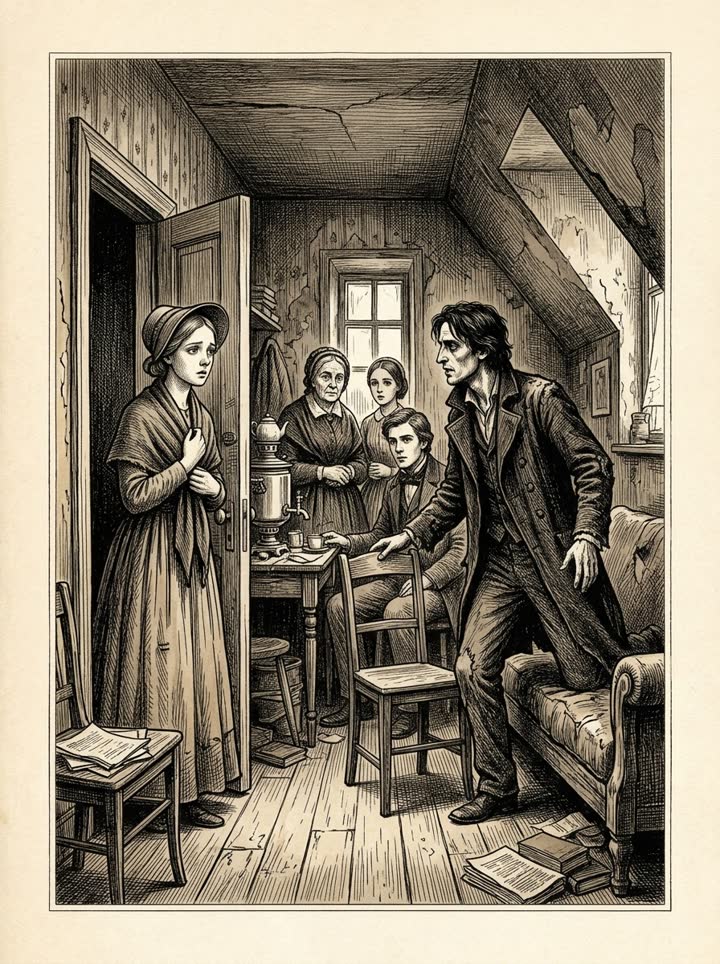
At that moment the door quietly opened, and a girl came into the room, looking timidly about her. Everyone turned to her with surprise and curiosity. Raskolnikov did not recognise her at first glance. It was Sofya Semyonovna Marmeladova. Yesterday he had seen her for the first time, but at such a moment, in such surroundings and in such a costume, that the picture kept in his memory was of an entirely different person. Now she was a modestly, even poorly dressed girl, still very young, almost like a child, with a modest and decent manner and a clear but somehow slightly frightened face. She wore a very plain little house dress, and on her head an old hat of a bygone fashion; only in her hand she had, as yesterday, a parasol. Seeing a room unexpectedly full of people, she was not so much embarrassed as utterly lost; she grew timid like a small child, and even made a movement to go back out.
"Ah... it's you?..." said Raskolnikov in extreme surprise, and suddenly felt confused himself.
It occurred to him at once that his mother and sister knew already, in passing, from Luzhin's letter, about a certain young woman of "notorious" behaviour. He had only just been protesting against Luzhin's slander and had mentioned that he had seen this girl for the first time, and now suddenly she walked in herself. He remembered, too, that he had not protested in the least against the expression "notorious behaviour". All this slid through his head vaguely and in an instant. But looking at her more closely, he suddenly saw that this humbled creature was so humbled already that he felt sorry for her. And when she made a movement to run away in fright, something in him seemed to turn over.
"I did not expect you at all," he said hurriedly, stopping her with a look. "Please be so good, sit down. You are surely from Katerina Ivanovna. Allow me, not there, sit here..."
When Sonya came in, Razumikhin, who had been sitting on one of Raskolnikov's three chairs, right by the door, half rose to let her pass. At first Raskolnikov had pointed her to a place in the corner of the sofa, where Zosimov was sitting, but remembering that the sofa was too familiar a place and served him as a bed, he hastened to point her to Razumikhin's chair instead.
"And you sit here," he said to Razumikhin, putting him in the corner where Zosimov had been sitting.
Sonya sat down, almost trembling with fear, and glanced timidly at the two ladies. It was plain that she herself did not understand how she could have sat down beside them. Realising it, she was so frightened that she suddenly stood up again and, in complete confusion, turned to Raskolnikov.
"I... I... I only came for one minute, forgive me for disturbing you," she began, stammering. "I am from Katerina Ivanovna, and she had no one else to send... And Katerina Ivanovna told me to ask you very much to be at the funeral service tomorrow, in the morning... at the liturgy... at the Mitrofanievsky, and then at our place... at hers... to have something to eat... To do her the honour... She told me to ask you."
Sonya faltered and fell silent.
"I will try without fail... without fail," answered Raskolnikov, rising too, and stammering too, and not finishing his words... "Please be so good, sit down," he said suddenly. "I must speak with you. Please, perhaps you are in a hurry, but be so good, give me two minutes..."
And he moved a chair towards her. Sonya sat down again and again glanced timidly, in confusion, as quickly as she could at the two ladies, and suddenly dropped her eyes.
Raskolnikov's pale face flushed; he seemed to shudder all over; his eyes blazed.
"Mother," he said firmly and insistently, "this is Sofya Semyonovna Marmeladova, the daughter of that unfortunate Mr. Marmeladov who was run down by the horses yesterday before my eyes, and of whom I have already told you..."
Pulcheria Alexandrovna looked at Sonya and slightly narrowed her eyes. In spite of all her embarrassment before Rodya's insistent and challenging look, she simply could not deny herself this pleasure. Dunechka fixed her serious gaze straight on the poor girl's face and studied her in bewilderment. Sonya, hearing the introduction, raised her eyes again, but was more confused than before.
"I wanted to ask you," Raskolnikov turned to her quickly, "how things have been arranged for you today? Were you not troubled?... by the police, for instance."
"No, sir, it all went off all right... It is only too plain what the death was from; they did not trouble us; only the lodgers are angry."
"Why?"
"Because the body stays so long... it is hot now, and the smell... so that today, towards vespers, it will be taken to the cemetery, to stand in the chapel until tomorrow. Katerina Ivanovna did not want it at first, but now she sees herself that it can't be helped..."
"So today?"
"She asks you to do us the honour of being at the funeral service in the church tomorrow, and then to come to her for the funeral meal."
"She is giving a funeral meal?"
"Yes, sir, a little food; she told me to thank you very much for helping us yesterday... without you we would have had nothing to bury him with." And her lips and chin suddenly began to tremble, but she controlled herself and held back, quickly lowering her eyes to the ground again.
All through the talk Raskolnikov studied her closely. It was a thin, quite thin and pale little face, rather irregular, somehow sharp, with a sharp little nose and chin. She could not even be called pretty, but her blue eyes were so clear, and when they lit up, the expression of her face became so kind and simple-hearted that one was drawn to her without wishing it. There was also one special, characteristic trait in her face, and in her whole figure: in spite of her eighteen years she seemed almost still a little girl, much younger than her age, almost a child, and this sometimes showed itself, even comically, in some of her movements.
"But can Katerina Ivanovna really manage with such small means, and even intend to give a meal?..." asked Raskolnikov, persistently keeping the conversation going.
"The coffin will be plain, sir... and everything will be plain, so it won't cost much... Katerina Ivanovna and I reckoned it all up just now, so that something is left over for the remembrance... and Katerina Ivanovna very much wants it to be so. For it can't be otherwise, sir... it is a comfort to her... she is like that, you know..."
"I understand, I understand... of course... Why are you looking at my room? Mother also says it is like a coffin."
"You gave us everything yesterday!" Sonechka said suddenly in reply, in a strong, quick sort of whisper, again suddenly dropping her eyes low. Her lips and chin began to tremble again. She had long been struck by the poverty of Raskolnikov's surroundings, and now these words burst out of themselves. A silence followed. Dunechka's eyes somehow grew brighter, and Pulcheria Alexandrovna even looked at Sonya kindly.
"Rodya," she said, getting up, "of course we shall dine together. Dunechka, let us go... And you, Rodya, go and walk a little, and then rest, lie down, and then come to us quickly... Otherwise I am afraid we have tired you out..."
"Yes, yes, I will come," he answered, rising and hurrying... "I have some business, though..."
"What, will you really dine apart from us?" shouted Razumikhin, looking at Raskolnikov in surprise. "What is the matter with you?"
"Yes, yes, I will come, of course, of course... But you stay a minute. You don't need him just now, Mother, do you? Or am I taking him from you?"
"Oh no, no! And you, Dmitri Prokofich, will you come to dinner, will you be so kind?"
"Please come," Dunya asked.
Razumikhin bowed and was all radiance. For one moment everyone somehow became strangely embarrassed.
"Goodbye, Rodya, that is, until we meet; I don't like saying 'goodbye'. Goodbye, Nastasya... ah, I said 'goodbye' again!..."
Pulcheria Alexandrovna wanted to bow to Sonechka too, but somehow it did not come off, and, hurrying, she left the room.
But Avdotya Romanovna seemed to have been waiting her turn, and, passing Sonya behind her mother, she bowed to her with an attentive, polite and full bow. Sonechka was confused, and bowed in a hurried and frightened way; something even like a painful feeling showed in her face, as if Avdotya Romanovna's politeness and attention were burdensome and tormenting to her.
"Dunya, goodbye then!" Raskolnikov called, already in the passage. "Give me your hand!"
"But I did give it, have you forgotten?" answered Dunya, turning to him warmly and awkwardly.
"Well, give it again!"
And he pressed her little fingers hard. Dunechka smiled at him, blushed, quickly pulled her hand away and went after her mother, also all happy for some reason.
"Well, that is fine!" he said to Sonya, returning to his room and looking at her clearly. "God give rest to the dead, and let the living live! Isn't that so? Isn't it? Surely it is?"
Sonya looked in surprise at his face, suddenly brightened; for some moments he gazed at her silently and fixedly; the whole story of her told by her dead father swept at that moment into his memory...
"Lord, Dunechka!" Pulcheria Alexandrovna began at once, as soon as they were out in the street. "Why, now I am really glad myself that we have left: it is somehow easier. Well, did I think yesterday, in the railway carriage, that I would be glad even of this!"
"I tell you again, Mother, he is still very ill. Can't you see it? Perhaps, suffering over us, he upset himself. We must be indulgent, and much, much can be forgiven."
"But you were not indulgent!" Pulcheria Alexandrovna cut in at once, hotly and jealously. "Do you know, Dunya, I looked at the two of you, you are his perfect portrait, and not so much in face as in soul: you are both melancholy, both gloomy and hot-tempered, both haughty and both generous... He can't be an egoist, Dunechka, can he? Eh?... And when I think what will happen at our place this evening, my heart simply sinks!"
"Do not worry, Mother, what must be will be."
"Dunechka! But only think what a position we are in now! Well, what if Pyotr Petrovich refuses?" poor Pulcheria Alexandrovna blurted out imprudently.
"Then what will he be worth after that!" Dunechka answered sharply and scornfully.
"We did well to leave just now," Pulcheria Alexandrovna hurried on, interrupting. "He was hurrying off somewhere on business; let him walk, at least breathe the air... it is dreadfully stuffy at his place... but where is one to breathe air here? Even in the streets here it is like rooms without ventilation windows. Lord, what a city!... Wait, stand aside, you'll be crushed, they are carrying something! Why, that was a piano they carried by, really... how they push... I am very afraid of that girl too..."
"What girl, Mother?"
"Why, that one, Sofya Semyonovna, who was there just now..."
"Why?"
"I have a presentiment, Dunya. Well, believe it or not, the moment she came in, I thought that this is just where the main thing lies..."
"Nothing lies there at all!" Dunya cried out with vexation. "And what a one you are with your presentiments, Mamma! He has known her only since yesterday, and when she came in just now, he did not recognise her."
"Well, you will see!... She troubles me, you will see, you will see! And I was so frightened: she looks and looks at me, with such eyes, I could hardly keep my seat, do you remember how he began to introduce her? And it seems strange to me: Pyotr Petrovich writes about her like that, and yet he introduces her to us, and to you, too! So she must be dear to him!"
"What does it matter what he writes! They talked about us too, and wrote about us, have you forgotten? And I am sure that she is... a fine girl, and that all this is nonsense!"
"God grant it!"
"And Pyotr Petrovich is a worthless gossip," Dunechka suddenly snapped.
Pulcheria Alexandrovna shrank. The conversation broke off.
"Here is what it is, here is the business I have with you..." said Raskolnikov, leading Razumikhin away to the window...
"Then I will tell Katerina Ivanovna that you will come..." Sonya hurried, bowing to leave.
"In a moment, Sofya Semyonovna, we have no secrets, you are not in the way... I should like to say two more words to you... Here it is," he turned suddenly to Razumikhin, without finishing, as if breaking off short. "You know this... what's his name!... Porfiry Petrovich?"
"Of course! A relation of mine. What is it?" the other added, with a sort of burst of curiosity.
"He is now in charge of that case... well, that murder... that you were speaking of yesterday?"
"Yes... well?" Razumikhin suddenly goggled his eyes.
"He has been questioning the people who pawned things with her, and I have some pledges there too, trifles, but still, my sister's little ring, which she gave me as a keepsake when I was leaving to come here, and my father's silver watch. All of it is worth five or six roubles, but it is dear to me, a keepsake. So what am I to do now? I don't want the things to be lost, especially the watch. I trembled earlier that Mother would ask to look at it, when they began to talk about Dunechka's watch. It is the only thing that survived after Father. She will fall ill if it is lost! Women! So tell me what to do, teach me! I know I ought to report it to the police station. But wouldn't it be better to go to Porfiry himself, eh? What do you think? I want to get the matter settled quickly. You will see, Mother will ask before dinner!"
"Not the station at all, and certainly to Porfiry!" shouted Razumikhin, in an extraordinary excitement. "Well, how glad I am! Why wait, let's go at once, it is two steps away, we shall surely find him in!"
"Very well... let's go..."
"And he will be very, very, very, very glad to meet you! I have talked a great deal to him about you, at various times... And yesterday I talked too. Let's go!... So you knew the old woman? Well, well!... It has all turned out mag-nif-icently!... Ah yes... Sofya Ivanovna..."
"Sofya Semyonovna," Raskolnikov corrected him. "Sofya Semyonovna, this is my friend Razumikhin, and he is a good man..."
"If you have to go now..." Sonya began, without looking at Razumikhin at all, and being all the more confused for that.
"Then let us go!" Raskolnikov decided. "I will come to see you today, Sofya Semyonovna, only tell me where you live?"
He was not so much flustered as hurrying, as it were, and avoiding her glances. Sonya gave her address, and blushed as she did so. They all went out together.
"Don't you lock up?" asked Razumikhin, coming down the stairs after them.
"Never!... Though for two years now I have been meaning to buy a lock," he added carelessly. "Happy people, aren't they, who have nothing to lock up?" he said to Sonya, laughing.
In the street they stopped in the gateway.
"You go to the right, Sofya Semyonovna? By the way, how did you find me?" he asked, as if wanting to say something quite different to her. He kept wanting to look into her quiet, clear eyes, and somehow this did not work out...
"But you gave Polechka your address yesterday."
"Polya? Ah yes... Polechka! That is... the little one... is she your sister? So I gave her the address?"
"Why, have you forgotten?"
"No... I remember..."
"And I heard about you from my late father, back then... Only I did not yet know your surname then, and he himself did not know it... And now I have come... and since I learned your surname yesterday... I asked today: where does Mr. Raskolnikov live here?... And I did not know that you are a lodger too... Goodbye, sir... I will tell Katerina Ivanovna..."
She was terribly glad to have got away at last; she walked with her eyes lowered, hurrying, to get out of their sight somehow as quickly as possible, to get through those twenty steps to the turning on the right into the street and be alone at last, and there, walking, hurrying, looking at no one, noticing nothing, to think, to remember, to weigh each word that had been said, each circumstance. Never, never had she felt anything like it. A whole new world had come down into her soul, unknown and vague. She suddenly remembered that Raskolnikov himself wanted to call on her today, perhaps this morning, perhaps even now!
"Only not today, please, not today!" she muttered with a sinking heart, as if begging someone, like a frightened child. "Lord! To me... into that room... he will see... oh Lord!"
And of course she could not notice at that moment a gentleman unknown to her, who was diligently following her and dogging her steps. He had followed her from the moment she came out of the gateway. At the moment when all three, Razumikhin, Raskolnikov and she, stopped on the pavement for a couple of words, this passer-by, going round them, suddenly gave a sort of start, having caught in passing, by chance, Sonya's words: "and I asked: where does Mr. Raskolnikov live?" He quickly but attentively looked over all three, and especially Raskolnikov, to whom Sonya was speaking; then he looked at the house and took note of it. All this was done in an instant, in passing, and the passer-by, trying not to show it even by a look, went on further, slowing his pace, as if waiting. He was waiting for Sonya; he saw that they were saying goodbye and that Sonya was about to go somewhere to her own place.
"So where is her place? I have seen that face somewhere," he thought, recalling Sonya's face... "I must find out."
Reaching the turning, he crossed to the opposite side of the street, looked round and saw that Sonya was already walking behind him, by the same road, noticing nothing. Reaching the turning, she too turned into the same street. He walked on after her, not taking his eyes off her from the opposite pavement; after about fifty paces he crossed again to the side Sonya was walking on, caught up with her and followed her, keeping five paces' distance.
He was a man of about fifty, taller than average, stout, with broad, powerful shoulders, which gave him a slightly stooping look. He was dressed smartly and comfortably and looked like an imposing gentleman. In his hand he had a handsome cane, with which he tapped the pavement at every step, and his hands were in fresh gloves. His broad, high-cheekboned face was rather pleasant, and his complexion was fresh, not a Petersburg one. His hair, still very thick, was quite fair and only the least bit streaked with grey, and his broad, thick beard, spreading out like a spade, was even lighter than the hair on his head. His eyes were blue and looked cold, fixed and thoughtful; his lips were scarlet. In general he was a splendidly preserved man and seemed much younger than his years.
When Sonya came out on the canal, the two of them found themselves alone on the pavement. Watching her, he had managed to notice her thoughtfulness and absent-mindedness. Reaching her own house, Sonya turned in at the gateway, and he after her, as if somewhat surprised. Going into the yard, she took the right, to the corner where the stairs to her lodging were. "Ba!" muttered the unknown gentleman, and began to climb the steps after her. Only then did Sonya notice him. She went up to the third floor, turned into the gallery and rang at number nine, on whose door was written in chalk: "Kapernaumov, tailor." "Ba!" the stranger repeated, surprised at the strange coincidence, and rang at the next door, number eight. The two doors were about six paces from each other.
"You lodge at Kapernaumov's!" he said, looking at Sonya and laughing. "He altered a waistcoat for me yesterday. And I am here, next to you, at Madame Resslich's, Gertruda Karlovna's. How it has turned out!"
Sonya looked at him attentively.
"Neighbours," he went on, somehow particularly cheerfully. "I have been in town only three days. Well, goodbye for now."
Sonya did not answer; the door was opened, and she slipped into her place. For some reason she felt ashamed, and as if she had grown timid...
On the way to Porfiry, Razumikhin was in a particularly excited state.
"This is fine, brother," he repeated several times, "and I am glad! I am glad!"
"But what are you glad about?" Raskolnikov thought to himself.
"I did not even know that you had pledged things with the old woman too. And... and... was it long ago? That is, was it long ago that you were at her place?"
"What a naive fool!"
"When?..." Raskolnikov stopped, trying to recall. "Why, about three days before her death I was there, I think. However, I am not going now to redeem the things," he went on quickly, with a sort of hurried and special concern for the things, "for I have again only one silver rouble... because of this accursed delirium of yesterday!..."
He pronounced the word delirium with particular emphasis.
"Yes, yes, yes," Razumikhin agreed hurriedly, without knowing to what, "so that is why you were then... struck in part... and do you know, in your delirium you kept mentioning some rings and chains!... Yes, yes... That is clear, everything is clear now."
"There now! How this idea has spread among them! Here is a man who would go to the cross for me, and yet he is very glad that it has been cleared up why I mentioned rings in my delirium! How firmly it has settled in all of them!..."
"And shall we find him in?" he asked aloud.
"We shall, we shall," Razumikhin hurried. "He is a fine fellow, brother, you will see! A little clumsy, that is, he is a man of the world, but I mean clumsy in another respect. A clever fellow, clever, very much not a fool, only he has a special turn of mind... Distrustful, a sceptic, a cynic... he likes to take people in, that is, not take in, but make fools of them... Well, and the old, material method... But he knows his business, knows it! Last year he cleared up a murder case in which almost all the traces were lost! He very, very, very much wants to meet you!"
"But why on earth so very much?"
"That is, not exactly... you see, lately, since you fell ill, I have often and much had to mention you... Well, he listened... and when he learned that you were in the law faculty and cannot finish the course, because of circumstances, he said: 'What a pity!' And I concluded... that is, all of it together, not just this alone; yesterday Zametov... You see, Rodya, I babbled something to you yesterday in my drunkenness, as we were going home... so I am afraid, brother, that you may exaggerate, you see..."
"What is this? That they take me for a madman? Perhaps it is even true."
He smiled a strained smile.
"Yes... yes... that is, pah, no!... Well, everything I said (and about other things too) was all nonsense and from a hangover."
"But why do you apologise! How sick I am of all this!" cried Raskolnikov with exaggerated irritability. He was, however, partly pretending.
"I know, I know, I understand. Be sure that I understand. It is even shameful to talk about it..."
"And if it is shameful, then don't talk about it!"
Both fell silent. Razumikhin was more than delighted, and Raskolnikov felt it with disgust. He was also troubled by what Razumikhin had just said about Porfiry.
"With this one too I shall have to sing the beggar's Lazarus song," he thought, turning pale, his heart knocking, "and sing it more naturally. The most natural thing would be not to sing anything. To make a great effort to sing nothing! No, a great effort would again be unnatural... Well, we shall see how it turns out... in a moment... is it good or not good that I am going? The moth flies to the candle by itself. My heart is pounding, that is what is not good!..."
"In this grey house," said Razumikhin.
"The most important thing is, does Porfiry know or not know that yesterday I was in that witch's flat... and asked about the blood? In one instant I must find that out, from the first step, as I go in, from his face; oth-er-wise... even if I perish, I will find out!"
"Do you know what?" he suddenly turned to Razumikhin with a sly smile. "I noticed today, brother, that you have been in some extraordinary agitation since morning. Is it true?"
"What agitation? None at all, no agitation," Razumikhin gave a start.
"No, brother, truly, it shows. You sat on your chair earlier as you never sit, somehow on the very edge, and you kept twitching as if in a spasm. You jumped up for no reason. First you were angry, and then suddenly your mug went as sweet as barley sugar, for some reason. You even blushed; especially when you were invited to dinner, you blushed terribly."
"I did nothing of the sort; you are lying!... What are you talking about?"
"Why do you wriggle like a schoolboy! Ugh, the devil, he has blushed again!"
"What a swine you are, though!"
"But why are you embarrassed? Romeo! Wait, I shall tell this somewhere today, ha, ha, ha! I shall make Mother laugh... and a few others too..."
"Listen, listen, listen, this is serious, this is... What will come of it after that, devil take it!" Razumikhin was utterly muddled, going cold with horror. "What will you tell them? I, brother... Ugh, what a swine you are!"
"A regular spring rose! And how it suits you, if only you knew; a great towering Romeo! And how you washed today, you even cleaned your nails, eh? When did that ever happen? Why, by God, you have put pomade on your hair! Bend down a bit!"
"Swine!!!"
Raskolnikov laughed so much that he seemed no longer able to restrain himself, and so, laughing, they stepped into Porfiry Petrovich's flat. That was just what Raskolnikov needed: from the rooms it could be heard that they had come in laughing and were still roaring with laughter in the entrance hall.
"Not a word in here, or I will... smash you!" whispered Razumikhin in a fury, seizing Raskolnikov by the shoulder.