
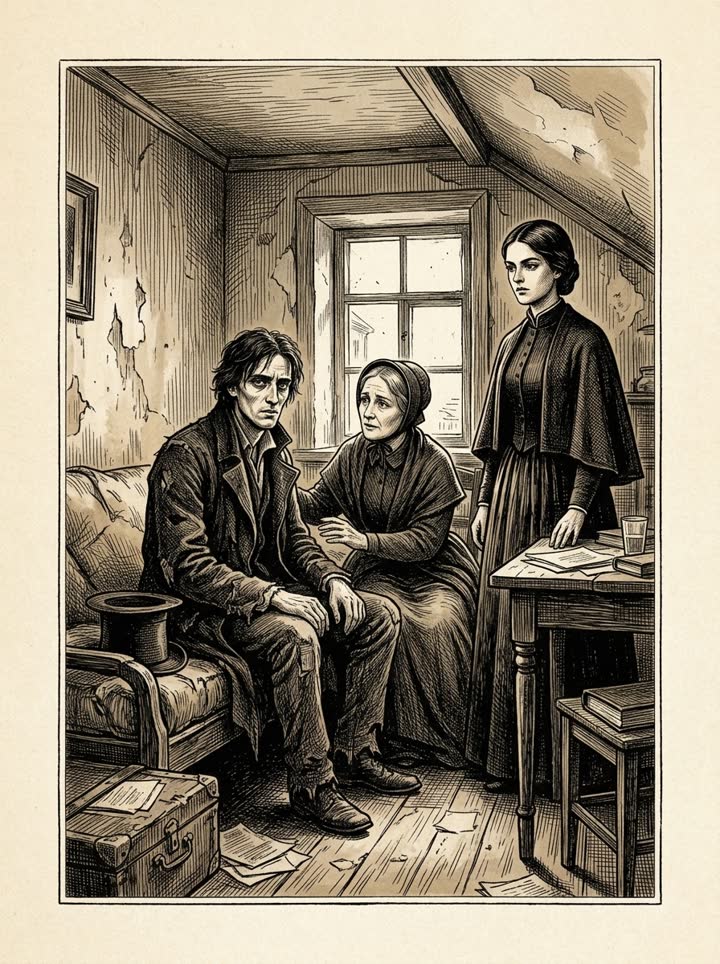
"He's well, he's well!" Zosimov cried cheerfully to them as they came in. He had come some ten minutes before and was sitting in his corner of the sofa, the same as yesterday. Raskolnikov sat in the corner opposite, fully dressed, and even carefully washed and combed, which had not happened to him for a long time. The room filled up at once, but Nastasya still managed to slip in behind the visitors and stood listening.
Indeed, Raskolnikov was almost well, especially compared with yesterday, only he was very pale, absent-minded and sullen. Outwardly he looked like a wounded man, or one enduring some severe physical pain: his brows were drawn together, his lips pressed tight, his gaze inflamed. He spoke little and unwillingly, as if with an effort, or as if performing a duty, and a kind of restlessness showed now and then in his movements.
All that was lacking was a bandage on his arm, or a taffeta cover on his finger, to make him exactly like a man who has, say, a very painful abscess on a finger, or a bruised arm, or something of the kind.
Yet even that pale and sullen face was lit for a moment, as if by a light, when his mother and sister came in, but this only added to its expression, in place of the former listless distraction, something like a more concentrated torment. The light soon faded, but the torment remained, and Zosimov, who was watching and studying his patient with all the young ardour of a doctor who has only just begun to practise, noticed with surprise that at the coming of his family there was in him, instead of joy, a kind of heavy, hidden resolve to endure an hour or two of torture that could no longer be avoided. He saw afterwards how almost every word of the conversation that followed touched some wound of his patient and tore it open; but at the same time he rather marvelled at today's ability to master himself and hide his feelings in the man who yesterday, a monomaniac, had almost flown into a rage at the slightest word.
"Yes, I can see for myself now that I am almost well," said Raskolnikov, kissing his mother and sister affectionately, at which Pulcheria Alexandrovna at once beamed, "and I don't say it as I did yesterday," he added, turning to Razumikhin and pressing his hand in a friendly way.
"Why, I was quite astonished at him myself today," began Zosimov, very glad of the visitors, because in ten minutes he had already lost the thread of conversation with his patient. "In three or four days, if it goes on like this, he will be quite as he was before, that is, as he was a month ago, or two... or perhaps even three? It began a long way back, after all, and was preparing... eh? You admit now that you may have been to blame yourself?" he added with a cautious smile, as if still afraid of irritating him by something.
"Very possibly," Raskolnikov answered coldly.
"I say this," Zosimov went on, grown greedy for his subject, "because your complete recovery depends now, in the main, on yourself alone. Now that one can talk to you, I should like to impress on you that it is necessary to remove the original, so to speak, the root causes that influenced the beginnings of your morbid state, and then you will be cured, otherwise it will even get worse. These original causes I do not know, but you must know them. You are a clever man and have surely observed yourself. It seems to me that the beginning of your disorder coincides partly with your leaving the university. You cannot remain without occupation, and so work and a firmly set goal before you would, I think, help you very much."
"Yes, yes, you are quite right... I shall go back to the university very soon, and then everything will go... like clockwork..."
Zosimov, who had begun his clever advice partly for effect before the ladies, was of course somewhat taken aback when, having finished his speech and glanced at his listener, he noticed an unmistakable mockery in his face. However, that lasted only a moment. Pulcheria Alexandrovna at once began thanking Zosimov, especially for his visit to them in the hotel the night before.
"What, he came to you even at night?" asked Raskolnikov, as if alarmed. "So you did not sleep either after the journey?"
"Oh, Rodya, but it was only until two o'clock. Dunya and I never went to bed before two even at home."
"I don't know how to thank him either," Raskolnikov went on, suddenly frowning and lowering his eyes. "Setting aside the question of money, forgive me for mentioning it (he turned to Zosimov), I really don't know what I have done to deserve such special attention from you. I simply don't understand it... and... and it is even a burden to me, because it is incomprehensible: I tell you frankly."
"Now, now, don't be irritated," Zosimov laughed with an effort. "Suppose that you are my first patient, and we fellows who are only just beginning to practise love our first patients like our own children, and some almost fall in love with them. And I am not rich in patients, you know."
"I don't even speak of him," added Raskolnikov, pointing at Razumikhin, "and yet he too has seen nothing from me but insults and trouble."
"What nonsense he talks! Are you in a sentimental mood today, or what?" cried Razumikhin.
He would have seen, had he been more perceptive, that there was no sentimental mood here at all, but something quite the opposite. But Avdotya Romanovna noticed it. She was watching her brother closely and anxiously.
"And of you, Mamma, I don't dare even to speak," he went on, as if reciting a lesson learned that morning. "It was only today that I could understand at all how you must have suffered here yesterday, waiting for my return." Having said this, he suddenly held out his hand to his sister, silently and with a smile. But in that smile this time flashed real, unfeigned feeling. Dunya at once seized and warmly pressed the hand held out to her, glad and grateful. It was the first time he had spoken to her since the quarrel of yesterday. His mother's face lit up with rapture and happiness at the sight of this final, wordless reconciliation of brother and sister.
"That is why I love him!" whispered Razumikhin, who exaggerated everything, turning energetically in his chair. "He has these impulses!.."
"And how well everything comes out with him," thought his mother to herself, "what noble impulses he has, and how simply, how delicately he ended all that misunderstanding with his sister yesterday, only by holding out his hand at such a moment and looking at her kindly... And what beautiful eyes he has, and what a beautiful face!.. He is even better looking than Dunechka... But, my God, what a suit, how dreadfully he is dressed! Vasya, the errand boy in Afanasy Ivanovich's shop, is better dressed!.. And I feel I could just run to him, and embrace him, and... weep, and yet I am afraid, afraid... what is he like, Lord!.. He speaks so kindly, and yet I am afraid! Well, what am I afraid of?.."
"Oh, Rodya, you won't believe," she caught up suddenly, hurrying to answer his remark, "how... unhappy Dunechka and I were yesterday! Now that it is all over and done and we are all happy again, I can tell it. Imagine, we run here to embrace you, almost straight from the train, and that woman, oh, and here she is! Good day, Nastasya!.. Suddenly she tells us that you are lying in a brain fever and have just run out secretly from the doctor, in delirium, into the street, and that people have run to look for you. You won't believe what happened to us! I thought at once of the tragic death of Lieutenant Potanchikov, an acquaintance of ours, a friend of your father's, you don't remember him, Rodya, who also in a brain fever ran out in the same way and fell into the well in the yard, and they could only pull him out the next day. And we, of course, imagined it even worse than that. We were going to rush off to look for Pyotr Petrovich, so that at least with his help... because we were alone, quite alone," she drew out in a plaintive voice, and suddenly broke off altogether, remembering that to speak of Pyotr Petrovich was still rather dangerous, in spite of the fact that "everyone was perfectly happy again."
"Yes, yes... all that is certainly vexing..." Raskolnikov muttered in reply, but with such an absent and almost inattentive air that Dunechka looked at him in amazement.
"What was it I wanted to say besides?" he went on, trying hard to recall. "Yes: please, Mamma, and you too, Dunechka, don't think that I did not want to come to you first today and waited for you to come first."
"Why, what are you saying, Rodya!" cried Pulcheria Alexandrovna, also astonished.
"Is he answering us out of duty, or what?" thought Dunechka. "He makes peace and begs forgiveness as if he were doing an official duty, or had learned a lesson by heart."
"I had only just woken up and wanted to come, but my clothes held me back; I forgot to tell her yesterday... Nastasya... to wash out this blood... I have only just managed to dress."
"Blood! What blood?" Pulcheria Alexandrovna said in alarm.
"It's nothing... don't worry. It is blood because yesterday, when I was wandering about somewhat in delirium, I came upon a man who had been run over... a clerk..."
"In delirium? But you remember everything," Razumikhin interrupted.
"That is true," Raskolnikov answered, with a peculiar sort of care, "I remember everything, down to the smallest detail, and yet, there it is: why I did this and went there and said that, I can't explain properly now."
"A very well-known phenomenon," Zosimov put in. "The execution of an act is sometimes masterly, extremely cunning, but the control of the actions, the beginning of the actions, is deranged and depends on various morbid impressions. It is like a dream."
"And perhaps it is even a good thing that he almost takes me for a madman," thought Raskolnikov.
"But then healthy people may be like that too," Dunechka remarked, looking anxiously at Zosimov.
"A fairly just remark," he answered. "In that sense we are indeed all, and very often, almost like madmen, with the only little difference that the 'sick' are somewhat more mad than we are, for here one must draw a line. A harmonious man, that is true, hardly exists at all; one is met with among tens, or perhaps among many hundreds of thousands, and even then in rather feeble specimens..."
At the word "madman," carelessly let slip by Zosimov, who had chattered on to his favourite subject, everyone winced. Raskolnikov sat as if paying no attention, lost in thought, with a strange smile on his pale lips. He was still working something out.
"Well, and what about this man who was run over? I interrupted you!" Razumikhin cried quickly.
"What?" Raskolnikov seemed to wake up. "Yes... well, I got stained with blood when I helped to carry him to his lodging... By the way, Mamma, I did one unpardonable thing yesterday; I truly was not in my right mind. Yesterday I gave away all the money you sent me... to his wife... for the funeral. Now she is a widow, consumptive, a pitiful woman... three little orphans, hungry... nothing in the house... and there is a daughter besides... Perhaps you would have given it yourselves, if you had seen... I had no right at all, however, I admit, especially knowing how you got that money yourselves. To help, one must first have the right to do so, otherwise it's: 'Die, dogs, if you're not content!'" He laughed. "Isn't that so, Dunya?"
"No, it isn't," Dunya answered firmly.
"Bah! You too... with intentions!.." he muttered, looking at her almost with hatred and smiling mockingly. "I ought to have realised that... Well, it is praiseworthy, and the better for you... and you will come to a line where, if you do not step over it, you will be unhappy, and if you do step over it, perhaps you will be still more unhappy... But then, it is all nonsense!" he added irritably, vexed at having been carried away in spite of himself. "I only wanted to say that I ask your forgiveness, Mamma," he concluded sharply and abruptly.
"Enough, Rodya, I am sure that everything you do is excellent!" said his mother, delighted.
"Don't be sure," he answered, twisting his mouth into a smile. Silence followed. There was something strained in the whole of this conversation, and in the silence, and in the reconciliation, and in the forgiveness, and everyone felt it.
"It is just as if they were afraid of me," Raskolnikov thought to himself, looking from under his brows at his mother and sister. Pulcheria Alexandrovna, indeed, grew more timid the longer she was silent.
"And yet when they were far away I seemed to love them so," flashed through his head.
"Do you know, Rodya, Marfa Petrovna is dead!" Pulcheria Alexandrovna suddenly burst out.
"What Marfa Petrovna?"
"Oh, my God, Marfa Petrovna Svidrigailova! I wrote you so much about her."
"A-a-ah, yes, I remember... So she is dead? Oh, really?" he suddenly roused himself, as if waking up. "Is she really dead? What of?"
"Imagine, quite suddenly!" Pulcheria Alexandrovna hurried on, encouraged by his curiosity. "And just at the very time when I sent you that letter, on that very day, even! Imagine, that dreadful man seems to have been the cause of her death. They say he beat her terribly!"
"Did they live like that?" he asked, turning to his sister.
"No, quite the contrary. With her he was always very patient, even polite. In many cases he was even too indulgent to her character, for seven whole years... Somehow he suddenly lost patience."
"Then he is not so dreadful at all, if he held out for seven years? You seem to be defending him, Dunechka?"
"No, no, he is a dreadful man! I can't imagine anything more dreadful," Dunya answered, almost with a shudder, knitting her brows and falling into thought.
"It happened between them in the morning," Pulcheria Alexandrovna went on, hurrying. "After that she at once ordered the horses to be put to, so as to drive to town straight after dinner, because she always went to town in such cases; she ate at dinner, they say, with a great appetite..."
"After being beaten?"
"...She always had that... habit, however, and as soon as she had dined, so as not to be late setting out, she went straight to the bathing house... You see, she was taking some kind of cure there by bathing; they have a cold spring there, and she bathed in it regularly every day, and as soon as she got into the water she suddenly had a stroke!"
"No wonder!" said Zosimov.
"And did he beat her badly?"
"It makes no difference," responded Dunya.
"Hm! But really, Mamma, why do you want to tell such rubbish?" Raskolnikov said suddenly, irritably, and as if by accident.
"Oh, my dear, I did not know what to talk about," broke from Pulcheria Alexandrovna.
"Why, are you all afraid of me or what?" he said with a twisted smile.
"That is really true," said Dunya, looking straight and sternly at her brother. "Mamma, as she came up the stairs, even crossed herself with fear."
His face was distorted as if by a spasm.
"Oh, what are you saying, Dunya! Don't be angry, please, Rodya... Why do you, Dunya!" Pulcheria Alexandrovna began in confusion. "It is true, as I was coming here, all the way, in the train, I dreamed: how we should meet, how we should tell each other everything... and I was so happy that I never even noticed the journey! But what am I saying! I am happy even now... You were wrong, Dunya! I am happy just to see you, Rodya..."
"Enough, Mamma," he muttered in confusion, not looking at her and pressing her hand. "We shall have time to talk!"
Having said this, he suddenly became confused and turned pale: again one of those recent dreadful sensations passed through his soul like a deadly chill; again it suddenly became perfectly clear and plain to him that he had just told a terrible lie, that not only would he never now have time to talk, but that he could not now talk about anything more, ever, with anyone. The impression of this agonising thought was so strong that for a moment he almost forgot himself completely, got up from his place and, looking at no one, started to walk out of the room.
"What is it?" cried Razumikhin, seizing him by the arm.
He sat down again and began looking around in silence; everyone was staring at him in bewilderment.
"But why are you all so glum!" he cried suddenly, quite unexpectedly. "Say something! What is the good of sitting like this! Well, speak! Let us talk... We have come together and are silent... Well, anything!"
"Thank God! And I thought it was beginning again, like yesterday," said Pulcheria Alexandrovna, crossing herself.
"What is it, Rodya?" Avdotya Romanovna asked distrustfully.
"Oh, nothing, I remembered something funny," he answered, and suddenly laughed.
"Well, if it's something funny, then it is all right! Otherwise I myself had begun to think..." muttered Zosimov, getting up from the sofa. "I must go, however; perhaps I'll look in again... if I find you in..."
He bowed and went out.
"What a fine man!" remarked Pulcheria Alexandrovna.
"Yes, fine, excellent, educated, clever..." Raskolnikov began suddenly with an unexpected rapidity and with an unusual animation such as he had not shown till now. "I don't remember where I met him before my illness... I seem to have met him somewhere... And this one is a good man too!" he nodded at Razumikhin. "Do you like him, Dunya?" he asked her, and suddenly, for no one knew what reason, he burst out laughing.
"Very much," answered Dunya.
"Ugh, what a... pig you are!" said Razumikhin, terribly embarrassed and blushing red, and he got up from his chair. Pulcheria Alexandrovna smiled faintly, and Raskolnikov roared with laughter.
"But where are you going?"
"I too... I have things to do."
"You have nothing to do at all, stay! Zosimov has gone, so you have to go too. Don't go... And what time is it? Is it twelve? What a pretty watch you have, Dunya! But why have you all fallen silent again? It is always only I, I who talk!.."
"It was a present from Marfa Petrovna," Dunya answered.
"And very expensive," added Pulcheria Alexandrovna.
"A-a-ah! How big it is, hardly a lady's watch."
"I like them like that," said Dunya.
"So it is not a bridegroom's present," thought Razumikhin, and was glad for no one knew what reason.
"And I thought it was Luzhin's present," remarked Raskolnikov.
"No, he has not given Dunechka anything yet."
"A-a-ah! And do you remember, Mamma, that I was in love once and wanted to marry?" he said suddenly, looking at his mother, who was struck by the unexpected turn and by the tone in which he spoke of it.
"Oh, my dear, yes!" Pulcheria Alexandrovna exchanged glances with Dunechka and Razumikhin.
"Hm! Yes! But what can I tell you? I hardly remember. She was such a sickly girl," he went on, as if again suddenly falling into thought and lowering his eyes, "quite ill; she liked to give to beggars, and was always dreaming of a convent, and once she burst into tears when she began to speak to me about it, yes, yes... I remember... I remember very well. A plain little thing. Truly, I don't know why I got attached to her then, I think because she was always ill... If she had been lame as well, or hunchbacked, I think I should have loved her even more... (He smiled thoughtfully.) It was... a sort of spring delirium..."
"No, it was not only a spring delirium," said Dunechka with feeling.
He looked at his sister attentively and intently, but did not hear, or perhaps did not even understand, her words. Then, in deep thought, he got up, went to his mother, kissed her, came back to his place and sat down.
"You love her even now!" said Pulcheria Alexandrovna, touched.
"Her? Now? Ah, yes... you mean her! No. It is all now as if in the other world... and so long ago. And everything around, too, seems not to be happening here..."
He looked at them attentively.
"Even you... it is as if I were looking at you from a thousand versts away... And the devil knows why we are talking about this! And why ask questions?" he added with vexation, and fell silent, biting his nails and falling into thought again.
"What a bad lodging you have, Rodya, like a coffin," Pulcheria Alexandrovna said suddenly, breaking the oppressive silence. "I am sure that half of your melancholy comes from the room."
"The room?.." he answered absently. "Yes, the room did a great deal... I have thought of that too... But if you only knew, Mamma, what a strange thought you have just spoken," he added suddenly, with a strange smile.
A little more, and this company, these relations, after a separation of three years, this family tone of conversation in the complete impossibility of speaking about anything at all, would have become at last decidedly unbearable to him. There was, however, one urgent matter which, one way or another, had to be settled today without fail; so he had decided earlier, when he woke up. Now he was glad of the matter, as of a way out.
"Listen, Dunya," he began gravely and drily, "of course I ask your forgiveness for yesterday, but I consider it my duty to remind you again that I will not give way on the main point. Either I or Luzhin. Let me be a scoundrel, but you must not be. One or the other. If you marry Luzhin, I shall cease at once to consider you my sister."
"Rodya, Rodya! But it is all the same as yesterday," Pulcheria Alexandrovna exclaimed sorrowfully, "and why do you keep calling yourself a scoundrel, I cannot bear it! It was the same yesterday..."
"Brother," Dunya answered firmly and also drily, "there is a mistake in all this on your part. I thought it over in the night and found the mistake. It is all that you seem to suppose that I am sacrificing myself to someone and for someone. It is not so at all. I am marrying simply for myself, because it is hard for me; and afterwards, of course, I shall be glad if I can be useful to my family, but in my decision that is not the main motive..."
"She is lying!" he thought to himself, biting his nails with spite. "Proud creature! She won't admit that she wants to play the benefactress! Oh, base characters! Even their love is like hatred... Oh, how I... hate them all!"
"In a word, I am marrying Pyotr Petrovich," Dunechka went on, "because of two evils I choose the lesser. I intend to fulfil honestly everything he expects of me, and so I am not deceiving him... Why did you smile just now?"
She too flushed, and anger flashed in her eyes.
"You will fulfil everything?" he asked, smiling venomously.
"Up to a certain limit. The manner and the form of Pyotr Petrovich's courtship showed me at once what he wants. He values himself, of course, perhaps too highly, but I hope that he values me too... What are you laughing at again?"
"And why are you blushing again? You are lying, sister, you are lying on purpose, out of nothing but feminine obstinacy, only to have your own way before me... You cannot respect Luzhin: I have seen him and talked with him. So you are selling yourself for money, and so in any case you are acting basely, and I am glad that you, at least, can blush!"
"It is not true, I am not lying!.." cried Dunechka, losing all her composure. "I will not marry him without being convinced that he values me and cherishes me; I will not marry him without being firmly convinced that I can respect him myself. Fortunately I can make sure of that for certain, and even today. And such a marriage is not a baseness, as you say! And even if you were right, even if I had really made up my mind to a baseness, is it not merciless of you to speak to me like this? Why do you demand of me a heroism that perhaps you do not have yourself? It is despotism, it is violence! If I ruin anyone, it is only myself... I have not murdered anyone yet!.. Why do you look at me like that? Why have you turned so pale? Rodya, what is the matter? Rodya, dear!.."
"Lord! She has frightened him into a faint!" cried Pulcheria Alexandrovna.
"No, no... nonsense... it's nothing!.. My head went round a little. Not a faint at all... You and your fainting fits!.. Hm! yes... what did I want to say? Yes: how will you be convinced today that you can respect him and that he... values you, as you said? You said today, I think? Or did I mishear?"
"Mamma, show my brother Pyotr Petrovich's letter," said Dunechka.
Pulcheria Alexandrovna handed over the letter with trembling hands. He took it with great curiosity. But before unfolding it he suddenly looked at Dunechka with a kind of surprise.
"Strange," he said slowly, as if suddenly struck by a new thought, "why am I fussing so? What is all the shouting for? Marry whom you like!"
He spoke as if to himself, but said it aloud, and for some time looked at his sister, as if perplexed.
At last he unfolded the letter, still keeping an air of strange surprise; then slowly and attentively he began to read, and read it twice. Pulcheria Alexandrovna was in particular anxiety; and everyone expected something out of the ordinary.
"This surprises me," he began after some reflection, handing the letter to his mother but addressing no one in particular. "He goes about on business, he is a lawyer, and his conversation too is of that sort... with airs, and yet how illiterately he writes."
Everyone stirred; they had expected nothing of the kind.
"But they all write like that," Razumikhin remarked abruptly.
"Have you read it?"
"Yes."
"We showed it, Rodya, we... consulted him earlier," began Pulcheria Alexandrovna, embarrassed.
"That is precisely the law-court style," Razumikhin interrupted. "Legal papers are written like that to this day."
"Law-court? Yes, exactly law-court, businesslike... Not that it is very illiterate, nor that it is very literary; businesslike!"
"Pyotr Petrovich does not hide that he was educated on next to nothing, and even boasts that he made his own way," remarked Avdotya Romanovna, somewhat offended by her brother's new tone.
"Well, if he boasts of it, he has something to boast of, I don't contradict. You, sister, seem to be offended that from the whole letter I drew such a frivolous remark, and you think that I spoke of such trifles on purpose, to needle you out of vexation. On the contrary, the style suggested to me a remark that is not at all superfluous in the present case. There is one expression there, 'blame yourselves,' put very significantly and clearly, and besides there is a threat that he will leave at once if I come. This threat to leave is the same as a threat to abandon you both if you are disobedient, and to abandon you now, when he has already summoned you to Petersburg. Well, what do you think: could one take offence at such an expression from Luzhin just as one would if it had been written by him (he pointed at Razumikhin), or Zosimov, or any of us?"
"N-no," answered Dunechka, growing animated. "I understood very well that it was put too naively and that he is perhaps simply not a master of writing... You have judged that well, brother. I did not even expect it..."
"It is expressed in the law-court way, and in the law-court way it cannot be written otherwise, and it came out coarser than perhaps he meant. However, I must disappoint you a little: there is one more expression in this letter, one slander against me, and rather a mean one. I gave the money yesterday to the widow, consumptive and crushed, and not 'on the pretext of the funeral,' but directly for the funeral, and not into the hands of the daughter, a young woman, as he writes, 'of notorious behaviour' (whom I saw yesterday for the first time in my life), but precisely to the widow. In all this I see a too hasty wish to blacken me and to set you against me. It is expressed again in the law-court way, that is, with too plain a disclosure of the aim and with a very naive haste. He is a clever man, but to act cleverly cleverness alone is not enough. All this paints the man and... I do not think that he values you much. I tell you only for your edification, because I sincerely wish you well..."
Dunechka did not answer; her decision had been made earlier, she was only waiting for the evening.
"So what do you decide, Rodya?" asked Pulcheria Alexandrovna, more anxious than before at his sudden, new, businesslike tone of speech.
"What do you mean, 'decide'?"
"Well, Pyotr Petrovich writes that you are not to be with us this evening and that he will leave... if you come. So what will you do... will you come?"
"That, of course, is not for me to decide, but first of all for you, if such a demand of Pyotr Petrovich does not offend you, and secondly for Dunya, if she is not offended either. And I shall do whatever is best for you," he added drily.
"Dunechka has already decided, and I entirely agree with her," Pulcheria Alexandrovna hastened to put in.
"I have decided to ask you, Rodya, to ask you earnestly, to be sure to be with us at this meeting," said Dunya. "Will you come?"
"I will."
"And I ask you too to be with us at eight o'clock," she said, turning to Razumikhin. "Mamma, I am inviting him as well."
"And very well, Dunechka. Well, as you have decided," added Pulcheria Alexandrovna, "so let it be. And it is easier for me myself; I don't like to pretend and lie; better let us speak the whole truth... Pyotr Petrovich may be angry or not, as he pleases!"