
But the moment she had gone out, he got up, put the hook on the door, untied the bundle of clothes that Razumikhin had brought earlier and tied up again himself, and began to dress. A strange thing: he seemed suddenly to have become perfectly calm. There was no half-mad raving, as before, and no panic terror, as there had been all this last time. It was the first minute of some strange, sudden calm. His movements were precise and clear, and a firm intention showed in them. "Today, this very day!..." he muttered to himself. He understood, however, that he was still weak, but the most extreme straining of his soul, which had reached calm, a fixed idea, gave him strength and self-assurance. He hoped, besides, that he would not fall in the street. When he was fully dressed, all in new clothes, he looked at the money lying on the table, thought, and put it in his pocket. There were twenty-five roubles. He took also all the copper five-kopeck pieces, the change from the ten roubles Razumikhin had spent on the clothes. Then he quietly lifted the hook, went out of the room, went down the stairs and glanced into the kitchen, which stood wide open. Nastasya was standing with her back to him, bending over and blowing up the landlady's samovar. She heard nothing. And who could have supposed that he would go out? A minute later he was already in the street.
It was about eight o'clock, the sun was going down. The stifling heat was the same as before, but he breathed in this stinking, dusty air, poisoned by the town, with greed. His head began to swim a little. Some kind of wild energy flashed suddenly in his inflamed eyes and in his wasted, pale yellow face. He did not know, and did not even think, where he was to go. He knew one thing: "that all this must be finished today, at one stroke, this very minute; that otherwise he would not go back home, because he did not want to live like this." How to finish it? With what? Of that he had no idea, and did not want to think. He drove the thought away: the thought tormented him. He only felt and knew that everything must change, one way or another, "no matter how," he repeated with desperate, fixed self-assurance and determination.
Out of old habit, along the usual route of his former walks, he went straight towards the Haymarket. Before reaching the Haymarket, in the roadway in front of a little shop, a young black-haired organ-grinder was standing, turning out some very sentimental ballad. He was accompanying a girl who stood in front of him on the pavement, about fifteen years old, dressed like a young lady, in a crinoline, a little mantle, gloves and a straw hat with a flame-coloured feather. All of it was old and worn out. In a street singer's cracked but rather pleasant and strong voice she was singing out the ballad, in expectation of a two-kopeck piece from the shop. Raskolnikov stopped beside two or three listeners, listened, took out a five-kopeck piece and put it in the girl's hand. She suddenly cut off her singing on the most sentimental and highest note, as if with a knife, shouted sharply to the organ-grinder, "That's enough!", and the two trudged on to the next shop.
"Do you like street singing?" Raskolnikov suddenly addressed a man who was no longer young, a passer-by standing beside him at the organ, with the look of a loafer. The man stared wildly and was astonished. "I do," Raskolnikov went on, but with the air of not speaking about street singing at all, "I like it when they sing to a barrel organ on a cold, dark, damp autumn evening, it must be damp, when all the passers-by have pale green, sickly faces. Or better still, when wet snow is falling, quite straight, with no wind, you know? and the gas lamps shine through it..."
"I don't know, sir... Excuse me..." muttered the gentleman, frightened both by the question and by Raskolnikov's strange look, and he crossed to the other side of the street.
Raskolnikov went straight on and came out at that corner of the Haymarket where the tradesman and his wife had been selling, the ones who had been talking to Lizaveta then. But they were not there now. Recognising the place, he stopped, looked round and turned to a young fellow in a red shirt, who was yawning at the entrance to a flour store.
"It's a tradesman who sells here on the corner, with a woman, his wife, isn't it?"
"All sorts sell here," answered the fellow, measuring Raskolnikov with a superior look.
"What is he called?"
"What he was christened, that's what he's called."
"Aren't you from Zaraisk too? Which province?"
The fellow looked at Raskolnikov again.
"With us, your excellency, it's not a province but a district, and it was my brother who travelled, while I stayed at home, so I don't know, sir... Pray forgive me, your excellency, in your generosity."
"Is that an eating-house, upstairs?"
"That's a tavern, and there's a billiard table; and princesses are to be found... Tra-la-la!"
Raskolnikov crossed the square. There, on the corner, stood a dense crowd of people, all peasants. He pushed into the very thick of it, looking into their faces. For some reason he felt drawn to talk to everybody. But the peasants paid no attention to him, and all of them were babbling something among themselves, huddling in little knots. He stood, thought, and went to the right along the pavement, in the direction of V. Prospect. Having passed the square, he found himself in a lane...
He had often passed before through this short lane, which makes a bend and leads from the square into Sadovaya Street. Of late he had even felt drawn to loaf about all these places when he felt sick at heart, "so as to feel still sicker." Now he went in without thinking of anything. There is a big house here, entirely taken up by taverns and other eating and drinking places. Women kept running out of them, dressed as people go "to the neighbours," bareheaded and in nothing but their dresses. In two or three places they crowded on the pavement in groups, mostly at the steps down to the lower floor, where by two steps one could descend into various very entertaining establishments. In one of them, at this moment, there was a din and uproar that filled the whole street, a guitar was twanging, songs were being sung, and everyone was very merry. A large group of women crowded at the entrance. Some sat on the steps, others on the pavement, others stood and talked. Close by, in the roadway, a drunken soldier with a cigarette was roaming about, swearing loudly, and he seemed to want to go in somewhere, but to have forgotten where. One ragamuffin was cursing at another ragamuffin, and someone dead drunk lay sprawled across the street. Raskolnikov stopped by the large group of women. They talked in hoarse voices. All of them wore cotton dresses and goatskin shoes, and all were bareheaded. Some were over forty, but there were some of seventeen, and almost all had blackened eyes.
For some reason the singing and all that din and uproar down there interested him. From there, amid laughter and shrieks, to the thin falsetto of some dashing tune and to the guitar, someone could be heard dancing desperately, beating time with his heels. He listened intently, gloomily and thoughtfully, bending down at the entrance and peering curiously from the pavement into the passage.
You, my handsome constable,
Do not beat me for nothing!
the singer's thin voice poured out. Raskolnikov terribly wanted to make out what they were singing, as if that were the whole point.
"Shall I go in?" he thought. "They're roaring with laughter! Drunk. Well, why not get drunk?"
"Won't you come in, dear sir?" asked one of the women, in a rather ringing voice that was not yet quite hoarse. She was young and not even repulsive, the only one in the whole group.
"Why, how pretty you are!" he answered, straightening up and looking at her.
She smiled. The compliment pleased her very much.
"You're very pretty yourself," she said.
"How thin you are!" remarked another, in a bass voice. "Just out of hospital, are you?"
"They look like generals' daughters, but their noses are all snub!" a peasant who had come up suddenly broke in, a little merry, in a coat hanging open, with a sly, laughing mug. "Look at the fun!"
"Go on in, since you've come!"
"I'll go in! Sweet!"
And he tumbled head over heels down the steps.
Raskolnikov moved on.
"Listen, sir!" the girl shouted after him.
"What?"
She became embarrassed.
"Dear sir, I'll always be glad to spend an hour with you, but now somehow I can't find the courage in front of you. Give me, pleasant gentleman, six kopecks for a drink!"
Raskolnikov took out what came to hand: three five-kopeck pieces.
"Ah, what a kind gentleman!"
"What is your name?"
"Ask for Duklida."
"No, but really, what's this," suddenly remarked one of the group, shaking her head at Duklida. "I don't know how anyone can ask like that! I think I'd fall through the ground from shame alone..."
Raskolnikov looked curiously at the speaker. She was a pockmarked wench of about thirty, all bruises, with a swollen upper lip. She spoke and condemned calmly and seriously.
"Where was it," thought Raskolnikov, going on, "where was it that I read how a man condemned to death, an hour before his death, says or thinks that if he had to live somewhere on a height, on a rock, on such a narrow ledge that there was room only for his two feet, with abysses all round, the ocean, eternal darkness, eternal solitude and eternal storm, and had to remain like that, standing on an arshin of space, all his life, a thousand years, eternity, then it would be better to live so than to die at once! Only to live, to live and to live! However one lives, only to live!... How true that is! Lord, how true! Man is a scoundrel! And a scoundrel is he who calls him a scoundrel for it," he added a minute later.
He came out into another street. "Aha! The 'Crystal Palace'! Razumikhin was talking about the 'Crystal Palace' earlier. But what was it I wanted? Yes, to read!... Zosimov said he had read in the newspapers..."
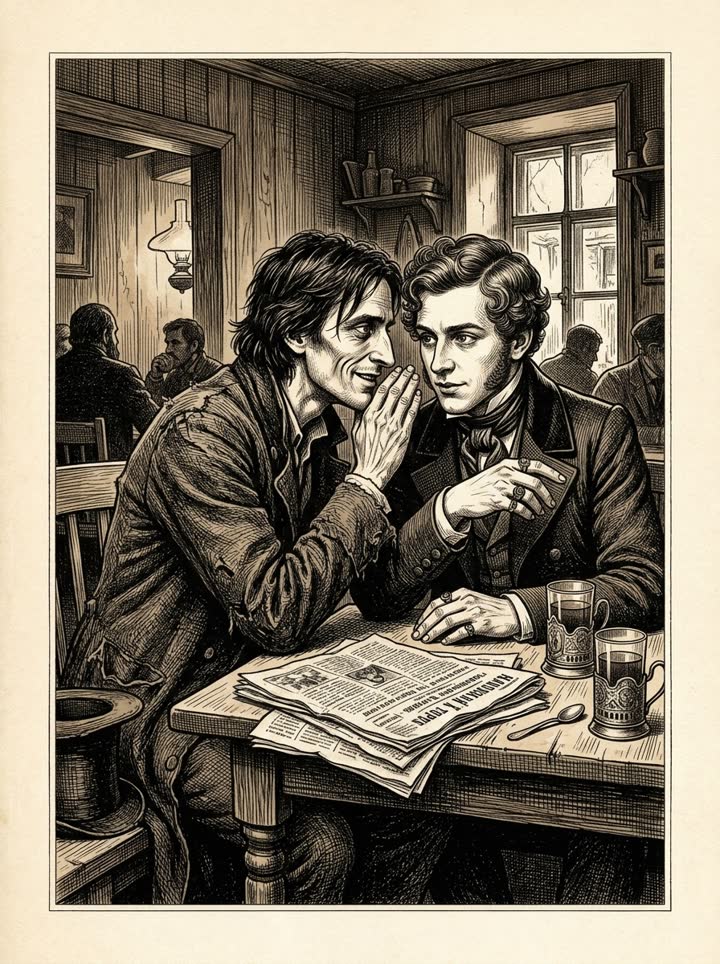
"Have you any newspapers?" he asked, entering a very spacious and even tidy tavern of several rooms, though rather empty. Two or three customers were drinking tea, and in one far room a group of about four were sitting and drinking champagne. It seemed to Raskolnikov that Zametov was among them. However, from a distance one could not see well.
"Let him be!" he thought.
"Will you take vodka, sir?" asked the waiter.
"Bring tea. And bring me newspapers, old ones, for about the last five days, and I'll give you something for yourself."
"Yes, sir. Here are today's, sir. And will you take vodka, sir?"
The old newspapers and the tea appeared. Raskolnikov sat down and began to search: "Izler, Izler, Aztecs, Aztecs, Izler, Bartola, Massimo, Aztecs, Izler... ugh, the devil! Ah, here are the notices: fell down the stairs, a tradesman burned up from drink, a fire in the Sands, a fire on the Petersburg Side, another fire on the Petersburg Side, another fire on the Petersburg Side, Izler, Izler, Izler, Izler, Massimo... Ah, here..."
He found at last what he was after and began to read. The lines jumped before his eyes, but he nevertheless finished the whole "report," and greedily began to search in the following numbers for later additions. His hands trembled, turning over the sheets, from convulsive impatience. Suddenly someone sat down beside him, at his table. He glanced round, and it was Zametov, the same Zametov, looking just the same, with rings, with watch-chains, with a parting in his black, curly, pomaded hair, in a smart waistcoat and a rather shabby frock coat and soiled linen. He was cheerful, or at least he was smiling very merrily and good-naturedly. His swarthy face was a little flushed from the champagne he had drunk.
"What! You here?" he began in bewilderment, in a tone as if he had known him for ages. "And only yesterday Razumikhin was telling me you were still unconscious. How strange! And I was at your place..."
Raskolnikov had known that he would come up. He put aside the newspapers and turned to Zametov. There was a smile on his lips, and some new, irritable impatience showed in that smile.
"I know that you were there," he answered. "I heard, sir... You were looking for a sock... And do you know, Razumikhin is mad about you, he says you went with him to Lavisa Ivanovna, you know, the one you were so concerned about then, you winked at Lieutenant Gunpowder and he still did not understand, remember? Surely anyone would understand, it was plain enough... eh?"
"And what a rowdy he is!"
"Gunpowder?"
"No, your friend, Razumikhin..."
"You have a good life, Mr. Zametov. Free admission to the most agreeable places! Who was pouring you champagne just now?"
"Well, we... had a drink... What do you mean, pouring?!"
"A fee! You make use of everything!" Raskolnikov laughed. "It's nothing, my kind boy, nothing!" he added, slapping Zametov on the shoulder. "I'm not saying it out of spite, but 'in all love, in play,' as that workman of yours said when he was thrashing Mitka, over the old woman's affair."
"And how do you know that?"
"Perhaps I know more than you."
"How strange you are... You must still be very ill. You shouldn't have gone out..."
"Do I seem strange to you?"
"Yes. Why are you reading newspapers?"
"Newspapers."
"They write a great deal about fires..."
"No, I'm not reading about fires." Here he looked mysteriously at Zametov, and the mocking smile twisted his lips again. "No, I'm not reading about fires," he went on, winking at Zametov. "But confess, dear young man, that you are dreadfully eager to know what I was reading about?"
"Not at all eager. I only asked. Can't a man ask? Why do you keep..."
"Listen, you are an educated man, a literary man, eh?"
"I was in the sixth class at the gymnasium," answered Zametov with some dignity.
"The sixth! Ah, my little sparrow! With a parting, with rings, a rich man! Ugh, what a darling boy!" Here Raskolnikov burst into nervous laughter, straight in Zametov's face. The other drew back, not so much offended as very much surprised.
"Ugh, how strange you are!" repeated Zametov, very seriously. "It seems to me you are still raving."
"Raving? You're lying, sparrow!... So I'm strange? Well, and am I interesting to you, eh? Interesting?"
"Interesting."
"That is, what I was reading, what I was looking for? See how many numbers I made them drag in! Suspicious, eh?"
"Well, tell me."
"Ears pricked up?"
"What do you mean, pricked up?"
"I'll tell you afterwards what I mean, but now, my dearest, I declare to you... no, better: I 'confess'... No, that's not it either: 'I give evidence, and you take it down,' that's it! So I give evidence that I was reading, was interested... was searching... looking for..." Raskolnikov screwed up his eyes and waited, "looking for, and came in here for that very purpose, the murder of the old woman, the official's widow," he said at last, almost in a whisper, bringing his face extremely close to Zametov's face. Zametov looked straight at him, without moving and without drawing his face back from his. What seemed strangest to Zametov afterwards was that exactly a whole minute of silence lasted between them, and exactly a whole minute they looked at each other like that.
"Well, so what if you were reading?" he cried suddenly, in bewilderment and impatience. "What is it to me! What of it?"
"It is that very old woman," Raskolnikov went on, in the same whisper, not stirring at Zametov's exclamation, "the very one they began talking about, remember, in the office, when I fainted. Well, do you understand now?"
"But what is it? What... 'understand'?" said Zametov, almost in alarm.
Raskolnikov's motionless, serious face was transformed in an instant, and suddenly he burst again into the same nervous laughter as before, as though he himself were utterly unable to restrain himself. And in one moment, with extraordinary clearness of sensation, there came back to him a recent instant when he had stood behind the door with the axe, the latch jumping, the people outside the door swearing and battering, and he had suddenly wanted to shout to them, to swear at them, to put out his tongue at them, to tease them, to laugh, to roar with laughter, to roar, to roar!
"You are either mad, or..." said Zametov, and stopped, as if suddenly struck by a thought that had flashed across his mind.
"Or? What 'or'? Well, what? Come, say it!"
"Nothing!" answered Zametov angrily. "It's all nonsense!"
Both fell silent. After this sudden, fit-like burst of laughter Raskolnikov suddenly became thoughtful and sad. He leaned his elbow on the table and propped his head on his hand. He seemed to have completely forgotten Zametov. The silence lasted quite a long time.
"Why don't you drink your tea? It will get cold," said Zametov.
"Eh? What? Tea?... Perhaps..." Raskolnikov took a gulp from the glass, put a bit of bread in his mouth and suddenly, looking at Zametov, seemed to remember everything and as if to shake himself. His face at that same minute took on its original mocking expression. He went on drinking his tea.
"A great many of these swindles have sprung up nowadays," said Zametov. "Just lately I read in the Moscow News that they had caught a whole gang of counterfeiters in Moscow. A whole society. They were forging banknotes."
"Oh, that was long ago! I read it a month back," answered Raskolnikov calmly. "So you think they are swindlers?" he added, smiling.
"How can they not be swindlers?"
"Those? Those are children, greenhorns, not swindlers! A whole fifty people gather for such an aim! Is that possible? Even three would be too many, and then each must be surer of the others than of himself! Otherwise it is enough for one to blab when drunk, and everything goes to pieces! Greenhorns! They hire unreliable people to change the notes in offices. To trust such a business to the first man who comes along! Well, suppose it succeeds even with greenhorns, suppose each has changed a million for himself, well, and then? All their lives? Each depends on the other for all his life! Better to hang oneself! And they did not even know how to change them. One went to change in an office, received five thousand, and his hands shook. He counted four, and took the fifth without counting, on trust, only to get it into his pocket and run away quickly. Well, and he aroused suspicion. And it all burst because of one fool! How can it be done like that?"
"That his hands shook?" Zametov took it up. "No, that is possible, sir. No, I am perfectly sure that it is possible. Sometimes you can't stand it."
"That?"
"And you, I suppose, would stand it? No, I would not! To go for the sake of a hundred roubles' reward to such a horror! To go with a false note, and where? To a banker's office, where they have grown old in the business. No, I should be confused. Wouldn't you be confused?"
Raskolnikov suddenly wanted dreadfully to "put out his tongue" again. A shiver ran down his back at moments.
"I would not do it like that," he began, in a roundabout way. "This is how I would change them. I would count the first thousand, some four times, from every side, looking at every note, and I would start on the second thousand. I would begin to count it, count up to the middle, and then take out some fifty-rouble note, hold it up to the light, turn it over and hold it up to the light again: is it false? 'I am afraid,' I would say, 'a relation of mine lost twenty-five roubles in that way the other day,' and I would tell a story there. And when I began to count the third thousand, no, excuse me, I think I counted the seventh hundred wrong in the second thousand, I am doubtful, and I would drop the third and go back to the second, and so on through all five. And when I finished, I would take one note out of the fifth and one out of the second, and again to the light, and again doubtful, 'change them, please,' and I would drive the clerk into a sweat, so that he would not know how to get rid of me! When I had finished everything at last, I would go, open the door, but no, excuse me, I would come back again, to ask about something, to get some explanation. That is how I would do it!"
"Ugh, what terrible things you say!" said Zametov, laughing. "But it is all just talk, and when it came to the deed you would certainly stumble. Here, I tell you, in my opinion, not only you and I, even a seasoned, desperate man cannot answer for himself. But why go far? Here is an example: in our district, the old woman was murdered. Surely he was a desperate fellow, he risked everything in broad daylight, was saved by a miracle, and yet his hands shook all the same. He could not rob, he could not stand it. It is clear from the case..."
Raskolnikov seemed offended.
"Clear! Well, catch him, go on, now!" he cried, spitefully egging Zametov on.
"Well, and they will catch him."
"Who? You? You catch him? You'll tire yourselves out! What matters most to you is whether a man spends money or not. He had no money, and suddenly he begins to spend. Well, how could it not be he? Why, a child like that could fool you on that point, if he wished!"
"That is just it, they all do so," answered Zametov. "He kills cunningly, risks his life, and then straight away is caught in a tavern. It is on their spending that they are caught. Not all are such cunning fellows as you. You would not go to a tavern, of course?"
Raskolnikov frowned and looked intently at Zametov.
"You seem to have developed a taste for it, and want to know how I would act here too?" he asked with displeasure.
"I should like to," the other answered firmly and seriously. He had begun to speak and look somehow too seriously.
"Very much?"
"Very much."
"Good. This is how I would act," began Raskolnikov, again suddenly bringing his face close to Zametov's face, again staring straight at him and again speaking in a whisper, so that this time the other even shuddered. "This is what I would do: I would take the money and the things and, as soon as I had left the place, at once, without stopping anywhere, I would go to some place that is deserted and has only fences and almost nobody about, a vegetable garden or something of the kind. I would have spotted beforehand, in that yard, some stone, of a pood or a pood and a half in weight, somewhere in a corner by the fence, one that has perhaps been lying there since the house was built. I would lift this stone, there must be a hollow under it, and into this hollow I would put all the things and the money. I would put them in and roll the stone back, just as it lay before, press it down with my foot, and walk away. And for a year, for two years I would not touch it, for three years I would not touch it. Well, now search for it! There was something, and there's nothing left!"
"You are mad," said Zametov, for some reason also almost in a whisper, and for some reason he suddenly moved away from Raskolnikov. The other's eyes flashed. He turned dreadfully pale. His upper lip trembled and began to twitch. He bent towards Zametov as close as possible and began to move his lips, pronouncing nothing. So it lasted for about half a minute. He knew what he was doing, but could not restrain himself. The terrible word, like the latch on the door that time, kept jumping on his lips: it would break out in a moment, in a moment he need only let it go, in a moment only say it!
"And what if it was I who killed the old woman and Lizaveta?" he said suddenly, and came to his senses.
Zametov stared wildly at him and turned white as a tablecloth. His face twisted into a smile.
"But is that possible?" he said, barely audible.
Raskolnikov looked at him angrily.
"Confess that you believed it? Yes? Didn't you?"
"Not at all! Now more than ever I don't believe it!" Zametov said hurriedly.
"Caught at last! They caught the little sparrow. So you did believe it before, if now you 'don't believe it more than ever'?"
"But not at all!" exclaimed Zametov, evidently confused. "Did you frighten me just so as to lead up to this?"
"So you don't believe it? And what did you start talking about without me, when I left the office then? And why did Lieutenant Gunpowder question me after my faint? Hey, you," he shouted to the waiter, getting up and taking his cap, "how much do I owe?"
"Thirty kopecks in all, sir," answered the waiter, running up.
"Here, here's twenty kopecks more for yourself. Look how much money!" He held out his trembling hand with the notes to Zametov. "Red ones, blue ones, twenty-five roubles. Where from? And where did the new clothes come from? You know very well that I hadn't a kopeck! You've questioned the landlady already, I suppose... Well, enough! Enough chatter! Goodbye... it has been most delightful!..."
He went out, trembling all over with a kind of wild hysterical sensation, in which, however, there was a part of unbearable delight, but gloomy and terribly tired. His face was twisted, as after some fit. His weariness was growing fast. His strength was roused and came suddenly now, with the first shock, with the first irritating sensation, and weakened just as quickly, as the sensation weakened.
And Zametov, left alone, sat on a long time in the same place, in thought. Raskolnikov had unwittingly turned all his thoughts upside down on a certain point and had finally settled his opinion.
"Ilya Petrovich is a blockhead!" he decided finally.
Raskolnikov had hardly opened the door to the street when, right on the steps, he collided with Razumikhin coming in. Even a step away, neither had seen the other, so that they almost knocked heads. For some time they measured each other with their eyes. Razumikhin was in the greatest amazement, but suddenly anger, real anger, flashed menacingly in his eyes.
"So that's where you are!" he shouted at the top of his voice. "Ran away from your bed! And I was even looking for him under the sofa! We even went up to the attic! I almost beat Nastasya because of you... And he's here! Rodka! What does this mean? Tell me the whole truth! Confess! Do you hear?"
"It means that all of you have bored me to death, and I want to be alone," answered Raskolnikov calmly.
"Alone? When you can't walk yet, when your face is still as pale as linen, and you are gasping for breath! Fool!... What were you doing in the 'Crystal Palace'? Confess at once!"
"Let me go!" said Raskolnikov, and tried to pass. That made Razumikhin lose his temper: he seized him hard by the shoulder.
"Let you go? You dare say 'let me go'? Do you know what I am going to do with you now? I'll take you in my arms, tie you in a knot and carry you home under my arm, and lock you in!"
"Listen, Razumikhin," began Raskolnikov quietly and apparently perfectly calmly, "can't you see that I don't want your kindnesses? And what is this passion for doing kindnesses to people who... spit on them? To people, in the end, to whom it is seriously hard to bear? Well, why did you look me up at the beginning of my illness? I might have been very glad to die. Well, haven't I shown you enough today that you torment me, that you... bore me! It is a real passion for tormenting people! I assure you that all this seriously hinders my recovery, because it irritates me incessantly. Zosimov went away earlier, so as not to irritate me! For God's sake, leave me alone, you too! And what right, in the end, have you to hold me by force? Can't you see that I am speaking now in my full senses? How, how, teach me, am I to beg you, in the end, not to pester me and not to do me kindnesses? Let me be ungrateful, let me be base, only leave me alone, all of you, for God's sake, leave me alone! Leave me alone! Leave me alone!"
He began calmly, rejoicing beforehand in all the venom he was preparing to pour out, and ended in frenzy and gasping, as earlier with Luzhin.
Razumikhin stood, thought, and let go of his hand.
"Then go to the devil!" he said quietly and almost thoughtfully. "Stop!" he roared suddenly, when Raskolnikov made a move to go. "Listen to me. I announce to you that all of you, to a man, are windbags and braggarts! If you get some little suffering, you carry it about like a hen with an egg! Even in that you steal other people's authors. There is not a sign of independent life in you! You are made of spermaceti ointment, and in place of blood you have whey! I don't believe any of you! The first thing with you, in all circumstances, is not to look like a human being! Sto-o-op!" he cried with redoubled fury, noticing that Raskolnikov was again moving to go. "Listen to the end! You know, today I have people coming for my housewarming, they may have arrived already, but I left my uncle there, I looked in just now, to receive the arrivals. So, if you were not a fool, not a vulgar fool, not a stuffed fool, not a translation from a foreign language... you see, Rodya, I confess you are a clever fellow, but you are a fool! So, if you were not a fool, you would do better to come to me today and sit with us for the evening, than wear out your boots for nothing. Since you have come out, there is nothing to be done! I would roll up such soft armchairs for you, the landlord has some... A little tea, company... Or no, then I'll lay you on the couch, you will lie all the same among us... And Zosimov will be there. Will you come, then?"
"No."
"Y-o-ou lie!" Razumikhin cried impatiently. "How do you know? You can't answer for yourself! And you understand nothing of it... A thousand times I have fallen out with people just like that and then run back again... You feel ashamed, and you return to the man! So remember, Pochinkov's house, the third floor..."
"But at this rate you might let someone beat you, Mr. Razumikhin, from pleasure in doing kindnesses."
"Whom? Me! I'd twist off his nose for such a fancy! Pochinkov's house, number forty-seven, in the flat of the official Babushkin..."
"I won't come, Razumikhin!" Raskolnikov turned and walked away.
"I bet you will!" Razumikhin shouted after him. "Otherwise you... otherwise I don't want to know you! Wait, hey! Is Zametov there?"
"He is."
"Did you see him?"
"I saw him."
"And talked?"
"Talked."
"What about? Well, the devil take you, don't tell me, if you like. Pochinkov's, forty-seven, Babushkin's, remember!"
Raskolnikov reached Sadovaya Street and turned the corner. Razumikhin looked after him, pondering. At last, with a wave of his hand, he went into the house, but stopped halfway up the stairs.
"The devil take it!" he went on, almost aloud. "He talks sensibly, and yet as if... But I am a fool too! Why, don't madmen talk sensibly? And Zosimov, it seemed to me, is afraid of just that!" He tapped his finger against his forehead. "Well, what if... how can I let him go alone now? He might drown himself... Ah, I made a blunder! I can't!" And he ran back after Raskolnikov, but the trail was cold. He spat, and with quick steps went back to the "Crystal Palace" to question Zametov as soon as possible.
Raskolnikov walked straight on to the bridge, stood in the middle by the rail, leaned on it with both elbows and began to look along the water. After parting from Razumikhin he had grown so weak that he had barely made his way here. He wanted to sit or lie down somewhere, in the street. Bending over the water, he looked mechanically at the last rosy glow of the sunset, at the row of houses darkening in the thickening dusk, at one distant window, somewhere in an attic on the left embankment, which gleamed as if in flames from the last ray of sun that struck it for an instant, at the darkening water of the canal, and seemed to gaze attentively at that water. At last red circles began to whirl before his eyes, the houses began to move, the passers-by, the embankments, the carriages, all of it whirled and danced round. Suddenly he shuddered, saved perhaps once more from fainting by one wild and ugly sight. He felt that someone had stopped beside him, on the right, close by. He looked and saw a woman, tall, with a kerchief on her head, with a yellow, long, wasted face and reddish, sunken eyes. She was looking straight at him, but evidently saw nothing and distinguished no one. Suddenly she leaned her right hand on the rail, lifted her right leg and swung it over the railing, then the left, and threw herself into the canal. The dirty water parted, swallowed the victim for a moment, but a minute later the drowning woman floated up and was carried gently down the current, head and feet in the water, back uppermost, her skirt bunched and swollen above the water like a pillow.
"She's drowned herself! She's drowned herself!" dozens of voices cried. People came running, both embankments were strung with spectators, on the bridge, all round Raskolnikov, a crowd gathered, pressing and squeezing him from behind.
"Mercy, it's our Afrosinyushka!" a woman's tearful cry was heard somewhere not far off. "Mercy, save her! Dear fathers, pull her out!"
"A boat! A boat!" they shouted in the crowd.
But a boat was no longer needed. A policeman ran down the steps to the canal, threw off his greatcoat and boots and plunged into the water. There was little work to do: the drowning woman was being carried by the current two paces from the steps, he seized her clothes with his right hand, with the left managed to catch hold of a pole that a comrade held out to him, and at once the woman was pulled out. They laid her on the granite slabs of the landing. She came to quickly, raised herself, sat up and began to sneeze and snort, wiping her wet dress senselessly with her hands. She said nothing.
"She's drunk herself till she sees devils, mercy, till she sees devils," howled the same woman's voice, now close beside Afrosinyushka. "The other day she wanted to hang herself too, they took her down from the rope. I went to the shop just now, left a little girl to watch her, and look what's happened! A tradeswoman, sir, one of our tradespeople, we live next door, the second house from the end, just here..."
The people were dispersing, the police were still busy with the drowned woman, someone shouted about the office... Raskolnikov looked at it all with a strange sensation of indifference and detachment. He felt disgusted. "No, it's vile... water... it isn't worth it," he muttered to himself. "Nothing will come of it," he added. "There is nothing to wait for. What is this, the office... And why isn't Zametov at the office? The office is open after nine..." He turned his back to the rail and looked round him.
"Well then, so be it!" he said resolutely. He moved off the bridge and headed in the direction where the office was. His heart was empty and dull. He did not want to think. Even the anguish had passed, no trace of the earlier energy with which he had left the house "to finish it all!" Complete apathy had taken its place.
"Well, this is a way out!" he thought, walking quietly and listlessly along the embankment of the canal. "Anyway I shall finish it, because I want to... But is it a way out? No matter! There will be an arshin of space, ha! What an end, though! Is it really the end? Shall I tell them or not? Ah... the devil! And I am tired, too: to lie down or sit somewhere as soon as possible! The most shameful thing is that it is so very stupid. But I spit on that too. Ugh, what foolish things come into my head..."
To get to the office one had to go straight on and at the second turning take the left: it was two steps from there. But on reaching the first turning he stopped, thought, turned into a lane and went by a roundabout way, through two streets, perhaps without any aim, perhaps to drag out one more minute and gain time. He walked and looked at the ground. Suddenly, as though someone had whispered something in his ear, he raised his head and saw that he was standing at that house, right at the gate. He had not been here since that evening, nor had he passed by.
An irresistible and inexplicable desire drew him. He went into the house, passed through the whole gateway, then in at the first entrance on the right and began to climb the familiar staircase, to the fourth floor. On the narrow, steep stairs it was very dark. He stopped on every landing and looked about with curiosity. On the landing of the first floor the window frame had been taken out altogether. "That wasn't so then," he thought. Here was the flat on the second floor where Nikolashka and Mitka had worked. "Locked, and the door freshly painted. So it is to let." Here was the third floor... and the fourth... "Here!" Bewilderment seized him: the door of that flat was wide open, there were people there, voices could be heard. He had not expected this at all. After hesitating a little, he climbed the last steps and went into the flat.
It too was being done up afresh, there were workmen in it. This seemed to strike him. For some reason he had imagined that he would find everything exactly as he left it then, perhaps even the corpses in the same places on the floor. And now: bare walls, no furniture, how strange! He went to the window and sat down on the windowsill.
There were only two workmen, both young fellows, one older and the other much younger. They were pasting new wallpaper on the walls, white with lilac flowers, in place of the former yellow, torn and tattered. For some reason Raskolnikov disliked this terribly. He looked at the new paper with hostility, as though he were sorry that everything had been changed.
The workmen had evidently lingered, and now were hurriedly rolling up their paper and getting ready to go home. Raskolnikov's appearance hardly drew their attention. They were talking about something. Raskolnikov folded his arms and began to listen.
"She comes to me, this one, in the morning," the older said to the younger, "early, early, all dressed up. 'And why,' I say, 'are you putting on lemon airs before me, why,' I say, 'are you putting on orange airs before me?' 'I want,' she says, 'Tit Vasilich, from now on, henceforth, to be in your full will.' So that's how it is! And how she was dressed: a fashion plate, simply a fashion plate!"
"And what is that, uncle, a fashion plate?" asked the younger. He was evidently learning from "uncle."
"A fashion plate, that is, my dear fellow, such pictures, coloured, and they come here to the tailors every Saturday, by post, from abroad, to show how everyone is to dress, the male sex and the female sex alike. A drawing, that is. The male sex is mostly drawn in fur-lined coats, and as for the ladies' department, such prompters there, brother, that you'd give me everything and it wouldn't be enough!"
"And what isn't there in this Petersburg!" cried the younger with enthusiasm. "Except father and mother, there's everything!"
"Except that, my dear fellow, everything is to be found," the older decided didactically.
Raskolnikov got up and went to the other room, where the chest, the bed and the chest of drawers had stood before. The room seemed terribly small to him without furniture. The wallpaper was the same. In the corner on the wallpaper the place where the case with the icons had stood was sharply marked. He looked and went back to his window. The older workman was watching him out of the corner of his eye.
"What do you want, sir?" he asked suddenly, turning to him.
Instead of answering, Raskolnikov got up, went out into the entry, took hold of the bell and pulled it. The same bell, the same tinny sound! He pulled a second time, a third. He listened and remembered. The former tormenting, terrible, ugly sensation began to come back to him ever more vividly and brightly. He shuddered at each ring, and it became more and more pleasant to him.
"But what do you want? Who are you?" cried the workman, coming out to him. Raskolnikov went in at the door again.
"I want to rent a flat," he said. "I'm looking it over."
"Flats aren't rented at night. And besides, you must come with the yardkeeper."
"The floor has been washed. Will they paint it?" Raskolnikov went on. "Is there no blood?"
"What blood?"
"Why, the old woman was murdered here with her sister. There was a whole pool."
"But what sort of man are you?" cried the workman uneasily.
"I?"
"Yes."
"You want to know?... Let's go to the police office, I'll tell you there."
The workmen looked at him in bewilderment.
"It's time for us to go, sir, we've lingered. Let's go, Alyoshka. We must lock up," said the older workman.
"Well, let's go!" answered Raskolnikov indifferently, and went out first, descending the stairs slowly. "Hey, yardkeeper!" he shouted, coming out under the gateway.
Several people were standing right at the entrance to the house from the street, gaping at the passers-by: both yardkeepers, a woman, a tradesman in a dressing gown and some others. Raskolnikov went straight up to them.
"What do you want?" responded one of the yardkeepers.
"Have you been to the office?"
"Just now. What do you want?"
"Are they in?"
"They are."
"And the assistant is there?"
"He was for a while. What do you want?"
Raskolnikov did not answer and stood beside them, thinking.
"He came to look at the flat," said the older workman, coming up.
"What flat?"
"The one where we're working. 'Why,' he says, 'did you wash the blood off? A murder happened here,' he says, 'and I've come to rent.' And he started ringing the bell, nearly tore it off. And 'let's go,' he says, 'to the office, I'll prove everything there.' He's been pestering us."
The yardkeeper, frowning, studied Raskolnikov in bewilderment.
"But who are you?" he cried more menacingly.
"I am Rodion Romanovich Raskolnikov, a former student, and I live in Shil's house, here in the lane, not far from here, in flat number fourteen. Ask the yardkeeper... he knows me." Raskolnikov said all this somehow lazily and thoughtfully, without turning round, looking fixedly at the darkened street.
"But why did you go into the flat?"
"To look."
"What was there to look at?"
"Why not take him and lead him to the office?" the tradesman interfered suddenly, and fell silent.
Raskolnikov squinted at him over his shoulder, looked at him attentively and said, as quietly and lazily as before:
"Let's go!"
"Yes, lead him in!" the emboldened tradesman took it up. "Why did he go into that, what has he got on his mind, eh?"
"Drunk or not drunk, God knows," muttered the workman.
"But what do you want?" shouted the yardkeeper again, beginning to be seriously angry. "Why are you pestering?"
"Afraid of the office?" Raskolnikov said to him mockingly.
"Afraid of what? Why are you pestering?"
"Crook!" cried the woman.
"Why talk to him," cried the other yardkeeper, a huge peasant in a coat hanging open and with keys at his belt. "Be off!... He really is a crook... Be off!"
And seizing Raskolnikov by the shoulder, he flung him into the street. He nearly tumbled over, but did not fall, righted himself, looked silently at all the spectators and went on.
"A queer man," said the workman.
"People have got queer nowadays," said the woman.
"All the same, he should have been taken to the office," added the tradesman.
"No use getting mixed up with him," decided the big yardkeeper. "A real crook! He's asking for it himself, we know that, but once you get mixed up, you can't get free... We know!"
"So shall I go or not?" thought Raskolnikov, stopping in the middle of the roadway at a crossing and looking round, as if expecting someone's last word. But nothing answered from anywhere. Everything was deaf and dead, like the stones he trod on, dead for him, for him alone... Suddenly, far off, some two hundred paces from him, at the end of the street, in the thickening darkness, he made out a crowd, talk, shouts... In the middle of the crowd stood a carriage... A light began to flicker in the middle of the street. "What is it?" Raskolnikov turned to the right and went towards the crowd. He seemed to cling to everything, and smiled coldly as he thought this, because he had certainly decided about the office and knew firmly that everything would be over in a moment.