
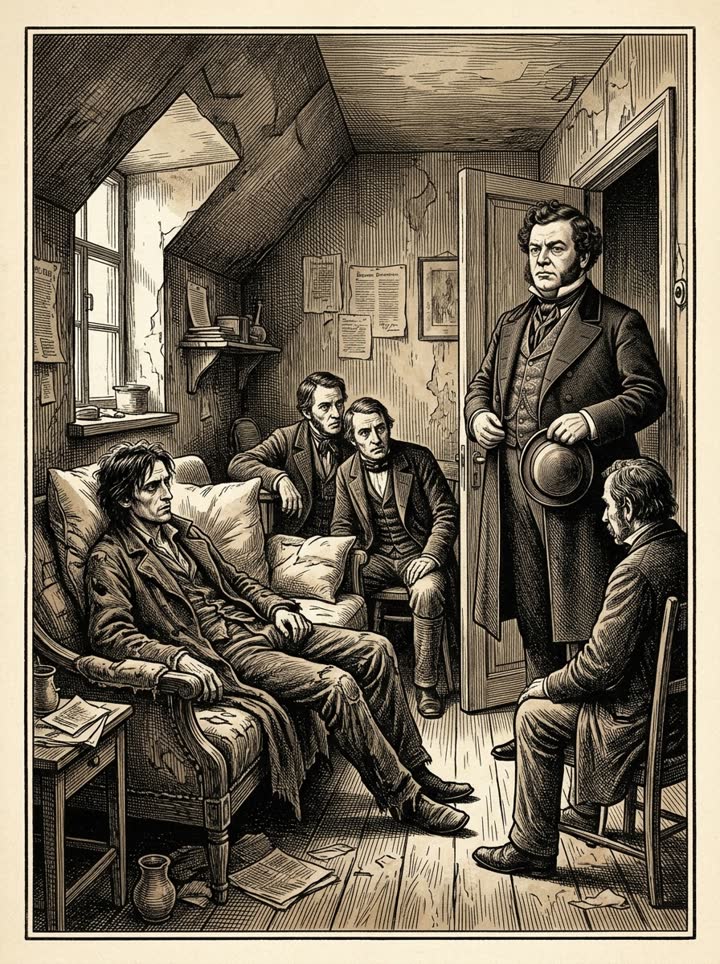
He was a gentleman no longer young, prim, portly, with a cautious and peevish face. He began by stopping in the doorway and looking around with an insultingly undisguised astonishment, as if asking with his eyes: "Where on earth have I come to?" Distrustfully, and even with an affectation of some alarm, almost of offence, he surveyed Raskolnikov's cramped, low "ship's cabin." With the same astonishment he then turned and fixed his eyes on Raskolnikov himself, undressed, dishevelled, unwashed, lying on his wretched dirty sofa and likewise staring at him without moving. Then, with the same slowness, he began to examine the unkempt, unshaven, uncombed figure of Razumikhin, who in his turn looked him boldly and questioningly straight in the eyes, without stirring from his place. The tense silence lasted a minute, and at last, as might have been expected, there was a small change of scene. Having reckoned, no doubt, from certain indications, very glaring ones, it must be said, that an exaggeratedly stern bearing would get him absolutely nowhere here, in this "ship's cabin," the visitor softened somewhat and said politely, though not without severity, addressing Zosimov and rapping out every syllable of his question:
"Rodion Romanovich Raskolnikov, the student, or former student?"
Zosimov stirred slowly and might perhaps have answered, if Razumikhin, to whom the question was not addressed at all, had not forestalled him at once:
"There he is, lying on the sofa! And what do you want?"
This familiar "and what do you want?" simply knocked the ground from under the prim gentleman. He very nearly turned to Razumikhin, but managed to restrain himself in time and quickly turned back to Zosimov.
"That is Raskolnikov!" mumbled Zosimov, nodding at the patient, then he yawned, opening his mouth extraordinarily wide and holding it that way extraordinarily long. Then he slowly dragged his hand into his waistcoat pocket, took out an enormous, convex, closed gold watch, opened it, looked at it, and just as slowly and lazily dragged it back again to put it away.
Raskolnikov himself lay silent the whole time, on his back, staring stubbornly, though without any thought, at the newcomer. His face, turned away now from the curious flower on the wallpaper, was extremely pale and expressed extraordinary suffering, as if he had just undergone a painful operation or had just been let out from under torture. But the gentleman who had come in gradually began to arouse in him more and more attention, then bewilderment, then distrust, and even something like fear. And when Zosimov, pointing at him, said, "That is Raskolnikov," he suddenly sat up in bed, quickly, as if he had leapt, and said in an almost challenging, but broken and weak voice:
"Yes! I am Raskolnikov! What do you want?"
The visitor looked at him attentively and said impressively:
"Pyotr Petrovich Luzhin. I am in full hope that my name is not altogether unknown to you."
But Raskolnikov, who had expected something quite different, looked at him blankly and thoughtfully and answered nothing, as if he were hearing the name of Pyotr Petrovich decidedly for the first time.
"What? Is it possible that you have not yet been favoured with any news?" asked Pyotr Petrovich, bristling slightly.
In answer to this Raskolnikov slowly sank back on the pillow, put his hands behind his head and began to look at the ceiling. Dejection showed in Luzhin's face. Zosimov and Razumikhin began to look him over with still greater curiosity, and at last he was visibly embarrassed.
"I supposed and calculated," he began to mumble, "that a letter sent off more than ten days ago, nearly two weeks in fact..."
"Listen, why do you keep standing at the door?" Razumikhin suddenly interrupted. "If you have something to explain, sit down, it's too cramped there for the two of you, you and Nastasya. Nastasyushka, step aside, let him pass! Come in, here's a chair for you, here! Squeeze through, then!"
He pushed his chair back from the table, freed a little space between the table and his knees, and waited in a somewhat strained position for the visitor to "squeeze through" this little crack. The moment was so chosen that it was quite impossible to refuse, and the visitor made his way through the narrow space, hurrying and stumbling. Reaching the chair, he sat down and looked suspiciously at Razumikhin.
"Don't be embarrassed, though," the other blurted out. "Rodya has been ill for five days now and was delirious for three, but now he's come round and has even eaten with an appetite. That's his doctor sitting there, he's just examined him, and I'm Rodka's comrade, also a former student, and I'm nursing him now. So don't take any notice of us, don't stand on ceremony, but go on with whatever you need to say."
"Thank you. But shall I not disturb the patient with my presence and my conversation?" said Pyotr Petrovich, turning to Zosimov.
"N-no," mumbled Zosimov, "you may even distract him," and he yawned again.
"Oh, he's been in his senses for a long time, since the morning!" Razumikhin went on, and his familiarity had the look of such unfeigned simplicity that Pyotr Petrovich thought it over and began to take heart, perhaps partly because this ragamuffin and impudent fellow had managed to introduce himself as a student.
"Your mamma..." began Luzhin.
"Hm!" Razumikhin said loudly. Luzhin looked at him questioningly.
"It's nothing, I just... go on..."
Luzhin shrugged his shoulders.
"...Your mamma, while I was still with them, began a letter to you. On arriving here, I purposely let several days pass and did not come to you, so as to be perfectly certain that you had been informed of everything. But now, to my astonishment..."
"I know, I know!" Raskolnikov said suddenly, with an expression of the most impatient vexation. "It's you? The fiancé? Well, I know!... And that's enough!"
Pyotr Petrovich was decidedly offended, but kept silent. He hurried with all his might to work out what all this meant. For a minute the silence continued.
Meanwhile Raskolnikov, who had turned slightly towards him as he answered, suddenly began to examine him again, intently and with a kind of peculiar curiosity, as if he had not managed to see all of him a little while ago, or as if something new in him had struck him. He even raised himself from the pillow on purpose to do it. And indeed something peculiar struck one in Pyotr Petrovich's whole appearance, namely something that seemed to justify the name of "fiancé" so unceremoniously given him just now. In the first place, it was evident, even too evident, that Pyotr Petrovich had hastened to make use of his few days in the capital to smarten and adorn himself while awaiting his betrothed, which, incidentally, was quite innocent and permissible. Even his own, perhaps even too self-satisfied, his own awareness of his pleasant change for the better might have been forgiven on such an occasion, for Pyotr Petrovich was, after all, in the position of a bridegroom. All his clothes were fresh from the tailor, and all of it was good, except perhaps only that it was all too new and too clearly betrayed a certain purpose. Even the dashing, brand-new round hat bore witness to this purpose: Pyotr Petrovich treated it somehow too reverently and held it too carefully in his hands. Even the charming pair of lilac gloves, real Jouvin gloves, testified to the same thing, if only by the fact that he did not wear them but merely carried them in his hands for show. In Pyotr Petrovich's clothing light and youthful colours predominated. He wore a pretty summer jacket of a light brown shade, light thin trousers, a waistcoat of the same kind, fine linen just bought, and the lightest cambric little cravat with pink stripes, and best of all, all this actually suited Pyotr Petrovich. His face, very fresh and even handsome, looked younger than his forty-five years even without that. Dark side-whiskers pleasantly shaded it on both sides, in the form of two cutlets, and thickened very handsomely around his clean-shaven, shining chin. Even his hair, though only just touched with grey, combed and curled by a hairdresser, did not on that account look at all ridiculous or foolish, as curled hair usually does, since it gives the face an inevitable resemblance to a German going to his wedding. If there was anything really unpleasant and repellent in this fairly handsome and solid face, it came from other causes. Having examined Mr. Luzhin without ceremony, Raskolnikov smiled venomously, sank back on the pillow and went on looking at the ceiling as before.
But Mr. Luzhin pulled himself together and seemed to resolve not to notice all these oddities for the time being.
"I am very, very sorry to find you in such a condition," he began again, forcing himself to break the silence. "Had I known of your illness, I would have come earlier. But, you know, so much to see to!... I also have a very important matter in the Senate in my legal line. I do not even mention those cares which you will guess for yourself. Your people, that is your mamma and sister, I expect any hour now..."
Raskolnikov stirred and wanted to say something; his face showed some agitation. Pyotr Petrovich paused, waited, but as nothing followed, he went on:
"...Any hour now. I have found them a lodging to begin with..."
"Where?" Raskolnikov said weakly.
"Quite close to here, in Bakaleyev's house..."
"That's on Voznesensky," Razumikhin interrupted, "there are two floors of furnished rooms, kept by the merchant Yushin. I've been there."
"Yes, furnished rooms, sir..."
"A horrible place: filth, stink, and a suspicious spot besides. Things have happened there, and the devil knows who doesn't live there!... I went in myself over a scandal. Cheap, though."
"I, of course, could not gather so much information, being a newcomer here myself," Pyotr Petrovich objected touchily, "but, however, two very, very clean little rooms, and as it is for a very short time... I have already found our real, that is our future, flat," he turned to Raskolnikov, "and it is being done up now. Meanwhile I myself am cramped in furnished rooms, two steps from here, at Mrs. Lippewechsel's, in the lodgings of a young friend of mine, Andrei Semyonovich Lebezyatnikov. It was he who pointed out Bakaleyev's house to me..."
"Lebezyatnikov?" Raskolnikov said slowly, as if recalling something.
"Yes, Andrei Semyonovich Lebezyatnikov, who serves in a ministry. Do you happen to know him?"
"Yes... no..." answered Raskolnikov.
"Excuse me, I thought so from your question. I was once his guardian... a very nice young man... and well-informed... I am glad to meet young people: from them one learns what is new." Pyotr Petrovich looked round hopefully at all those present.
"In what respect?" asked Razumikhin.
"In the most serious, so to say, in the very essence of the matter," Pyotr Petrovich took up, as if delighted by the question. "You see, I have not visited Petersburg for ten years. All these new things of ours, reforms, ideas, all that has touched us too in the provinces. But to see more clearly and to see everything, one must be in Petersburg. Well, sir, and my thought is precisely that one notices and learns most by observing our younger generations. And I confess I was gladdened..."
"By what exactly?"
"Your question is a wide one. I may be mistaken, but it seems to me I find a clearer view, more, so to say, criticism, more businesslike spirit..."
"That's true," Zosimov muttered through his teeth.
"Rubbish, there's no businesslike spirit," Razumikhin fastened on him. "A businesslike spirit is acquired with difficulty, it doesn't drop from heaven for nothing. And we've been out of the habit of every kind of business for nearly two hundred years... Ideas, perhaps, do wander about," he turned to Pyotr Petrovich, "and there is a desire for good, though a childish one, and even honesty can be found, in spite of the fact that swindlers have poured in by the countless thousand, but a businesslike spirit there still isn't! A businesslike spirit goes about in boots."
"I do not agree with you," Pyotr Petrovich objected with visible enjoyment. "Of course there are enthusiasms, irregularities, but one must be indulgent too: enthusiasms bear witness to zeal for the cause and to the irregular external circumstances in which the cause finds itself. If little has been done, well, there has been little time. I do not speak of means. In my own personal view, if you like, something has even been done: new, useful ideas have been spread, some new, useful writings have been spread, in place of the former dreamy and romantic ones. Literature is taking on a more mature shade; many harmful prejudices have been rooted out and laughed at... In a word, we have cut ourselves off irrevocably from the past, and that, in my opinion, is already an achievement, sir..."
"He's learnt it by heart! He's recommending himself," Raskolnikov said suddenly.
"What, sir?" asked Pyotr Petrovich, not having heard, but he got no answer.
"All this is quite just," Zosimov hastened to put in.
"Is it not, sir?" Pyotr Petrovich went on, glancing pleasantly at Zosimov. "You must agree yourself," he continued, turning to Razumikhin, but now with a shade of triumph and superiority, and he almost added "young man," "that there is advancement, or, as they say now, progress, if only in the name of science and economic truth..."
"A commonplace!"
"No, not a commonplace, sir! If, for example, until now they said to me, 'Love,' and I loved, what came of it?" Pyotr Petrovich went on, perhaps with excessive haste. "What came of it was that I tore my coat in two, shared it with my neighbour, and we were both left half naked, as the Russian proverb says: 'If you chase several hares at once, you will not catch one.' But science says: love, before all others, yourself alone, for everything in the world is founded on personal interest. If you love yourself alone, you will manage your affairs properly, and your coat will remain whole. And economic truth adds that the more properly arranged private affairs there are in a society, and, so to say, whole coats, the firmer are its foundations, and the better the common cause is arranged in it too. Consequently, by acquiring solely and exclusively for myself, I am by that very act acquiring, as it were, for everyone, and bringing it about that my neighbour receives something more than a torn coat, and no longer from private, individual generosity, but as a result of universal prosperity. A simple thought, but unfortunately one that was too long in coming, obscured by rapture and dreaminess, and yet it would seem little wit is needed to guess it..."
"Excuse me, I'm not witty either," Razumikhin cut in sharply, "and so let us stop. I started talking with a purpose, you see, because all this chatter, this self-comforting, all these endless, unceasing commonplaces, always the same and the same again, have grown so loathsome to me in three years that, by God, I blush when other people talk like that in my presence, never mind myself. You were in a hurry, of course, to recommend yourself by your learning, which is very pardonable, and I don't condemn it. I only wanted to find out now who you are, because, you see, so many different opportunists have attached themselves to the common cause lately, and have so distorted everything they touched to their own interest, that they've positively fouled the whole business. Well, sir, and enough!"
"My dear sir," Mr. Luzhin began, bristling with extreme dignity, "do you wish to say, so unceremoniously, that I too..."
"Oh, for mercy's sake, for mercy's sake... How could I?... Well, sir, and enough!" Razumikhin snapped, and turned sharply away to continue his earlier conversation with Zosimov.
Pyotr Petrovich proved clever enough to believe the explanation at once. He decided, however, to leave in two minutes.
"I hope that the acquaintance now begun between us," he said, turning to Raskolnikov, "after your recovery and in view of the circumstances known to you, will be strengthened still more... I especially wish you health..."
Raskolnikov did not even turn his head. Pyotr Petrovich began to rise from his chair.
"So it was certainly one of the people who pawned things with her?" Zosimov was saying, more as a statement than a question.
"Certainly one of them!" Razumikhin agreed. "Porfiry doesn't give away his thoughts, but he is questioning the pawners all the same..."
"He's questioning the pawners?" Raskolnikov asked loudly.
"Yes, what of it?"
"Nothing."
"Where does he get them from?" asked Zosimov.
"Koch pointed out some; others had their names written on the wrappings of the pledges; and some came of their own accord when they heard..."
"Well, he must be a clever and experienced scoundrel! What boldness! What resolution!"
"That's just it, he isn't!" Razumikhin interrupted. "That's what throws all of you off the track. And I say he's clumsy, inexperienced, and no doubt it was his first step! Suppose calculation and a clever scoundrel, and it comes out incredible. Suppose an inexperienced man, and it comes out that only chance carried him out of trouble, and what won't chance do? Good heavens, he perhaps didn't even foresee the obstacles! And how does he go about it? He takes things worth ten or twenty roubles, stuffs his pockets with them, rummages in the old woman's trunk, among the rags, and meanwhile in the chest of drawers, in the top drawer, in a casket, they found fifteen hundred roubles in clean cash alone, besides the bonds! He didn't even know how to rob, all he knew how to do was kill! A first step, I tell you, a first step; he lost his head! And he got out not by calculation but by chance!"
"This seems to be about the recent murder of the old official's widow," Pyotr Petrovich put in, turning to Zosimov, already standing with his hat and gloves in his hand, but wishing to throw in a few more clever words before leaving. He was evidently anxious to make a favourable impression, and vanity overcame prudence.
"Yes. Have you heard?"
"Of course, sir, in the neighbourhood..."
"Do you know the details?"
"I could not say; but another circumstance interests me in it, so to say, a whole question. I do not speak of the fact that crimes among the lower class have increased in the last five years; I do not speak of the robberies and fires everywhere and without end. What is strangest of all to me is that crimes in the higher classes are increasing in the same way and, so to say, in parallel. In one place, they say, a former student has robbed the mail on the high road; in another, people of leading social position make forged banknotes; in another, in Moscow, a whole company forging bonds of the last lottery loan has been caught, and one of the chief participants was a lecturer in world history; in another, our secretary abroad is killed, for some obscure reason to do with money... And if now this old pawnbroker has been killed by one of her pawners, then he too was a man from a higher society, for peasants do not pawn gold things, so how is one to explain this, on one side, looseness of the civilised part of our society?"
"There are many economic changes..." Zosimov responded.
"How to explain?" Razumikhin fastened on it. "Why, it could be explained precisely by our far too deep-rooted lack of a businesslike spirit."
"That is, how so, sir?"
"What did that lecturer of yours answer in Moscow to the question why he forged bonds? 'Everyone gets rich in different ways, so I too wanted to get rich quickly.' I don't remember the exact words, but the sense is: for nothing, quickly, without labour! We're used to living on everything ready-made, to walking on other people's leading-strings, to eating food that's been chewed for us. Well, and when the great hour struck, every man showed what he was..."
"But, however, morality? And, so to say, principles..."
"But what are you fussing about?" Raskolnikov unexpectedly intervened. "It's come out according to your own theory!"
"How, according to my theory?"
"Carry to its consequences what you were preaching a little while ago, and it will come out that it's all right to cut people's throats..."
"For mercy's sake!" cried Luzhin.
"No, that's not so!" Zosimov responded.
Raskolnikov lay pale, his upper lip trembling, and breathed with difficulty.
"There is a limit to everything," Luzhin went on haughtily. "An economic idea is not yet an invitation to murder, and if one only supposes..."
"And is it true that you," Raskolnikov suddenly interrupted again, in a voice trembling with fury, in which could be heard a kind of joy of insult, "is it true that you told your fiancée... at the very hour you received her consent, that you were most glad of this... that she is a beggar... because it is more profitable to take a wife out of poverty, so as to rule over her afterwards... and reproach her with everything you have done for her?..."
"My dear sir!" Luzhin cried spitefully and irritably, flushing all over and getting confused. "My dear sir... to distort a thought like that! Excuse me, but I must tell you that the rumours which have reached you, or, better to say, been brought to you, have not even the shadow of a sensible foundation, and I... suspect who... in a word... this arrow... in a word, your mamma... Even before this, for all her excellent qualities, she seemed to me to have a somewhat rapturous and romantic shade in her thoughts... But all the same I was a thousand versts from supposing that she could understand and present the matter in such a form, perverted by fancy... And finally... finally..."
"Do you know what?" cried Raskolnikov, raising himself on the pillow and looking at him point-blank with a piercing, flashing gaze. "Do you know what?"
"What, sir?" Luzhin stopped and waited with an offended and defiant air. Some seconds of silence passed.
"This: that if you ever again... dare to mention even one word... about my mother... I'll send you flying down the stairs head over heels!"
"What's the matter with you!" cried Razumikhin.
"So that's how it is, sir!" Luzhin turned pale and bit his lip. "Listen to me, sir," he began deliberately, restraining himself with all his might, but still gasping, "I guessed your hostility a little while ago, from the moment I came in, but I stayed here on purpose to find out still more. Much I could have forgiven a sick man and a relative, but now... to you... never, sir..."
"I am not ill!" cried Raskolnikov.
"All the more, sir..."
"Go to the devil!"
But Luzhin was already going out of his own accord, without finishing his speech, squeezing again between the table and the chair. This time Razumikhin got up to let him pass. Without looking at anyone and without even nodding to Zosimov, who had long been nodding to him to leave the sick man in peace, Luzhin went out, lifting his hat carefully beside his shoulder as he stooped to pass through the door. And even in the curve of his back it seemed to be expressed on this occasion that he was carrying away with him a terrible insult.
"Can one, can one behave like that?" said the bewildered Razumikhin, shaking his head.
"Leave me, leave me alone, all of you!" Raskolnikov cried in a frenzy. "Will you leave me alone at last, tormentors! I am not afraid of you! I'm not afraid of anyone, anyone now! Away from me! I want to be alone, alone, alone, alone!"
"Let's go!" said Zosimov, nodding to Razumikhin.
"For mercy's sake, can one leave him like this?"
"Let's go!" Zosimov repeated insistently and went out. Razumikhin thought and ran to catch up with him.
"It might have been worse if we hadn't obeyed him," said Zosimov, already on the stairs. "He must not be irritated..."
"What is the matter with him?"
"If only he could have some favourable shock, that's what he needs! A little while ago he was strong... You know, he has something on his mind! Something fixed, weighing on him... I'm very afraid of that; certainly!"
"Perhaps it's this gentleman, this Pyotr Petrovich! From the conversation you can see that he's going to marry his sister and that Rodya received a letter about it just before his illness..."
"Yes; the devil brought him just now; perhaps he has upset the whole business. And did you notice that he's indifferent to everything, keeps silent about everything, except one point, which makes him beside himself: this murder..."
"Yes, yes!" Razumikhin took up. "I noticed very well! He's interested, he's frightened. They frightened him on the very day of his illness, at the police office, at the superintendent's; he fainted."
"You must tell me about that in more detail this evening, and then I'll tell you something. He interests me, very much! I'll look in to see how he is in half an hour... There'll be no inflammation, though..."
"Thank you! And meanwhile I'll wait at Pashenka's and watch him through Nastasya..."
Left alone, Raskolnikov looked at Nastasya with impatience and anguish; but she still delayed going.
"Will you drink your tea now?" she asked.
"Later! I want to sleep! Leave me..."
He turned convulsively to the wall; Nastasya went out.