
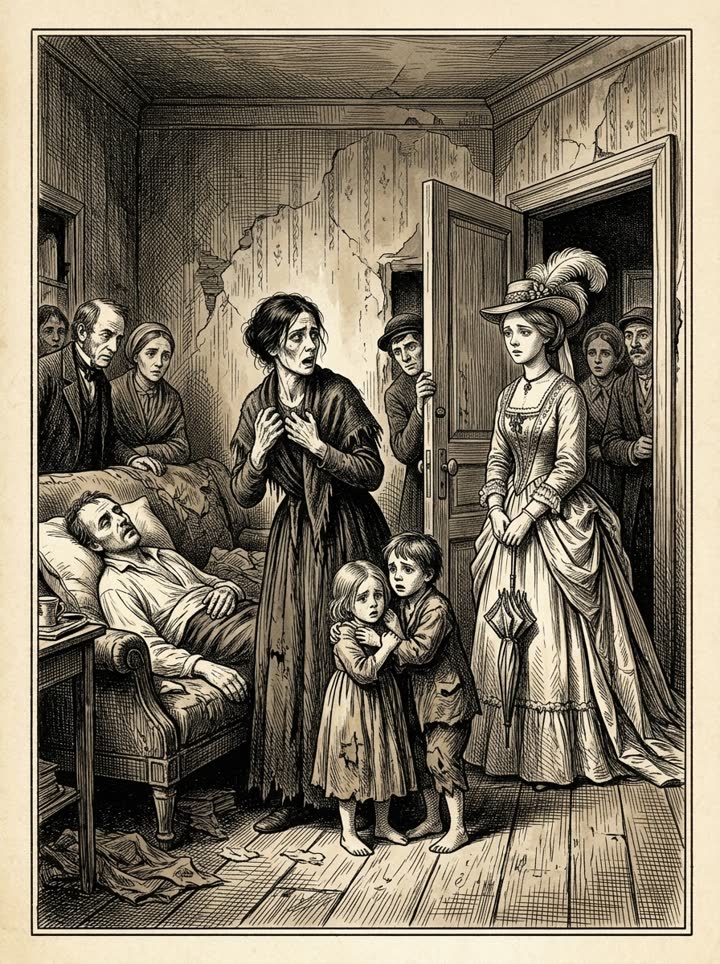
In the middle of the street stood a carriage, a smart, lordly one, drawn by a pair of spirited grey horses. There was no one in it, and the coachman himself had climbed down from the box and was standing beside it; the horses were being held by the bridles. A great crowd of people was pressing all around, and in front of them all were the policemen. One of them had a lighted lantern in his hand, and bending down he was shining it on something on the pavement, right by the wheels. Everyone was talking, shouting, gasping; the coachman seemed bewildered and now and then repeated:
"What a sin! Lord, what a sin!"
Raskolnikov pushed his way through as best he could, and at last he saw the object of all this fuss and curiosity. On the ground lay a man who had just been run down by the horses, apparently unconscious, very poorly dressed, but in "gentleman's" clothes, all covered in blood. Blood was running from his face and from his head; his face was all bruised, scraped and mangled. It was plain that he had been run down in earnest.
"Good heavens!" the coachman wailed. "How could I have seen him! If I'd been driving fast, or hadn't shouted at him, but I was going slowly, steadily. Everyone saw it: I say no more than anyone else says. You can't expect a drunk man to watch himself, everyone knows that!... I see him crossing the street, staggering, nearly falling over. I shouted once, then twice, then a third time, and I even held the horses back; and he fell right under their feet! Whether he did it on purpose, or was just very drunk... The horses are young and skittish. They jerked, he cried out, and they got worse... and so the trouble came."
"That's how it was!" someone in the crowd called out, bearing witness.
"He shouted, that's true, he shouted at him three times," answered another voice.
"Exactly three times, everyone heard it!" cried a third.
Still, the coachman was not very downcast or frightened. It was plain that the carriage belonged to a rich and important owner who was waiting for it somewhere; and the police, of course, were taking no little trouble over how to arrange that last circumstance. The man who had been run down had to be taken to the police station and to the hospital. No one knew his name.
Meanwhile Raskolnikov had pushed forward and bent down still closer. Suddenly the lantern lit up the unfortunate man's face brightly, and he recognised him.
"I know him, I know him!" he cried, squeezing right to the front. "He's a clerk, retired, a titular councillor, Marmeladov! He lives here, close by, in Kozel's house... A doctor, quickly! I'll pay, look!" He pulled money out of his pocket and showed it to a policeman. He was in extraordinary agitation.
The police were glad that they had found out who the injured man was. Raskolnikov gave his own name too, gave his address, and with all his strength, as though it were a matter of his own father, he urged them to carry the unconscious Marmeladov to his lodging as quickly as possible.
"Just here, three houses along," he fussed. "Kozel's house, a German, a rich man... He was surely drunk, trying to make his way home. I know him... He's a drunkard... He has a family there, a wife, children, and there's a grown daughter. It's a long way to drag him to the hospital, and surely there's a doctor right here in the house! I'll pay, I'll pay!... At least he'll have his own people looking after him, they'll help at once, otherwise he'll die before the hospital..."
He even managed to slip something unnoticed into someone's hand; the matter, however, was plain and lawful, and in any case help was nearer here. They lifted the injured man and carried him; helpers were found. Kozel's house was thirty paces away. Raskolnikov walked behind, carefully supporting the head and showing the way.
"This way, this way! On the stairs you have to carry him with his head up; turn him round... that's it! I'll pay, I'll thank you," he muttered.
Katerina Ivanovna, as always the moment a free minute turned up, had begun walking to and fro in her little room, from the window to the stove and back, her arms crossed tightly on her chest, talking to herself and coughing. Lately she had begun to talk more and more with her elder girl, the ten-year-old Polenka, who, though she still did not understand a great deal, had understood very well that her mother needed her, and so she always followed her with her big clever eyes and used all her cunning to seem to understand everything. This time Polenka was undressing her little brother, who had been unwell all day, to put him to bed. While he waited for them to change his shirt, which had to be washed that very night, the boy sat silently on a chair with a serious face, straight and motionless, with his little legs stretched out in front of him and pressed tightly together, heels towards the audience and toes apart. He listened to what mamma was saying to his sister, with pouting lips and bulging eyes, not stirring, exactly as all clever little boys must sit when they are being undressed to go to bed. A still smaller girl, in complete rags, stood by the screen waiting her turn. The door to the stairs was open, to give at least some protection from the waves of tobacco smoke that burst in from the other rooms and every minute set the poor consumptive coughing long and painfully. Katerina Ivanovna seemed to have grown even thinner in this one week, and the red patches on her cheeks burned even brighter than before.
"You won't believe it, you can't even imagine, Polenka," she was saying, walking about the room, "how merrily and splendidly we lived in papa's house, and how this drunkard has ruined me and will ruin all of you! Papa was a civil colonel and almost a governor; he had only one step left to take, so that everyone visited him and said: 'We already count you, Ivan Mikhailych, as our governor.' When I... ahem! when I... ahem-hem-hem... oh, accursed life!" she cried out, coughing up phlegm and clutching at her chest, "when I... ah, when at the last ball... at the marshal of nobility's... Princess Bezzemelnaya saw me, the one who blessed me afterwards when I married your papa, Polya, and she asked at once: 'Isn't that the sweet girl who danced with the shawl at the graduation?'... (That tear must be mended; you should take a needle and darn it right now, as I taught you, otherwise tomorrow... ahem! tomorrow... ahem-hem-hem!... it will tear worse!" she cried, straining.)... "Then Prince Shchegolskoy, a gentleman of the bedchamber, had just arrived from Petersburg... he danced the mazurka with me and wanted to come the very next day with a proposal; but I thanked him myself in flattering terms and said that my heart had long belonged to another. That other was your father, Polya; papa was terribly angry... Is the water ready? Well, give me the little shirt; and the stockings?... Lida," she turned to the little daughter, "you'll just have to sleep without a shirt tonight; somehow... and lay your stockings out beside it... They can all be washed together... Why doesn't that ragamuffin come, that drunkard! He's worn his shirt like a dishcloth, torn it all to pieces... Everything together, so as not to torment myself two nights running! Lord! Ahem-hem-hem-hem! Again! What is this?" she cried, looking at the crowd in the passage and at the people pushing into her room with some burden. "What is this? What are they carrying? Lord!"
"Where shall we put him?" asked the policeman, looking around, when the bloodied and unconscious Marmeladov had already been dragged into the room.
"On the sofa! Lay him straight on the sofa, here, with his head this way," Raskolnikov showed them.
"Run down in the street! Drunk!" someone shouted from the passage.
Katerina Ivanovna stood quite pale and breathing with difficulty. The children were terrified. Little Lidochka screamed, rushed to Polenka, threw her arms around her and began to tremble all over.
Having laid Marmeladov down, Raskolnikov rushed to Katerina Ivanovna.
"For God's sake, calm yourself, don't be frightened!" he said in a rapid patter. "He was crossing the street, a carriage ran him down, don't worry, he'll come round, I told them to bring him here... I've been to see you, you remember... He'll come round, I'll pay!"
"He's done it at last!" Katerina Ivanovna cried in despair and rushed to her husband.
Raskolnikov soon noticed that this woman was not one of those who faint at once. In an instant a pillow was under the unfortunate man's head, one that no one had thought of; Katerina Ivanovna began to undress him, to examine him, she bustled and did not lose her head, forgetting herself, biting her trembling lips and stifling the cries that were ready to burst from her chest.
Meanwhile Raskolnikov had persuaded someone to run for a doctor. The doctor, it turned out, lived two doors away.
"I've sent for a doctor," he kept telling Katerina Ivanovna. "Don't worry, I'll pay. Is there any water?... And give me a napkin, a towel, anything, quickly; we don't know yet how badly he's hurt... He's hurt, not killed, be sure of that... What will the doctor say!"
Katerina Ivanovna rushed to the window; there, on a broken-down chair in the corner, stood a big earthenware basin of water, prepared for the night washing of the children's and her husband's linen. This night washing was done by Katerina Ivanovna herself, with her own hands, at least twice a week, and sometimes more often, for they had come to the point where there was almost no spare linen at all, and each member of the family had only one of each thing, and Katerina Ivanovna could not bear uncleanliness and preferred to torment herself at night beyond her strength, when everyone was asleep, so as to have the wet linen dried on a stretched line by morning and to hand out clean things, rather than see dirt in the house. She seized the basin to carry it at Raskolnikov's request, but nearly fell with the load. But he had already managed to find a towel, wetted it in the water and begun to wash the blood-soaked face of Marmeladov. Katerina Ivanovna stood there, catching her breath painfully and pressing her hands to her chest. She herself needed help. Raskolnikov began to understand that he had perhaps done badly in persuading them to carry the injured man here. The policeman too stood at a loss.
"Polya!" cried Katerina Ivanovna. "Run to Sonya, quickly. If you don't find her at home, never mind, say that the horses have run down her father and that she must come here at once... when she gets back. Quickly, Polya! Here, cover yourself with a shawl!"
"Wun for your life!" the boy suddenly cried from his chair, and having said it, he sank again into his former silent, upright sitting on the chair, eyes bulging, heels forward and toes apart.
Meanwhile the room had filled so that there was no room to drop an apple. The police had gone, except one, who stayed for the time being and tried to drive the public who had crowded in from the stairs back out onto the stairs. But from the inner rooms almost all the lodgers of Mrs. Lippewechsel had poured out, and at first they only crowded in the doorway, but then they surged in a mob into the room itself. Katerina Ivanovna flew into a frenzy.
"At least let him die in peace!" she shouted at the whole crowd. "What a spectacle you've found! With cigarettes! Ahem-hem-hem! Come in with your hats on too!... And there's one in a hat already... Out! Have some respect, at least, for a dead body!"
The cough choked her, but the warning had its use. They were evidently even a little afraid of Katerina Ivanovna; the lodgers, one after another, squeezed back towards the door with that strange inner feeling of contentment which is always noticed, even in the closest people, at the sudden misfortune of their neighbour, and from which no man, without exception, is free, even with the most sincere feeling of pity and sympathy.
Behind the door, however, voices were heard talking about the hospital, saying it was not right to disturb people here for nothing.
"Not right to die, is it!" cried Katerina Ivanovna, and she was about to rush and fling open the door to burst out on them with a whole thunderclap, but she collided in the doorway with Mrs. Lippewechsel herself, who had only just heard of the misfortune and had run in to restore order. This was an extremely quarrelsome and disorderly German woman.
"Ah, my God!" she clapped her hands. "Your husband drunk, a horse has trampled him. To the hospital with him! I am the landlady!"
"Amalia Ludwigovna! I beg you to remember what you are saying," Katerina Ivanovna began haughtily (with the landlady she always spoke in a haughty tone, so that she should "remember her place," and even now she could not deny herself this pleasure), "Amalia Ludwigovna..."
"I told you once before that you never dare to say me Amal Ludwigovna; I am Amal-Ivan!"
"You are not Amal-Ivan, you are Amalia Ludwigovna, and since I do not belong to your base flatterers, like Mr. Lebezyatnikov, who is laughing now behind the door (behind the door there was indeed laughter and a cry of: 'They've gone at it!'), I shall always call you Amalia Ludwigovna, although I positively cannot understand why you don't like that name. You see for yourself what has happened to Semyon Zakharovich; he is dying. I ask you to lock that door at once and let no one in here. Let him at least die in peace! Otherwise, I assure you, your conduct will be known tomorrow to the Governor-General himself. The Prince knew me when I was a girl and remembers Semyon Zakharovich very well, to whom he did many kindnesses. Everyone knows that Semyon Zakharovich had many friends and patrons, whom he abandoned himself out of noble pride, feeling his unhappy weakness, but now (she pointed to Raskolnikov) a generous young man is helping us, a man with means and connections, whom Semyon Zakharovich knew when he was still a child, and you may be sure, Amalia Ludwigovna..."
All this was uttered in an extremely rapid patter, faster and faster as it went on, but a cough suddenly cut short Katerina Ivanovna's eloquence. At that moment the dying man came to himself and groaned, and she ran to him. The sick man opened his eyes and, not yet recognising or understanding, began to stare at Raskolnikov, who stood over him. He breathed heavily, deeply, at long intervals; blood showed at the corners of his lips; sweat stood out on his forehead. Not recognising Raskolnikov, he began to look restlessly around. Katerina Ivanovna looked at him with a sad but stern look, and tears ran from her eyes.
"My God! His whole chest is crushed! So much blood, blood!" she said in despair. "We must take off all his outer clothes! Turn a little, Semyon Zakharovich, if you can," she cried to him.
Marmeladov recognised her.
"A priest!" he said in a hoarse voice.
Katerina Ivanovna went to the window, leaned her forehead against the window frame and cried out in despair:
"Oh, accursed life!"
"A priest!" the dying man said again after a minute's silence.
"Someone's go-o-one for one!" Katerina Ivanovna cried at him; he obeyed the shout and fell silent. With a timid, anguished look his eyes sought her; she came back to him and stood at the head of the sofa. He grew somewhat calmer, but not for long. Soon his eyes rested on little Lidochka (his favourite), who was trembling in the corner as if in a fit and looking at him with her astonished, childishly fixed eyes.
"A... a..." he pointed at her anxiously. He wanted to say something.
"What now?" cried Katerina Ivanovna.
"Barefoot! Barefoot!" he muttered, pointing with a crazed look at the girl's bare little feet.
"Be qui-i-iet!" Katerina Ivanovna cried irritably. "You know yourself why she's barefoot!"
"Thank God, the doctor!" cried Raskolnikov, relieved.
The doctor came in, a precise little old man, a German, looking around with a distrustful air; he went up to the sick man, took his pulse, carefully felt his head and, with Katerina Ivanovna's help, unbuttoned the whole shirt, soaked with blood, and bared the sick man's chest. The whole chest was mangled, crushed and torn; several ribs on the right side were broken. On the left side, right over the heart, there was an ominous, large, yellowish-black spot, a cruel blow from a hoof. The doctor frowned. The policeman told him that the injured man had been caught by the wheel and dragged, spinning, for thirty paces along the pavement.
"It's astonishing that he came round at all," the doctor whispered quietly to Raskolnikov.
"What do you say?" the latter asked.
"He will die any minute."
"Is there really no hope?"
"Not the slightest! He is at his last gasp... Besides, the head is very dangerously wounded... Hm. I could, if you like, let some blood... but... it would be useless. In five or ten minutes he will certainly die."
"Then let the blood, all the same!"
"If you like... However, I warn you, it will be completely useless."
At that moment more steps were heard, the crowd in the passage parted, and on the threshold appeared a priest with the sacrament, a grey-haired little old man. A policeman had gone to fetch him while they were still in the street. The doctor at once gave up his place to him and exchanged a significant look with him. Raskolnikov begged the doctor to wait at least a little. He shrugged his shoulders and stayed.
Everyone drew back. The confession lasted a very short time. The dying man could hardly understand anything; and he could utter only broken, indistinct sounds. Katerina Ivanovna took Lidochka, lifted the boy from his chair and, going into the corner by the stove, knelt down, and made the children kneel in front of her. The girl only trembled; the boy, standing on his bare little knees, raised his small hand in measured fashion, crossed himself with a full sign of the cross and bowed to the ground, knocking his forehead, which apparently gave him special pleasure. Katerina Ivanovna bit her lips and held back her tears; she was praying too, now and then straightening the child's little shirt, and she managed to throw over the girl's too bare shoulders a kerchief that she took from the chest of drawers, without rising from her knees and without ceasing to pray. Meanwhile the doors from the inner rooms began to be opened again by the curious. And in the passage the spectators, lodgers from the whole staircase, pressed ever more thickly, though without stepping across the threshold of the room. Only one candle end lit the whole scene.
At that moment Polenka, who had run for her sister, quickly pushed her way through the crowd from the passage. She came in, hardly able to catch her breath from running fast, took off her shawl, looked for her mother with her eyes, went up to her and said: "She's coming! I met her in the street!" Her mother drew her down to her knees beside her. Out of the crowd, soundlessly and timidly, a girl pushed through, and her sudden appearance in this room, amid poverty, rags, death and despair, was strange. She too was in rags; her dress was cheap, but decked out in the street fashion, to the taste and rules formed in her own special world, with a brightly and shamefully obvious purpose. Sonya stopped in the passage right at the threshold, but did not cross it, and looked like one lost, seeming conscious of nothing, forgetting both her silk dress, bought fourth-hand, coloured and indecent here, with its very long and absurd train, and the immense crinoline that blocked the whole doorway, and her light-coloured shoes, and her parasol, useless at night, but which she had brought with her, and her ridiculous round straw hat with its bright flame-coloured feather. From under this hat, worn tilted at a boyish angle, peered a thin, pale and frightened little face with an open mouth and eyes fixed with terror. Sonya was small, about eighteen years old, thin, but a rather pretty blonde, with remarkable blue eyes. She looked intently at the bed, at the priest; she too was breathless from hurrying. At last the whispering, some words in the crowd, must have reached her. She lowered her eyes, took a step over the threshold and stood in the room, but still right in the doorway.
The confession and communion were over. Katerina Ivanovna again went up to her husband's bed. The priest stepped back and, as he went, turned to say a couple of words of parting and comfort to Katerina Ivanovna.
"And where am I to put these?" she interrupted sharply and irritably, pointing at the little ones.
"God is merciful; hope for the help of the Almighty," the priest began.
"Ee-ech! Merciful, but not to us!"
"That is a sin, a sin, madam," observed the priest, shaking his head.
"And this isn't a sin?" cried Katerina Ivanovna, pointing at the dying man.
"Perhaps those who were the involuntary cause will agree to compensate you, at least for the loss of income..."
"You don't understand me!" Katerina Ivanovna cried irritably, waving her hand. "And what is there to compensate? He himself, drunk, crawled under the horses! What income? From him there was no income, only torment. He drank everything away, the drunkard. He robbed us and carried it to the tavern, he wasted their life and mine in the tavern! And thank God that he is dying! That's less of a loss!"
"One ought to forgive in the hour of death, and this is a sin, madam, such feelings are a great sin!"
Katerina Ivanovna was bustling around the sick man, she gave him drink, wiped the sweat and blood from his head, straightened the pillows, and spoke to the priest, now and then managing to turn to him between tasks. But now she suddenly flew at him almost in a frenzy.
"Ech, father! Words, words and nothing but words! Forgive! If he had come home drunk today and not been run over, with only the one shirt on him, all worn and in tatters, he would have flopped down and snored, and I would have been rinsing in water till dawn, washing his rags and the children's, and then drying them outside the window, and the moment it was light I'd have sat down to darn, and that's my night!... So why talk about forgiveness here! I've forgiven already!"
A deep, terrible cough broke off her words. She spat into a handkerchief and thrust it out for the priest to see, holding her chest painfully with the other hand. The handkerchief was all in blood...
The priest bowed his head and said nothing.
Marmeladov was in his last agony; he did not take his eyes from the face of Katerina Ivanovna, who had bent over him again. He kept wanting to say something to her; he even began, moving his tongue with effort and pronouncing the words indistinctly, but Katerina Ivanovna, understanding that he wanted to ask her forgiveness, at once shouted at him commandingly:
"Be qui-i-iet! No need!... I know what you want to say!..." And the sick man fell silent; but at that same moment his wandering look fell on the door, and he saw Sonya...
Until now he had not noticed her: she stood in the corner and in shadow.
"Who is that? Who is that?" he said suddenly in a hoarse, gasping voice, all in alarm, pointing with his eyes in terror at the door where his daughter stood, and straining to raise himself.
"Lie still! Lie sti-i-ill!" Katerina Ivanovna cried out.
But with an unnatural effort he managed to prop himself on his arm. He looked wildly and fixedly for some time at his daughter, as if not recognising her. And indeed he had never yet seen her in such a costume. Suddenly he recognised her, humbled, crushed, dressed up and ashamed, humbly waiting her turn to say goodbye to her dying father. Infinite suffering showed in his face.
"Sonya! Daughter! Forgive me!" he cried, and wanted to stretch out his hand to her, but, losing his support, he slipped and crashed off the sofa, face down on the floor; they rushed to lift him, laid him back, but he was already dying. Sonya cried out faintly, ran up, embraced him, and froze in that embrace. He died in her arms.
"He's got what he wanted!" cried Katerina Ivanovna, seeing her husband's corpse. "Well, what is to be done now! What shall I bury him with! And these, these, what shall I feed them with tomorrow?"
Raskolnikov went up to Katerina Ivanovna.
"Katerina Ivanovna," he began, "last week your late husband told me his whole life and all his circumstances... You may be sure that he spoke of you with enthusiastic respect. From that evening, when I learned how devoted he was to all of you, and how especially he respected and loved you, Katerina Ivanovna, in spite of his unhappy weakness, from that evening we became friends... Allow me now... to help in paying a debt to my late friend. Here... twenty roubles, I think, and if that can be of any help to you, then... I... in a word, I will call, I will certainly call... I may even call tomorrow... Goodbye!"
And he quickly left the room, pushing through the crowd to the stairs as fast as he could; but in the crowd he suddenly collided with Nikodim Fomich, who had learned of the misfortune and wished to give orders in person. They had not met since the scene in the office, but Nikodim Fomich recognised him at once.
"Ah, is that you?" he asked him.
"He's dead," answered Raskolnikov. "There has been a doctor, there has been a priest, everything is in order. Don't trouble the poor woman too much, she is consumptive as it is. Cheer her up, if you can in any way... You're a kind man, I know..." he added with a wry smile, looking straight into his eyes.
"But you are soaked in blood, though," observed Nikodim Fomich, making out in the light of the lantern several fresh stains on Raskolnikov's waistcoat.
"Yes, soaked... I'm all covered in blood!" said Raskolnikov with some peculiar air; then he smiled, nodded his head and went down the stairs.
He went down quietly, without hurrying, all in a fever and, without realising it, full of one new, boundless sensation of a full and powerful life suddenly surging in. This sensation might resemble that of a man condemned to death who is suddenly and unexpectedly told he is pardoned. Halfway down the stairs the priest, going home, overtook him; Raskolnikov silently let him pass, exchanging a mute bow with him. But as he was going down the last steps, he suddenly heard hurried footsteps behind him. Someone was catching up with him. It was Polenka; she was running after him and calling: "Listen! Listen!"
He turned to her. She ran down the last flight and stopped right in front of him, one step above him. A dim light came from the yard. Raskolnikov made out the girl's thin but sweet little face, smiling at him and looking at him merrily, like a child. She had run after him with an errand which, evidently, she herself liked very much.
"Listen, what is your name?... and one more thing: where do you live?" she asked hurriedly, in a breathless little voice.
He laid both hands on her shoulders and looked at her with a kind of happiness. It was so pleasant for him to look at her, he himself did not know why.
"And who sent you?"
"Sister Sonya sent me," answered the girl, smiling still more merrily.
"I knew it was sister Sonya who sent you."
"Mamma sent me too. When sister Sonya began to send me, mamma came up too and said: 'Run quickly, Polenka!'"
"Do you love sister Sonya?"
"I love her more than anyone!" Polenka said with a kind of special firmness, and her smile suddenly became more serious.
"And will you love me?"
Instead of an answer he saw the girl's little face coming close to him and her plump little lips naively stretched out to kiss him. Suddenly her arms, thin as matchsticks, clasped him very, very tightly, her head bent to his shoulder, and the girl began to cry quietly, pressing her face to him harder and harder.
"I'm sorry for papa!" she said after a minute, lifting her tear-stained little face and wiping away the tears with her hands. "So many misfortunes now, one after another," she added unexpectedly, with that especially grave air which children put on with effort when they suddenly want to talk like "grown-ups."
"And did your papa love you?"
"He loved Lidochka more than any of us," she went on very seriously and without smiling, already exactly as grown-ups speak, "he loved her because she is little, and also because she is sick, and he always brought her presents, and he taught us to read, and me grammar and the catechism," she added with dignity, "and mamma said nothing, only we knew she liked it, and papa knew, and mamma wants to teach me French, because it is already time for me to get an education."
"And do you know how to pray?"
"Oh, of course we do! For a long time now; I, since I'm big, pray by myself, silently, and Kolya and Lidochka pray aloud with mamma; first they say 'Mother of God,' and then one more prayer: 'God, forgive and bless sister Sonya,' and then another: 'God, forgive and bless our other papa,' because our first papa has already died, and this one is another to us, and we pray for him too."
"Polechka, my name is Rodion; pray for me too sometimes: 'and Thy servant Rodion,' nothing more."
"All my future life I will pray for you," the girl said warmly, and suddenly she laughed again, rushed to him and hugged him tightly once more.
Raskolnikov told her his name, gave her his address and promised to call without fail the very next day. The girl went away in complete delight with him. It was past ten o'clock when he came out into the street. Five minutes later he was standing on the bridge, exactly in the same place from which the woman had thrown herself earlier.
"Enough!" he said resolutely and solemnly. "Away with mirages, away with feigned fears, away with phantoms!... There is life! Was I not alive just now? My life has not yet died with the old crone! The Kingdom of Heaven to her, and enough, ma'am, it's time to rest! Now the kingdom of reason and light, and... and of will, and of strength... and now we shall see! Now we shall measure ourselves!" he added arrogantly, as if addressing some dark power and challenging it. "And I was already agreeing to live on an arshin of space!
"...I am very weak at this moment, but... it seems the whole illness has passed. I knew it would pass when I went out earlier. By the way: Pochinkov's house, that's two steps away. I must go to Razumikhin's, even if it weren't two steps... let him win his wager!... Let him have his fun too, never mind, let him!... Strength, strength is needed: without strength you take nothing; and strength must be won by strength, and this is just what they don't know," he added proudly and self-confidently, and walked off the bridge, barely moving his feet. Pride and self-confidence grew in him every minute; in the next minute he was already not the man he had been in the previous one. What, however, had happened that was so special, that had turned him so upside down? He himself did not know; like a man clutching at a straw, it suddenly seemed to him that he too "could live, that there was still life, that his life had not died with the old crone." Perhaps he was too hasty in his conclusion, but he did not think of that.
"But I did ask them to remember Thy servant Rodion, all the same," flashed suddenly through his head. "Well, that was... just in case!" he added, and at once laughed himself at his boyish prank. He was in the best of spirits.
He found Razumikhin easily; in Pochinkov's house the new lodger was already known, and the yardkeeper at once showed him the way. Already from halfway up the stairs one could make out the noise and animated talk of a large gathering. The door to the stairs was wide open; shouts and arguments could be heard. Razumikhin's room was quite large, and the company was some fifteen people. Raskolnikov stopped in the entry. Here, behind a partition, two of the landlady's maids were busy around two big samovars, around bottles, plates and dishes of pie and snacks, brought from the landlady's kitchen. Raskolnikov sent for Razumikhin. He came running in delight. At first glance it was noticeable that he had drunk an extraordinary amount, and though Razumikhin could almost never get really drunk, this time something showed.
"Listen," Raskolnikov hastened to say, "I have come only to tell you that you've won your wager and that really no one knows what may happen to him. As for coming in, I can't: I'm so weak that I'll fall down any minute. And so good evening and goodbye! And come to me tomorrow..."
"Do you know what, I'll see you home! Since you say yourself that you're weak, then..."
"And the guests? Who is that curly-haired one who just looked in here?"
"That one? The devil knows! An acquaintance of my uncle's, probably, or perhaps he came on his own... I'll leave my uncle with them; he's a most precious man; it's a pity you can't make his acquaintance now. But the devil take them all! They've no time for me now, and I need to freshen up, because, brother, you came at the right time: two more minutes and I'd have got into a fight there, by God! They tell such nonsense... You can't imagine how utterly a man can tangle himself in his own lies in the end! But why shouldn't you imagine it? Don't we ourselves lie? And let them lie: then afterwards they won't lie... Sit a minute, I'll fetch Zosimov."
Zosimov fell on Raskolnikov with a sort of greed; some special curiosity was noticeable in him; soon his face cleared.
"Straight to bed," he decided, having examined the patient as far as he could, "and for the night he should take one little thing. Will you take it? I prepared it earlier... a little powder."
"Even two," answered Raskolnikov.
The powder was taken on the spot.
"It's very good that you're taking him home yourself," Zosimov remarked to Razumikhin; "what will be tomorrow we shall see, but today it's not at all bad: a considerable change since earlier. Live and learn..."
"Do you know what Zosimov just whispered to me as we were leaving?" Razumikhin blurted out, as soon as they came into the street. "I'll tell you everything straight, brother, because they're fools. Zosimov told me to chatter with you on the way and make you chatter, and then tell him, because he has an idea... that you're... mad or close to it. Just imagine! In the first place, you're three times cleverer than he is; in the second, if you're not insane, you needn't care a straw that he has such nonsense in his head; and in the third, this lump of meat, a surgeon by his speciality, has gone crazy about mental illnesses, and as for you, what finally turned him was your talk today with Zametov."
"Zametov told you everything?"
"Everything, and he did excellently. I now understand the whole inside story, and Zametov understood... Well, in a word, Rodya... the thing is... I'm a drop drunk now... But that's nothing... the thing is that this idea... do you understand? really had begun to hatch among them... do you understand? That is, none of them dared say it aloud, because it's the most absurd nonsense, and especially when they arrested that painter, all of it burst and went out for ever. But why are they fools? I thumped Zametov a little then, that's between us, brother; please, don't give a hint that you know; I noticed he's touchy; it was at Lavisa's; but today, today everything became clear. Above all, this Ilya Petrovich! He took advantage then of your fainting in the office, and afterwards he was ashamed himself; I know..."
Raskolnikov listened greedily. Razumikhin, drunk, was babbling.
"I fainted then because it was stuffy and there was a smell of oil paint," said Raskolnikov.
"He explains it too! And it wasn't only the paint: the inflammation had been preparing for a whole month; Zosimov is there to witness! But as for how this boy is crushed now, you can't imagine! 'I'm not worth,' he says, 'that man's little finger!' Yours, that is. He has good feelings sometimes, brother. But the lesson, the lesson he had today in the Crystal Palace, that's the height of perfection! You frightened him first, brought him to convulsions! You almost made him believe all over again in the whole of that hideous nonsense, and then suddenly you stuck your tongue out at him: 'There, take that!' Perfection! He's crushed, annihilated now! You're a master, by God, that's how they should be treated. Ech, if only I'd been there! He was terribly eager to see you tonight; Porfiry also wants to make your acquaintance..."
"Ah... so that one too... And why did they write me down as mad?"
"That is, not mad. I think, brother, I've chattered too much to you... What struck him, you see, earlier was that only this one point interests you; now it's clear why it interests you; knowing all the circumstances... and how that irritated you then and got mixed up with the illness... I'm a bit drunk, brother, only the devil knows, he has some idea of his own. I tell you: he's gone crazy about mental illnesses. But you just spit on it..."
For about half a minute both were silent.
"Listen, Razumikhin," Raskolnikov began, "I want to tell you straight: I've just been with a dead man, a clerk died... I gave all my money there... and besides, I was just kissed by a creature who, even if I had killed someone, would also... in a word, I saw there another creature too... with a flame-coloured feather... but anyway, I'm talking nonsense; I'm very weak, support me... the stairs are right here..."
"What's the matter with you? What's the matter?" asked Razumikhin, alarmed.
"My head spins a little, only that's not the point, the point is that I'm so sad, so sad! like a woman... truly! Look, what is that? Look! Look!"
"What is it?"
"Don't you see? A light in my room, do you see? Through the crack..."
They were already standing before the last flight of stairs, next to the landlady's door, and indeed it was noticeable from below that there was a light in Raskolnikov's little room.
"Strange! Nastasya, perhaps," remarked Razumikhin.
"She's never in my room at this hour, and she's been asleep a long time, but... it's all the same to me! Goodbye!"
"What do you mean? I'll see you up, we'll go in together!"
"I know we'll go in together, but I want to shake your hand here and say goodbye to you here. Well, give me your hand, goodbye!"
"What's the matter with you, Rodya?"
"Nothing; let's go; you will be a witness..."
They began to climb the stairs, and the thought flashed through Razumikhin's mind that Zosimov might be right after all. "Ech! I've upset him with my chatter!" he muttered to himself. Suddenly, as they approached the door, they heard voices in the room.
"What is it, then?" cried Razumikhin.
Raskolnikov was the first to take hold of the door and threw it wide open, opened it and stood rooted on the threshold.
His mother and sister were sitting on his sofa and had been waiting for an hour and a half. Why was it that he expected them least of all and thought of them least of all, in spite of the news repeated even today that they were setting out, were on the way, would arrive any minute? All this hour and a half they had been interrupting each other asking Nastasya, who was standing before them even now and had already managed to tell them the whole inside story. They were beside themselves with fright when they heard that he had "run away today," sick and, as appeared from the story, surely delirious! "God, what is the matter with him!" Both were weeping, both had endured the torment of the cross in that hour and a half of waiting.
A joyful, rapturous cry greeted Raskolnikov's appearance. Both rushed to him. But he stood like a dead man; an unbearable sudden consciousness struck him like thunder. His arms would not rise to embrace them: they could not. His mother and sister clasped him in their arms, kissed him, laughed, wept... He took a step, swayed and collapsed on the floor in a faint.
Alarm, cries of horror, groans... Razumikhin, who was standing on the threshold, flew into the room, seized the sick man in his powerful arms, and in a moment he was on the sofa.
"It's nothing, nothing!" he cried to the mother and sister. "It's a faint, it's rubbish! The doctor has only just said that he's much better, that he's perfectly well! Water! Well, there, he's already coming to, well, there, he's come round!..."
And seizing Dunechka by the hand so that he nearly twisted her arm out, he bent her down to look at how "there, he's already come round." Both mother and sister looked at Razumikhin as at providence, with tenderness and gratitude; they had already heard from Nastasya what this "resourceful young man" had been to their Rodya during the whole of his illness, as Pulcheria Alexandrovna Raskolnikova herself called him that same evening in an intimate talk with Dunya.