
But here was his room. Nothing and no one; nobody had looked in. Even Nastasya had not touched anything. But, good God! How could he have left all those things in that hole just now?
He rushed into the corner, thrust his hand under the wallpaper and began pulling the things out and loading his pockets with them. There turned out to be eight pieces in all: two small boxes with earrings or something of the sort, he had not looked properly; then four small morocco cases. One chain was simply wrapped in newspaper. Something else in newspaper, a decoration of some order, it seemed...
He put it all into different pockets, in his overcoat and in the remaining right-hand pocket of his trousers, trying to make it as inconspicuous as he could. He took the purse as well, along with the things. Then he went out of the room, this time even leaving it wide open.
He walked quickly and firmly, and though he felt that he was all broken to pieces, his mind was clear. He feared pursuit; he feared that in half an hour, or in a quarter of an hour, an instruction to watch him might perhaps already be issued; so, whatever happened, he had to get rid of the evidence in good time. He had to manage it while he still had some strength left and some power of reasoning... But where was he to go?
That had been settled long ago: "Throw it all into the canal, and the evidence goes under, and that's the end of it." So he had decided in the night, in his delirium, in those moments when, he remembered it, he had several times tried to get up and go: "quicker, quicker, and throw it all away." But throwing it away turned out to be very hard.
He had been wandering along the embankment of the Ekaterininsky canal for half an hour already, perhaps more, and several times he had glanced at the steps going down to the canal wherever he came upon them. But it was not even to be thought of, carrying out his intention: either rafts stood right at the steps with washerwomen rinsing linen on them, or boats were moored there, and everywhere the people simply swarmed, and from all the embankments, from every side, one could be seen, noticed: it was suspicious that a man had gone down on purpose, stopped and was throwing something into the water. And what if the cases did not sink, but floated? And of course they would. Everyone would see. As it was, everyone he met was already staring, looking him over, as if they had no other business but him. "Why should it be so, or perhaps it only seems so to me," he thought.
At last it came into his head that it might be better to go somewhere to the Neva. There were fewer people there, he would be less noticed, and in any case it was more convenient, and above all it was farther from these parts. And suddenly he was amazed: how was it that he had wandered for a whole half hour in anguish and alarm, and in dangerous places, and had not been able to think of this sooner! And he had wasted a whole half hour on a senseless business only because it had once been decided so, in a dream, in delirium! He was becoming extremely absent-minded and forgetful, and he knew it. He simply must hurry!
He set off for the Neva along V. Prospect; but on the way yet another thought suddenly came to him: "Why the Neva? Why into water? Would it not be better to go somewhere very far away, to the Islands again, say, and there, somewhere in a lonely place, in a wood, under a bush, bury it all, and perhaps mark the tree?" And although he felt that he was in no state at that moment to weigh everything clearly and soundly, the thought seemed to him faultless.
But he was not fated to reach the Islands either; something else happened. As he came out of V. Prospect onto a square, he suddenly saw on his left the entrance to a yard, walled in by completely blank walls. On the right, immediately inside the gate, the blank unwhitewashed wall of the neighbouring four-storey house stretched far into the yard. On the left, parallel to the blank wall and also starting right at the gate, ran a wooden fence, some twenty paces into the yard, and then it turned to the left. This was a secluded, fenced-off place where some sort of materials were lying. Farther on, deeper in the yard, the corner of a low, sooty stone shed peeped out from behind the fence, evidently part of some workshop. There must have been some establishment here, a carriage-maker's or a locksmith's, or something of the kind; almost from the very gate everything was black with coal dust. "Here is the place to throw it down and go away!" it suddenly occurred to him. Noticing no one in the yard, he stepped in through the gate and at once saw, close by the gate, a gutter fixed against the fence (as is often arranged in houses where there are many factory hands, artisans, cab drivers and so on), and above the gutter, on the fence itself, was written in chalk the usual witticism for such places: "Standing here is forbiden." So that in itself was good: there would be no suspicion that he had come in and stopped. "Here I can throw it all down in a heap somewhere and go away!"
Having looked round once more, he had already thrust his hand into his pocket, when suddenly, right by the outer wall, between the gate and the gutter, where the whole space was an arshin wide, he noticed a large rough stone, perhaps weighing a pood and a half, lying right up against the stone wall of the street. Beyond that wall was the street, the pavement; he could hear the passers-by hurrying along, of whom there are always many here; but behind the gate no one could see him, unless someone came in from the street, which, however, might very well happen, and so he must hurry.
He bent down to the stone, took hold of the top of it firmly with both hands, gathered all his strength and turned the stone over. Under the stone a small hollow had formed; at once he began throwing everything from his pocket into it. The purse landed right on top, and still there was room left in the hollow. Then he took hold of the stone again, with one heave turned it back over, and it fell exactly into its former place, only perhaps seeming a very little higher. But he raked up some earth and pressed it down round the edges with his foot. Nothing could be noticed.
Then he went out and made for the square. Again a strong joy, hardly bearable, as earlier in the police office, seized him for a moment. "The evidence is buried! And who, who could ever think of looking under that stone? It has perhaps been lying there since the house was built, and will lie there as long again. And even if they found it: who would suspect me? It's all over! There is no evidence!" And he laughed. Yes, he remembered afterwards that he laughed, a nervous, small, noiseless, long laugh, and went on laughing all the time as he crossed the square. But when he stepped onto K. Boulevard, where the day before yesterday he had met that girl, his laughter suddenly passed. Other thoughts began to crawl into his head. It also suddenly seemed to him that it would now be horribly repulsive to pass that bench on which he had sat and brooded after the girl had gone, and that it would also be horribly hard to meet again that moustached man to whom he had given a twenty-kopeck piece: "Devil take him!"
He walked on, looking about him absently and angrily. All his thoughts were now circling round some one chief point, and he felt himself that it really was the chief point, and that now, precisely now, he was left alone with this chief point, and that this was even for the first time in these two months.
"Oh, devil take all this!" he thought suddenly, in a fit of inexhaustible fury. "Well, it has begun, so it has begun, to the devil with it and with the new life! How stupid it is, Lord!... And how much I have lied and how many base things I have done today! How vilely I fawned and played up to that wretched Ilya Petrovich just now! But then, that's nonsense too! I spit on them all, and on my fawning and playing up too! It's not that at all! It's not that at all!..."
Suddenly he stopped; a new, completely unexpected and extremely simple question at once threw him off his balance and bitterly astonished him:
"If all this business was really done consciously, and not like a fool, if you really had a definite and firm aim, then how is it that up to now you have not even looked into the purse and do not know what you got, what you took all the torments for and went knowingly to such a base, foul, low deed? Why, you wanted to throw it into the water just now, the purse, together with all the things, which you have not seen either... How is that?"
Yes, it was so; it was all so. He had known it before, however, and it was not at all a new question for him; and when it was decided in the night to throw it into the water, it had been decided without any hesitation or objection, simply as though that was how it must be, as though it could not be otherwise... Yes, he had known it all and remembered it all; why, it had very nearly been decided so yesterday, at the very moment when he sat over the trunk and dragged the cases out of it... Yes, that is how it was!...
"It is because I am very ill," he decided at last, gloomily. "I have tormented and tortured myself, and I don't know myself what I am doing... Yesterday, and the day before, and all this time I have been tormenting myself... I shall get well and... I shall not torment myself... But what if I don't get well at all? Lord! How sick I am of all this!..." He walked on without stopping. He terribly wanted to distract himself somehow, but he did not know what to do or what to undertake. One new, irresistible sensation was taking hold of him more and more, almost with every minute: it was a kind of boundless, almost physical loathing for everything he met and everything around him, stubborn, spiteful, hateful. Everyone he passed was repulsive to him, their faces were repulsive, their walk, their movements. He would simply have spat at someone, he would have bitten him, it seemed, if anyone had spoken to him...
He stopped suddenly when he came out onto the embankment of the Little Neva, on Vasilyevsky Island, near the bridge. "He lives here, in this house," he thought. "Why, it looks as though I have come to Razumikhin's of my own accord! The same story again, as then... But it is very curious, all the same: did I come on purpose, or did I just walk and end up here? No matter; I said... the day before yesterday... that I would go to him the day after, well then, I'll go! As if I couldn't go in now..."
He went up to Razumikhin's on the fifth floor.
The other was at home, in his little room, and was busy at that moment, writing, and opened the door himself. They had not seen each other for about four months. Razumikhin was sitting at home in a dressing-gown worn to rags, in slippers on his bare feet, dishevelled, unshaven and unwashed. Astonishment showed on his face.
"What's the matter with you?" he cried, looking his comrade over from head to foot; then he paused and whistled.
"Can it really be as bad as that? Why, my dear fellow, you've outdone even our sort," he added, looking at Raskolnikov's rags. "But sit down, you must be tired!" And when the other dropped onto the oilcloth Turkish sofa, which was even worse than his own, Razumikhin suddenly saw that his visitor was ill.
"But you are seriously ill, do you know that?" He began to feel his pulse; Raskolnikov tore his hand away.
"Don't," he said. "I have come... it's this: I have no lessons... I wanted... however, I don't need lessons at all..."
"Do you know what? You are raving!" observed Razumikhin, who was watching him closely.
"No, I'm not raving..." Raskolnikov got up from the sofa. As he went up to Razumikhin's, he had not thought that he would therefore have to meet him face to face. Now, in one instant, he had guessed, from experience, that of all things he was least disposed, at this moment, to meet face to face with anyone in the whole world. All his bile rose in him. He almost choked with fury at himself, as soon as he crossed Razumikhin's threshold.
"Goodbye!" he said suddenly and went to the door.
"But wait, wait, you queer fellow!"
"Don't!..." the other repeated, tearing his hand away again.
"Then what the devil did you come for! Have you gone out of your mind? Why, this is... almost insulting. I won't let you go like this."
"Well, listen: I came to you because, besides you, I know no one who could help... to begin... because you are kinder than all of them, that is, cleverer, and can judge... But now I see that I need nothing, do you hear, nothing at all... no one's services or sympathy... I myself... alone... Well, enough! Leave me in peace!"
"But wait a minute, you chimney-sweep! Completely mad! It's all one to me, do as you like. You see: I have no lessons either, and I don't care, but there is a bookseller at the Tolkuchy market, Kheruvimov, and he is a sort of lesson in himself. I wouldn't exchange him now for five lessons in merchants' houses. He puts out these little editions and publishes little natural-science books, and how they sell! The titles alone are worth the money! You always maintained that I was stupid; by God, brother, there are stupider men than I! Now he has taken up progressive ideas too; he doesn't understand a blessed thing about them himself, but I, of course, encourage him. Here are two sheets and more of German text, in my opinion the stupidest charlatanism: in a word, it examines whether woman is a human being or not? And of course it triumphantly proves that she is. Kheruvimov is getting this up as part of the woman question; I am translating; he'll stretch these two and a half sheets to six, we'll stick on a most magnificent title half a page long and put it out at fifty kopecks. It will go! For the translation I get six roubles a sheet, so about fifteen roubles for the lot, and I have taken six roubles in advance. When we finish this, we'll begin translating about whales, then we have marked out some of the most tedious gossip from the second part of the Confessions, we'll translate that too; somebody told Kheruvimov that Rousseau was a sort of Radishchev. I don't contradict, of course, the devil take him! Well, do you want to translate the second sheet of 'Is Woman a Human Being?' If you do, take the text now, take pens, take paper, all of it is supplied, and take three roubles: since I took the advance for the whole translation, for the first sheet and the second, three roubles come straight to your share. And when you finish the sheet, you'll get three more roubles. And one thing more, please, don't count it as any sort of favour from me. On the contrary, the moment you came in, I had already worked out how you would be useful to me. In the first place, I am weak in spelling, and in the second, in German I am sometimes simply a dunce, so that I mostly make it up out of my own head, and I console myself only with the thought that it comes out even better that way. But then who knows, perhaps it doesn't come out better, but worse... Will you take it or not?"
Raskolnikov silently took the German pages of the article, took the three roubles and, without saying a word, went out. Razumikhin looked after him in astonishment. But having got as far as the First Line, Raskolnikov suddenly turned back, went up to Razumikhin's again and, laying both the German pages and the three roubles on the table, again without saying a word, went away.
"Have you got delirium tremens, or what!" roared Razumikhin, who was at last enraged. "What sort of farce are you playing! You've muddled even me... Then why did you come, damn you?"
"I don't want... translations..." muttered Raskolnikov, already going down the stairs.
"Then what the devil do you want?" Razumikhin shouted from above. The other went on descending in silence.
"Hey, you! Where do you live?"
There was no answer.
"Well, to the dev-v-vil with you!..."
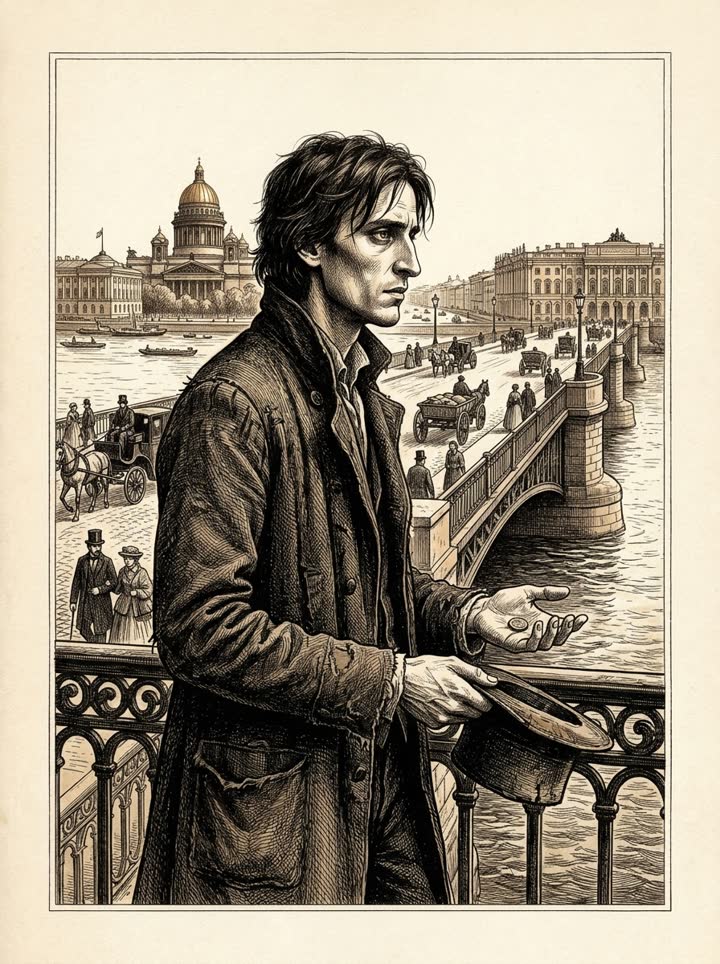
But Raskolnikov was already going out into the street. On the Nikolaevsky Bridge he was brought fully to his senses once more by an incident very unpleasant for him. The coachman of a carriage lashed him hard across the back with his whip, because he had nearly got under the horses, although the coachman had shouted to him three or four times. The blow of the whip so enraged him that he sprang back to the railing (for some unknown reason he had been walking in the very middle of the bridge, where vehicles drive and people do not walk) and angrily ground and clicked his teeth. Laughter rang out all round, of course.
"Serves him right!"
"Some sharper or other."
"Of course, he'll pretend to be drunk and purposely get under the wheels; and you have to answer for him."
"That's how they make their living, worthy sir, that's how they make their living..."
But at the moment when he stood at the railing, still staring senselessly and angrily after the receding carriage and rubbing his back, he suddenly felt someone thrusting money into his hands. He looked: an elderly merchant's wife, in a head-kerchief and goatskin shoes, and with her a girl in a hat and with a green parasol, probably her daughter. "Take it, my good man, for Christ's sake." He took it, and they passed on. It was a twenty-kopeck piece. By their dress and looks they might very well have taken him for a beggar, a real collector of coppers in the street, and for the gift of a whole twenty-kopeck piece he was no doubt indebted to the blow of the whip, which had moved them to pity.
He closed his hand on the twenty-kopeck piece, walked on some ten paces and turned his face towards the Neva, in the direction of the palace. The sky was without the least cloud, and the water was almost blue, which is so rare on the Neva. The dome of the cathedral, which is nowhere better outlined than when looked at from here, from the bridge, some twenty paces short of the chapel, simply shone, and through the clear air one could distinctly make out even each of its ornaments. The pain from the whip died down, and Raskolnikov forgot the blow; one restless and not quite clear thought now occupied him exclusively. He stood and gazed into the distance long and intently; this place was especially familiar to him. When he used to go to the university, it had happened to him, perhaps a hundred times, usually when returning home, to stop at exactly this same spot, gaze intently at this truly magnificent panorama and each time almost marvel at one vague and unresolvable impression of his own. An inexplicable chill always blew on him from this magnificent panorama; this splendid picture was for him full of a mute and deaf spirit... Each time he wondered at his gloomy and enigmatic impression and put off the solution of it, not trusting himself, to the future. Now suddenly he sharply recalled these former questions and perplexities of his, and it seemed to him that it was not by chance that he recalled them now. The mere fact that he had stopped at the same place as before, as though he really imagined he could think now about the same things as before, and be interested in the same former themes and pictures that had interested him... so recently, seemed to him wild and strange. It almost made him laugh, and at the same time it squeezed his chest to the point of pain. All this former past now seemed to him to lie somewhere in a depth, below, barely visible under his feet: the former thoughts, and the former problems, and the former themes, and the former impressions, and all this panorama, and he himself, and everything, everything... It seemed he was flying away somewhere upwards and everything was vanishing from his sight... Making an involuntary movement with his hand, he suddenly felt the twenty-kopeck piece clenched in his fist. He opened his hand, looked intently at the little coin, swung his arm and threw it into the water; then he turned and went home. It seemed to him that at that moment he had cut himself off from everyone and everything, as if with scissors.
He reached home towards evening, so he had been walking in all about six hours. Where and how he came back, he remembered nothing of it. Undressing, and trembling all over like a driven horse, he lay down on the sofa, pulled his greatcoat over himself and at once lost consciousness...
He came to in full twilight from a terrible shouting. God, what a shout it was! Such unnatural sounds, such howling, wailing, grinding of teeth, tears, blows and curses he had never yet heard or seen. He could not even have imagined such brutality, such frenzy. In terror he raised himself and sat up on his bed, his heart sinking every moment, in torment. But the fighting, the wailing and the cursing grew stronger and stronger. And then, to his greatest astonishment, he suddenly made out the voice of his landlady. She was howling, shrieking and lamenting, hurrying, rushing, letting out words so that it was impossible to make out what she was begging for, of course that they should stop beating her, because she was being beaten mercilessly on the stairs. The voice of the one who was beating had become so terrible with spite and rage that it only rasped, but still the beater too was saying something, also quickly, indistinctly, hurrying and choking. Suddenly Raskolnikov trembled like a leaf: he recognised this voice; it was the voice of Ilya Petrovich. Ilya Petrovich was here and was beating the landlady! He was kicking her, knocking her head against the steps, that was clear, one could tell it by the sounds, by the wails, by the blows! What was this, had the world turned upside down? One could hear a crowd gathering on all the floors, all along the staircase, voices, exclamations; people were coming up, knocking, banging doors, running together. "But why, why, and how can it be!" he kept repeating, seriously thinking that he had gone quite mad. But no, he heard it far too clearly!... But then, they would come to him next, if that was so, "because... surely all this is from the same... because of yesterday... Lord!" He wanted to lock himself in with the hook, but his hand would not rise... and besides it was useless! Fear wrapped his soul like ice, tormented him, numbed him... But at last all this din, which had lasted a good ten minutes, began gradually to die down. The landlady moaned and groaned, Ilya Petrovich was still threatening and cursing... But now at last, it seemed, he too fell silent; now he could not be heard; "can he really have gone! Lord!" Yes, now the landlady too was going away, still with moaning and weeping... now her door slammed... Now the crowd was dispersing from the stairs to the flats, gasping, arguing, calling to one another, now raising their talk to a shout, now lowering it to a whisper. There must have been a great many of them; almost the whole house had run together. "But, my God, is all this possible! And why, why did he come here!"
Raskolnikov fell on the sofa in helplessness, but could no longer close his eyes; he lay for about half an hour in such suffering, in such an unbearable sensation of boundless terror as he had never yet experienced. Suddenly a bright light lit up his room: Nastasya came in with a candle and a plate of soup. Looking at him attentively and seeing that he was not asleep, she set the candle on the table and began to lay out what she had brought: bread, salt, a plate, a spoon.
"I dare say you haven't eaten since yesterday. You've been roaming about the whole day, and you're shaking with fever."
"Nastasya... why was the landlady beaten?"
She looked at him intently.
"Who beat the landlady?"
"Just now... half an hour ago, Ilya Petrovich, the superintendent's assistant, on the stairs... Why did he beat her so? And... why did he come?..."
Nastasya looked at him in silence and with a frown, and went on looking for a long time. He felt very uncomfortable at this scrutiny, even frightened.
"Nastasya, why are you silent?" he said timidly at last, in a weak voice.
"It's blood," she answered at last, quietly and as if speaking to herself.
"Blood!... What blood?..." he muttered, turning pale and drawing back towards the wall. Nastasya went on looking at him in silence.
"Nobody beat the landlady," she said again in a stern and decided voice. He looked at her, hardly breathing.
"I heard it myself... I wasn't asleep... I was sitting up," he said still more timidly. "I listened a long time... The superintendent's assistant came... Everyone ran out onto the stairs, from all the flats..."
"Nobody came. It's the blood in you crying out. When it finds no way out and begins to clot in the liver, that is when you begin to imagine things... Will you eat, or not?"
He did not answer. Nastasya still stood over him, looking at him intently, and did not go away.
"Give me something to drink... Nastasyushka."
She went downstairs and in a couple of minutes returned with water in a white earthenware mug; but he no longer remembered what happened next. He remembered only how he took one sip of cold water and spilled some from the mug onto his chest. Then came unconsciousness.