
He lay like that for a very long time. Now and then he seemed to wake, and at those moments he noticed that it had been night for a long while, but it did not occur to him to get up. At last he noticed that it was already as light as day. He lay on his back on the sofa, still dazed from his recent oblivion. Terrible, desperate screams from the street reached him sharply; he heard them, as it happened, every night under his window, some time after two. They were what had woken him now. "Ah! There they are, the drunks coming out of the taverns," he thought, "it's past two..." and suddenly he leapt up, as if somebody had torn him off the sofa. "What! Past two already!" He sat up on the sofa, and then he remembered everything! All at once, in a single instant, he remembered everything!
For the first moment he thought he would go mad. A terrible cold gripped him; but the cold came from the fever too, which had begun long ago, in his sleep. Now suddenly such a shivering fit struck him that his teeth almost jumped out of his head and everything in him began to shake. He opened the door and began to listen: in the house everything was fast asleep. In amazement he looked himself over and everything in the room, and he could not understand how he could have come in yesterday without fastening the door with the hook, and thrown himself on the sofa, not only without undressing but even with his hat on; it had rolled off and lay there on the floor by the pillow. "If anyone had come in, what would he have thought? That I was drunk, but..." He rushed to the window. There was light enough, and he hurriedly began to examine himself, all of himself, from head to foot, and all his clothes: were there any traces? But it could not be done like that; trembling with the chill, he began to take everything off and to look it over again. He turned everything inside out, down to the last thread and scrap, and, not trusting himself, repeated the examination some three times. But there was nothing, it seemed, no traces at all; only in the place where the trousers were frayed at the bottom and hung in a fringe, there were thick traces of dried blood on that fringe. He seized his big clasp-knife and cut off the fringe. There seemed to be nothing else. Suddenly he remembered that the purse and the things he had pulled out of the old woman's chest were all still lying in his pockets! He had not even thought until now of taking them out and hiding them! He had not remembered them even now, while he was examining his clothes! What was this? In a moment he rushed to take them out and throw them on the table. When he had taken everything, even turning the pockets inside out to make sure nothing was left, he carried the whole heap to the corner. There, right in the corner, low down, in one place the wallpaper had come away from the wall and was torn; at once he began to stuff everything into this hole, under the paper. "It goes in! Everything out of sight, and the purse too!" he thought joyfully, getting up a little and staring stupidly at the corner, at the hole that now bulged out even more. Suddenly he shuddered all over with horror. "My God," he whispered in despair, "what is the matter with me? Is that hidden? Is that how things are hidden?"
It is true that he had not counted on the things; he had thought there would be only money, and so he had not prepared a place beforehand. "But now, now, what am I glad about?" he thought. "Is that how one hides things? Truly my reason is leaving me!" Exhausted, he sat down on the sofa, and at once the unbearable shivering shook him again. Mechanically he dragged towards him his old winter coat from his student days, which lay on a chair beside him, warm but now almost in rags, covered himself with it, and sleep and delirium seized him again at once. He sank into oblivion.
No more than five minutes later he leapt up again and at once, in a frenzy, flung himself again at his clothes. "How could I fall asleep again when nothing has been done! So it is, so it is: I still haven't taken off the loop under my arm! I forgot, forgot about such a thing! Such evidence!" He tore off the loop and hurriedly began to rip it into pieces, stuffing them under the pillow into the linen. "Pieces of torn canvas will never rouse suspicion; I think so, I think so!" he kept repeating, standing in the middle of the room, and with an attention strained to the point of pain he began again to look all round, on the floor and everywhere, in case he had forgotten something else. The conviction that everything, even his memory, even simple reasoning, was deserting him began to torment him unbearably. "What, is it beginning already, is the punishment coming already? There, there, so it is!" Indeed, the scraps of fringe that he had cut off the trousers were lying right on the floor in the middle of the room, for the first person to see! "But what is the matter with me!" he cried again, like a lost man.
Then a strange thought came into his head: that perhaps all his clothes were covered with blood, that perhaps there were many stains, only he could not see them, did not notice them, because his reasoning had grown weak, shattered... his mind was clouded... Suddenly he remembered that there had been blood on the purse too. "Ah! So there must be blood in the pocket as well, because I thrust the purse into my pocket while it was still wet!" In a moment he turned the pocket inside out, and, sure enough, there were traces on the lining of the pocket, stains! "So my reason has not left me altogether, so I still have reasoning and memory, if I have caught myself and guessed it!" he thought in triumph, drawing a deep, joyful breath with all his chest. "It's simply feverish weakness, a moment of delirium." And he tore the whole lining out of the left pocket of his trousers. At that moment a ray of sun lit up his left boot: on the toe of the sock, which showed out of the boot, there seemed to be marks. He flung off the boot. "Marks indeed! The whole tip of the sock is soaked in blood"; he must have stepped carelessly into that pool then... "But what am I to do with it now? Where am I to put this sock, the fringe, the pocket?"
He gathered it all up in his hand and stood in the middle of the room. "In the stove? But in the stove they will start rummaging first of all. Burn it? But what with? I haven't even any matches. No, it is better to go out somewhere and throw it all away. Yes! Better to throw it away!" he kept repeating, sitting down on the sofa again, "and at once, this very minute, without delay!..." But instead of that his head sank again on the pillow; again the unbearable chill turned him to ice; again he dragged his greatcoat over himself. And for a long time, several hours, it kept appearing to him in fits that "I ought to go this very moment, without putting it off, somewhere and throw it all away, so that it is out of sight, quickly, quickly!" He tried several times to get up from the sofa, he wanted to rise, but he could not. At last a loud knocking at the door woke him completely.
"Open up, are you alive or not? He's sleeping again, always sleeping!" shouted Nastasya, banging her fist on the door. "All the blessed days he sleeps like a dog! A dog, that's what he is! Open up, will you. It's gone ten."
"Perhaps he isn't even at home!" said a man's voice.
"Ah! That is the yardkeeper's voice... What does he want?"
He leapt up and sat on the sofa. His heart was beating so that it even hurt.
"Then who has fastened the hook?" retorted Nastasya. "Look at that, he's started locking himself in! As if anyone would carry him off! Open up, man, wake up!"
"What do they want? Why the yardkeeper? They know everything. Resist or open? Come what may..."
He half rose, bent forward and lifted the hook.
His whole room was of such a size that he could lift the hook without getting out of bed.
So it was: the yardkeeper and Nastasya were standing there.
Nastasya looked at him somehow strangely. He looked at the yardkeeper with a defiant and desperate air. The man silently held out to him a grey paper folded in two, sealed with bottle wax.
"A summons, from the office," he said, handing him the paper.
"From what office?..."
"To the police, that is, they're calling you to the office. Everybody knows what office."
"To the police!... What for?..."
"How should I know. They demand you, so go." He looked at him attentively, glanced round, and turned to leave.
"Has he fallen quite ill?" remarked Nastasya, who had not taken her eyes off him. The yardkeeper also turned his head for a moment. "He's been in a fever since yesterday," she added.
He did not answer and held the paper in his hands without opening it.
"Well, don't get up," Nastasya went on, taking pity on him and seeing that he was lowering his feet from the sofa. "If you're ill, don't go: nothing's on fire. What have you got in your hands?"
He looked: in his right hand he had the cut-off pieces of fringe, the sock and the shreds of the torn-out pocket. He had slept with them like that. Afterwards, reflecting on it, he remembered that even when half waking in his fever he had clutched it all tight in his hand and so fallen asleep again.
"Look what rags he's collected, and sleeps with them as if with a treasure..." And Nastasya went off into her sickly, nervous laughter. In a moment he thrust everything under the greatcoat and fixed his eyes keenly upon her. Though he could hardly think anything through sensibly at that moment, he felt that a man would not be treated like this when they came to arrest him. "But... the police?"
"Would you like some tea? Do you want it, then? I'll bring it; there's some left..."
"No... I'll go: I'll go at once," he muttered, getting to his feet.
"You'll never even get down the stairs, will you?"
"I'll go..."
"As you like."
She went out after the yardkeeper. At once he rushed to the light to examine the sock and the fringe. "There are stains, but not quite noticeable; everything is dirty, rubbed and already faded. Whoever doesn't know beforehand will see nothing. So Nastasya could not have noticed anything from a distance, thank God!" Then with trembling he broke open the summons and began to read; he read for a long time and at last understood. It was an ordinary summons from the district office to appear that day, at half past nine, at the office of the district superintendent.
"But when has this ever happened? I have no business of my own with the police! And why just today?" he thought in tormenting bewilderment. "Lord, let it be quick!" He was about to throw himself on his knees to pray, but he even laughed, not at the prayer, but at himself. He began hurriedly to dress. "If I'm lost, I'm lost, it's all the same! Put on the sock!" it suddenly occurred to him. "It will get rubbed in the dust even more, and the traces will vanish." But no sooner had he put it on than he pulled it off again with disgust and horror. He pulled it off, but, realising that he had no other, he took it and put it on again, and again he laughed. "All this is conventional, all relative, all just forms," he thought fleetingly, with one tiny edge of a thought, while he trembled in every limb. "Look, I have put it on! In the end I have put it on!" The laughter, however, was at once replaced by despair. "No, it is beyond my strength..." he thought. His legs were trembling. "From fear," he muttered to himself. His head was spinning and aching with fever. "It's a trick! They want to lure me by a trick and trip me up suddenly on everything," he went on to himself, going out on to the stairs. "The bad thing is that I am almost delirious... I might blurt out some stupidity..."
On the stairs he remembered that he was leaving all the things like that, in the hole behind the wallpaper. "And perhaps they will deliberately search while he is away." He remembered, and stopped. But such despair and such, if one may say so, cynicism of ruin suddenly seized him that he waved his hand and went on.
"Only let it be quick!..."
In the street the heat was again unbearable; if only there had been a drop of rain in all these days. Again dust, brick and lime, again the stench from the shops and taverns, again drunks every minute, Finnish pedlars and half-collapsing cabs. The sun flashed brightly in his eyes, so that it hurt to look and his head spun completely, the usual sensation of a feverish man who goes out into the street suddenly on a bright sunny day.
Coming to the turning into yesterday's street, he looked into it with agonising anxiety, at that house... and at once turned his eyes away.
"If they ask, perhaps I will say," he thought, approaching the office.
The office was about a quarter of a verst from him. It had just moved to new rooms, in a new house, on the fourth floor. He had once been at the old place, in passing, but very long ago. Going in under the gateway, he saw on the right a staircase down which a peasant was coming with a book in his hands. "A yardkeeper, so; so the office is here," and he began to climb upstairs at random. He did not want to ask anyone anything.
"I'll go in, kneel down and tell everything..." he thought, as he came to the fourth floor.
The staircase was narrow, steep and all slopped with dirty water. The kitchens of all the flats on all four floors opened on to this staircase and stood so almost the whole day. For that reason there was a terrible stuffiness. Up and down went yardkeepers with their books under their arms, constables and all sorts of people of both sexes, visitors. The door of the office itself also stood wide open. He went in and stopped in the entrance hall. Some peasants stood there all the while, waiting. Here too the stuffiness was extraordinary and, besides that, the fresh, still unsettled smell of paint on stale drying-oil in the newly painted rooms struck the nose until it made one sick. After waiting a little, he decided to move on further, into the next room. The rooms were all tiny and low. A terrible impatience drew him further and further. Nobody noticed him. In the second room some clerks were sitting and writing, dressed only a little better than he was, and all of them, to look at, a strange sort of people. He turned to one of them.
"What do you want?"
He showed the summons from the office.
"Are you a student?" the man asked, glancing at the summons.
"Yes, a former student."
The clerk looked him over, though without any curiosity. He was a particularly dishevelled man, with a fixed idea in his look.
"You'll learn nothing from this one, because it's all the same to him," thought Raskolnikov.
"Go there, to the head clerk," said the clerk, and poked his finger forward, pointing to the very last room.
He went into that room (the fourth in order), cramped and packed with people, a public rather more cleanly dressed than in the other rooms. Among the visitors there were two ladies. One, in mourning, poorly dressed, sat at the table opposite the head clerk and was writing something to his dictation. The other lady, very stout and purplish-red, with blotches, a conspicuous woman, dressed rather too splendidly, with a brooch on her breast the size of a tea saucer, stood to one side and was waiting for something. Raskolnikov thrust his summons at the head clerk. He glanced at it in passing, said "wait," and went on dealing with the lady in mourning.
He breathed more freely. "Surely it is not that!" Little by little he began to take heart; he used every effort to persuade himself to take heart and come to his senses.
"Some stupidity, some tiniest piece of carelessness, and I may give myself away completely! Hm... it's a pity there is no air here," he added. "The stuffiness... My head is spinning even more... and my mind too..."
He felt a terrible disorder in his whole self. He was afraid himself that he would not keep control of himself. He tried to catch hold of something and to think about something, something quite unconnected, but this did not succeed at all. The head clerk, however, interested him greatly: he kept wanting to guess something from his face, to crack him open. He was a very young man of about twenty-two, with a swarthy, mobile face that looked older than his years, dressed fashionably and like a dandy, with his hair parted at the back of his head, combed and pomaded, with a great many rings and signets on his white fingers scrubbed with brushes, and gold chains on his waistcoat. With a foreigner who happened to be there he even said a couple of words in French, and very satisfactorily.
"Luisa Ivanovna, won't you sit down?" he said in passing to the gaudily dressed purplish-red lady, who was still standing, as if not daring to sit down herself, though there was a chair beside her.
"I thank you," said she, and quietly, with a silken rustle, lowered herself on to the chair. Her light-blue dress with white lace trimming spread round the chair like a balloon and took up almost half the room. A smell of scent filled the air. But the lady was evidently shy of taking up half the room and of smelling so strongly of scent, though she smiled, timidly and impudently at once, but with obvious uneasiness.
The lady in mourning finally finished and began to rise. Suddenly, with some noise, very jauntily and somehow turning his shoulders in a special way at every step, an officer came in, threw his cap with its cockade on the table and sat down in an armchair. The splendid lady positively jumped up from her place at the sight of him and began to curtsy with a kind of special rapture; but the officer paid not the slightest attention to her, and she no longer dared to sit down in his presence. This was a lieutenant, the assistant to the district superintendent, with reddish moustaches sticking out horizontally on both sides and extremely small features, which expressed nothing in particular, however, except a certain insolence. He looked sideways and partly with indignation at Raskolnikov: his clothes were too wretched, and, in spite of all his humiliation, his bearing was still not in keeping with his clothes; Raskolnikov, through carelessness, had looked at him too directly and for too long, so that the man even took offence.
"What do you want?" he shouted, probably amazed that such a ragamuffin did not think of vanishing before his lightning glance.
"I was summoned... by a summons..." Raskolnikov answered somehow.
"It is about the recovery of money from him, from the student," the head clerk hurried to say, tearing himself away from his paper. "Here, sir!" and he tossed Raskolnikov a notebook, pointing out the place in it. "Read it!"
"Money? What money?" thought Raskolnikov. "But... so surely it is not that!" And he shuddered with joy. He suddenly felt terribly, inexpressibly light. Everything fell from his shoulders.
"And at what hour were you told to come, my dear sir?" shouted the lieutenant, growing more and more offended, nobody knew by what. "They write to you nine o'clock, and now it is past eleven!"
"They brought it to me only a quarter of an hour ago," Raskolnikov answered loudly and over his shoulder, himself suddenly and unexpectedly angry too, and even finding some pleasure in it. "And it is enough that I came ill, in a fever."
"Kindly do not shout!"
"I am not shouting, I am speaking quite evenly, and it is you who are shouting at me; and I am a student, and I will not allow anyone to shout at me."
The assistant flew into such a rage that for the first minute he could not utter a word, and only some sort of spluttering flew from his lips. He jumped up from his place.
"Kindly be si-i-i-lent! You are in an office. No r-r-rudeness, sirr!"
"And you are in an office too," cried Raskolnikov, "and besides shouting, you are smoking a cigarette, so you are showing disrespect to all of us." Having said this, Raskolnikov felt an inexpressible delight.
The head clerk looked at them with a smile. The hot-tempered lieutenant was visibly taken aback.
"That is no business of yours, sir!" he shouted at last, somehow unnaturally loudly. "But kindly give the answer that is demanded of you. Show it to him, Alexander Grigorievich. There are complaints against you! You don't pay your money! Look what a bright falcon has flown in!"
But Raskolnikov was no longer listening and greedily seized the paper, looking for the explanation as quickly as he could. He read it once, twice, and did not understand.
"What is this?" he asked the head clerk.
"They are demanding money from you on a promissory note, a claim for recovery. You must either pay it, with all costs, fines and so on, or give a written answer as to when you can pay, and at the same time an undertaking not to leave the capital until you have paid, and not to sell or conceal your property. And the creditor is free to sell your property and deal with you according to the law."
"But I... I owe nobody anything!"
"That is not our business. But there has come to us for recovery an overdue and legally protested promissory note for a hundred and fifteen roubles, given by you to the widow of a collegiate assessor, Zarnitsyna, nine months ago, and passed from the widow Zarnitsyna by payment to the court councillor Chebarov, and we therefore invite you to give your answer."
"But she is my landlady?"
"Well, so what if she is your landlady?"
The head clerk looked at him with an indulgent smile of pity, and at the same time of some triumph, as at a novice who is only just beginning to be shot at: "Well now, how do you feel at present?" But what, what did he care now about a promissory note, about a claim for recovery! Was it worth the least alarm now, or even the least attention! He stood, read, listened, answered, even asked questions himself, but all of it mechanically. The triumph of self-preservation, the rescue from a danger that had been crushing him, that was what filled his whole being at that moment, without foresight, without analysis, without guessing and divining about the future, without doubts and without questions. It was a moment of complete, direct, purely animal joy. But at that very moment something like thunder and lightning took place in the office. The lieutenant, still quite shaken by the disrespect, burning all over and evidently wishing to maintain his wounded pride, fell with all his thunderbolts on the unfortunate "splendid lady," who had been looking at him, ever since he came in, with a most idiotic smile.
"And you, you so-and-so and such-and-such," he shouted suddenly at the top of his voice (the lady in mourning had already gone out), "what went on at your place last night? Eh? Again you are making a disgrace, a riot for the whole street. Again fighting and drunkenness. You are dreaming of the house of correction! Why, I have told you already, I have warned you ten times already that the eleventh time I won't let it go! And you again, again, you so-and-so and such-and-such!"
The paper even fell from Raskolnikov's hands, and he stared wildly at the splendid lady who was being dressed down so unceremoniously; but soon, however, he realised what it was about, and at once the whole story began to please him very much. He listened with pleasure, so much that he wanted to burst out laughing, laughing, laughing... All his nerves were fairly jumping.
"Ilya Petrovich!" the head clerk began anxiously, but stopped to wait for a moment, because the boiling lieutenant could not be held back in any way except by the arms, as he knew from his own experience.
As for the splendid lady, at first she trembled all over at the thunder and lightning; but, strange to say, the more numerous and the stronger the abuse became, the more amiable her appearance grew, the more charming became her smile, turned towards the terrible lieutenant. She tripped about in one place and curtsied without stopping, impatiently waiting for them at last to let her put in her own word, and at last she got it.
"No noise and no fights at my place was, Herr Captain," she suddenly rattled off, like peas spilled out, with a strong German accent, though fluently in Russian, "and no, no scandal, but he come drunk, and all this I will tell, Herr Captain, and I am not guilty... I have noble house, Herr Captain, and noble manners, Herr Captain, and I always, always myself did not want no scandal. But he come quite drunk and then asked again three bottles, and then one lifted up legs and began with foot to play piano, and this is not at all good in noble house, and he quite piano broke, and altogether, altogether here is no manners, and I said so. And he took bottle and began to push everyone from behind with bottle. And then how I quick the yardkeeper called, and Karl came, he took Karl and hit eye, and Henriette also hit eye, and me he hit five times on cheek. And it is so indelicate in noble house, Herr Captain, and I screamed. And he opened window on canal and stood in window, like little pig, squealed; and it is shame. And how can one in window to street, like little pig, squeal; and it is shame. Fie-fie-fie! And Karl from behind pulled him by tailcoat from window and here, it is true, Herr Captain, his coat tore. And then he shouted that I must him fifteen roubles fine pay. And I myself, Herr Captain, five roubles him for coat paid. And this is not noble guest, Herr Captain, and made every scandal! I, he said, will you in big satire print, because I in all newspapers can about you everything write."
"A writer, then?"
"Yes, Herr Captain, and what kind of noble guest is this, Herr Captain, when in noble house..."
"Now, now, now! Enough! I have told you, told you, I have told you already..."
"Ilya Petrovich!" the head clerk said again, meaningfully. The lieutenant glanced quickly at him; the head clerk nodded his head slightly.
"...So here is what I say to you, most respectable Lavisa Ivanovna, my last word, and this is the last time," the lieutenant went on. "If there is another scandal in your noble house even once more, I'll haul you yourself off to the lock-up, as they say in high style. Do you hear? So a man of letters, a writer, got five roubles in a 'noble house' for a coat-tail? There they are, these writers!" and he threw a contemptuous look at Raskolnikov. "The day before yesterday there was a business in a tavern too: he dined, and doesn't want to pay; 'I will describe you in a satire for it,' he says. On a steamer, another one, last week, called the respectable family of a civil councillor, his wife and daughter, the vilest names. The other day one was thrown out of a pastry-cook's with shoves. That is what they are like, writers, literary men, students, spokesmen... bah! And you, off with you! I'll look in on you myself... then beware! Do you hear?"
Luisa Ivanovna, with hurried amiability, began to curtsy in all directions and, curtsying, backed as far as the door; but in the doorway she bumped with her back into a fine-looking officer with an open, fresh face and magnificent, very thick fair side-whiskers. This was Nikodim Fomich himself, the district superintendent. Luisa Ivanovna hastened to curtsy almost to the floor and, with quick little steps, skipping, flew out of the office.
"Again the crash, again thunder and lightning, a whirlwind, a hurricane!" Nikodim Fomich said amiably and in a friendly way to Ilya Petrovich. "Again they have upset your heart, again you have boiled over! I heard it from the stairs."
"Well, what of it!" said Ilya Petrovich with noble carelessness (and not even "what," but somehow "Wha-a-at of i-it!"), moving with some papers to another table and picturesquely jerking his shoulders at every step, wherever the step went, there went the shoulder. "Here, sir, if you please to see: this gentleman writer, that is a student, a former one, that is, doesn't pay his money, has given out bills of exchange, won't vacate his lodging, there are constant complaints against him, and he has been pleased to take offence because I lit a cigarette in his presence! They behave m-m-meanly themselves, and here, sir, kindly look at him: here he is in his most attractive aspect now, sir!"
"Poverty is no vice, my friend, well, never mind! He's gunpowder, everyone knows it, he could not bear the insult. You were no doubt offended by something of his, and could not restrain yourself," Nikodim Fomich went on, turning amiably to Raskolnikov, "but you were wrong there: he is the no-o-oblest of men, I tell you, but gunpowder, gunpowder! He flares up, boils over, burns out, and it's gone! It's all over! And as a result there is nothing but a heart of gold! They even called him in the regiment: 'Lieutenant Gunpowder'..."
"And what a r-r-regiment it was!" exclaimed Ilya Petrovich, very pleased that he had been tickled so pleasantly, but still sulking.
Raskolnikov suddenly wanted to say something extraordinarily pleasant to them all.
"But for goodness' sake, Captain," he began very freely, suddenly addressing Nikodim Fomich, "enter into my position too... I am even ready to ask their pardon, if I have failed in anything on my side. I am a poor and sick student, crushed (he said just that: 'crushed') by poverty. I am a former student, because now I cannot support myself, but I shall get money... I have a mother and sister in such-and-such a province. They will send it to me, and I... will pay. My landlady is a good woman, but she has become so angry because I have lost my lessons and have not paid her for going on four months, that she does not even send me my dinner... And I don't understand at all what bill this is. Now she demands from me on this promissory note, what am I to pay her with, judge for yourselves!..."
"But that is not our business..." the head clerk was about to remark again...
"Allow me, allow me, I quite agree with you, but allow me too to explain," Raskolnikov took it up again, addressing not the head clerk but still Nikodim Fomich, yet trying with all his might to address Ilya Petrovich too, though he stubbornly pretended to be rummaging in his papers and contemptuously paid no attention to him. "Allow me too on my side to explain that I have been living with her for about three years, ever since I came from the provinces, and before... before... though why shouldn't I confess it in my turn, from the very beginning I gave a promise that I would marry her daughter, a verbal promise, quite free... She was a girl... however, I even liked her... though I was not in love... in a word, youth, that is, I mean to say that my landlady gave me a great deal of credit then and I led partly such a life... I was very thoughtless..."
"Nobody demands such intimacies from you, my dear sir, and there is no time for them," Ilya Petrovich interrupted roughly and in triumph, but Raskolnikov stopped him with heat, though it had suddenly become extremely hard for him to speak.
"But allow me, allow me, in part, to tell everything... how the matter was and... in my turn... though it is superfluous, I agree with you, to tell it, but a year ago this girl died of typhus, and I remained a lodger, as I was, and my landlady, when she moved to her present flat, said to me... and said it in a friendly way... that she had complete trust in me and everything... but would I not like to give her this promissory note for a hundred and fifteen roubles, which was all that she reckoned I owed her. Allow me, sir: she said precisely that as soon as I gave her this paper she would again give me credit as much as I liked, and that never, never, in her turn, those were her own words, would she make use of this paper until I paid of my own accord... And now, when I have lost my lessons and have nothing to eat, she presents it for recovery... What am I to say now?"
"All these sentimental details, my dear sir, do not concern us," Ilya Petrovich cut him off insolently. "You must give an answer and an undertaking, and as for your having been pleased to be in love and all these tragic passages, we have no business with them at all."
"Come now, you... that's harsh..." muttered Nikodim Fomich, sitting down at the table and also beginning to sign papers. He somehow felt ashamed.
"Write, then," the head clerk said to Raskolnikov.
"Write what?" the other asked, somehow particularly rudely.
"I will dictate to you."
It seemed to Raskolnikov that the head clerk had become more careless and contemptuous with him after his confession, but, strange to say, he himself suddenly became absolutely indifferent to anyone's opinion, and this change took place somehow in an instant, in a single minute. If he had wanted to think a little, he would of course have been amazed that he could have talked to them like that a minute ago, and even force his feelings on them. And where had those feelings come from? On the contrary, now, if the room had suddenly been filled not with district officers but with his dearest friends, even then, it seemed, he would have found not a single human word for them, so suddenly empty had his heart become. A gloomy sensation of tormenting, endless solitude and estrangement suddenly declared itself consciously in his soul. It was not the baseness of his sentimental outpourings before Ilya Petrovich, nor the baseness of the lieutenant's triumph over him, that had so suddenly turned his heart over. Oh, what did he care now about his own meanness, about all these ambitions, lieutenants, German women, claims, offices and so on, and so on! If they had sentenced him even to be burned at that moment, even then he would not have stirred, he would hardly even have listened to the sentence attentively. Something was happening to him that was quite unknown to him, new, sudden and never experienced. It was not that he understood, but he clearly felt, with all the force of sensation, that he could no longer turn to these people in the district office, not only with sentimental effusions as just now, but with anything whatever, and if they had all been his own brothers and sisters, and not district lieutenants, even then there would have been no reason at all for him to turn to them, and not in any circumstance of life; never until this minute had he experienced such a strange and terrible sensation. And what was most tormenting of all, it was more a sensation than a consciousness, than a concept; an immediate sensation, the most tormenting of all the sensations he had so far lived through in his life.
The head clerk began to dictate to him the form of the usual answer in such a case, that is: I cannot pay, I promise on such-and-such a date (some time), I will not leave the town, I will neither sell nor give away my property, and so on.
"But you can't write, the pen is falling from your hands," remarked the head clerk, looking at Raskolnikov with curiosity. "Are you ill?"
"Yes... my head is going round... go on!"
"That's all! Sign it."
The head clerk took the paper and busied himself with others.
Raskolnikov handed back the pen, but instead of getting up and leaving, he put both elbows on the table and clasped his head in his hands. It was as if a nail were being driven into his crown. A strange thought came to him suddenly: to get up now, go to Nikodim Fomich and tell him everything about yesterday, everything to the last detail, then go with them to the flat and show them the things, in the corner, in the hole. The urge was so strong that he had already risen from his place to carry it out. "Shouldn't I think it over, if only for a minute?" flashed through his head. "No, better without thinking, and off my shoulders!" But suddenly he stopped as if rooted to the spot: Nikodim Fomich was speaking with heat to Ilya Petrovich, and the words reached him:
"It cannot be, they will release them both! In the first place, everything is against it; judge for yourself: why should they call the yardkeeper if it were their doing? To inform against themselves? Or out of cunning? No, that would be too cunning! And finally, the student Pestryakov was seen right at the gate by both yardkeepers and a tradesman's wife at the very moment he was going in: he was walking with three friends and parted from them right at the gate and asked the yardkeepers where the lodging was, in front of his friends. Now would such a man ask where the lodging was, if he were going with such an intention? And as for Koch, before he went in to the old woman he sat downstairs with the silversmith for half an hour, and exactly at a quarter to eight he went from him up to the old woman. Now consider..."
"But allow me, how did such a contradiction come about in what they say: they themselves assure us that they knocked and that the door was locked, and three minutes later, when they came with the yardkeeper, it turns out that the door was unlocked?"
"That is the whole point: the murderer was certainly sitting there and had locked himself in with the bolt; and he would certainly have been caught there if Koch had not been a fool and gone off himself for the yardkeeper. And it was exactly in that interval that he managed to get down the stairs and slip past them somehow. Koch crosses himself with both hands: 'If I had stayed there,' he says, 'he would have jumped out and killed me with the axe.' He wants to have a Russian thanksgiving service said, he-he!..."
"And nobody saw the murderer?"
"How could anyone see him here? The house is Noah's ark," remarked the head clerk, who was listening from his place.
"The matter is clear, the matter is clear!" Nikodim Fomich repeated warmly.
"No, the matter is very unclear," Ilya Petrovich rejoined firmly.
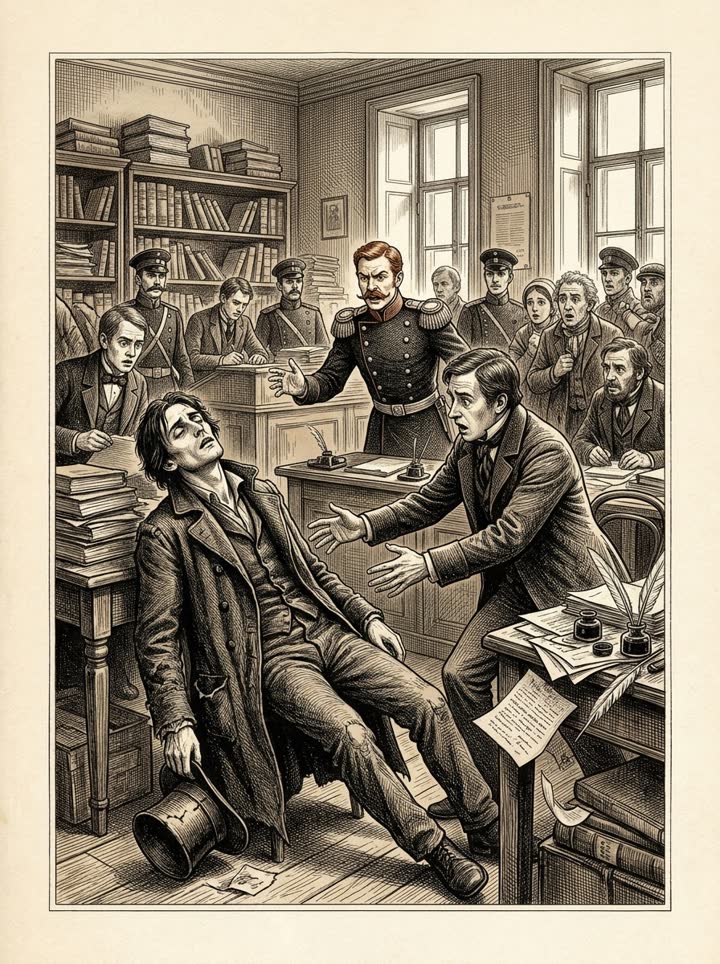
Raskolnikov picked up his hat and went towards the door, but he did not reach the door...
When he came to himself, he saw that he was sitting on a chair, that some man was holding him up on the right, that another man stood on the left with a yellow glass filled with yellow water, and that Nikodim Fomich was standing in front of him and looking at him intently; he got up from the chair.
"What is this, are you ill?" Nikodim Fomich asked rather sharply.
"Even when he was signing, he could hardly move the pen," remarked the head clerk, settling into his place and taking up his papers again.
"And have you been ill long?" Ilya Petrovich shouted from his place, also turning over papers. He too had, of course, looked at the sick man while he was in his faint, but he had walked away at once when he came to.
"Since yesterday..." Raskolnikov muttered in reply.
"And did you go out of doors yesterday?"
"I did."
"Ill?"
"Ill."
"At what hour?"
"Some time after seven in the evening."
"And where, may I ask?"
"In the street."
"Short and clear."
Raskolnikov answered sharply, in snatches, white as a handkerchief, and not lowering his black, inflamed eyes before Ilya Petrovich's look.
"He can scarcely stand on his feet, and you..." Nikodim Fomich began to remark.
"No-thing!" said Ilya Petrovich in a peculiar way. Nikodim Fomich wanted to add something more, but, glancing at the head clerk, who was also looking at him very intently, he fell silent. Suddenly everyone fell silent. It was strange.
"Well, sir, very well, sir," Ilya Petrovich concluded, "we won't detain you."
Raskolnikov went out. He could still hear, after his departure, an animated conversation begin, in which the questioning voice of Nikodim Fomich sounded loudest of all... In the street he came completely to himself.
"A search, a search, they will search at once!" he kept repeating to himself, hurrying on. "Villains! They suspect!" The fear of earlier seized him again, from head to foot.