
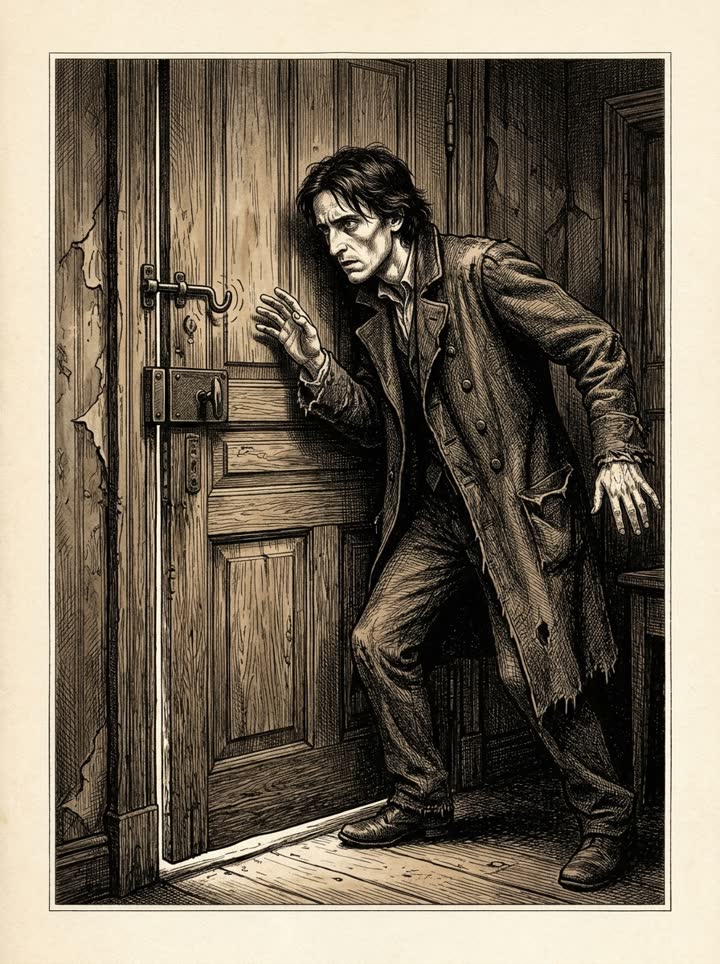
The door opened, as before, to a tiny crack, and again two sharp, mistrustful eyes stared at him out of the darkness. Here Raskolnikov lost his head and nearly made a serious mistake.
Afraid that the old woman would be frightened at finding them alone, and not hoping that the sight of him would reassure her, he took hold of the door and pulled it towards him, so that she should not somehow take it into her head to lock herself in again. Seeing this, she did not jerk the door back, but she did not let go of the handle of the lock either, so that he almost pulled her out onto the stairs, door and all. And seeing that she stood across the doorway and would not let him pass, he went straight at her. She leapt back in fright and wanted to say something, but seemed unable to, and stared at him with wide eyes.
"Good day, Alyona Ivanovna," he began, as casually as he could, but his voice would not obey him, broke off and trembled. "I have... brought you something... but let us go in here, rather... to the light..." And leaving her, he walked straight into the room without being asked. The old woman ran after him, and her tongue came loose.
"Lord! What do you want? Who are you? What is it you want?"
"For pity's sake, Alyona Ivanovna... you know me... Raskolnikov... here, I have brought the pledge I promised the other day..." And he held it out to her.
The old woman glanced at the pledge, but at once fixed her eyes straight on the eyes of the uninvited guest. She looked at him closely, spitefully and mistrustfully. About a minute went by; it even seemed to him that there was something like mockery in her eyes, as if she had already guessed everything. He felt that he was losing his nerve, that he was almost afraid, so afraid that if she went on looking like that, without a word, for another half a minute, he would have run away from her.
"Why do you look at me like that, as if you did not know me?" he said suddenly, also with spite. "Take it if you like, and if not I shall go to others, I have no time."
He had not thought of saying it, it simply came out of him all at once.
The old woman recovered herself, and the guest's resolute tone seemed to encourage her.
"But why so sudden, my good sir... what is it?" she asked, looking at the pledge.
"A silver cigarette case. I told you last time."
She held out her hand.
"But why are you so pale? And your hands are trembling! Have you been bathing, my good sir?"
"A fever," he answered curtly. "You can't help being pale... when there is nothing to eat," he added, barely getting the words out. His strength was leaving him again. But the answer seemed plausible, and the old woman took the pledge.
"What is it?" she asked, once more looking Raskolnikov over closely and weighing the pledge in her hand.
"A thing... a cigarette case... silver... look at it."
"But it doesn't seem to be silver... Look how he has wrapped it up."
She turned to the window, to the light, trying to untie the string (all her windows were shut, in spite of the stuffiness), and for a few seconds she left him altogether and stood with her back to him. He unbuttoned his coat and freed the axe from the loop, but he did not take it out completely, only held it with his right hand under his clothes. His hands were terribly weak; he could hear for himself how with every moment they grew more numb and more wooden. He was afraid he would let go and drop the axe... suddenly his head seemed to spin.
"What has he gone and tied up here!" the old woman cried in vexation, and moved in his direction.
Not one moment more could be lost. He pulled the axe right out, swung it up with both hands, hardly feeling himself, and almost without effort, almost mechanically, brought it down on her head with the blunt side. His strength seemed not to be in it at all. But as soon as he had once brought the axe down, strength was born in him.
The old woman, as always, was bareheaded. Her thin hair, fair streaked with grey, greasy with oil as usual, was plaited into a rat's tail and tucked up under a broken piece of horn comb that stuck out at the back of her head. The blow fell on the very crown, helped by her small height. She cried out, but very faintly, and suddenly sank all the way to the floor, though she still managed to raise both hands to her head. In one hand she was still holding the "pledge". Then he struck with all his force, once and again, always with the blunt side and always on the crown. The blood poured out as from an overturned glass, and the body fell over on its back. He stepped away, let it fall, and at once bent down to her face; she was already dead. Her eyes were bulging as if they wanted to leap out, and her forehead and her whole face were wrinkled and twisted in convulsion.
He laid the axe on the floor beside the dead woman and at once felt in her pocket, trying not to get smeared with the flowing blood, the very same right pocket from which she had taken the keys last time. He was in full possession of his mind, there were no more blackouts or dizziness, but his hands were still shaking. He remembered afterwards that he had even been very attentive, very careful, trying all the time not to get dirty... The keys he took out at once; they were all, as before, in one bunch, on one steel ring. At once he ran with them into the bedroom. It was a very small room, with an enormous case of icons. Against another wall stood a large bed, very clean, with a quilted silk coverlet made of patchwork. Against the third wall was a chest of drawers. A strange thing: as soon as he began to fit the keys to the chest, as soon as he heard them jingle, it was as if a convulsion went through him. Suddenly he wanted again to throw everything up and go away. But it was only a moment; it was too late to go. He even smiled at himself, when suddenly another alarming thought struck his head. It suddenly seemed to him that the old woman might still be alive and might still come to. Throwing down the keys and the chest, he ran back to the body, seized the axe and swung it once more over the old woman, but did not bring it down. There was no doubt that she was dead. Bending down and examining her again more closely, he saw clearly that the skull was smashed and even turned a little to one side. He wanted to feel it with his finger, but drew his hand back; it could be seen without that. Meanwhile the blood had already run into a whole pool. Suddenly he noticed a string on her neck and pulled at it, but the string was strong and would not break; besides, it was soaked in blood. He tried to pull it out like that, from inside her dress, but something was in the way and caught. In his impatience he swung the axe again to chop the string right there, over the body, but did not dare, and with difficulty, after two minutes of fumbling, smearing his hands and the axe, he cut the string without touching the body with the axe, and took it off; he had not been wrong, it was a purse. On the string were two crosses, one of cypress wood and one of copper, and besides them a little enamelled icon; and hanging there with them was a small, greasy purse of suede, with a steel rim and ring. The purse was stuffed very tight; Raskolnikov thrust it into his pocket without looking at it, threw the crosses down on the old woman's breast, and this time taking the axe too, rushed back into the bedroom.
He hurried terribly, snatched up the keys and began again to fumble with them. But somehow it all went wrong: they would not go into the locks. It was not that his hands shook so much, but he kept making mistakes: he could see, for instance, that a key was the wrong one and did not fit, and still he kept pushing it in. Suddenly he remembered and realised that this big key with the toothed bit, which dangled there with the other small ones, must certainly not belong to the chest of drawers at all (as it had occurred to him last time too), but to some trunk, and that perhaps everything was hidden in this trunk. He left the chest and at once crawled under the bed, knowing that old women usually keep their trunks under their beds. So it was: there stood a sizeable trunk, more than an arshin long, with an arched lid, covered in red morocco and studded with steel nails. The toothed key fitted exactly and opened it. On top, under a white sheet, lay a hare-skin coat covered with red brocade; under it was a silk dress, then a shawl, and further down it seemed to be nothing but rags. First of all he began to wipe his bloody hands on the red brocade. "It's red, and blood shows less on red," he reasoned, and suddenly he came to himself: "Lord! Am I going out of my mind?" he thought in fright.
But the moment he stirred these rags, a gold watch suddenly slipped out from under the coat. He rushed to turn everything over. Indeed, gold things were mixed in among the rags, probably all pledges, redeemed and unredeemed: bracelets, chains, earrings, pins and so on. Some were in cases, others simply wrapped in newspaper, but neatly and carefully, in double sheets, and tied round with tape. Without the least delay he began to stuff them into the pockets of his trousers and his coat, not sorting them or opening the packets and cases; but he did not manage to gather much...
Suddenly he heard that someone was walking about in the room where the old woman lay. He stopped and went quiet as a dead man. But everything was still, so it must have been his imagination. Suddenly he distinctly heard a faint cry, or as if someone had quietly and abruptly groaned and fallen silent. Then again dead silence, for a minute or two. He sat crouching by the trunk, waiting and hardly drawing breath, but suddenly he leapt up, seized the axe and ran out of the bedroom.
In the middle of the room stood Lizaveta, with a big bundle in her hands, looking in a stupor at her murdered sister, white as linen and as if unable to cry out. Seeing him run out, she shook like a leaf, with a fine trembling, and convulsions ran over her whole face; she lifted her hand and opened her mouth, but still did not scream, and slowly, backwards, began to draw away from him into the corner, looking at him fixedly, point-blank, but still not crying out, as if she had not air enough to cry. He rushed at her with the axe; her lips twisted so piteously, like those of very small children when they begin to be frightened of something, stare fixedly at the thing that frightens them and are about to cry. And this wretched Lizaveta was so simple, so downtrodden and so frightened once and for all, that she did not even raise her hand to protect her face, though that was the most necessary and natural gesture at that moment, because the axe was lifted straight above her face. She only raised her free left hand a little, far from reaching her face, and slowly stretched it out towards him, as if to push him away. The blow fell straight on the skull, with the edge, and at once cut through the whole upper part of the forehead, almost to the crown. She simply crashed down. Raskolnikov quite lost his head, snatched up her bundle, threw it down again and ran to the entry.
Fear seized him more and more, especially after this second, quite unexpected murder. He wanted to run away from here as quickly as he could. And if in that moment he had been able to see and reason more correctly; if he had only been able to grasp all the difficulties of his position, all the despair, all the ugliness and all the absurdity of it, to understand besides how many obstacles, and perhaps even crimes, he still had to get past and commit in order to break out of here and get home, then very possibly he would have thrown everything up and gone at once to give himself up, and not even from fear for himself, but from sheer horror and loathing at what he had done. The loathing especially rose and grew in him with every minute. Not for anything in the world would he now have gone to the trunk, or even into the rooms.
But a kind of absent-mindedness, even a sort of brooding, began little by little to master him: at moments he seemed to forget himself or, better to say, forgot the main thing and clung to trifles. However, glancing into the kitchen and seeing a bucket half full of water on a bench, he thought of washing his hands and the axe. His hands were bloody and sticky. He lowered the axe blade first into the water, seized a bit of soap that lay on the windowsill in a cracked saucer, and began to wash his hands right in the bucket. When he had washed them, he drew out the axe too, washed the iron, and for a long time, about three minutes, scrubbed the wood where it was bloodied, even trying soap on the blood. Then he wiped everything with the linen that was drying there on a line stretched across the kitchen, and afterwards for a long time, carefully, examined the axe by the window. No traces were left, only the handle was still damp. He carefully put the axe into the loop under his coat. Then, as far as the light in the dim kitchen allowed, he examined his coat, trousers and boots. On the outside, at first glance, there seemed to be nothing; only on the boots there were stains. He wetted a rag and wiped the boots. He knew, however, that he was not looking properly, that perhaps there was something that caught the eye which he did not notice. He stood in the middle of the room, lost in thought. A tormenting, dark thought was rising in him, the thought that he was going mad, and that at this moment he was not able either to reason or to defend himself, that perhaps he ought not to be doing at all what he was doing now... "My God! I must run, run!" he muttered, and rushed into the entry. But here a horror awaited him such as, of course, he had never yet experienced.
He stood and looked and could not believe his eyes: the door, the outer door, from the entry onto the staircase, the very one he had rung at and come in by a while ago, stood unlocked, open fully a hand's breadth: no lock, no bolt, all the time, all this time! The old woman had not locked it behind him, perhaps out of caution. But God! He had seen Lizaveta afterwards! And how could he, how could he not have guessed that she must have come in from somewhere! Not through the wall, surely!
He rushed to the door and put the bolt on.
"But no, that is wrong again! I must go, go..."
He took off the bolt, opened the door and began to listen on the stairs.
He listened a long time. Somewhere far below, probably under the gateway, two voices were shouting loudly and shrilly, arguing and swearing. "What are they at?..." He waited patiently. At last everything went quiet all at once, as if cut off; they had gone their ways. He was about to go out, but suddenly, one floor below, a door onto the staircase was flung open with a noise, and someone began to go down, humming some tune. "How noisy they all are!" flashed through his head. He shut the door again behind him and waited. At last everything fell silent, not a soul. He had already put one foot on the stairs when suddenly new footsteps sounded again.
These steps sounded very far off, still at the very beginning of the stairs, but he remembered very well and distinctly that from the first sound he had begun, for some reason, to suspect that they were certainly coming here, to the fourth floor, to the old woman. Why? Were the sounds somehow so special, so significant? The steps were heavy, even, unhurried. Now he had passed the first floor, now he came up another; louder and louder! He could hear the heavy panting of the man climbing. Now the third floor was begun... Here! And suddenly it seemed to him that he had turned to stone, that it was like a dream, when you dream that they are catching up with you, close, that they want to kill you, and you are as if rooted to the spot and cannot move your hands.
And at last, when the visitor had already begun to climb to the fourth floor, only then did he suddenly start all over, and managed to slip quickly and deftly back from the entry into the flat and shut the door behind him. Then he seized the bolt and quietly, soundlessly, dropped it onto the loop. Instinct helped. When he had finished everything, he hid, not breathing, right by the door. The uninvited visitor was also at the door by now. They stood now facing each other, as he had stood a while ago with the old woman, when the door divided them and he listened.
The visitor drew breath heavily several times. "A fat man and a big one, it must be," thought Raskolnikov, gripping the axe in his hand. Truly it was all as if in a dream. The visitor seized the bell and rang it hard.
As soon as the tin sound of the bell rang out, he suddenly seemed to fancy that someone moved in the room. For several seconds he even listened in earnest. The stranger rang once more, waited a little, and suddenly, in impatience, began to tug at the door handle with all his might. In terror Raskolnikov watched the hook of the bolt jumping in its loop, and with dull fear expected that any moment the bolt would jump out. Indeed it seemed possible: they were pulling so hard. He thought of holding the bolt with his hand, but the other might guess. His head seemed to begin spinning again. "I shall fall!" flashed through him, but the stranger began to speak, and he came to himself at once.
"What are they at in there, sleeping like logs, or has somebody strangled them? Cur-r-rse them!" he roared as if from a barrel. "Hey, Alyona Ivanovna, you old witch! Lizaveta Ivanovna, beauty beyond description! Open up! Ugh, curse them, are they asleep, or what?"
And again, furious, he tugged at the bell some ten times at once, with all his strength. Certainly he was a man of authority and on familiar terms with the household.
At that very moment small, hurried steps sounded not far off on the stairs. Someone else was coming up. At first Raskolnikov did not even hear.
"Can there really be nobody in?" cried the newcomer, ringing and cheerful, speaking straight to the first visitor, who was still pulling at the bell. "Good day, Koch!"
"By the voice, he must be very young," thought Raskolnikov suddenly.
"The devil knows, I have nearly broken the lock," answered Koch. "And how do you come to know me?"
"Well, really! The day before yesterday, at the Gambrinus, I won three games running from you at billiards!"
"Ah-h-h..."
"So they are not in? Strange. Stupid, though, terribly. Where could the old woman have gone? I have business with her."
"And I have business too, my dear fellow!"
"Well, what is to be done? Back again, then. Eh! And I had thought of getting some money!" cried the young man.
"Of course, back again, but why make an appointment? The witch herself named the hour to me. And it is out of my way. And where the devil is she off to, I don't understand? All the year round she sits there, the witch, souring, her legs aching, and now suddenly she goes for a walk!"
"Shouldn't we ask the yardkeeper?"
"What?"
"Where she has gone and when she will be back?"
"Hm... damn... ask... But she never goes anywhere..." and he pulled once more at the handle of the lock. "Damn, nothing to be done, let us go!"
"Wait!" the young man cried suddenly. "Look: do you see how the door gives when you pull?"
"Well?"
"That means it is not on the lock but on the bolt, on the hook, that is! Do you hear how the bolt rattles?"
"Well?"
"But how is it you don't understand? It means that one of them is at home. If they had all gone out, they would have locked it from outside with the key, and not bolted it from inside. But here, do you hear how the bolt rattles? And to fasten oneself in with the bolt from inside, one must be at home, do you understand? So they are sitting there and not opening!"
"Why, so it is, indeed!" cried Koch, astonished. "Then what are they doing in there!" And he began furiously to tug at the door.
"Wait!" cried the young man again. "Don't pull! There is something wrong here... you have rung, you have pulled, and they don't open; so either they are both in a faint, or..."
"What?"
"I'll tell you what: let us go for the yardkeeper; let him wake them himself."
"Good!" Both went down.
"Wait! You stay here, and I will run down for the yardkeeper."
"Why stay?"
"Who knows what may happen..."
"Well, perhaps..."
"I am preparing to be an examining magistrate, you know! Here it is evident, ev-i-dent that something is wrong!" cried the young man hotly, and ran down the stairs.
Koch stayed, stirred the bell gently once more, and it gave out a single clang; then quietly, as if thinking and examining, he began to move the handle of the door, pulling it and letting it go, to make sure again that it was held only by the bolt. Then, puffing, he bent down and began to look into the keyhole; but the key was sticking in it from inside, and so nothing could be seen.
Raskolnikov stood gripping the axe. He was as if in delirium. He even prepared to fight them when they came in. While they knocked and conferred, several times the thought came suddenly to him to end it all at once and shout to them from behind the door. At times he wanted to begin abusing them, to taunt them, until they opened. "If only it were quicker!" flashed through his head.
"But he, damn him..."
Time passed, a minute, another, and no one came. Koch began to fidget.
"Devil take it, though!" he cried suddenly, and in impatience, abandoning his post, he too went downstairs, hurrying and clattering on the stairs with his boots. The steps died away.
"Lord, what is to be done!"
Raskolnikov took off the bolt and opened the door a little. Nothing could be heard, and suddenly, no longer thinking at all, he went out, shut the door behind him as tight as he could, and set off downstairs.
He had already gone down three flights when suddenly a great noise sounded below. Where could he go! There was nowhere at all to hide. He started to run back up, to the flat again.
"Hey, you devil, you fiend! Hold him!"
With a shout someone broke out below from some flat and did not so much run as fall down the stairs, shouting at the top of his voice:
"Mitka! Mitka! Mitka! Mitka! Mitka! Curse you-u-u!"
The shout ended in a squeal; the last sounds came from the yard; everything went still. But at that very moment several people, talking loudly and fast, began to climb the stairs noisily. There were three or four of them. He made out the ringing voice of the young man. "It is they!"
In utter despair he went straight to meet them: come what may! If they stop him, all is lost; if they let him pass, all is lost too: they will remember him. They were already drawing together; only one flight remained between them, and suddenly, salvation! A few steps from him, on the right, an empty flat stood wide open, the very flat on the second floor where the workmen had been painting, and had now, as if on purpose, gone away. It must have been they who had just run out with such shouting. The floors had just been painted; in the middle of the room stood a little tub and a pot of paint with a brush. In one instant he slipped through the open door and hid behind the wall, and there was only just time: they were already standing on the landing. Then they turned upward and went past, to the fourth floor, talking loudly. He waited, came out on tiptoe and ran down.
Nobody on the stairs! Nobody under the gateway either. Quickly he passed through the archway and turned left along the street.
He knew very well, he knew perfectly well, that at this moment they were already in the flat, that they were very much astonished to see it unlocked when it had just been locked, that they were already looking at the bodies, and that not more than a minute would pass before they guessed and fully understood that the murderer had been here just now and had managed to hide somewhere, to slip past them, to escape; they would guess, perhaps, even that he had sat in the empty flat while they went up. And yet on no account did he dare to quicken his pace much, though it was a hundred paces to the first turning. "Shall I slip into some gateway and wait somewhere on a strange staircase? No, that is bad! Or throw the axe away somewhere? Or take a cab? Bad! Bad!"
At last there was the lane; he turned into it half dead; here he was already half saved and he understood it: there would be less suspicion, besides, many people were moving about here, and he was lost in them like a grain of sand. But all these torments had so exhausted him that he could hardly move. Sweat ran off him in drops; his neck was all wet. "Look how he's drunk himself silly!" someone shouted at him as he came out on the canal.
He was barely aware of himself now; the further he went, the worse. He remembered, however, how suddenly, coming out on the canal, he took fright that there were few people and that he was more conspicuous here, and wanted to turn back into the lane. Although he almost fell down, he still made a detour and came home from a quite different side.
Hardly knowing what he did, he passed in at the gate of his house; at any rate, he was already on the stairs before he remembered the axe. And yet a very important task lay before him: to put it back, and as unnoticed as possible. Of course he was no longer able to reason that perhaps it would have been much better not to put the axe back in its old place at all, but to throw it away later, somewhere in another man's yard.
But everything went off well. The door of the yardkeeper's lodge was pulled to, but not locked, so most likely the yardkeeper was at home. But he had lost the power of reasoning anything out to such a degree that he walked straight up to the lodge and opened it. If the yardkeeper had asked him, "What do you want?" he might very well have handed him the axe just like that. But the yardkeeper was again not there, and he managed to put the axe back in its old place under the bench; he even covered it with the log, as before. He met no one, not a single soul, afterwards, all the way to his own room; the landlady's door was shut. Going in, he threw himself on the sofa just as he was. He did not sleep, but he was in a stupor. If anyone had come into his room then, he would have leapt up at once and cried out. Scraps and fragments of some thoughts simply swarmed in his head; but he could not catch hold of one, could not rest on a single one, in spite of all his efforts...