
He was not, however, entirely unconscious all through his illness: it was a feverish state, with delirium and half-consciousness. Afterwards he remembered a great deal. At one moment it seemed to him that many people had gathered round him and wanted to seize him and carry him off somewhere, and they were arguing about him and quarrelling. At another he was suddenly alone in the room, they had all gone and were afraid of him, and only now and then opened the door a little to look at him, threatened him, plotted something among themselves, laughed and teased him. He often remembered Nastasya beside him; he made out one other person too, someone who seemed very familiar, but who exactly he could never guess, and this made him miserable, even made him cry. Sometimes it seemed to him that he had been lying there a month; at other times, that it was still the same day going on. But that, that he had completely forgotten; yet every minute he remembered that he had forgotten something he must never forget. He tormented himself, struggling to recall it, groaned, fell into a fury or into a dreadful, unbearable fear. Then he would tear himself from his place and try to run away, but someone always stopped him by force, and he fell back again into weakness and unconsciousness. At last he came completely to himself.
It happened in the morning, at ten o'clock. At that hour of the morning, on clear days, the sun always passed in a long strip along his right-hand wall and lit the corner by the door. Nastasya was standing by his bed, and with her one other person, who was looking at him with great curiosity and whom he did not know at all. It was a young fellow in a long coat, with a little beard, and by the look of him he was a messenger from some firm. The landlady was peeping in through the half-open door. Raskolnikov raised himself.
"Who is that, Nastasya?" he asked, pointing at the fellow.
"There now, he's come round!" she said.
"He's come round," the messenger echoed. Guessing that he had come round, the landlady, who had been peeping from the door, at once shut it and hid. She had always been shy, and found talk and explanations a burden; she was about forty, stout and fat, black-browed and black-eyed, good-natured from stoutness and laziness, and even rather pretty. And she was bashful beyond all need.
"Who... are you?" he went on questioning, turning to the messenger himself. But at that moment the door opened wide again, and, stooping a little because he was tall, Razumikhin came in.
"What a ship's cabin!" he shouted as he came in. "I always knock my forehead; and they call this lodgings! Well, brother, so you've come round? I've just heard it from Pashenka."
"He's only just come round," said Nastasya.
"He's only just come round," the messenger agreed again, with a little smile.
"And who might you be yourself, sir?" Razumikhin asked suddenly, turning to him. "I, you see, am Vrazumikhin; not Razumikhin, as everybody calls me, but Vrazumikhin, a student, a gentleman's son, and he is my friend. Well, sir, and who are you?"
"I am a messenger at our office, sir, the merchant Shelopaev's, sir, and I am here on business, sir."
"Kindly sit down on that chair," and Razumikhin himself sat down on another, on the other side of the little table. "You did well, brother, to come round," he went on, turning to Raskolnikov. "For four days you have hardly eaten or drunk. Truly, we gave you tea from a spoon. I brought Zosimov to you twice. Do you remember Zosimov? He looked you over carefully and said at once that it was all nonsense, that something had somehow gone to your head. Some nervous rubbish, he says, the rations were bad, you had too little beer and horseradish, and that's why you're ill, but it's nothing, it will pass and all come right. A fine fellow, Zosimov! He has begun his cures splendidly. Well then, I won't keep you," he turned again to the messenger, "will you be good enough to explain your business? Mark this, Rodya, it's the second time they have come from their office; only the first time it was not this man but another, and we talked it over with him. Who was it that came here before you?"
"That would be three days ago, I suppose, sir, yes, sir. That was Alexei Semyonovich, sir; he is also employed in our office, sir."
"And he is a little more intelligent than you, wouldn't you say?"
"Yes, sir; he is certainly more solid, sir."
"Commendable; well, go on."
"Well, sir, through Afanasy Ivanovich Vakhrushin, of whom you have, I believe, heard more than once, sir, at the request of your mamma, a transfer for you has come through our office, sir," the messenger began, addressing Raskolnikov directly. "In case you are already in your senses, sir, I am to hand you thirty-five roubles, sir, since Semyon Semyonovich has received notice of it from Afanasy Ivanovich, at your mamma's request, in the same manner as before. Do you know of it, sir?"
"Yes... I remember... Vakhrushin..." said Raskolnikov thoughtfully.
"You hear: he knows the merchant Vakhrushin!" cried Razumikhin. "How can he not be in his senses? And by the way, I notice now that you too are a sensible man. Well, sir! It is pleasant to hear clever talk."
"He is the very man, sir, Vakhrushin, Afanasy Ivanovich, and at the request of your mamma, who has already once sent you money through him in the same way, he did not refuse this time either, sir, and has lately informed Semyon Semyonovich from his own parts to hand you thirty-five roubles, sir, in expectation of better, sir."
"That 'in expectation of better' came out best of all; and not bad either, that bit about 'your mamma.' Well then, what do you think: is he in his right mind or not, eh?"
"It's all one to me, sir. Only there ought to be a little receipt, sir."
"He'll scrawl it! What have you got, a book?"
"A book, sir, here it is, sir."
"Give it here. Well, Rodya, sit up. I'll hold you; sign Raskolnikov for him, take the pen, because, brother, money is sweeter to us now than treacle."
"I don't want it," said Raskolnikov, pushing the pen away.
"What don't you want?"
"I won't sign."
"Damn it, how can we do it without a receipt?"
"I don't want... the money..."
"Don't want the money! Come, brother, you're lying, I am witness! Don't trouble yourself, please, it's only that he... is voyaging again. It happens to him even when he's awake, though... You are a sensible man, and we will guide him, that is, simply guide his hand, and he will sign. Set to..."
"But I can call again another time, sir."
"No, no; why should you put yourself out? You are a sensible man... Well, Rodya, don't keep the visitor... you see, he's waiting," and he got ready in earnest to guide Raskolnikov's hand.
"Leave it, I'll do it myself..." said the other, took the pen and signed his name in the book. The messenger laid out the money and went away.
"Bravo! And now, brother, do you want to eat?"
"I do," answered Raskolnikov.
"Have you got soup?"
"Yesterday's," answered Nastasya, who had been standing there all this time.
"With potatoes and rice?"
"With potatoes and rice."
"I know it by heart. Bring the soup, and give us some tea too."
"I'll bring it."
Raskolnikov looked at it all with deep astonishment and a dull, senseless fear. He decided to be silent and wait: what would happen next? "I don't seem to be delirious," he thought, "it seems this is really..."
In two minutes Nastasya came back with the soup and announced that the tea would be ready directly. With the soup there appeared two spoons, two plates and the whole service: salt cellar, pepper pot, mustard for the beef and the rest, things that had not been set out in such order for a long time. The cloth was clean.
"It would do no harm, dear Nastasya, if Praskovya Pavlovna were to detach a couple of bottles of beer for us. We'll drink them, sir."
"Well, you sharp-shanks!" muttered Nastasya, and went to carry out the order.
Raskolnikov went on watching wildly and with strain. Meanwhile Razumikhin moved over to him on the sofa, clumsily, like a bear put his left arm round his head, although he could have raised himself, and with his right brought a spoonful of soup to his mouth, having first blown on it several times so that he should not burn himself. But the soup was only just warm. Raskolnikov swallowed one spoonful greedily, then another, then a third. But after giving him several spoonfuls Razumikhin suddenly stopped and announced that as to going on he must consult Zosimov.
Nastasya came in, carrying two bottles of beer.
"And do you want tea?"
"I do."
"Fetch it quick, Nastasya, because as to tea, it seems we can manage without the faculty. But here is the beer!" He moved back to his own chair, drew the soup and the beef towards him and began to eat with such appetite as if he had not eaten for three days.
"I, brother Rodya, dine like this here with you every day now," he muttered, as far as his mouth, stuffed full of beef, allowed, "and it is all Pashenka, your landlady, who looks after it, and entertains me with all her heart. I do not insist, of course, but then I don't protest either. And here is Nastasya with the tea. How nimble she is! Nastenka, would you like some beer?"
"Oh, go on with you, you rascal!"
"And some tea?"
"Tea, well, all right."
"Pour it out. Wait, I'll pour it for you myself; sit down at the table."
He at once took charge, poured, then poured another cup, abandoned his breakfast and moved over to the sofa again. As before he put his left arm round the sick man's head, raised him and began to give him tea from a teaspoon, again blowing on the spoon ceaselessly and with special zeal, as though in this process of blowing lay the chief and saving point of recovery. Raskolnikov was silent and did not resist, although he felt that he had quite strength enough to sit up and stay sitting on the sofa without any help from anyone, and not only to use his hands well enough to hold a spoon or a cup, but perhaps even to walk. But out of some strange, almost animal cunning it suddenly came into his head to hide his strength for the time being, to lie low, to pretend, if need be, not to understand quite yet, and meanwhile to listen and find out what was going on here. All the same, he could not master his disgust: after sipping some ten spoonfuls of tea he suddenly freed his head, pushed away the spoon capriciously and fell back on the pillow. Under his head there were now real pillows, down ones, with clean cases; he noticed this too and took it into account.
"Pashenka must send us some raspberry jam today, to make him a drink," said Razumikhin, settling into his place and falling to his soup and beer again.
"And where will she get raspberries for you?" asked Nastasya, holding a saucer on her five spread fingers and straining tea into herself "through the sugar."
"Raspberries, my friend, she will get from the shop. You see, Rodya, a whole story has happened here without you. When you ran away from me in such a rascally manner and did not tell me your lodgings, I was suddenly so angry that I resolved to find you and execute you. I set about it that very day. I walked and walked, I asked and asked! This present lodging I had forgotten; though in fact I never remembered it, because I never knew it. Well, and your former lodging: I remember only that it was near the Five Corners, Kharlamov's house. I searched and searched for that Kharlamov's house, and then it turned out that it was not Kharlamov's house at all, but Bukh's, how one gets muddled sometimes over sounds! Well, I got angry. I got angry and went, come what may, the next day to the address bureau, and imagine: in two minutes they found you for me there. You are registered there."
"Registered!"
"Of course; but General Kobelev they could not find there while I was by. Well, sir, it's a long story. Only as soon as I descended on this place I at once became acquainted with all your affairs; with all of them, brother, all, I know everything; she saw it too: I got to know Nikodim Fomich, and they pointed out Ilya Petrovich to me, and I got to know the yardkeeper, and Mr. Zametov, Alexander Grigorievich, the clerk at the local office, and finally Pashenka too, that was the crown of it; she knows it too..."
"Sweetened her up, he has," muttered Nastasya, smiling slyly.
"You should take your sugar in the cup, Nastasya Nikiforovna."
"Oh, you dog!" Nastasya suddenly cried and burst out laughing. "And I'm Petrova, not Nikiforova," she added suddenly, when she stopped laughing.
"We shall treasure that. Well then, brother, not to say too much, I wanted at first to let an electric current loose here everywhere, so as to root out all the prejudices of this neighbourhood at once; but Pashenka won. I did not expect at all, brother, that she would be so... so fetching... eh? What do you think?"
Raskolnikov was silent, although he had not for a minute taken his troubled gaze off him, and now went on staring at him stubbornly.
"And very much so," Razumikhin went on, not in the least embarrassed by the silence, as if agreeing with an answer he had received, "very much in order, in every respect."
"The wretch!" Nastasya cried out again, for this conversation evidently gave her inexpressible bliss.
"The bad thing, brother, is that you did not know how to set about it from the very beginning. You should not have gone about her like that. She is, so to speak, the most unexpected character! Well, about character later... Only how, for example, did you manage to bring it to the point where she would dare to stop sending you dinner? Or, for example, that promissory note? You must have gone out of your mind, to sign promissory notes! Or, for example, that proposed marriage, when the daughter, Natalya Egorovna, was still alive... I know everything! But I see that it is a delicate string and that I am an ass; forgive me. But speaking of foolishness: do you think, brother, that Praskovya Pavlovna is not nearly so stupid as one might suppose at first glance, eh?"
"Yes..." said Raskolnikov through his teeth, looking away, but understanding that it was to his advantage to keep the conversation going.
"Isn't that so?" cried Razumikhin, evidently delighted that he had been answered. "But she's not clever either, eh? A completely, completely unexpected character! I am, brother, partly at a loss, I assure you... She must be forty, for certain. She says thirty-six, and has every right to. However, I swear to you that I judge her more by the mind, by metaphysics alone; there, brother, we have such an emblem tied up that it is worse than your algebra! I understand nothing! Well, all that is nonsense, only, seeing that you were no longer a student, that you had lost your lessons and your clothes, and that now that the young lady was dead there was no need to keep you on a family footing, she suddenly took fright; and as you, for your part, shut yourself up in your corner and kept up nothing of the old ways, she took it into her head to drive you out of the lodging. And she had long nursed this intention, but she did not want to lose what was owed on the note. Besides, you yourself assured her that your mamma would pay..."
"I said that out of my baseness... My mother herself is almost begging alms... and I lied so that they would keep me in the lodging and... feed me," said Raskolnikov loudly and distinctly.
"Yes, that was sensible of you. Only the whole trouble is that Mr. Chebarov turned up here, a court councillor and a man of business. Pashenka would have thought of nothing without him, she is too shy; but a man of business is not shy, and of course the first thing he did was to put the question: is there any hope of realising the note? Answer: there is, because there is such a mamma, who out of her hundred and twenty-five roubles of pension, even if she goes hungry herself, will help Rodenka out, and such a sister, who for her brother's sake would go into bondage. On that he based himself... Why do you stir? I know all your inner secrets now, brother, it was not for nothing that you were frank with Pashenka when you were still on a family footing, and now I speak with love... That's just it: the honest and sensitive man is frank, and the man of business listens and eats, and then eats him up. So she assigned this note to the said Chebarov as if in payment, and he formally demanded it, without a blush. When I learned all this, I wanted, just for the clearing of my conscience, to let a current loose on him too, but at that time harmony had come about between Pashenka and me, and I ordered the whole business stopped, at the very source, that is, having vouched that you would pay. I vouched for you, brother, do you hear? We called Chebarov, ten roubles shoved in his fist, and the paper back, and here I have the honour to present it to you, they take your word now, here, take it, and I have torn it, as is proper."
Razumikhin laid the promissory note on the table; Raskolnikov looked at it and, without saying a word, turned away to the wall. Even Razumikhin was taken aback.
"I see, brother," he said after a minute, "that I have played the fool again. I thought to distract you and amuse you with chatter, and it seems I have only stirred up your bile."
"Was it you I failed to recognise in my delirium?" asked Raskolnikov, also after a minute's silence and without turning his head.
"Me, and you even went into a frenzy on that account, especially when I brought Zametov once."
"Zametov?... The clerk?... What for?" Raskolnikov turned quickly and fixed his eyes on Razumikhin.
"But why are you like that... What are you alarmed about? He wished to make your acquaintance; he wished it himself, because we talked a great deal about you... Otherwise, from whom should I have learned so much about you? He is a fine fellow, brother, a wonderful one... in his own way, of course. We are friends now; we see each other almost daily. I have moved into this district, you know. Don't you know yet? I have only just moved. We have been twice with him to Luisa's. Luisa, do you remember her, Luisa Ivanovna?"
"Did I rave about anything?"
"I should think so! You were not yourself, sir."
"What did I rave about?"
"Well, now! What did you rave about? We know what people rave about... Well, brother, now, so as not to lose time, to business."
He rose from his chair and seized his cap.
"What did I rave about?"
"How he does keep at it! Are you afraid of some secret? Don't worry: nothing was said about the countess. But about some bulldog, and some earrings, and some chains, and Krestovsky Island, and some yardkeeper, and Nikodim Fomich, and Ilya Petrovich, the superintendent's assistant, a great deal was said. And besides, you were pleased to take a great interest in your own sock, a very great interest! You complained: give it to me, you said, and that was all. Zametov himself hunted in every corner for your socks and with his own hands, washed in scent, with rings on them, handed you that rubbish. Only then did you calm down, and for a whole day you held that rubbish in your hands; we could not tear it away. It must be lying somewhere under your blanket even now. And then you asked for fringe for your trousers, and so tearfully! We tried to find out: what fringe was that? But nothing could be made out... Well then, to business! Here are thirty-five roubles; out of them I take ten, and in a couple of hours I will render you an account. Meanwhile I shall let Zosimov know, though in any case he ought to have been here long ago, for it is past eleven. And you, Nastenka, look in more often while I am away, for drink or anything else he might wish... And Pashenka I will tell myself, now, what is needed. Goodbye!"
"He calls her Pashenka! Oh, you sly mug!" said Nastasya after him; then she opened the door and began to listen, but could not hold out and ran downstairs herself. She was very curious to learn what he was saying there to the landlady; and in general it was plain that she was completely charmed by Razumikhin.
No sooner had the door closed behind her than the sick man threw off the blanket and jumped out of bed like a madman. With burning, convulsive impatience he had waited for them to go quickly, so that he could set to work at once without them. But to what work, what work? He seemed now, as if on purpose, to have forgotten. "Lord! tell me only one thing: do they know everything or don't they know yet? What if they know already and are only pretending, teasing me while I lie here, and then suddenly they will come in and say that it has all been known long ago and that they only... What am I to do now? And now I have forgotten, as if on purpose; suddenly forgotten, a moment ago I remembered!..."
He stood in the middle of the room and looked round in tormenting perplexity; went up to the door, opened it, listened; but that was not it. Suddenly, as if remembering, he rushed to the corner where there was a hole in the wallpaper, began to examine everything, thrust his hand into the hole, felt about, but that was not it either. He went to the stove, opened it and began to rummage in the ashes: the bits of fringe from the trousers and the rags of the torn pocket lay just as he had thrown them then, so nobody had looked! Then he remembered the sock that Razumikhin had just talked about. True, there it lay on the sofa, under the blanket, but it had got so rubbed and dirty since then that Zametov certainly could not have made out anything.
"Bah, Zametov!... the office!... And why am I summoned to the office? Where is the summons? Bah!... I have mixed it up: that was the time before, when they summoned me! Then too I examined the sock, but now... now I have been ill. And why did Zametov come? Why did Razumikhin bring him?..." he muttered in helplessness, sitting down on the sofa again. "What is this? Is the delirium still going on with me, or is it real? It seems real... Ah, I remember: run away! quickly run away, certainly, certainly run away! Yes... but where? And where are my clothes? There are no boots! They've taken them away! Hidden them! I understand! Ah, here is the coat, they overlooked it! And here is the money on the table, thank God! And here is the note... I will take the money and go, and rent another lodging, they will not find me!... Yes, but the address bureau? They will find me! Razumikhin will find me. Better to run away altogether... far... to America, and spit on them! And take the note... it will be useful there. What else to take? They think I am ill! They don't even know that I can walk, he-he-he!... I guessed by their eyes that they know everything! If only I can get down the stairs! And what if they have watchmen standing there, police! What is this, tea? Ah, and here is some beer left, half a bottle, cold!"
He seized the bottle, in which there was still a whole glass of beer, and drank it off with relish in one gulp, as if putting out a fire in his chest. But not a minute had passed before the beer went to his head, and a light and even pleasant chill ran down his back. He lay down and pulled the blanket over himself. His thoughts, already sick and disconnected, began to grow more and more tangled, and soon a sleep, light and pleasant, wrapped him round. With delight he found a place for his head on the pillow, wrapped himself closer in the soft wadded blanket, which was on him now instead of his old torn greatcoat, sighed quietly and fell asleep, a deep, sound, healing sleep.
He woke on hearing that someone had come in to him, opened his eyes and saw Razumikhin, who had thrown the door wide open and stood on the threshold, wondering whether to come in or not. Raskolnikov quickly sat up on the sofa and looked at him, as if straining to remember something.
"Ah, you're not asleep, well, here I am! Nastasya, bring the bundle here!" Razumikhin shouted downstairs. "You'll have your account directly..."
"What time is it?" asked Raskolnikov, looking round anxiously.
"A fine sleep you had, brother: it's evening outside, about six o'clock. You slept more than six hours..."
"Lord! What's come over me!..."
"What of it? Good health to you! Where are you hurrying? To a rendezvous, is it? We have all the time in the world now. I've been waiting for you three hours; I looked in twice, you were asleep. I called at Zosimov's twice: not at home, and that's all! But never mind, he'll come!... I also went off on my own little business. You know, I moved today, moved altogether, with my uncle. I have an uncle now... Well, to the devil with it, to business!... Give me the bundle here, Nastenka. We'll do it directly... And how do you feel, brother?"
"I am well! I'm not ill... Razumikhin, have you been here long?"
"I tell you, I have been waiting three hours."
"No, I mean before."
"Before what?"
"Since when have you been coming here?"
"But I told you all about it just now; or don't you remember?"
Raskolnikov thought. What had happened a little while ago appeared to him as in a dream. He could not remember it by himself, and looked questioningly at Razumikhin.
"Hm!" said the latter, "forgotten! It seemed to me even then that you were still not yourself... Now after sleep you have mended. Truly, you look much better. Fine fellow! Well, to the point! You'll remember in a moment. Look here, my dear man."
He began to untie the bundle, in which he was evidently extremely interested.
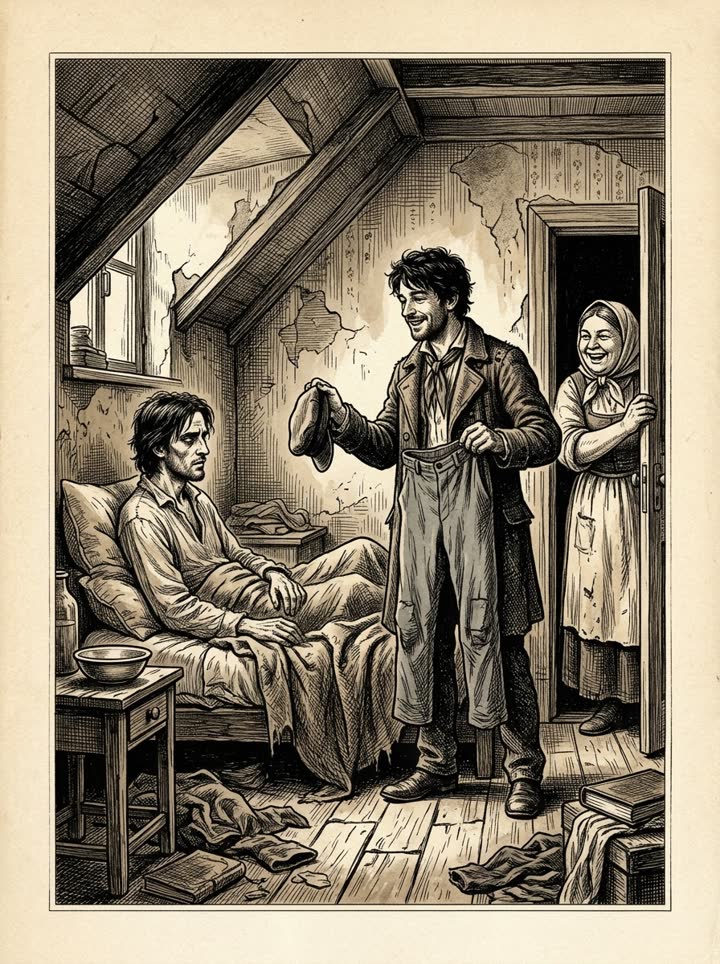
"This, brother, would you believe it, lay particularly on my heart. Because we must make a man of you. Let us begin: from the top. Do you see this cap?" he began, taking out of the bundle a rather pretty but at the same time very ordinary and cheap cap. "Let me try it on you?"
"Later, afterwards," said Raskolnikov, waving him off peevishly.
"No, brother Rodya, don't resist, later will be too late; and I shall not sleep all night, because I bought it without measuring, at random. Just right!" he exclaimed triumphantly, having tried it on. "Just to measure! Headgear, brother, is the most important thing in a costume, a sort of recommendation. Tolstyakov, my friend, is obliged every time to take off his covering when he goes into any public place where all the others stand in their hats and caps. Everyone thinks he does it from servile feelings, and he does it simply because he is ashamed of his bird's nest: such a bashful man! Well now, Nastenka, here are two headgears for you: this Palmerston" (he took from the corner Raskolnikov's battered round hat, which he called a Palmerston, for some reason unknown) "or this jeweller's piece? Appraise it, Rodya, what do you think I paid? Nastasyushka?" he turned to her, seeing that the other was silent.
"Twenty kopecks, I daresay, you gave," answered Nastasya.
"Twenty kopecks, you fool!" he cried, offended. "Nowadays for twenty kopecks you couldn't buy even you. Eighty kopecks! And that only because it's second-hand. True, there is an agreement: you wear this one out, next year they give you another free, by God! Well, sir, now let us proceed to the United States of America, as we called it at school. I warn you, I am proud of the trousers!" and he spread out before Raskolnikov a pair of grey trousers of light summer woollen stuff, "not a hole, not a spot, and yet quite tolerable, though worn, and a waistcoat to match, all one colour, as fashion requires. And that they are worn is, to tell the truth, even better: softer, more tender... You see, Rodya, to make a career in the world it is enough, in my opinion, always to observe the season; if you don't ask for asparagus in January, you will keep a few roubles in your purse; the same applies to this purchase. This is the summer season, and I made a summer purchase, because by autumn the season will in any case demand a warmer stuff, so you will have to throw it away... all the more as by then it will have fallen to pieces of itself, if not from increased luxury then from inner disorders. Well, appraise! How much, in your opinion? Two roubles twenty-five kopecks! And remember, again on the former condition: you wear these out, next year you take others free! At Fedyaev's shop they trade in no other way: you pay once, and it's enough for your whole life, because you will not go a second time of your own accord. Well, sir, now to the boots, how do you like them? You can see they are worn, but they will serve for two months, because it is foreign work and foreign goods: the secretary of the English embassy sold them off at the Flea Market last week; he wore them only six days, but he needed money badly. The price is one rouble fifty kopecks. Lucky?"
"But maybe they won't fit!" remarked Nastasya.
"Won't fit! And what is this?" and he pulled out of his pocket Raskolnikov's old boot, hardened, all plastered with dried mud, full of holes. "I went prepared, and from this monster they restored me the true size. The whole thing was done with feeling. And as for the linen, I came to terms with the landlady. Here, first, are three shirts, of coarse linen but with a fashionable front... Well then, so: eighty kopecks the cap, two roubles twenty-five the rest of the clothing, total three roubles five kopecks; one rouble fifty the boots, because they are very good, total four roubles fifty-five kopecks, and five roubles for all the linen, we bargained for it wholesale, total exactly nine roubles fifty-five kopecks. Forty-five kopecks change, in copper five-kopeck pieces, here, if you please, accept it, and in this way, Rodya, you are now restored in your whole costume, because in my opinion your coat can not only still serve but even has about it a look of peculiar nobility: that's what it means to order from Scharmer! As for socks and the rest, I leave it to you; we have twenty-five roubles left, and about Pashenka and paying for the lodging don't worry; I have said: unlimited credit. And now, brother, allow me to change your linen, for perhaps the illness sits now only in your shirt..."
"Leave it! I don't want it!" Raskolnikov waved him off, listening with disgust to Razumikhin's strained, playful report about the purchase of the clothes...
"That's impossible, brother; what did I wear out my boots for!" insisted Razumikhin. "Nastasyushka, don't be shy, but help, that's it!" and, despite Raskolnikov's resistance, he changed his linen all the same. The other fell back on the pillow and for two minutes said not a word.
"It will be long before they leave me alone!" he thought. "From what money was all this bought?" he asked at last, looking at the wall.
"Money? Well, I like that! From your own. The messenger was here earlier, from Vakhrushin, your mamma sent it; or have you forgotten that too?"
"Now I remember..." said Raskolnikov, after long and sullen thought. Razumikhin, frowning, looked at him anxiously.
The door opened, and a tall, stout man came in, who also seemed to Raskolnikov already somewhat familiar by sight.
"Zosimov! At last!" cried Razumikhin, delighted.