
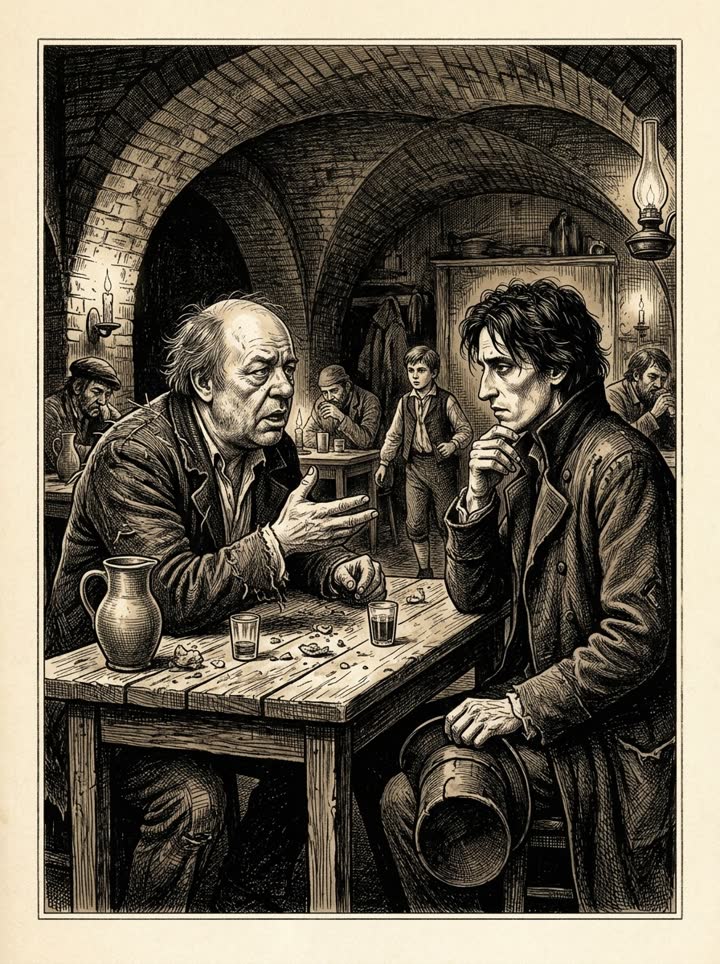
Raskolnikov was not used to crowds and, as has already been said, he shunned company of every kind, especially of late. But now something suddenly drew him towards people. Something new seemed to be happening inside him, and with it he felt a kind of thirst for people. He was so tired after a whole month of this concentrated misery and gloomy agitation that he longed to breathe, if only for one minute, in another world, any world at all; and in spite of all the filth of the place, he was glad to be staying in the tavern now.
The owner of the establishment was in another room, but he often came into the main one, coming down into it from somewhere by a few steps, and the first thing to show itself was always his dandyish greased boots with their big red tops. He wore a long coat and a terribly greasy black satin waistcoat, with no cravat, and his whole face looked as if it had been smeared with oil, like an iron lock. Behind the counter stood a boy of about fourteen, and there was another, younger boy who served if anyone asked for anything. There were chopped cucumbers, black rusks and fish cut into pieces; all of it smelt very bad. It was stifling, so that it was even unbearable to sit there, and everything was so soaked in the smell of wine that it seemed one could get drunk in five minutes from the air alone.
There are certain meetings, even with people we do not know at all, in whom we begin to take an interest at the first glance, somehow suddenly, all at once, before we have said a word. Exactly this impression was made on Raskolnikov by a customer who sat some way off and looked like a retired clerk. The young man later recalled this first impression several times and even put it down to a presentiment. He kept glancing at the clerk, of course, partly because the clerk himself was staring at him stubbornly, and it was plain that he very much wanted to begin a conversation. At the others in the tavern, the owner included, the clerk looked somehow out of habit, even with boredom, and at the same time with a shade of haughty contempt, as at people of lower station and understanding, with whom he had nothing to talk about. He was a man already past fifty, of middle height and solid build, greying, with a large bald patch, and a face yellow, even greenish, and swollen from constant drinking, with puffy eyelids behind which shone tiny, slit-like, but lively reddish eyes. But there was something very strange about him; there was something almost rapturous in his look, perhaps there was even sense and intelligence in it, but at the same time something like madness flickered there. He was dressed in an old, completely ragged black frock coat with the buttons falling off. Only one still hung on somehow, and he kept it fastened, evidently wishing not to depart from decency. A shirt front, all crumpled, dirty and stained, stuck out from under his nankeen waistcoat. His face was shaved, in the clerkly manner, but a long time ago, so that a thick bluish stubble had begun to show. And in his manner, too, there really was something solid and clerkly. But he was uneasy, ruffled his hair, and sometimes in misery propped his head in both hands, setting his torn elbows on the sticky, stained table. At last he looked straight at Raskolnikov and said loudly and firmly:
"May I venture, my dear sir, to address you in polite conversation? For although you are not in an imposing state, my experience distinguishes in you a man of education, unaccustomed to drink. I have always myself respected education when joined with sincere feeling, and besides, I hold the rank of titular councillor. Marmeladov is the name; titular councillor. May I venture to ask whether you have been in the service?"
"No, I'm studying..." answered the young man, partly surprised at the peculiar flowery tone of the speech and at being addressed so directly, point blank. In spite of his recent momentary wish for any sort of company with people, at the first word actually addressed to him he suddenly felt his usual unpleasant, irritable feeling of loathing for every stranger who touched, or only wished to touch, his person.
"A student, then, or a former student!" cried the clerk. "So I thought! Experience, my dear sir, repeated experience!" And as a sign of boasting he put his finger to his forehead. "You were a student or you pursued the learned line! But allow me..." He half rose, swayed, took his little vessel, his glass, and sat down by the young man, somewhat to one side of him. He was drunk, but spoke fluently and briskly, only now and then losing the thread a little and dragging out his words. He fell upon Raskolnikov with a sort of greediness, as though he too had spoken to no one for a whole month.
"My dear sir," he began almost solemnly, "poverty is not a vice, that is a truth. I know too that drunkenness is not a virtue, and that is even more so. But destitution, my dear sir, destitution is a vice, sir. In poverty you still keep the nobility of your inborn feelings, but in destitution never, no one does. For destitution they do not even drive a man out with a stick, they sweep him out of human company with a broom, to make it the more insulting; and rightly, for in destitution I am the first to be ready to insult myself. And hence the drink! My dear sir, a month ago Mr. Lebezyatnikov beat my wife, and my wife is not like me! Do you understand, sir? Allow me to ask you something more, merely out of simple curiosity, so to speak: have you ever spent the night on the Neva, on the hay barges?"
"No, I never have," answered Raskolnikov. "What do you mean?"
"Well, sir, I have come from there, and this is already the fifth night, sir..."
He poured out a glass, drank it and fell to thinking. And indeed, bits of hay were visible sticking to his clothes and even here and there in his hair. It was very likely that he had not undressed or washed for five days. His hands in particular were dirty, greasy and red, with black nails.
His talk seemed to arouse a general, though lazy, attention. The boys behind the counter began to giggle. The owner, it seemed, had come down from the upper room on purpose to listen to the "funny fellow," and sat down a little way off, yawning lazily but with importance. Evidently Marmeladov had long been known here. And he had probably acquired his inclination for flowery speech from the habit of frequent tavern conversations with all sorts of strangers. With some drinkers this habit turns into a need, especially with those who are treated strictly at home and ordered about. That is why in drinking company they always try to win some justification for themselves, and if possible even respect.
"Funny fellow!" the owner said loudly. "Why don't you work, why don't you serve, if you're a clerk?"
"Why I do not serve, my dear sir," Marmeladov took up, addressing himself solely to Raskolnikov, as though it were he who had asked the question, "why do I not serve? Does my heart not ache that I crawl about to no purpose? When Mr. Lebezyatnikov, a month ago, beat my wife with his own hand, and I lay there drunk, did I not suffer? Allow me, young man, has it ever happened to you... hm... well, to ask for a loan without hope?"
"It has... what do you mean, without hope?"
"I mean without hope entirely, sir, knowing beforehand that nothing will come of it. You know, for example, beforehand and thoroughly, that this man, this most well-meaning and most useful citizen, will on no account give you money, for why, I ask, should he give it? He knows I shall not pay it back. Out of compassion? But Mr. Lebezyatnikov, who keeps up with the new ideas, explained the other day that compassion has in our time even been forbidden by science, and that this is how it is already done in England, where there is political economy. Why, then, I ask, should he give it? And so, knowing in advance that he will not give it, you set out all the same and..."
"Then why go?" added Raskolnikov.
"But if there is no one else, if there is nowhere else to go! For every man must have somewhere he can go. Because there comes a time when you absolutely must go somewhere, anywhere! When my only daughter went out for the first time with a yellow ticket, I too went then... (for my daughter lives by a yellow ticket, sir...)" he added in parentheses, looking with some uneasiness at the young man. "It is nothing, my dear sir, nothing!" he hastened to declare at once, and apparently calmly, when both boys behind the counter snorted and the owner himself smiled. "It is nothing, sir! This wagging of heads does not disturb me, for everything is already known to everyone, and all that is secret becomes plain; and I take it not with contempt but with humility. So be it! So be it! 'Behold the man!' Allow me, young man: can you... But no, let me put it more strongly and more vividly: not can you, but do you dare, looking at me at this hour, say positively that I am not a swine?"
The young man did not answer a word.
"Well, sir," the orator went on, having waited with solid and even, this time, redoubled dignity for the giggling in the room to die down again. "Well, sir, let me be a swine, but she is a lady! I have the image of a beast, but Katerina Ivanovna, my wife, is an educated person and the daughter of a staff officer by birth. Let me be, let me be a scoundrel, but she is a woman of high heart, and full of feelings ennobled by upbringing. And yet... oh, if only she would pity me! My dear sir, my dear sir, every man must have at least one place where he too is pitied! And Katerina Ivanovna, though a magnanimous lady, is unjust... And although I myself understand that when she pulls my hair, she pulls it out of nothing but pity of heart (for, I repeat without embarrassment, she pulls my hair, young man," he confirmed with doubled dignity, hearing the giggling again), yet, O God, if only she would once... But no! no! all this is in vain, and there is nothing to say! nothing to say!.. for what I wished for has happened more than once, and more than once I have been pitied, but... such is my trait, and I am a born beast!"
"I should think so!" remarked the owner, yawning.
Marmeladov struck the table decisively with his fist.
"Such is my trait! Do you know, do you know, my dear sir, that I even drank away her stockings? Not her shoes, sir, for that would at least have borne some resemblance to the order of things, but her stockings, her stockings I drank away, sir! Her little goat's-down shawl I drank away too, a gift, from before, her own, not mine; and we live in a cold corner, and this winter she caught a cold and began to cough, and now she coughs blood. And we have three small children, and Katerina Ivanovna is at work from morning till night, scrubbing and washing and bathing the children, for she has been used to cleanliness since childhood, and with a weak chest and inclined to consumption, and I feel it. Do I not feel it? And the more I drink the more I feel it. That is why I drink, because in this drinking I seek compassion and feeling. Not merriment, but sorrow alone I seek... I drink because I want to suffer doubly!" And as if in despair he bowed his head on the table.
"Young man," he went on, lifting himself again, "in your face I read, as it were, a certain sorrow. I read it as you came in, and therefore I turned to you at once. For in telling you the story of my life, I do not wish to put myself on show before these idlers, who know everything already anyway, but I seek a sensitive and educated man. Know, then, that my wife was brought up in a noble provincial boarding school for the gentry and at her leaving danced with a shawl before the governor and other persons, for which she received a gold medal and a certificate of merit. The medal... well, the medal was sold... long ago... hm... the certificate of merit still lies in her trunk, and she showed it to the landlady not long ago. And although she is in the most ceaseless quarrels with the landlady, she wanted to boast before somebody and to tell of the happy days gone by. And I do not condemn, I do not condemn, for that is all that is left her in her memories, and the rest has gone to dust! Yes, yes; a hot, proud and unbending lady. She washes the floor herself and lives on black bread, but she will not allow disrespect to herself. That is why she would not let Mr. Lebezyatnikov's rudeness pass, and when Mr. Lebezyatnikov beat her for it, she took to her bed not so much from the blows as from feeling. I took her as a widow already, with three children, each smaller than the last. She married her first husband, an infantry officer, for love, and ran away with him from her parents' house. She loved her husband excessively, but he took to cards, was put on trial, and died of it. Towards the end he used to beat her; and although she did not let him off, of which I know for certain and by documents, still to this day she remembers him with tears and reproaches me with him, and I am glad, I am glad, for although in her imagination she sees herself as once happy... And after him she was left with three small children in a distant and savage district, where I too was then, and left in such hopeless poverty that although I have seen many adventures of different kinds, I am not even able to describe it. Her relations all turned away. And she was proud, too proud... And then, my dear sir, then I, a widower too, with a fourteen-year-old daughter by my first wife, offered her my hand, for I could not bear to look on such suffering. You can judge from this to what degree her misfortunes went, that she, educated and well brought up and of a well-known family, consented to marry me! But she did! Weeping and sobbing and wringing her hands, she did! For there was nowhere to go. Do you understand, do you understand, my dear sir, what it means when there is nowhere left to go? No! That you do not yet understand... And for a whole year I performed my duty piously and sacredly and did not touch this (he jabbed his finger at the half-bottle), for I have feeling. But even so I could not please her; and then I lost my place, and not through any fault either, but through a change in the staff, and then I touched it!.. It will be a year and a half now since we found ourselves at last, after wanderings and many misfortunes, in this magnificent capital, adorned with many monuments. And here I got a place... I got it and lost it again. Do you understand, sir? This time I lost it by my own fault, for my trait came on... We live now in a corner, with the landlady Amalia Fyodorovna Lippewechsel, but what we live on and what we pay with, I do not know. And many others live there besides us... A Sodom, sir, the most hideous... hm... yes... And in the meantime my daughter by the first marriage grew up, and what she endured, my daughter, from her stepmother while growing up, I pass over in silence. For although Katerina Ivanovna is full of magnanimous feelings, she is a hot and irritable lady, and she snaps... Yes, sir! Well, there is no need to remember that! Education, as you can imagine, Sonya did not receive. I tried, some four years ago, to go through geography and world history with her; but as I myself was not firm in that knowledge, and there were no proper textbooks either, for such books as there were... hm!.. well, they are gone now, those books, so all the teaching ended there. We stopped at Cyrus of Persia. Later, when she had reached a mature age, she read several books of a romantic content, and quite recently, through Mr. Lebezyatnikov, one book, Lewes's Physiology, do you know it, sir? She read it with great interest and even told us bits of it aloud: that is all her enlightenment. And now I turn to you, my dear sir, with a private question of my own: how much can a poor but honest girl earn by honest work?.. Not fifteen kopecks a day, sir, can she earn, if she is honest and has no special talents, and even that working without ever resting her hands! And even then State Councillor Klopstock, Ivan Ivanovich, have you heard of him? has not only to this day not paid her for sewing half a dozen shirts of Holland linen, but drove her away with insult, stamping his feet and calling her improper names, on the pretext that the shirt collar was not sewn to measure and was crooked. And meanwhile the children are hungry... And meanwhile Katerina Ivanovna walks about the room wringing her hands, and red spots come out on her cheeks, as always happens in that illness: 'You live with us, you parasite,' she says, 'you eat and drink and enjoy the warmth,' and what is there to eat and drink, when the children have not seen a crust for three days! I was lying there then... well, never mind! I lay there drunk, sir, and I hear my Sonya say (she is meek, and has such a gentle little voice... fair-haired, her little face always pale and thin), she says: 'Well then, Katerina Ivanovna, must I really go and do such a thing?' And Darya Frantsevna, an ill-intentioned woman, many times known to the police, had already called some three times through the landlady. 'Well, what of it,' answers Katerina Ivanovna, mockingly, 'what is there to guard? A fine treasure!' But do not blame her, do not blame her, my dear sir, do not blame her! It was not said in her right mind, but in agitated feelings, in illness and with the children crying who had not eaten, and it was said more to wound than in the exact sense... For Katerina Ivanovna has such a character, and as soon as the children begin to cry, even from hunger, she begins to beat them at once. And I see, some time after five o'clock, Sonechka got up, put on her kerchief, put on her cape and went out of the lodging, and some time after eight she came back again. She came, and went straight to Katerina Ivanovna, and silently laid thirty roubles on the table before her. She did not utter a single word, nor even look at her, but only took our big green woollen shawl (we have one in common, a woollen one), covered her head and face with it completely and lay down on the bed with her face to the wall, only her little shoulders and her whole body trembling... And I, as before, lay there in the same state, sir... And I saw then, young man, I saw how afterwards Katerina Ivanovna, also without saying a word, went up to Sonechka's little bed and stood all evening on her knees at her feet, kissing her feet, and would not get up, and then they both fell asleep together like that, in each other's arms... both... both... yes, sir... and I... lay there drunk, sir."
Marmeladov fell silent, as though his voice had broken. Then suddenly he hurriedly poured out, drank, and grunted.
"Since then, my dear sir," he went on after some silence, "since then, owing to one unfavourable occurrence and through the reports of ill-intentioned persons, to which Darya Frantsevna particularly contributed, supposedly because she had not been shown proper respect, since then my daughter, Sofya Semyonovna, was forced to take a yellow ticket, and on that account could no longer remain with us. For the landlady, Amalia Fyodorovna, would not allow it (though she herself had earlier helped Darya Frantsevna), and Mr. Lebezyatnikov too... hm... It was over Sonya that this affair of his with Katerina Ivanovna arose. At first he himself pressed Sonechka, and then all at once he stood on his dignity: 'How can I, such an enlightened man, live in the same lodging with a person like that?' And Katerina Ivanovna would not let it pass, she took her part... well, and so it happened... And Sonechka comes to us now mostly at dusk, and relieves Katerina Ivanovna, and brings what means she can... She lodges with the tailor Kapernaumov, rents a room from them, and Kapernaumov is lame and tongue-tied, and all his very numerous family are tongue-tied too. And his wife is tongue-tied too... They are all in one room, and Sonya has her own, separate, with a partition... Hm, yes... Poorest people and tongue-tied... yes... Only I got up then in the morning, sir, put on my rags, raised my hands to heaven and set off to his Excellency Ivan Afanasyevich. His Excellency Ivan Afanasyevich, do you know him?.. No? Then you do not know a man of God! He is wax... wax before the face of the Lord; as wax melteth! He even shed tears, having deigned to hear everything. 'Well, Marmeladov,' he said, 'since you have already once deceived my expectations... I take you once more on my own personal responsibility,' those were his very words, 'remember,' he said, 'now go!' I kissed the dust of his feet, in my mind, for in reality he would not have allowed it, being a dignitary and a man of new state and educated ideas; I returned home, and when I announced that I was again enrolled in the service and would receive a salary, Lord, what happened then!.."
Marmeladov stopped again in great agitation. At that moment a whole party of drunkards came in from the street, men already drunk enough, and at the entrance there sounded a hired barrel organ and the cracked voice of a child of seven singing "The Little Farm." It became noisy. The owner and the servants were busy with the newcomers. Marmeladov, paying no attention to them, went on with his story. He seemed already very weak, but the drunker he grew the more talkative he became. The memory of his recent success in the service seemed to bring him to life and even showed on his face as a kind of radiance. Raskolnikov listened attentively.
"That was, my dear sir, five weeks ago. Yes... As soon as they both found out, Katerina Ivanovna and Sonechka, Lord, it was as if I had moved into the kingdom of God. Before, I could lie like a beast, nothing but abuse! And now they walk on tiptoe, they hush the children: 'Semyon Zakharych is tired from the service, he is resting, sh!' They give me coffee before service, they boil cream! They began to get real cream, do you hear! And where they scraped together the money for a decent outfit for me, eleven roubles fifty kopecks, I cannot understand. Boots, calico shirt fronts, most magnificent, a uniform coat, all of it fitted out in the most splendid style for eleven and a half. I came home on the first day in the morning from the service, and I look: Katerina Ivanovna has cooked two dishes, soup and salt beef with horseradish, of which until then we had no idea. She has no dresses at all... that is, none at all, sir, and here she was as if going visiting, dressed up, and not with anything much, but they know how to make everything out of nothing: they do their hair, some clean little collar, cuffs, and an altogether different person comes out, younger and prettier. Sonechka, my dove, helped only with money, and herself, she says, it is not proper for me to be with you often now, not for a time, unless at dusk, so that no one sees. Do you hear, do you hear? I went to sleep after dinner, and what do you think, Katerina Ivanovna could not hold out: only a week before she had quarrelled with the landlady, Amalia Fyodorovna, in the last degree, and now she invited her to a cup of coffee. They sat two hours and whispered all the while: 'Now Semyon Zakharych is in the service and gets a salary, and he himself called on his Excellency, and his Excellency himself came out, told everyone to wait, and led Semyon Zakharych past all of them by the hand into his study.' Do you hear, do you hear? 'I, of course, Semyon Zakharych,' he says, 'remembering your services, and although you did indulge in that frivolous weakness, since you now promise, and since besides things have gone badly for us without you (do you hear, do you hear!), I now rely,' he says, 'on your noble word,' that is, all this, I tell you, she simply took and made up, and not out of levity, merely for boasting, sir! No, sir, she herself believes it all, she amuses herself with her own imaginings, by God, sir! And I do not condemn; no, that I do not condemn!.. And when, six days ago, I brought my first salary, twenty-three roubles forty kopecks, in full, she called me her little minnow: 'You little minnow,' she said, 'that you are!' And in private, sir, do you understand? Well, what beauty is there in me, one would think, and what sort of husband am I? No, she pinched my cheek: 'You little minnow,' she said."
Marmeladov stopped, wanted to smile, but suddenly his chin began to jump. He kept control, however. This tavern, his depraved look, five nights on the hay barges and the bottle, and with them this sick love for his wife and family, confused his listener. Raskolnikov listened intently, but with a sickly feeling. He was annoyed that he had come in here.
"My dear sir, my dear sir!" exclaimed Marmeladov, recovering himself. "Oh my dear sir, perhaps all this seems to you a laughing matter, as to the others, and I only trouble you with the foolishness of all these wretched details of my domestic life, but to me it is no laughing matter! For I can feel all this... And during that whole heavenly day of my life and that whole evening I too passed in flying dreams: how I would arrange it all, and clothe the children, and give her peace, and restore my only daughter from dishonour to the bosom of the family... And much, much more... It is permitted, sir. Well, sir, my dear sir" (Marmeladov suddenly seemed to start, raised his head and looked point blank at his listener), "well, sir, and on the very next day, after all these dreams (that is, exactly five days ago), towards evening, by cunning deceit, like a thief in the night, I stole from Katerina Ivanovna the key to her trunk, took out what was left of the salary I had brought, how much altogether I do not remember, and here, sir, look at me, all of you! It is the fifth day from home, and they are looking for me there, and the service is at an end, and my uniform coat lies in a tavern by the Egyptian Bridge, in exchange for which I received this garment... and all is at an end!"
Marmeladov struck himself on the forehead with his fist, clenched his teeth, closed his eyes and leaned hard on his elbow on the table. But a minute later his face suddenly changed, and with a sort of feigned slyness and put-on impudence he glanced at Raskolnikov, laughed and said:
"And today I was at Sonya's, I went to ask her for money for a hair of the dog! Heh-heh-heh!"
"Did she really give it?" shouted someone from the side among the newcomers, shouted and burst out laughing at the top of his voice.
"This very half-bottle, sir, was bought with her money," said Marmeladov, addressing himself solely to Raskolnikov. "Thirty kopecks she brought out, with her own hands, the last, all she had, I saw it myself... She said nothing, only looked at me in silence... That is how it is, not on earth but up there... they grieve over people, they weep, but they do not reproach, they do not reproach! And that hurts more, sir, more, sir, when they do not reproach!.. Thirty kopecks, yes, sir. And does she not need them now, eh? What do you think, my dear sir? For now she must keep herself clean. This cleanliness costs money, a special sort, do you understand? Do you understand? Well, to buy a little pomade too, one cannot do without, sir; starched petticoats, some such little shoe, a smart one, to show off her foot when she has to step across a puddle. Do you understand, do you understand, sir, what this cleanliness means? Well, sir, and I, her own father, I filched those thirty kopecks for my hangover! And I am drinking, sir! And have already drunk them, sir!.. Well, who will pity such a man as I? Eh? Do you pity me now, sir, or not? Tell me, sir, do you pity me or not? Heh-heh-heh-heh!"
He wanted to pour, but there was nothing left. The half-bottle was empty.
"And what's there to pity you for?" shouted the owner, who had turned up again beside them.
Laughter went up, and even curses. They laughed and cursed, those who had been listening and those who had not, merely from looking at the figure of the retired clerk.
"Pity! why pity me!" Marmeladov suddenly cried out, rising with his arm stretched forward, in decisive inspiration, as though he had only been waiting for these words. "Why pity, you say? Yes! there is nothing to pity me for! I should be crucified, crucified on a cross, and not pitied! But crucify, O judge, crucify, and having crucified him, pity him! And then I shall go to you myself to be crucified, for it is not merriment I thirst for, but sorrow and tears!.. Do you think, seller, that this half-bottle of yours was sweet to me? Sorrow, sorrow I sought at the bottom of it, sorrow and tears, and I tasted and I found; and he will pity us who pitied all men and who understood all men and all things, he alone, he is the judge. He will come on that day and ask: 'Where is the daughter who gave herself for a wicked and consumptive stepmother, for little children not her own? Where is the daughter who took pity on her earthly father, a vile drunkard, not shrinking from his beastliness?' And he will say: 'Come! I have already forgiven thee once... I have forgiven thee once... Thy sins, which are many, are forgiven thee too now, for thou hast loved much...' And he will forgive my Sonya, he will forgive, I know already that he will forgive... I felt it in my heart just now, when I was with her!.. And he will judge and forgive all, the good and the evil, the wise and the meek... And when he has finished with all, then he will speak to us also: 'Come forth,' he will say, 'you too! Come forth, you drunken ones, come forth, you weak ones, come forth, you shameless ones!' And we shall all come forth, without shame, and stand. And he will say: 'You are swine! of the image of the beast and bearing his mark; but come, you also!' And the wise will speak, the prudent will speak: 'Lord! why dost thou receive these?' And he will say: 'I receive them, O wise ones, I receive them, O prudent ones, because not one of them ever thought himself worthy of this...' And he will stretch out his hands to us, and we shall fall down... and weep... and understand everything! Then we shall understand everything!.. and all will understand... and Katerina Ivanovna... even she will understand... Lord, thy kingdom come!"
And he sank down on the bench, exhausted and drained of strength, looking at no one, as if he had forgotten his surroundings and fallen into deep thought. His words made some impression; for a minute silence fell, but soon the former laughter and curses rang out:
"He's judged it!"
"He's lying his head off!"
"Some clerk!"
And so on, and so on.
"Let us go, sir," Marmeladov said suddenly, raising his head and turning to Raskolnikov, "take me home... Kozel's house, in the courtyard. It is time... to Katerina Ivanovna..."
Raskolnikov had long wanted to leave; and he had himself thought of helping him. Marmeladov turned out to be much weaker on his legs than in his speeches, and leaned heavily on the young man. They had two or three hundred paces to go. Confusion and fear took possession of the drunkard more and more as they came nearer the house.
"It is not Katerina Ivanovna I am afraid of now," he muttered in agitation, "nor that she will begin to pull my hair. What is hair!.. nonsense, hair! That is what I say! It is even better if she begins to pull it, but that is not what I am afraid of... I... I am afraid of her eyes... yes... her eyes... I am afraid of the red spots on her cheeks too... and I am afraid of her breathing... Have you seen how people breathe in that illness... when their feelings are agitated? I am afraid of the children's crying too... Because if Sonya has not fed them, then... I do not know what! I do not know! But beatings I do not fear... Know, sir, that such beatings are not only no pain to me, but a delight... For I myself cannot do without it. It is better. Let her beat me, let her ease her soul... it is better... But here is the house. Kozel's house. A locksmith, a German, a rich one... lead on!"
They entered from the yard and went up to the fourth floor. The staircase grew darker the further they went. It was already almost eleven o'clock, and although at that time of year there is no real night in Petersburg, at the top of the staircase it was very dark.
A small, soot-blackened door at the end of the staircase, right at the top, stood open. A candle end lit a very poor room about ten paces long; the whole of it could be seen from the passage. Everything was scattered and in disorder, especially various children's rags. A torn sheet was stretched across the back corner. Behind it, probably, stood the bed. In the room itself there were only two chairs and a very tattered oilcloth sofa, before which stood an old kitchen table of pine, unpainted and uncovered. On the edge of the table stood a guttering tallow candle end in an iron candlestick. It turned out that Marmeladov lived in a separate room, not in a corner, but his room was a passage room. The door to the further quarters or cages into which Amalia Lippewechsel's apartment was divided was ajar. There was noise and shouting there. They were roaring with laughter. They seemed to be playing cards and drinking tea. Words of the most unceremonious sort flew out now and then.
Raskolnikov recognised Katerina Ivanovna at once. She was a woman terribly thin, slender, rather tall and well shaped, still with beautiful dark chestnut hair and indeed with cheeks flushed to red spots. She walked up and down her small room with her hands pressed to her chest, her lips parched, and breathed unevenly and with catches. Her eyes glittered as in a fever, but her look was sharp and fixed, and her consumptive, agitated face made a sickly impression in the last light of the dying candle end, which trembled on it. To Raskolnikov she seemed about thirty years old, and indeed she was no match for Marmeladov... She had not heard the people coming in and did not notice them; she seemed to be in some sort of trance, neither hearing nor seeing. The room was stuffy, but she did not open the window; a stench came up from the staircase, but the door to the staircase was not shut; from the inner quarters, through the unclosed door, waves of tobacco smoke came in, she coughed, but did not close the door. The smallest girl, about six, was asleep on the floor, somehow sitting, huddled up with her head pressed into the sofa. A boy, a year older than her, was trembling all over in the corner and crying. He had probably just been beaten. The eldest girl, about nine, tall and thin as a match, in one thin shift torn everywhere and a ragged woollen cape thrown over her bare shoulders, made for her, probably, two years ago, for it did not reach her knees now, stood in the corner beside her little brother, her long arm, dried up like a match, clasped round his neck. She seemed to be quieting him, whispering something to him, restraining him in every way so that he should not begin whimpering again, and at the same time she followed her mother with fear in her big, big dark eyes, which seemed still bigger in her thin and frightened little face. Marmeladov, not entering the room, knelt down right in the doorway, and pushed Raskolnikov forward. The woman, seeing a stranger, stopped absently before him, coming to herself for a moment and as if wondering why he had come in. But, no doubt, it at once occurred to her that he was going to the other rooms, since theirs was a passage room. Having worked this out and no longer paying any attention to him, she went to the outer door to close it, and suddenly cried out on seeing her husband kneeling on the very threshold.
"Ah!" she cried in a frenzy. "He's come back! Jailbird! Monster!.. And where is the money? What have you in your pocket, show me! And those are not your clothes! where are your clothes? where is the money? speak!.."
And she rushed to search him. Marmeladov at once obediently and meekly spread his arms out on both sides to make the search of his pockets easier. There was not one kopeck.
"Where is the money then?" she cried. "Oh Lord, can he really have drunk it all? Why, there were twelve roubles left in the trunk!.." and suddenly, in a rage, she seized him by the hair and dragged him into the room. Marmeladov himself eased her efforts, crawling meekly after her on his knees.
"And this is a delight to me! And this is not pain to me, but a de-light, my de-ar sir," he cried out, shaken by the hair and even once striking his forehead on the floor. The child asleep on the floor woke and began to cry. The boy in the corner could not bear it, trembled, screamed and flung himself at his sister in terrible fright, almost in a fit. The eldest girl was trembling like a leaf from sleep.
"He's drunk it! all, all drunk!" cried the poor woman in despair. "And those are not his clothes! They are hungry, hungry!" (and wringing her hands, she pointed at the children). "Oh, this cursed life! And you, are you not ashamed," she suddenly flew at Raskolnikov, "coming from the tavern! You drank with him? You drank with him too! Out!"
The young man hurried away without a word. Besides, the inner door opened wide and several curious people looked out of it. Insolent, laughing heads were thrust out with cigarettes and pipes, in skullcaps. Figures could be seen in dressing gowns and quite undone, in summer clothes to the point of indecency, some with cards in their hands. They laughed especially heartily when Marmeladov, dragged by the hair, cried out that this was a delight to him. They even began to come into the room; at last an ominous screech was heard: it was Amalia Lippewechsel herself pushing her way forward to put things in order in her own fashion and for the hundredth time frighten the poor woman with an abusive order to clear out of the apartment the very next day. As he left, Raskolnikov managed to thrust his hand into his pocket, scooped up as many copper coins as came, from the rouble he had changed in the tavern, and unnoticed laid them on the windowsill. Then on the staircase he thought better of it and wanted to go back.
"What stupid nonsense have I done," he thought, "they have Sonya, and I need it myself." But reflecting that it was impossible to take it back now and that in any case he would not have taken it, he waved his hand and went to his own lodging. "Sonya needs pomade too," he went on, striding along the street, and smiled sarcastically, "this cleanliness costs money... Hm! And Sonechka herself, perhaps, will go bankrupt today, because there is the same risk, hunting big game... gold mining... so they will all be left with nothing tomorrow without my money... Well done, Sonya! What a well, though, they managed to dig! and they use it! They do use it! And have got used to it. They wept, and got used to it. Man gets used to everything, the scoundrel!"
He fell to thinking.
"Well, and if I have lied," he suddenly exclaimed involuntarily, "if man really is not a scoundrel, man as a whole, that is, the whole human race, then it means that all the rest is prejudice, nothing but fears put into us, and there are no barriers, and so it ought to be!.."