
At the beginning of July, in a spell of extraordinary heat, towards evening, a young man came out of the little room he rented from lodgers in S. Lane, walked out into the street and slowly, as if in two minds, set off towards K. Bridge.
He had safely avoided meeting his landlady on the stairs. His little room was right under the roof of a tall, five-storey house, and it looked more like a cupboard than a place to live. As for the landlady, from whom he rented the room with dinner and service, she lived one flight below, in a separate flat, and every time he went out into the street he had to pass her kitchen, whose door almost always stood wide open onto the stairs. And every time he passed, the young man felt a sort of sick, cowardly sensation, which he was ashamed of and which made him wince. He owed the landlady money all round, and he was afraid to meet her.
It was not that he was so cowardly and downtrodden, quite the contrary; but for some time he had been in an irritable, strained state, much like hypochondria. He had withdrawn so far into himself and shut himself off so completely from everyone that he was afraid of any meeting at all, not only a meeting with the landlady. He was crushed by poverty; but even his cramped situation had lately stopped weighing on him. He had quite given up his everyday affairs, and did not want to attend to them. In reality, he was not afraid of any landlady, whatever she might be plotting against him. But to stop on the stairs, to listen to all that nonsense about all that everyday trash which was no concern of his, all those pestering demands for payment, the threats, the complaints, and to have to wriggle out of it himself, make excuses, lie... no, better to slip down the stairs like a cat, somehow, and vanish so that nobody saw him.
However, this time the fear of meeting his creditor struck even him, once he was out in the street.
"Here I am wanting to attempt such a thing, and at the same time I'm afraid of such trifles!" he thought with a strange smile. "Hm... yes... everything is in a man's hands, and he lets it all slip by under his very nose, purely out of cowardice... that is an axiom... It's curious, what are people most afraid of? A new step, a new word of their own, that's what they fear most... But then, I talk too much. That's why I do nothing, because I talk. Though perhaps it's the other way round: I talk because I do nothing. I learned to talk in this last month, lying whole days in my corner and thinking... about pie in the sky. Well, why am I going there now? Am I capable of that? Is that serious? It's not serious at all. I'm just amusing myself with a fancy; toys! Yes, perhaps just toys!"
In the street the heat was terrible, and besides that the stuffiness, the jostling, lime everywhere, scaffolding, bricks, dust, and that peculiar summer stench so familiar to every Petersburger who cannot afford to rent a country cottage. All this at once gave an unpleasant shock to the young man's nerves, which were upset enough already. The intolerable stink from the taverns, of which there are an especially great number in this part of town, and the drunkards, who kept turning up every minute although it was a working day, completed the repulsive and mournful colouring of the picture. A feeling of the deepest disgust flickered for a moment in the young man's delicate features. By the way, he was remarkably handsome, with fine dark eyes and dark brown hair, taller than average, slim and well built. But soon he fell into a kind of deep thoughtfulness, or rather, to say it more truly, into a kind of oblivion, and walked on no longer noticing what was around him, and not wishing to notice it. Only now and then he muttered something to himself, from that habit of monologues which he had just admitted to himself. At this very moment he was himself aware that his thoughts sometimes grew muddled and that he was very weak: it was now the second day that he had eaten almost nothing at all.
He was so badly dressed that another man, even one used to it, would have been ashamed to go out into the street by day in such rags. However, the neighbourhood was such that it was hard to surprise anyone here with a costume. The nearness of the Haymarket, the abundance of certain well-known establishments, and above all the guild and craftsman population crowded into these central Petersburg streets and lanes, sometimes dotted the general panorama with such characters that it would have been strange to be surprised at meeting any figure whatever. But so much spiteful contempt had already gathered in the young man's soul that, in spite of all his sometimes very youthful touchiness, he was least of all ashamed of his rags in the street. It was another matter when he met certain acquaintances, or former fellow students, whom in general he did not like to meet... And yet, when a drunkard, who was being driven somewhere for some unknown reason along the street in an enormous cart drawn by an enormous dray horse, suddenly shouted to him as he passed, "Hey, you, German hatter!" and yelled at the top of his voice, pointing at him with his hand, the young man suddenly stopped and clutched convulsively at his hat. The hat was tall and round, from Zimmermann's, but now quite worn out, completely rust-coloured, full of holes and stains, with no brim, and crumpled over to one side at the most hideous angle. But it was not shame, it was quite another feeling, even like fright, that seized him.
"I knew it!" he muttered in confusion. "I thought so! This is the worst of all! Some stupidity like this, some vulgar little trifle, can spoil the whole plan! Yes, the hat is too noticeable... It's ridiculous, and that is why it's noticeable... With my rags I must have a cap, any old pancake of a cap, not this monster. Nobody wears such a thing, they'd notice it a verst away, they'd remember it... above all they'd remember it afterwards, and there you have evidence. One must be as unnoticeable as possible... Trifles, trifles are the main thing!.. It's just these trifles that always ruin everything..."
He had not far to go; he even knew how many steps it was from the gate of his house: exactly seven hundred and thirty. He had counted them once, when he had been dreaming very hard. At that time he did not yet believe in those dreams of his himself, and only teased himself with their hideous but tempting boldness. But now, a month later, he was beginning to look at it differently, and in spite of all the taunting monologues about his own weakness and indecision, he had even got used, somehow, almost against his will, to regarding the "hideous" dream as an undertaking, although he still did not believe in it himself. He was even going now to make a trial of his undertaking, and with every step his agitation grew stronger and stronger.
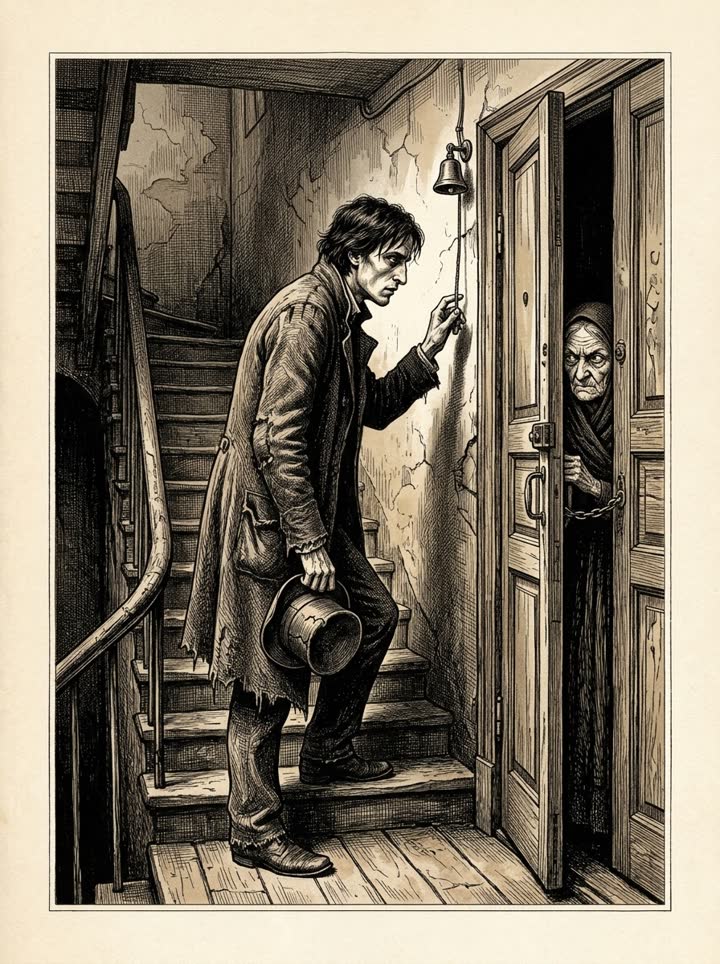
With a sinking heart and a nervous trembling he came up to an enormous house, which had one wall on the canal and the other on a street. This house was full of little flats and was inhabited by all sorts of tradespeople, tailors, locksmiths, cooks, Germans of various kinds, girls living on their own, small clerks and so on. People coming in and going out darted about under both gateways and in both courtyards of the house. Three or four yardkeepers worked there. The young man was very pleased not to meet any of them, and slipped unnoticed straight from the gate to the right, up the stairs. The staircase was dark and narrow, a "back" staircase, but he already knew all this and had studied it, and he liked the whole setting: in such darkness even a curious eye was no danger. "If I'm so afraid even now, what would it be like if it really came to the deed itself?.." he thought involuntarily as he went up to the fourth floor. Here his way was blocked by some discharged soldiers, porters, who were carrying furniture out of one of the flats. He had known before that a German, a clerk with a family, lived in that flat. "So this German is moving out now, and so, on the fourth floor, on this staircase and on this landing, for some time only the old woman's flat will be occupied. That's good... in case of anything..." he thought again, and rang at the old woman's flat. The bell tinkled faintly, as if it were made of tin and not of brass. In such little flats in such houses nearly all the bells are like that. He had forgotten the ring of this bell, and now this particular sound seemed suddenly to remind him of something and to picture it clearly... He quite shuddered, his nerves had grown too weak this time. A little later the door opened a tiny crack: the tenant was looking over the visitor through the crack with evident mistrust, and only her little eyes could be seen glittering out of the darkness. But seeing many people on the landing she took courage and opened the door wide. The young man stepped over the threshold into a dark entry, divided by a partition, behind which was a tiny kitchen. The old woman stood in front of him in silence, looking at him questioningly. She was a tiny, dried-up little old woman of about sixty, with sharp, spiteful little eyes, a small sharp nose, and her head bare. Her fair hair, only a little grey, was thickly greased with oil. Round her thin, long neck, which was like a chicken's leg, some flannel rags were wound, and on her shoulders, in spite of the heat, hung a quite tattered, yellowed fur jacket. The little old woman coughed and groaned every minute. The young man must have looked at her with some particular look, for the former mistrust suddenly flashed again in her eyes too.
"Raskolnikov, a student, I came to you a month ago," the young man hastened to mutter, with a half bow, remembering that he ought to be more polite.
"I remember, my dear sir, I remember very well that you came," the old woman said distinctly, still not taking her questioning eyes from his face.
"Well, then, sir... I've come again, on the same sort of little business..." Raskolnikov went on, a little confused and surprised at the old woman's mistrust.
"Perhaps, though, she is always like this, and I didn't notice it that time," he thought with an unpleasant feeling.
The old woman was silent, as if considering, then stepped aside and, pointing to the door into the room, said, letting her guest go first:
"Go in, my dear sir."
The small room into which the young man went, with yellow wallpaper, geraniums and muslin curtains at the windows, was at that moment brightly lit by the setting sun. "So then, too, the sun will shine like this!.." flashed as if by chance through Raskolnikov's mind, and with a quick glance he took in everything in the room, so as to study and remember the layout as far as he could. But there was nothing special in the room. The furniture, all very old and of yellow wood, consisted of a sofa with an enormous curved wooden back, a round table of oval shape in front of the sofa, a dressing table with a little mirror between the windows, chairs along the walls, and two or three cheap little pictures in yellow frames, showing German young ladies with birds in their hands; that was all the furniture. In the corner a lamp was burning before a small icon. Everything was very clean: the furniture and the floors were scrubbed to a polish; everything shone. "Lizaveta's work," thought the young man. Not a speck of dust could be found in the whole flat. "It is only with spiteful old widows that you find such cleanness," Raskolnikov went on to himself, and he glanced with curiosity at the cotton curtain in front of the door into the second tiny room, where the old woman's bed and chest of drawers stood and where he had never yet looked in. The whole flat consisted of these two rooms.
"What do you want?" the little old woman said sternly, coming into the room and again standing straight in front of him, in order to look him straight in the face.
"I've brought something to pawn, here, sir!" And he took from his pocket an old, flat silver watch. On its back plate a globe was engraved. The chain was of steel.
"But the time is up for your last pledge too. It was a month ago the day before yesterday."
"I'll pay you the interest for another month; be patient."
"That's as I please, my dear sir, whether to be patient or to sell your article right now."
"Will you give much for the watch, Alyona Ivanovna?"
"You come with trifles, my dear sir, it's worth nothing, you might say. For the ring last time I paid you two little notes, and you can buy it new from a jeweller for a rouble and a half."
"Give me four roubles, and I'll redeem it, it was my father's. I'll be getting some money soon."
"A rouble and a half, sir, and the interest in advance, if you want it, sir."
"A rouble and a half!" cried the young man.
"Your choice." And the old woman held the watch out to him again. The young man took it and was so angry that he was about to leave; but he checked himself at once, remembering that there was nowhere else to go, and that he had come for something else as well.
"Give it here!" he said roughly.
The old woman felt in her pocket for her keys and went into the other room behind the curtains. The young man, left alone in the middle of the room, listened with curiosity and reckoned things up. He could hear her unlocking the chest of drawers. "It must be the top drawer," he reckoned. "So she carries the keys in her right pocket... All on one bunch, on a steel ring... And there is one key there, much bigger than all the rest, three times as big, with a toothed bit, certainly not for the chest of drawers... So there is some other box or trunk... That is interesting. Trunks always have keys like that... But still, how vile it all is..."
The old woman came back.
"Here, my dear sir: if it's a grivna a month on the rouble, then on a rouble and a half there will be fifteen kopecks due from you, for a month in advance, sir. And for the two roubles from before there are another twenty kopecks due from you on the same account, in advance. So that makes thirty-five. So what you have to receive now for your watch is a rouble and fifteen kopecks. Here you are, sir."
"What! So now it's only a rouble fifteen kopecks!"
"Exactly so, sir."
The young man did not argue and took the money. He looked at the old woman and did not hurry to leave, as if he still wanted to say or do something, but as if he did not know himself what exactly...
"I may, Alyona Ivanovna, perhaps bring you another article in a few days... silver... a good one... a cigarette case... as soon as I get it back from a friend..." He grew confused and fell silent.
"Well, then we'll talk about it, my dear sir."
"Good-bye, sir... And you always sit at home alone, your sister isn't here?" he asked as casually as he could, going out into the hall.
"And what is she to you, my dear sir?"
"Nothing in particular. I just asked. You're so quick now... Good-bye, Alyona Ivanovna!"
Raskolnikov went out in decided confusion. This confusion grew more and more. Going down the stairs, he even stopped several times, as if suddenly struck by something. And at last, already in the street, he exclaimed:
"Oh God! How disgusting it all is! And can it be, can it be that I... no, it's nonsense, it's absurd!" he added resolutely. "And could such a horror really have come into my head? What filth my heart is capable of, after all! The main thing: it's filthy, nasty, vile, vile!.. And I, for a whole month..."
But he could not express his agitation either in words or in exclamations. The feeling of infinite disgust, which had begun to weigh on and sicken his heart even while he was only on his way to the old woman, had now reached such a size and showed itself so clearly that he did not know where to go to escape his anguish. He walked along the pavement like a drunken man, not noticing the passers-by and bumping into them, and only came to himself in the next street. Looking round, he noticed that he was standing beside a tavern, which was entered from the pavement by steps going down into a basement. Out of the doors, at that very moment, two drunkards were coming, and, holding each other up and swearing at each other, they were clambering up into the street. Without thinking long, Raskolnikov went straight down. Never till now had he gone into taverns, but now his head was spinning, and besides, a burning thirst tormented him. He wanted a drink of cold beer, the more so because he put his sudden weakness down partly to being hungry. He sat down in a dark, dirty corner, at a sticky little table, asked for beer, and drank the first glass greedily. At once everything eased, and his thoughts grew clear. "It's all nonsense," he said hopefully, "and there was nothing to be confused about! It's simply a physical disorder! One glass of beer, a piece of dry biscuit, and in one moment the mind grows strong, the thought grows clear, the intentions grow firm! Pah, how petty all this is!.." But in spite of this scornful spitting, he was already looking cheerful, as if suddenly freed from some terrible burden, and he glanced round at the people present in a friendly way. But even at this moment he had a distant foreboding that all this receptiveness to better things was also unhealthy.
There were few people left in the tavern at that time. Besides those two drunkards he had met on the stairs, a whole band had gone out right after them, five or so men, with one girl and a concertina. After them it was quiet and roomy. There remained: one man, tipsy but not much, sitting over his beer, a tradesman by the look of him; his companion, fat, huge, in a Siberian coat and with a grey beard, very drunk, dozing on the bench and now and then, suddenly, as if half awake, beginning to snap his fingers with his arms spread wide and to jump up and down with the upper part of his body, without getting up from the bench, singing along some nonsense, straining to recall the verses, something like:
For a whole year I caressed my wife,
For a who-ole year I ca-ressed my wife...
Or suddenly, waking up, again:
I walked along Podyacheskaya,
And found my old love there...
But nobody shared his happiness; his silent companion looked at all these outbursts even with hostility and mistrust. There was one other person there too, who looked something like a retired clerk. He sat apart, in front of his little vessel, now and then taking a sip and looking round. He too seemed to be in some agitation.