
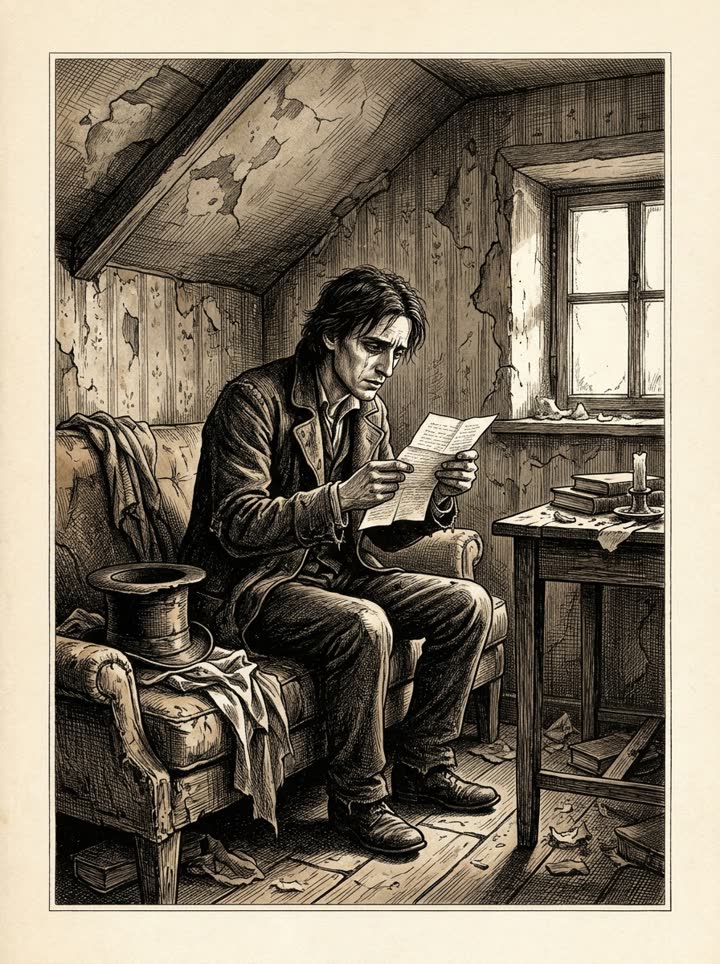
He woke late the next day, after a troubled sleep, but the sleep had not refreshed him. He woke bilious, irritable and spiteful, and looked at his little room with hatred. It was a tiny cell, about six paces long, and it looked utterly wretched with its yellowish, dusty wallpaper hanging away from the wall everywhere. It was so low that a man even slightly tall felt uneasy in it, and kept fancying he was about to knock his head on the ceiling. The furniture matched the room: three old chairs, none quite sound; a painted table in the corner, on which lay a few notebooks and books, so thick with dust that it was plain no hand had touched them for a long time; and finally a big clumsy sofa that took up almost a whole wall and half the width of the room. It had once been covered in chintz, but was now in rags, and it served Raskolnikov as a bed. Often he slept on it just as he was, without undressing, without a sheet, covering himself with his old, worn-out student's overcoat, with one small pillow under his head, and under the pillow he stuffed all the linen he had, clean and dirty, to raise the headrest higher. In front of the sofa stood a little table.
It would have been hard to sink lower or to go more to seed; but in his present state of mind Raskolnikov even found it agreeable. He had withdrawn from everyone decisively, like a tortoise into its shell, and even the face of the servant girl, whose duty it was to wait on him and who sometimes looked into his room, roused his bile and made him twitch. It is like that with certain monomaniacs who concentrate too much on one thing. His landlady had stopped sending up his meals two weeks ago, and he had not yet thought of going to have it out with her, although he was going without his dinner. Nastasya, the cook and the landlady's only servant, was partly glad of her lodger's mood and had quite stopped tidying and sweeping his room; only about once a week, by accident, she would take up the broom. It was she who had woken him now.
"Get up, what are you sleeping for!" she shouted over him. "It's gone nine. I've brought you tea. Do you want a drop of tea? You must be starving?"
The lodger opened his eyes, started, and recognised Nastasya.
"Is the tea from the landlady, then?" he asked, slowly and with a sickly look, raising himself on the sofa.
"From the landlady, indeed!"
She set down in front of him her own cracked teapot, with tea already brewed once from old leaves, and laid two yellow lumps of sugar beside it.
"Here, Nastasya, take this, please," he said, feeling in his pocket (he had slept in his clothes) and pulling out a handful of copper, "go and buy me a roll. And get a little sausage from the sausage shop, the cheapest."
"I'll bring you the roll this very minute. But wouldn't you rather have cabbage soup instead of sausage? Good soup, left from yesterday. I put it by for you yesterday, but you came in late. Good soup."
When the soup was brought and he began on it, Nastasya sat down beside him on the sofa and started to chatter. She was a village woman, and a very talkative one.
"Praskovya Pavlovna wants to complain of you to the police," she said.
He frowned hard.
"To the police? What does she want?"
"You don't pay and you won't leave the lodging. It's plain what she wants."
"Oh, the devil, that's all I needed," he muttered, grinding his teeth. "No, that would be... inconvenient for me now. She's a fool," he added aloud. "I'll go and see her today and talk to her."
"A fool she is, no doubt, same as me, but you, clever one, why do you lie there like a sack, and nothing to be seen of you? You used to go and teach children, you say, but why don't you do anything now?"
"I do something..." said Raskolnikov, unwillingly and sternly.
"What do you do?"
"Work..."
"What sort of work?"
"I think," he answered seriously, after a pause.
Nastasya simply rolled with laughter. She was one of the laughing sort, and when she was made to laugh she laughed without a sound, heaving and shaking all over, until she felt sick herself.
"Have you thought up a lot of money, then?" she managed to say at last.
"One can't teach children without boots. And I spit on it anyway."
"Don't spit in the well."
"For children they pay in coppers. What can you do with kopecks?" he went on reluctantly, as if answering his own thoughts.
"And you'd like the whole fortune at once?"
He looked at her strangely.
"Yes, the whole fortune," he answered firmly, after a pause.
"Well, go gently, or you'll frighten me; I'm frightened enough as it is. Am I to go for the roll or not?"
"As you like."
"Oh, I forgot! A letter came for you yesterday, while you were out."
"A letter! For me! From whom?"
"From whom, I don't know. I gave the postman three kopecks of my own. Will you pay me back?"
"Then bring it, for God's sake, bring it!" cried Raskolnikov, quite agitated. "Lord!"
A minute later the letter appeared. So it was: from his mother, from R. province. He even turned pale as he took it. It was a long time since he had received any letters; but now something else too suddenly clutched at his heart.
"Nastasya, go away, for God's sake; here are your three kopecks, only, for God's sake, go quickly!"
The letter trembled in his hands; he did not want to open it in front of her: he wanted to be left alone with this letter. When Nastasya had gone out, he quickly raised it to his lips and kissed it; then for a long while he went on gazing at the handwriting of the address, the small, slanting handwriting of his mother, so familiar and dear to him, who had once taught him to read and write. He delayed; he even seemed to be afraid of something. At last he opened it. The letter was big and thick, two lots in weight; two large postal sheets were written over in the tiniest hand.
"My dear Rodya," wrote his mother, "it is now more than two months since I talked with you in writing, and I have suffered from it myself and even lain awake some nights, thinking. But surely you will not blame me for this involuntary silence. You know how I love you; you are all we have, Dunya and I; you are our everything, all our hope and trust. What I felt when I learned that you had already left the university some months ago for want of means to keep yourself, and that your lessons and other resources had come to an end! How could I help you, with my hundred and twenty roubles a year of pension? The fifteen roubles that I sent you four months ago I borrowed, as you yourself know, against this very pension, from our local merchant here, Afanasy Ivanovich Vakhrushin. He is a good man and was a friend of your father's. But having given him the right to receive the pension in my place, I had to wait until the debt was paid off, and that has only just been done, so that all this time I could send you nothing. But now, thank God, I think I can send you something more, and indeed we can even boast of our fortune now, and I hasten to tell you of it. And first of all, can you guess, dear Rodya, that your sister has been living with me for a month and a half already, and we shall never again be parted? Thanks be to God, her torments are over, but I will tell you everything in order, so that you know how it all was, and what we have hidden from you until now. When you wrote to me two months ago that you had heard from someone that Dunya was suffering much from rudeness in the house of the Svidrigailovs, and asked me for exact explanations, what could I write to you in answer then? If I had written you the whole truth, you would perhaps have thrown everything up and come to us even on foot, because I know your character and your feelings, and you would not have let your sister be insulted. I myself was in despair, but what was to be done? I did not myself know the whole truth then. The chief difficulty was that Dunechka, when she entered their house last year as a governess, took a whole hundred roubles in advance, on condition that it be deducted monthly from her salary, and so it was impossible to leave the place without paying off the debt. That sum (now I can explain everything to you, my priceless Rodya) she took chiefly in order to send you sixty roubles, which you then needed so badly and which you received from us last year. We deceived you then, we wrote that it came from Dunechka's former savings, but that was not so, and now I tell you the whole truth, because everything has suddenly changed, by God's will, for the better, and so that you may know how Dunya loves you and what a priceless heart she has. It is true that Mr. Svidrigailov at first treated her very rudely and made various discourteous remarks and jeers at the table... But I do not want to enter into all these painful details, so as not to upset you for nothing, now that it is all over. In short, in spite of the kind and generous behaviour of Marfa Petrovna, Mr. Svidrigailov's wife, and of all the household, Dunechka had a very hard time, especially when Mr. Svidrigailov, by his old regimental habit, was under the influence of Bacchus. But what turned out afterwards? Imagine, this madman had long ago conceived a passion for Dunya, but hid it all under a show of rudeness and contempt for her. Perhaps he was himself ashamed and horrified to see himself, already getting on in years and the father of a family, entertaining such frivolous hopes, and so he involuntarily raged at Dunya. Or perhaps he only wanted, by the rudeness of his manner and his jeers, to hide the whole truth from others. But at last he could not restrain himself and dared to make Dunya an open and vile proposal, promising her all sorts of rewards and besides to throw up everything and go away with her to another village, or perhaps abroad. You can imagine all her suffering! To leave her place at once was impossible, not only because of the money debt, but also out of consideration for Marfa Petrovna, who might suddenly have conceived suspicions, and then discord would have been brought into the family. And for Dunechka too it would have been a great scandal; it would never have passed off quietly. There were also many other reasons, so that Dunya could not count on tearing herself from that dreadful house in less than six weeks. Of course, you know Dunya, you know how clever she is and what a firm character she has. Dunechka can bear a great deal and even in the most extreme cases find enough generosity in herself not to lose her firmness. She did not even write to me about everything, so as not to distress me, though we often sent each other news. But the outcome came unexpectedly. Marfa Petrovna accidentally overheard her husband pleading with Dunechka in the garden, and, understanding it all the wrong way, blamed her for everything, thinking that she was the cause of it all. A terrible scene took place between them there in the garden: Marfa Petrovna even struck Dunya, would not listen to anything, and herself shouted for a whole hour, and at last ordered Dunya to be taken straight to me in town, on a plain peasant cart, into which they flung all her things, her linen, her dresses, everything just as it happened, untied and unpacked. And then a pouring rain came on, and Dunya, insulted and disgraced, had to ride with a peasant for seventeen whole versts in an open cart. Think now what I could have written you in answer to your letter, which I received two months ago, and what was there to write about? I myself was in despair; I did not dare to write the truth, because you would have been very unhappy, grieved and indignant, and what could you have done? Perhaps ruined yourself, and Dunechka forbade it too; and to fill a letter with trifles and talk of one thing and another, when there was such grief in my soul, I could not do. For a whole month gossip about this affair went about our whole town, and it came to such a pass that we could not even go to church, Dunya and I, because of the contemptuous looks and whispers, and people even spoke aloud in our hearing. All our acquaintances drew away from us, everyone stopped even bowing, and I learned for certain that some merchants' clerks and some copying clerks wanted to inflict a vile insult on us by smearing the gates of our house with tar, so that the landlords began to demand that we leave the lodging. The cause of all this was Marfa Petrovna, who managed to accuse and besmirch Dunya in every house. She is acquainted with everyone here, and during that month she was constantly coming into town, and since she is a little talkative and likes to tell about her family affairs and especially to complain of her husband to everyone and anyone, which is very wrong, she spread the whole story in a short time, not only through the town but through the whole district. I fell ill, but Dunechka was stronger than I, and if you had seen how she bore it all, and consoled and cheered me too! She is an angel! But by God's mercy our torments were cut short: Mr. Svidrigailov came to his senses and repented, and, probably taking pity on Dunya, he presented Marfa Petrovna with full and obvious proofs of Dunechka's entire innocence, namely a letter which Dunya had been forced to write and hand to him, even before Marfa Petrovna surprised them in the garden, to put off the personal explanations and secret meetings which he insisted on, and which, after Dunechka's departure, remained in Mr. Svidrigailov's hands. In this letter she reproached him in the most passionate manner and with complete indignation for precisely the ignobility of his behaviour towards Marfa Petrovna, pointed out to him that he was a father and a family man, and, finally, how vile it was of him to torment and make unhappy a girl who was already unhappy and defenceless. In a word, dear Rodya, this letter is written so nobly and touchingly that I sobbed as I read it, and to this day I cannot read it without tears. Besides this, in Dunya's vindication, there appeared at last the testimony of the servants, who had seen and known much more than Mr. Svidrigailov himself supposed, as always happens. Marfa Petrovna was utterly stunned and 'killed anew,' as she herself confessed to us, but she was fully convinced of Dunechka's innocence, and the very next day, a Sunday, she drove straight to the cathedral, and on her knees and in tears begged the Mother of God to give her strength to bear this new trial and to do her duty. Then, straight from the cathedral, calling on no one, she came to us, told us everything, wept bitterly, and in complete repentance embraced Dunya and begged her to forgive her. The same morning, without the slightest delay, going straight from our house, she went round all the houses in the town, and everywhere, in the most flattering terms for Dunechka, shedding tears, she restored her innocence and the nobility of her feelings and conduct. More than that, she showed everyone and read aloud Dunechka's own handwritten letter to Mr. Svidrigailov, and even allowed copies to be taken of it (which, it seems to me, was already too much). In this way she had to spend several days in succession visiting everyone in town, since some began to take offence that others had been shown preference, and so queues were formed, so that in every house they were waiting in advance and everyone knew that on such and such a day Marfa Petrovna would be reading this letter in such and such a place, and to each reading there gathered again even those who had already listened to the letter several times, in their own houses and at other acquaintances', in turn. My opinion is that much, very much, of this was superfluous; but Marfa Petrovna is of such a character. At least she completely restored Dunechka's honour, and the whole vileness of the affair fell as an indelible disgrace on her husband, as the chief culprit, so that I am even sorry for him; they treated this madman too severely. Dunya was at once invited to give lessons in some houses, but she refused. In general, everyone suddenly began to treat her with particular respect. All this contributed chiefly to the unexpected event through which, one may say, our whole fate is now changing. Know, dear Rodya, that a suitor has proposed to Dunya and that she has already given her consent, and I hasten to inform you of it as soon as possible. And although this was done without your advice, you will probably not hold it against me or against your sister, since you will see for yourself, from the matter itself, that it would have been impossible for us to wait and put it off until we received your answer. And you could not have judged everything exactly yourself from a distance. It happened thus. He is already a court councillor, Pyotr Petrovich Luzhin, and a distant relative of Marfa Petrovna, who helped much in this. He began by expressing, through her, a wish to make our acquaintance, was properly received, drank coffee, and the very next day sent a letter in which he explained his proposal very politely and asked for a quick and decisive answer. He is a busy man of business, and is hurrying now to Petersburg, so that every minute is precious to him. Naturally we were at first very much struck, since it all happened too quickly and unexpectedly. We weighed it and thought it over together the whole of that day. He is a reliable man and well provided for, he holds posts in two places and already has his own capital. It is true he is already forty-five, but he is of rather pleasant appearance and may still please women, and altogether he is a very solid and decent man, only a little gloomy and, as it were, haughty. But perhaps that only seems so at first sight. And I warn you, dear Rodya, when you meet him in Petersburg, which will happen very soon, do not judge too quickly and hotly, as is your way, if at first sight something in him does not please you. I say this just in case, although I am sure he will make a pleasant impression on you. And besides, to get to know any man whatever, one must approach him gradually and carefully, so as not to fall into error and prejudice, which are very hard to correct and smooth over afterwards. And Pyotr Petrovich, at least by many signs, is a most respectable man. At his very first visit he declared to us that he is a practical man, but that in many things he shares, as he himself put it, 'the convictions of our newest generations,' and is an enemy of all prejudices. He said much else besides, because he is somewhat vain, as it were, and likes very much to be listened to, but that is hardly a vice. I understood little, of course, but Dunya explained to me that, though he is not a man of much education, he is clever and, it seems, kind. You know your sister's character, Rodya. She is a firm, sensible, patient and generous girl, though with an ardent heart, which I have studied well in her. Of course there is no special love on her side or his, but Dunya, besides being a clever girl, is at the same time a noble creature, like an angel, and she will make it her duty to create the happiness of her husband, who in his turn would take care of her happiness, and of the latter we have so far no great reason to doubt, although, to confess, the matter was done rather quickly. Besides, he is a very calculating man, and of course will see for himself that his own married happiness will be the more certain the happier Dunechka is with him. As for any irregularities of character, any old habits, and even some disagreement in ideas (which cannot be avoided even in the happiest marriages), on this score Dunechka herself told me that she relies on herself; that there is nothing to worry about there and that she can endure a great deal, provided their further relations are honest and just. He, for instance, seemed to me too at first rather abrupt; but that may come precisely from his being a straightforward man, and certainly so. For example, at his second visit, having already received her consent, he said in conversation that even before, not knowing Dunya, he had resolved to take an honest girl but without a dowry, and certainly one who had already experienced distress; because, as he explained, a husband ought to owe nothing to his wife, and it is much better if the wife regards her husband as her benefactor. I will add that he expressed himself somewhat more softly and kindly than I have written, because I have forgotten the actual expression and remember only the thought, and besides, he said it not at all on purpose, but obviously letting it slip, in the heat of conversation, so that he even tried afterwards to correct and soften it; but it still seemed to me a little abrupt, as it were, and I told Dunya afterwards. But Dunya answered me, even with vexation, that 'words are not yet deeds,' and that, of course, is just. Before deciding, Dunechka did not sleep the whole night, and, supposing that I was already asleep, got out of bed and walked up and down the room all night; at last she knelt and prayed long and fervently before the icon, and in the morning announced to me that she had decided.
I have already mentioned that Pyotr Petrovich is now going to Petersburg. He has large affairs there, and he wants to open a public lawyer's office in Petersburg. He has long been occupied in conducting various suits and lawsuits, and only the other day he won a considerable case. He needs to be in Petersburg also because he has an important matter in the Senate. So, dear Rodya, he may be very useful to you too, even in everything, and Dunya and I have already decided that you, even from this very day, could definitely begin your future career and consider your fate clearly settled. Oh, if only it came true! It would be such an advantage that it must be regarded as nothing less than a direct mercy to us from the Almighty. Dunya dreams of nothing else. We have already ventured to say a few words on this subject to Pyotr Petrovich. He expressed himself cautiously and said that, of course, since he cannot do without a secretary, it is naturally better to pay a salary to a relative than to a stranger, if only the former proves capable of the work (as if you would not prove capable!), but he at once expressed the doubt that your university studies would leave you no time for work in his office. That was the end of it for that time, but Dunya now thinks of nothing but this. For several days now she has been simply in a sort of fever, and has already made a whole project that in time you may be a colleague and even a partner of Pyotr Petrovich in his legal business, the more so since you yourself are in the faculty of law. I, Rodya, fully agree with her and share all her plans and hopes, seeing in them every probability; and in spite of Pyotr Petrovich's present evasiveness, which is easily explained (because he does not yet know you), Dunya is firmly sure that she will achieve everything by her good influence on her future husband, and of this she is certain. Of course, we have been careful not to let slip anything of these further dreams of ours to Pyotr Petrovich, and above all about your being his partner. He is a practical man, and might receive it very dryly, since all this would seem to him mere daydreams. In the same way neither I nor Dunya has said half a word to him yet about our firm hope that he will help us to assist you with money while you are at the university; we have not said it because, first, it will come about of itself afterwards, and he will no doubt offer it himself without superfluous words (as if he would refuse Dunechka that), all the sooner because you yourself may become his right hand in the office and receive this help not as a kindness but as a salary earned by you. So Dunechka wants to arrange it, and I fully agree with her. And second, we did not speak of it because I particularly wished to put you on an equal footing with him at our coming meeting. When Dunya spoke of you to him with enthusiasm, he answered that one must first look a man over oneself, and from close at hand, before judging him, and that he reserves to himself, after making your acquaintance, the forming of his own opinion of you. Do you know what, my priceless Rodya, it seems to me, for certain considerations (though not at all relating to Pyotr Petrovich, but simply for some of my own personal, perhaps even old-woman's, womanish whims), it seems to me that I may do better if I live apart after their marriage, as I live now, and not together with them. I am quite certain that he will be so noble and delicate that he will himself invite me and propose that I should no longer be parted from my daughter, and if he has not said so up to now, it is of course because it is understood without words; but I shall refuse. I have noticed more than once in life that mothers-in-law are not much to their sons-in-law's liking, and I not only do not want to be the slightest burden to anyone, but I want to be quite free myself, as long as I have some crust of my own and children such as you and Dunechka. If it is possible, I shall settle near you both, because, Rodya, I have kept the pleasantest thing for the end of the letter: know, then, my dear friend, that perhaps very soon we shall all be together again and embrace, all three of us, after almost three years of separation! It is quite settled that I and Dunya are leaving for Petersburg, when exactly I do not know, but in any case very, very soon, perhaps even in a week. Everything depends on Pyotr Petrovich's arrangements, who, as soon as he has looked about him in Petersburg, will let us know at once. He wishes, for certain reasons, to hasten the marriage ceremony as much as possible, and even, if it proves possible, to hold the wedding in the present season, before the fast, and if that cannot be managed, for the shortness of the time, then immediately after the Assumption fast. Oh, with what happiness I shall press you to my heart! Dunya is all agitation with joy at meeting you, and said once, in jest, that for this alone she would marry Pyotr Petrovich. She is an angel! She adds nothing to this letter now, but only told me to write that she has so much to say to you, so much, that now her hand will not lift itself to take up the pen, because in a few lines you can write nothing, you only upset yourself; and she told me to embrace you tightly and send you countless kisses. But in spite of the fact that we may very soon meet in person ourselves, I shall nevertheless send you money in a few days, as much as I can. Now that everyone knows that Dunechka is marrying Pyotr Petrovich, my credit too has suddenly increased, and I know for certain that Afanasy Ivanovich will now trust me, against the pension, even up to seventy-five roubles, so that I may perhaps send you twenty-five or even thirty roubles. I would send more, but I am afraid for our travelling expenses; and although Pyotr Petrovich was so kind as to take upon himself part of the cost of our journey to the capital, namely, he himself offered to have our baggage and the big trunk delivered at his own expense (somehow, through acquaintances of his there), still we must reckon on our arrival in Petersburg, where one cannot show oneself without a kopeck, at least for the first days. However, we have already reckoned everything out exactly with Dunechka, and it turns out that the road will cost little. It is only ninety versts from us to the railway, and we have already, in case of need, come to an arrangement with a peasant driver we know; and from there Dunechka and I will travel most comfortably in third class. So perhaps I shall manage to send you not twenty-five but certainly thirty roubles. But enough; I have filled two sheets all round, and there is no room left; our whole history; well, and how many events have piled up! And now, my priceless Rodya, I embrace you until our near meeting and bless you with my mother's blessing. Love Dunya, your sister, Rodya; love her as she loves you, and know that she loves you boundlessly, more than herself. She is an angel, and you, Rodya, you are everything to us, all our hope and all our trust. If only you are happy, we shall be happy. Do you pray to God, Rodya, as before, and do you believe in the goodness of our Creator and Redeemer? I fear in my heart that the newest fashionable unbelief may have visited you too. If so, I pray for you. Remember, dear boy, how in your childhood, in your father's lifetime, you lisped your prayers on my knees, and how happy we all were then! Farewell, or rather, till we meet! I embrace you very, very tightly and kiss you countless times.
Yours till the grave,
Pulcheria Raskolnikova."
Almost all the time that Raskolnikov was reading, from the very beginning of the letter, his face was wet with tears; but when he had finished it was pale, twisted by a spasm, and a heavy, bilious, spiteful smile crawled across his lips. He lay down with his head on his thin, shabby pillow and thought, thought for a long time. His heart beat hard, and his thoughts were violently stirred. At last he felt stifled and cramped in this yellow little room that was like a cupboard or a trunk. His eyes and his mind begged for space. He snatched up his hat and went out, this time no longer afraid of meeting anyone on the stairs; he had forgotten about that. He took the way towards Vasilyevsky Island, by V. Prospect, as if hurrying there on business, but, as was his habit, he walked without noticing the road, whispering to himself and even talking aloud to himself, which greatly surprised the passers-by. Many took him for a drunk.