
"It's true, I wanted to ask Razumikhin for work not long ago, so that he would get me lessons, or something..." Raskolnikov went on thinking. "But how can he help me now? Suppose he does get me lessons, suppose he even shares his last kopeck, if he has a kopeck, so that I could even buy boots and mend my suit to go to the lessons... hm... Well, and then? What will I do with a few five-kopeck pieces? Is that what I need now? Really, it's ridiculous that I went to Razumikhin..."
The question of why he had gone to Razumikhin now troubled him more than it even seemed to himself. Uneasily he searched for some sinister meaning for himself in this act, which was, one would think, perfectly ordinary.
"What, did I really want to put the whole business right through Razumikhin alone, and find the way out of everything in Razumikhin?" he asked himself in astonishment.
He thought and rubbed his forehead, and, strange to say, somehow quite by chance, suddenly and almost of its own accord, after very long reflection, one very strange thought came into his head.
"Hm... to Razumikhin," he said suddenly, quite calmly, as if it were a final decision. "I will go to Razumikhin, of course... but not now... I'll go to him... the day after, after that is done, when it is all over and everything begins in a new way..."
And suddenly he came to himself.
"After that," he cried out, starting up from the bench, "but will that happen? Will it really happen?"
He left the bench and walked off, almost running. He had meant to turn back, towards home, but all at once going home became horribly repulsive to him. There, in that corner, in that dreadful cupboard, all of this had been ripening for more than a month now. And he went wherever his eyes led him.
His nervous trembling had turned into something feverish; he even felt a chill. In that heat he was growing cold. As if with an effort, almost unconsciously, from some inner necessity, he began to look closely at every object he met, as though he were eagerly seeking distraction, but he had little success at it, and every minute he fell into brooding. And whenever, shuddering, he lifted his head again and looked around, he forgot at once what he had just been thinking about, and even where he was walking. In this way he crossed the whole of Vasilyevsky Island, came out on the Little Neva, crossed the bridge and turned towards the Islands. The greenery and the freshness pleased his tired eyes at first, eyes used to the dust of the city, to lime plaster and to the huge houses that crowded and crushed him. Here there was no stuffiness, no stench, no taverns. But soon even these new, pleasant sensations turned painful and irritating. Sometimes he stopped before some country house adorned with greenery, looked through the fence, and saw in the distance, on balconies and terraces, women dressed up in finery and children running in the garden. The flowers interested him especially; he looked at them longest of all. He also met splendid carriages, horsemen and horsewomen; he followed them with curious eyes and forgot them before they had even disappeared from sight. Once he stopped and counted his money: it came to about thirty kopecks. "Twenty to the policeman, three to Nastasya for the letter, so I must have given the Marmeladovs forty-seven or fifty kopecks yesterday," he thought, calculating for some reason, but he soon forgot even why he had taken the money out of his pocket. He remembered it as he passed an eating-house, a kind of cookshop, and felt that he wanted to eat. Going in, he drank a glass of vodka and ate a pie with some sort of filling. He finished it off on the road. He had not drunk vodka for a very long time, and it worked at once, though he had drunk only one glass. His legs suddenly grew heavy, and he began to feel a strong urge to sleep. He started for home, but when he had got as far as Petrovsky Island he stopped, completely exhausted, left the road, went into the bushes, fell on the grass and in that same minute was asleep.
In a sickly state, dreams are often remarkably vivid and bright, and extraordinarily like reality. Sometimes a monstrous picture is put together, yet the setting and the whole course of the scene are so lifelike, and contain such subtle, unexpected details, so artistically fitting to the fullness of the picture, that the dreamer himself could not invent them when awake, even if he were as great an artist as Pushkin or Turgenev. Such dreams, sickly dreams, are always remembered for a long time and make a strong impression on a man's disordered and already overexcited body.
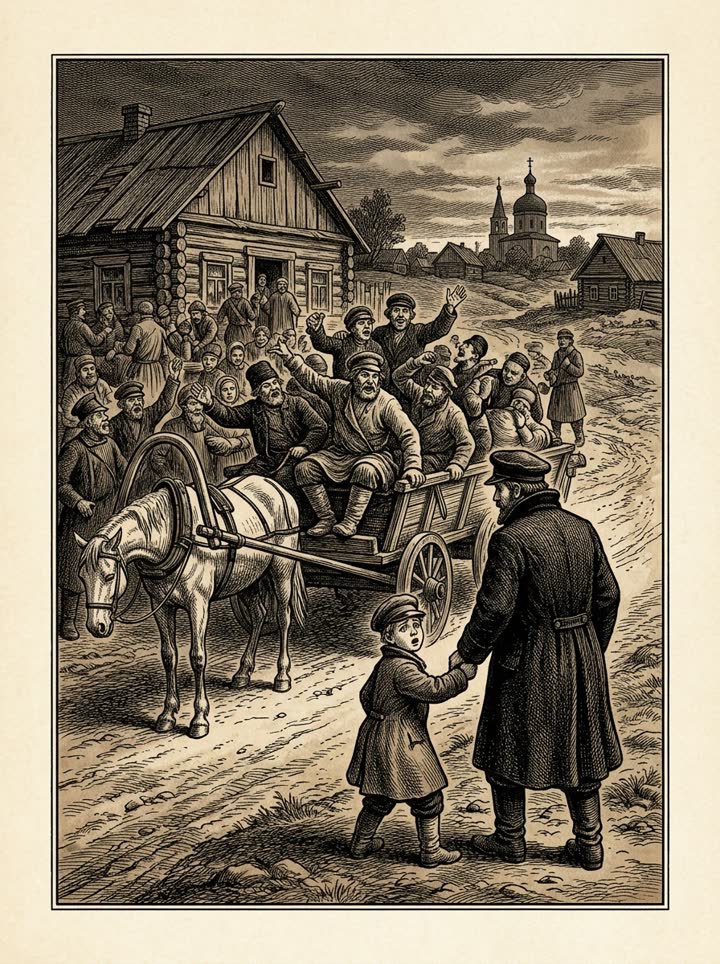
A terrible dream came to Raskolnikov. He dreamed of his childhood, still in their little town. He is about seven years old, and is walking on a holiday, towards evening, outside the town with his father. The weather is greyish, the day is oppressive, and the place is exactly as it has survived in his memory; indeed in his memory it had faded much more than it now appeared in the dream. The little town stands open, as if on the palm of a hand, not a willow anywhere around; somewhere very far off, on the very edge of the sky, a little wood shows black. A few steps from the last vegetable garden of the town there stands a tavern, a big tavern, which had always made a most unpleasant impression on him, and even frightened him, when he passed it walking with his father. There was always such a crowd there, they shouted so, laughed, swore, sang so hideously and hoarsely, and fought so often; around the tavern there always loitered such drunken and frightening faces... When he met them he pressed close against his father and trembled all over. Beside the tavern there is a road, a country track, always dusty, and the dust on it always so black. It goes winding on, and about three hundred paces further it bends to the right around the town cemetery. In the middle of the cemetery is a stone church with a green dome, where he used to go with his father and mother to liturgy about twice a year, when memorial services were held for his grandmother, who had died long ago and whom he had never seen. They always took with them the kutya, the memorial rice, on a white dish, wrapped in a napkin; and the kutya was sweet, made of rice with sugar, and raisins pressed into the rice in the shape of a cross. He loved this church and the old icons in it, mostly without their metal frames, and the old priest with the shaking head. Near his grandmother's grave, which had a slab on it, there was also the little grave of his younger brother, who had died at six months and whom he also did not know at all and could not remember; but he had been told that he had a little brother, and every time he visited the cemetery he crossed himself over the little grave, religiously and reverently, bowed to it and kissed it. And now he dreams: he and his father are walking along the road to the cemetery and pass the tavern; he holds his father by the hand and looks back at the tavern with fear. A particular circumstance catches his attention: this time there seems to be some kind of merrymaking there, a crowd of dressed-up tradesmen's wives, peasant women, their husbands, and all sorts of riffraff. Everyone is drunk, everyone is singing songs, and beside the tavern porch stands a cart, but a strange cart. It is one of those big carts into which big draught horses are harnessed to haul goods and wine barrels. He had always loved to watch those huge draught horses, long-maned, with thick legs, moving calmly at a measured pace and drawing behind them a whole mountain of a load without straining at all, as if it were even easier for them with their loads than without. But now, strange to say, to such a big cart there was harnessed a small, thin, dun-coloured peasant nag, one of those which, as he had often seen, strain themselves to bits sometimes with some high load of firewood or hay, especially if the cart gets stuck in the mud or in a rut, and then the peasants always beat them so painfully, so painfully with their whips, sometimes even right across the muzzle and the eyes, and he feels so sorry, so sorry to watch it, that he almost cries, and Mamma always used to lead him away from the window. But now suddenly it becomes very noisy: out of the tavern come, with shouts, with songs, with balalaikas, big peasants, drunk, dead drunk, in red and blue shirts, with their coats thrown over their shoulders. "Get in, everybody get in!" shouts one, still young, with such a thick neck and a fleshy face red as a carrot. "I'll take you all, get in!" But at once there is laughter and shouting:
"A nag like that, and she'll pull us!"
"Mikolka, are you in your right mind? Harnessing a little mare like that to a cart like that!"
"Why, that dun mare must be twenty years old if she's a day, brothers!"
"Get in, I'll take you all!" Mikolka shouts again, jumping into the cart first, taking the reins and standing up at the front to his full height. "The bay went off with Matvei a while ago," he shouts from the cart, "and this mare, brothers, only tears my heart: I feel I could kill her, she eats bread for nothing. I say get in! I'll set her galloping! She'll gallop!" And he takes the whip in his hand, preparing with delight to thrash the dun mare.
"Well, get in, what are you waiting for!" they laugh in the crowd. "Hear that, she'll gallop!"
"She hasn't galloped for ten years, I bet."
"She'll gallop now!"
"Don't spare her, brothers, everyone take a whip, get ready!"
"That's right! Thrash her!"
They all climb into Mikolka's cart with laughter and jokes. About six men have piled in, and there is room for more. They take along a woman, fat and rosy. She is in red calico, in a beaded headdress, with leather shoes on her feet, cracking nuts and giggling. All round in the crowd they are laughing too, and indeed, how could they not laugh: a wretched little mare like that, and she is to pull such a load at a gallop! Two lads in the cart at once take whips to help Mikolka. There comes a "Gee up!", the nag pulls with all her strength, but not only can she not gallop, she can hardly manage even a walk; she only patters her feet in little steps, groans and sinks down under the blows of three whips showering on her like peas. The laughter in the cart and in the crowd doubles, but Mikolka grows angry and in fury lashes the mare with quickening blows, as though he really believed she would gallop.
"Let me in too, brothers!" shouts one lad from the crowd, his appetite whetted.
"Get in! Everybody get in!" shouts Mikolka. "She'll pull you all. I'll flog her to death!" And he lashes and lashes, and in his frenzy no longer knows what to beat her with.
"Papa, Papa," he cries to his father, "Papa, what are they doing? Papa, they're beating the poor little horse!"
"Come, come!" says his father. "They're drunk, they're playing the fool, the idiots. Come on, don't look!" and he wants to lead him away, but he tears himself out of his hands and, not remembering himself, runs to the little horse. But it is already going badly for the poor little horse. She is gasping, she stops, she pulls again, she almost falls.
"Beat her to death!" shouts Mikolka. "That's what it's come to. I'll flog her to death!"
"What's the matter with you, have you no cross on you, you devil?" shouts one old man in the crowd.
"Who ever saw a little horse like that pulling a load like that?" adds another.
"You'll kill her!" shouts a third.
"Don't touch! She's mine! I'll do what I like. Get in some more! Everybody get in! I want her to gallop, I do!"
Suddenly laughter bursts out in a volley and drowns everything: the mare could not bear the quickening blows and in her helplessness began to kick. Even the old man could not help smiling. And really: a wretched little mare like that, and she still kicks!
Two lads from the crowd fetch themselves a whip each and run to the little horse to thrash her from the sides. Each runs from his own side.
"Across the muzzle, lash her across the eyes, the eyes!" shouts Mikolka.
"A song, brothers!" somebody shouts from the cart, and everyone in the cart joins in. A rollicking song rings out, a tambourine jangles, there is whistling in the refrains. The woman cracks her nuts and giggles.
...He runs beside the little horse, he runs ahead of her, he sees them whipping her across the eyes, right across the eyes! He is crying. His heart rises in him, tears are running. One of those who are whipping catches him across the face; he does not feel it, he wrings his hands, cries out, rushes to a grey-haired old man with a grey beard, who shakes his head and condemns all this. One woman takes him by the hand and wants to lead him away; but he tears himself free and runs to the little horse again. She is already making her last efforts, but once more begins to kick.
"Devil take you!" cries Mikolka in fury. He throws down the whip, bends down and pulls from the bottom of the cart a long, thick shaft, takes it by one end in both hands and with an effort swings it over the dun mare.
"He'll smash her!" they cry all round.
"He'll kill her!"
"She's mine!" cries Mikolka, and brings the shaft down, swinging with all his might. A heavy blow rings out.
"Whip her, whip her! Why have you stopped!" cry voices from the crowd.
And Mikolka swings a second time, and a second blow, swung with all his might, lands on the back of the unhappy nag. She sinks all down on her haunches, but she leaps up and pulls, pulls with all her last strength this way and that, to get the cart moving; but six whips meet her from every side, and the shaft rises again and falls a third time, then a fourth, steadily, with a full swing. Mikolka is in a rage that he cannot kill her with one blow.
"She's tough!" they cry all round.
"She'll surely drop in a moment, brothers, that's the end of her!" cries one connoisseur from the crowd.
"Use an axe on her, why not! Finish her off at once," cries a third.
"Ah, may the mosquitoes eat you! Stand back!" Mikolka cries wildly, throws away the shaft, bends once more into the cart and pulls out an iron crowbar. "Look out!" he cries, and with all his strength stuns his poor little horse with a swing. The blow crashes down; the mare staggers, sinks, tries to pull, but the bar, swung with full force, lands once more on her back, and she falls to the ground as though all four legs had been cut from under her at once.
"Finish her!" cries Mikolka, and, as if beside himself, jumps down from the cart. A few lads, also red-faced and drunk, snatch whatever comes to hand, whips, sticks, the shaft, and run to the dying mare. Mikolka stands at her side and begins to beat her with the crowbar at random on the back. The nag stretches out her muzzle, sighs heavily, and dies.
"He's done for her!" they cry in the crowd.
"Why didn't she gallop!"
"She's mine!" cries Mikolka, crowbar in his hands, with bloodshot eyes. He stands as though sorry that there is no one left to beat.
"Well, truly, you must have no cross on you!" many voices are now crying from the crowd.
But the poor boy is no longer himself. With a cry he forces his way through the crowd to the dun mare, throws his arms around her dead, bloodied muzzle and kisses it, kisses her on the eyes, on the lips... Then suddenly he jumps up and in a frenzy flies with his little fists at Mikolka. At that moment his father, who has been chasing after him for a long time, finally seizes him and carries him out of the crowd.
"Come! Come!" he says to him. "Let's go home!"
"Papa! Why did they... the poor little horse... kill her!" he sobs, but his breath catches, and the words burst in cries from his constricted chest.
"They're drunk, they're playing the fool, it's not our business, come!" says his father. He throws his arms around his father, but his chest is tight, so tight. He wants to draw breath, to cry out, and he wakes up.
He woke up all in a sweat, his hair wet with sweat, gasping, and raised himself in terror.
"Thank God, it's only a dream!" he said, sitting down under a tree and breathing deeply. "But what is this? Is a fever beginning in me? Such a hideous dream!"
His whole body was as if broken; his soul was murky and dark. He put his elbows on his knees and propped his head with both hands.
"God!" he exclaimed. "Can it be, can it really be that I will take an axe, begin to strike her on the head, crush her skull... will slip in sticky, warm blood, break the lock, steal and tremble; hide, all drenched in blood... with the axe... Lord, can it be?"
He trembled like a leaf as he said this.
"But what is the matter with me!" he went on, straightening up again and as if in deep amazement. "I knew, after all, that I could not bear it, so why have I tormented myself until now? Why, only yesterday, yesterday, when I went to make that... trial, I understood perfectly well yesterday that I could not endure it... So why now? Why did I still doubt until now? Why, yesterday, going down the stairs, I said myself that it was vile, foul, low, low... the mere thought of it, awake, made me sick and threw me into horror...
"No, I can't bear it, I can't bear it! Let it be, let it be that there is no doubt at all in all these calculations, let everything decided this month be clear as day, true as arithmetic. Lord! I still won't bring myself to do it all the same! I can't bear it, I can't bear it!... Why, why even until now..."
He stood up, looked around in surprise, as if surprised, too, that he had come this far, and went towards T. Bridge. He was pale, his eyes burned, there was exhaustion in all his limbs, but all at once it seemed easier to breathe. He felt that he had already thrown off that terrible burden which had weighed on him so long, and suddenly his soul felt light and peaceful. "Lord!" he prayed. "Show me my way, and I renounce this accursed... dream of mine!"
Crossing the bridge, he looked quietly and calmly at the Neva, at the bright sunset of the bright, red sun. In spite of his weakness he did not even feel tired. It was as though an abscess in his heart, which had been festering the whole month, had suddenly burst. Freedom, freedom! He was free now of these spells, of the sorcery, the enchantment, the obsession!
Afterwards, when he recalled this time and everything that happened to him in those days, minute by minute, point by point, feature by feature, one circumstance always struck him almost superstitiously. In essence it was not so very unusual, yet afterwards it constantly seemed to him a kind of predestination of his fate.
Namely, he could never understand or explain to himself why he, tired and worn out, when it would have been most to his advantage to go home by the shortest and most direct way, had gone home through the Haymarket, where it was quite unnecessary for him to go. The detour was small, but obvious and entirely needless. Of course, dozens of times it had happened that he went home without remembering the streets he walked through. But why, he always asked, why had such an important, such a decisive meeting for him, and at the same time such an extremely chance meeting, in the Haymarket (where he had not even any reason to go), come precisely now, at such an hour, at such a minute of his life, in precisely such a state of mind and in precisely such circumstances in which alone it could have the most decisive and final effect on his whole fate? As if it had been lying in wait for him on purpose!
It was about nine o'clock when he passed through the Haymarket. All the traders at their tables, on their trays, in their shops and little shops were closing up their businesses, or taking down and tidying away their goods, and going home, as were their customers. Around the cookshops on the ground floors, in the dirty, stinking yards of the houses of the Haymarket, and most of all around the taverns, a great many people of all sorts, small traders and ragged men, were crowding. Raskolnikov especially liked these places, and all the nearby lanes, when he went out into the street without any purpose. Here his rags drew no one's haughty attention, and one could walk about looking however one liked, without scandalising anyone. Right at K. Lane, on the corner, a tradesman and a woman, his wife, were selling goods from two tables: thread, tapes, cotton kerchiefs and so on. They too were getting ready to go home, but had lingered, talking with an acquaintance who had come up. This acquaintance was Lizaveta Ivanovna, or simply, as everyone called her, Lizaveta, the younger sister of that very old woman, Alyona Ivanovna, the collegiate registrar's widow and pawnbroker, whom Raskolnikov had visited yesterday, coming to pawn his watch and make his trial... He had known everything about this Lizaveta for a long time, and she even knew him a little. She was a tall, awkward, timid and meek woman, almost an idiot, thirty-five years old, in complete slavery to her sister, working for her day and night, trembling before her and even enduring beatings from her. She stood thinking, with a bundle, before the tradesman and his wife, and listened to them attentively. They were explaining something to her with particular warmth. When Raskolnikov suddenly saw her, a strange sensation, like the deepest astonishment, seized him, though there was nothing astonishing in this meeting.
"You ought to settle it yourself, Lizaveta Ivanovna," the tradesman was saying loudly. "Come tomorrow, some time after six. They'll be here too."
"Tomorrow?" said Lizaveta, slowly and thoughtfully, as if she could not make up her mind.
"Well, Alyona Ivanovna has certainly put the fear into you!" the dealer's wife gabbled, a brisk little woman. "I look at you, and you're quite like a small child. And she's not even your own sister, only a half-sister, and see what power she's taken."
"And this time don't say anything to Alyona Ivanovna," the husband interrupted. "That's my advice, ma'am: just drop in on us without asking leave. It's a profitable matter, ma'am. Later your sister can think it over herself."
"Should I come by?"
"Tomorrow, some time after six; and some of them will be here, ma'am; you can settle it yourself."
"And we'll put the samovar on," added the wife.
"All right, I'll come," said Lizaveta, still thinking it over, and slowly began to move from the spot.
Raskolnikov had already gone past and heard no more. He passed quietly, unnoticed, trying not to miss a single word. His first astonishment gradually gave way to horror, as if a frost had run down his spine. He had learned, suddenly, abruptly and quite unexpectedly he had learned, that tomorrow, at exactly seven o'clock in the evening, Lizaveta, the old woman's sister and her only companion in the house, would not be at home, and that therefore the old woman, at exactly seven o'clock in the evening, would be left at home alone.
It was only a few steps to his lodging. He went in like a man condemned to death. He reasoned about nothing and was quite unable to reason; but with his whole being he suddenly felt that he had no more freedom of mind, and no will, and that everything had suddenly been decided finally.
Of course, even if he had had to wait whole years for a convenient chance, even then, having his design, he could not have counted with any certainty on a more obvious step towards the success of that design than the one that had suddenly presented itself just now. In any case, it would have been difficult to find out the day before, and for certain, with greater precision and with the least risk, without any dangerous questioning or inquiries, that tomorrow, at such-and-such an hour, such-and-such an old woman, against whom the attempt was being prepared, would be at home all alone.