
He had been ill for a long time now; but it was not the horrors of convict life, not the work, not the food, not the shaved head, not the patchwork clothes that had broken him. Oh, what did he care for all those torments and tortures! On the contrary, he was even glad of the work: when he had worn himself out physically, he at least won himself a few hours of quiet sleep. And what did the food mean to him, that thin cabbage soup with cockroaches in it? As a student, in his former life, he had often not had even that. His clothes were warm and suited to his way of life. The fetters he did not even feel on himself. Was he to be ashamed of his shaved head and his two-coloured jacket? But before whom? Before Sonya? Sonya was afraid of him, and was he to be ashamed before her?
And what then? He was ashamed even before Sonya, whom he tormented for it with his contemptuous and rough behaviour. But it was not his shaved head and his fetters he was ashamed of: his pride had been badly wounded; and he had fallen ill from wounded pride. Oh, how happy he would have been if he could have accused himself! Then he could have borne everything, even shame and disgrace. But he judged himself severely, and his hardened conscience found no particularly terrible guilt in his past, except perhaps a simple blunder, such as could happen to anyone. He was ashamed precisely because he, Raskolnikov, had perished so blindly, so hopelessly, so dumbly and so stupidly, by some sentence of blind fate, and must humble himself and submit to the "senselessness" of some sentence, if he wanted to find any sort of peace.
Anxiety without object or purpose in the present, and in the future one unceasing sacrifice by which nothing was gained: that was what lay before him in the world. And what did it matter that in eight years he would be only thirty-two and could begin to live again! Why should he live? What was he to have in view? What to strive for? To live in order to exist? But a thousand times before he had been ready to give up his existence for an idea, for a hope, even for a fancy. Mere existence had always been too little for him; he had always wanted more. Perhaps it was only by the strength of his desires that he had then counted himself a man to whom more was permitted than to another.
And if only fate had sent him repentance, burning repentance, breaking the heart, driving away sleep, the kind of repentance from whose dreadful torments one imagines the noose and the whirlpool! Oh, he would have been glad of it! Torments and tears, for that too is life. But he did not repent of his crime.
At least he might have raged at his stupidity, as he had raged before at his hideous and idiotic actions that had brought him to the prison. But now, already in the prison, at leisure, he went over and considered all his former deeds again, and he did not find them at all as stupid and hideous as they had seemed to him in that fatal time, before.
"How, how," he thought, "was my idea stupider than other ideas and theories that swarm and collide with one another in the world, since the world began? One only has to look at the matter with a completely independent, broad view, freed from everyday influences, and then, of course, my idea will turn out not to be so... strange. Oh, you deniers and sages worth five silver kopecks, why do you stop halfway!
"Well, why does my deed seem to them so hideous?" he said to himself. "Because it is an evil deed? What does the word 'evil deed' mean? My conscience is at peace. Of course, a criminal offence has been committed; of course, the letter of the law has been broken and blood has been shed; well then, take my head for the letter of the law... and enough! Of course, in that case even many benefactors of mankind, who did not inherit power but seized it themselves, ought to have been executed at their very first steps. But those men endured their steps, and therefore they are right, and I did not endure mine, and so I had no right to permit myself that step."
That was the one thing in which he admitted his crime: only that he had not endured it and had made his confession.
He also suffered from the thought: why had he not killed himself then? Why had he stood over the river then and preferred to confess? Was there really such power in this wish to live, and was it so hard to overcome? Svidrigailov, who was afraid of death, had overcome it, hadn't he?
He asked himself this question in torment and could not understand that even then, when he stood over the river, he had perhaps sensed within himself and in his convictions a deep falsehood. He did not understand that this foreboding might be the herald of a future turning point in his life, of his future resurrection, of his future new view of life.
He was rather inclined to admit here only a dull weight of instinct, which it was not for him to break and which he was again unable to step across (through weakness and worthlessness). He looked at his fellow convicts and marvelled: how they all loved life too, how they prized it! It seemed to him precisely that in the prison it was loved and valued and prized even more than at liberty. What terrible torments and tortures some of them had endured, the vagrants for example! Could one single ray of sunlight really mean so much to them, or a deep forest, or somewhere in an unknown wilderness a cold spring that he marked out the year before last, which the vagrant dreams of meeting as he would dream of meeting a lover, and sees in his sleep, with the green grass around it and a bird singing in a bush? Looking further, he saw examples still more inexplicable.
In the prison, in the surroundings about him, he of course did not notice a great deal, and did not want to notice it at all. He lived somehow with his eyes lowered: it was loathsome and unbearable to him to look. But in the end much began to astonish him, and he somehow involuntarily began to notice what he had not even suspected before. In general, what began to astonish him most was that terrible, impassable gulf which lay between him and all these people. It seemed that he and they were of different nations. He and they looked at one another with distrust and hostility. He knew and understood the general causes of such a separation; but he had never before admitted that these causes were in fact so deep and strong. There were also exiled Poles in the prison, political prisoners. They simply regarded all these people as ignoramuses and serfs and despised them from above; but Raskolnikov could not look at it so: he clearly saw that in many things these ignoramuses were far cleverer than the Poles themselves. There were Russians there too, who also despised these people far too much, one former officer and two seminarists; Raskolnikov clearly noticed their mistake too.
As for him, everyone disliked and avoided him. In the end they even began to hate him. Why? He did not know. They despised him, they laughed at him, they laughed at his crime, those who were far more criminal than he.
"You're a gentleman!" they said to him. "Was it for you to go about with an axe? It's not a gentleman's business at all."
In the second week of Great Lent it was his turn to prepare for communion with the rest of his barracks. He went to church to pray with the others. Over what, he himself did not know, a quarrel broke out one day; all at once they fell on him with fury.
"You're an infidel! You don't believe in God!" they shouted at him. "You ought to be killed."
He had never spoken to them about God or about faith, but they wanted to kill him as an infidel; he was silent and did not answer them. One convict rushed at him in a state of desperate frenzy; Raskolnikov awaited him calmly and in silence: his eyebrow did not stir, not a single feature of his face trembled. The guard managed to step between him and the murderer in time, or blood would have been shed.
There was one more question that he could not solve: why did they all grow so fond of Sonya? She did not curry favour with them; they met her rarely, sometimes only at the work, when she came for just a minute to see him. And yet everyone already knew her, knew also that she had followed him, knew how she lived and where she lived. She gave them no money, did them no special services. Only once, at Christmas, she brought alms for the whole prison: pies and rolls. But little by little some closer relations grew up between them and Sonya: she wrote letters for them to their families and sent them off by post. Their relatives, men and women, who came to the town, left with Sonya, on their instructions, things for them and even money. Their wives and sweethearts knew her and went to see her. And when she appeared at the work, coming to see Raskolnikov, or met a party of convicts going to work, they all took off their caps, they all bowed: "Little mother, Sofya Semyonovna, our own mother, our tender, kind-hearted one!" these coarse, branded convicts said to this small, thin creature. She smiled and bowed back, and they all loved it when she smiled at them. They loved even her walk, they turned round to look after her as she went, and praised her; they praised her even for being so small, they no longer knew what to praise her for. They even went to her to be cured.
He lay in the hospital the whole end of Lent and Easter week. Already recovering, he remembered the dreams he had had when he lay in fever and delirium. He had dreamed in his illness that the whole world was condemned to be the victim of some terrible, unheard-of and unseen plague coming from the depths of Asia upon Europe. All were to perish, except some, a very few, chosen ones. Certain new trichinae appeared, microscopic creatures that lodged in the bodies of men. But these creatures were spirits, endowed with intelligence and will. People who took them into themselves at once became possessed and mad. But never, never had people thought themselves so clever and so unshakable in the truth as these infected ones thought themselves. Never had they thought their verdicts, their scientific conclusions, their moral convictions and beliefs more unshakable. Whole villages, whole cities and nations were infected and went mad. All were in alarm and did not understand one another, each thought that the truth was contained in him alone, and tormented himself looking at the others, beat his breast, wept and wrung his hands. They did not know whom to judge or how, could not agree on what to count as evil, what as good. They did not know whom to accuse, whom to justify. People killed one another in some senseless spite. They gathered against one another in whole armies, but the armies, already on the march, would suddenly begin to tear themselves apart, the ranks broke up, the soldiers threw themselves on one another, stabbed and cut, bit and ate one another. In the cities the alarm bell was rung all day long: everyone was called together, but who was calling and for what, no one knew, and all were in alarm. They abandoned the most ordinary trades, because everyone offered his own ideas, his own amendments, and they could not agree; farming stopped. Here and there people ran together in crowds, agreed together on something, swore not to part, but at once began something quite different from what they had just proposed themselves, began to accuse one another, fought and cut each other down. Fires began, famine began. Everyone and everything was perishing. The plague grew and spread further and further. Only a few people in the whole world could be saved, they were the pure and chosen, destined to begin a new race of men and a new life, to renew and purify the earth, but no one anywhere had seen these people, no one had heard their word and voice.
It tormented Raskolnikov that this senseless delirium echoed so sadly and so painfully in his memories, that the impression of these feverish dreams did not pass for so long. The second week after Easter week was already under way; there were warm, clear spring days; in the convicts' ward they opened the windows (barred, with a sentry walking beneath them). Sonya had been able to visit him in the ward only twice during the whole of his illness; each time permission had to be asked, and that was difficult. But she often came to the hospital yard, under the windows, especially towards evening, and sometimes only to stand in the yard a minute and look, if only from afar, at the windows of the ward. One evening Raskolnikov, almost completely recovered by now, fell asleep; when he woke, he chanced to go up to the window and suddenly saw Sonya in the distance, at the hospital gate. She stood as if waiting for something. Something seemed to pierce his heart at that moment; he shuddered and hurriedly moved away from the window. The next day Sonya did not come, nor the third day either; he noticed that he was waiting for her with uneasiness. At last he was discharged. Arriving at the prison, he learned from the convicts that Sofya Semyonovna had fallen ill, was lying at home and did not go out anywhere.
He was very uneasy and sent to ask after her. He soon learned that her illness was not dangerous. Learning in her turn that he was so anxious and concerned about her, Sonya sent him a note written in pencil and informed him that she was much better, that she had a slight, trifling cold, and that she would soon, very soon, come to see him at the work. When he read this note, his heart beat strongly and painfully.
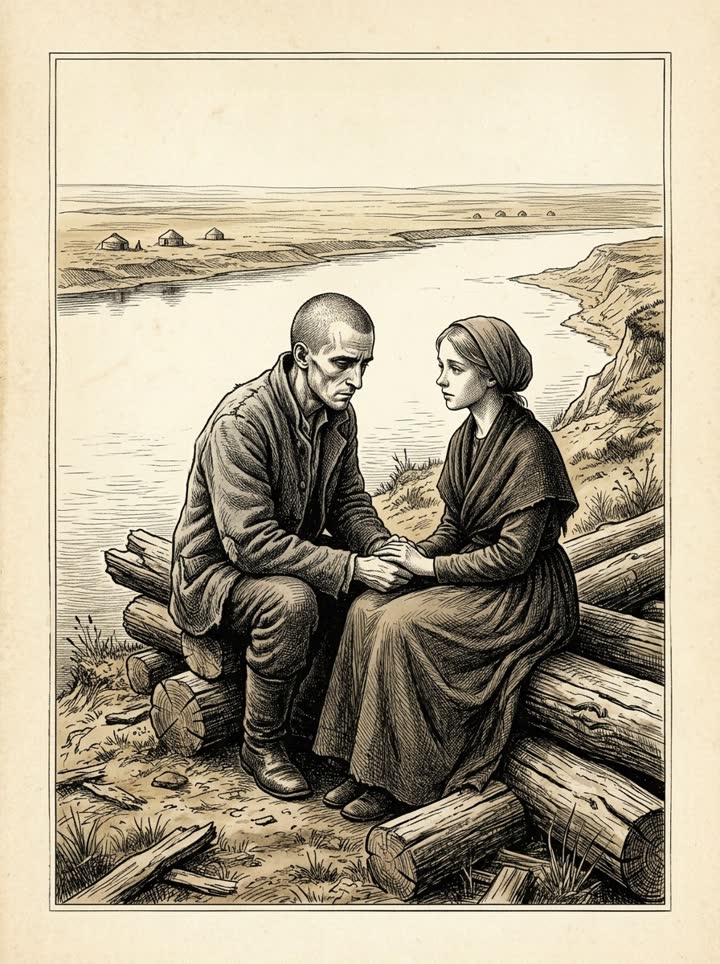
The day was again clear and warm. Early in the morning, at about six o'clock, he went to work on the river bank, where in a shed a kiln had been set up for burning alabaster and where they pounded it. Only three workers went there. One of the convicts took a guard and went with him to the fortress for some tool; another began to prepare firewood and to load it into the kiln. Raskolnikov came out of the shed to the very bank, sat down on the logs piled beside the shed and began to gaze at the wide, deserted river. From the high bank a broad stretch of country opened out. From the far other bank a song came, scarcely audible. There, in the boundless steppe flooded with sunlight, the nomads' yurts showed as barely noticeable black specks. There was freedom, and other people lived there, quite unlike those here; there it was as if time itself had stopped, as though the ages of Abraham and his flocks had not yet passed. Raskolnikov sat and looked, motionless, never taking his eyes away; his thought passed into reverie, into contemplation; he thought of nothing, but some longing disturbed and tormented him.
Suddenly Sonya was beside him. She had come up almost without a sound and sat down next to him. It was still very early, the morning chill had not yet softened. She wore her poor old burnous and her green shawl. Her face still bore the signs of illness: it had grown thinner, paler, hollower. She smiled at him kindly and joyfully, but, as usual, timidly held out her hand to him.
She always held out her hand to him timidly, sometimes did not offer it at all, as if afraid he would push it away. He always took her hand as if with disgust, always met her as if with vexation, sometimes remained stubbornly silent during the whole of her visit. It happened that she trembled before him and went away in deep sorrow. But now their hands did not part; he glanced at her briefly and quickly, said nothing, and lowered his eyes to the ground. They were alone, no one saw them. The guard had turned away at that moment.
How it happened he himself did not know, but suddenly something seemed to seize him and throw him at her feet. He wept and embraced her knees. At the first instant she was terribly frightened, and her whole face went deathly pale. She jumped up from her place and, trembling, looked at him. But at once, in that very instant, she understood everything. Infinite happiness shone in her eyes; she understood, and for her there was no longer any doubt that he loved her, loved her infinitely, and that at last this moment had come...
They wanted to speak but could not. Tears stood in their eyes. They were both pale and thin; but in those sick and pale faces there already shone the dawn of a renewed future, of a full resurrection into a new life. Love had raised them from the dead, the heart of one held infinite sources of life for the heart of the other.
They resolved to wait and to endure. They had still seven years left; and until then such unbearable torment and such infinite happiness! But he had risen from the dead, and he knew it, felt it fully with his whole renewed being, and she, she lived, after all, only by his life!
In the evening of that same day, when the barracks were already locked, Raskolnikov lay on the plank bed and thought of her. On that day it even seemed to him that all the convicts, his former enemies, were already looking at him differently. He had even spoken to them himself, and they had answered him kindly. He remembered it now, but so it had to be: must not everything change now?
He thought of her. He remembered how he had constantly tormented her and torn her heart; he remembered her pale, thin little face, but these memories hardly tormented him now: he knew with what infinite love he would now atone for all her sufferings.
And what were they, all these, all these torments of the past! Everything, even his crime, even the sentence and the exile, seemed to him now, in the first rush, some external, strange fact, as if it had not even happened to him. Yet that evening he could not think long and steadily about anything, or concentrate his thought on anything; and he would not have resolved anything consciously now; he only felt. Instead of dialectics, life had come, and something quite different had to work itself out in his consciousness.
Under his pillow lay the Gospel. He took it up mechanically. This book was hers, the very one from which she had read to him about the raising of Lazarus. At the beginning of the penal servitude he had thought that she would torment him with religion, would talk of the Gospel and force books on him. But, to his greatest surprise, she had not once spoken of it, had not once even offered him the Gospel. He had asked her for it himself, not long before his illness, and she had brought him the book in silence. Until now he had not even opened it.
He did not open it now either, but one thought flashed through him: "Can her convictions not be mine now? Her feelings, her aspirations, at least..."
She too was in agitation all that day, and in the night she even fell ill again. But she was so happy that she was almost frightened of her happiness. Seven years, only seven years! At the beginning of their happiness, at some moments, they were both ready to look at those seven years as at seven days. He did not even know that the new life is not given to him for nothing, that it must still be bought dearly, paid for with a great deed in the future...
But here a new story begins, the story of the gradual renewal of a man, the story of his gradual rebirth, of his gradual passing from one world into another, of his acquaintance with a new, hitherto quite unknown reality. That might make the theme of a new tale, but our present tale is ended.